


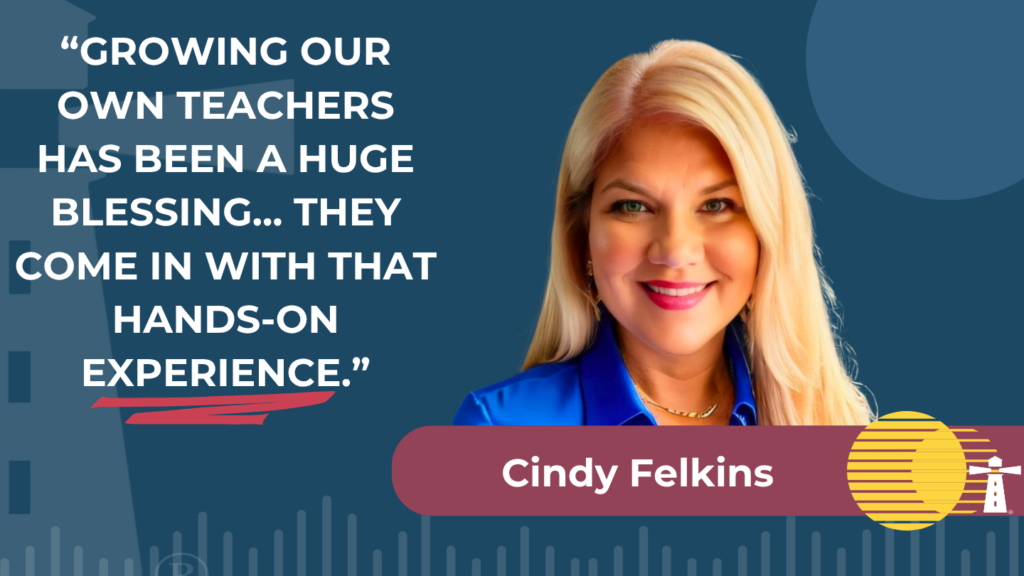
Here’s a hard truth: we’re losing special education teachers faster than we can train them—especially in rural districts where teacher shortages feel like a crisis, not a challenge. But what if the answer to retention wasn’t better incentives alone, but a completely reimagined support system? On this episode, we talk with Cindy Felkins, Director of Student Support Services and Federal Programs at Blakely County School District in Georgia, about how to build special education infrastructure that protects teacher wellbeing while actually serving students.
About Your Guest
Cindy Felkins brings over two decades of frontline experience in special education and federal program management. As Director of Student Support Services and Federal Programs for Blakely County Schools, she oversees student support initiatives, federal compliance requirements, and innovative teacher development programs—all while managing the very real pressures of rural education and federal accountability.
What You’ll Learn
Discover practical strategies for reducing teacher burnout in special education, including:
- A “grow your own” teacher pipeline that uses hands-on experience to prepare the next generation of educators (and why classroom reality matters more than any textbook)
- How to manage the compliance and testing season crunch without burning out your staff
- Building a true village approach that meets the needs of students, families, and teachers
- Why rural districts have a unique advantage in teacher recruitment when they lean into community and support systems
- Concrete ways to structure student support services that don’t add burden to an already stretched team
Key Takeaways
✓ Real experience beats theory every time — “You can only learn so much in a classroom and from reading a book. You’ve got to be in that classroom and experience it.”
✓ Teacher retention is a systems problem, not an individual problem — When special education teachers feel supported by administration and their community, they stay.
✓ “Growing your own” teachers creates loyalty and cultural fit — Recruiting from within your community builds educators who understand rural realities and are invested in staying.
✓ Meeting family needs is central to supporting teachers — When families get what they need, teacher stress decreases dramatically.
✓ Spring testing season is a crisis we can anticipate and plan for — Strategic workload management during peak compliance periods can be the difference between retention and burnout.
Notable Quotes
“We don’t want to see them graduate to the couch.” — On ensuring students transition to meaningful post-secondary outcomes, not dependency
“It truly takes that village and we’ve got to meet the needs of the families.” — Why special education success requires a community-wide commitment
“Growing our own teachers has been a huge blessing… they come in with that hands-on experience.” — On the power of developing educators from within
“I didn’t learn anything until I got to my student teaching when I had to go in every day and take control of that classroom.” — Why mentorship and real-world experience matter more than credentials alone
If you’re an administrator in a rural or under-resourced district struggling with special education teacher retention, or if you’re looking for fresh approaches to compliance and student support systems, this episode is essential listening.
Listen now and subscribe to the podcast for more practical strategies from education leaders who are solving real problems in real classrooms.
FULL PODCAST Transcript
Lighthouse Therapy (00:01.216)
Hello everyone and welcome to the Brighter Together podcast. My name is Janet Courtney and my special guest today is Cindy Falcons. Cindy is the Director of Student Support Services and Federal Programs at Blackley County School District, which is in Cochrane, Georgia. And I almost tripped over that, Cindy. Well, welcome to the show. We’re happy to have you here.
Cindy Felkins (00:19.342)
That is correct. All of that is right.
Cindy Felkins (00:27.478)
It’s great to be here. Thank you for having me.
Lighthouse Therapy (00:29.948)
Absolutely. Tell us a little bit Cindy about you and your background and a little bit about Blackley.
Cindy Felkins (00:37.422)
Well, I am Director of Student Support Services in Federal Programs, just as you mentioned. I have been in education for this about 30 years for me.
I am not retiring just yet. I do have some a few more years left due to some private school years that I also had initially. But my background in special education goes way back. I have only been in the special education arena. My job currently
It encompasses more than just special education. So with federal programs and student support services, it kind of encompasses a lot of different things. But special education is the main focus of what I do. In my personal experience, I had an aunt and uncle who were educators, longtime educators, and they are one of the reasons why I went into education myself. I was the first one in my immediate
family to go to college and my immediate family and pick education as a vocation. So it’s been very important to me that same aunt and uncle were long time over well over 30 year educators and they both recently passed away within the past couple of months. So I just mentioned that because they it’s kind of near and dear to my heart. I did have various
Lighthouse Therapy (02:04.18)
Yeah.
Cindy Felkins (02:08.962)
family members and friends who have had children in special education and needed to have that advocate and have support services. And that was very important to me too, especially being in a rural district and making sure that our students with special needs have the services and have the supports that they need in place. And also working with our team.
here to make sure that these students see outside the boundaries of our town. And I learned from a very, very, very knowledgeable colleague. She uses the phrase all the time. We don’t want to see them graduate to the couch. And she’s very, very smart. She’s very, very talented. She’s very, very wonderful at what she does in a neighboring district. And that just stuck with me when she said that because that’s very important.
Lighthouse Therapy (02:56.566)
yes.
Cindy Felkins (03:08.896)
to me too because we often see some of our students with special needs in our program and it is in families and it presents itself in families sometimes and we want to provide those supports that they need here even though we are rural. I know we’re actually a very desirable school district in our area and we are very very proud of being a Blackley County royal and we have
Lighthouse Therapy (03:20.886)
Yeah.
Cindy Felkins (03:38.728)
neighboring districts whose families want to bring their children to us. So we do tend to have a lot of that too in our district. But yes, that’s where I am and that’s what I do day in and day out is work to make sure that the students and families in our district are taken care of.
Lighthouse Therapy (04:00.854)
Yeah, and you were telling me before the before we went hit record you have about 2600 students, correct?
Cindy Felkins (04:08.568)
is correct. have near sometimes a little over sometimes a little less 2600 students. That’s fluid data but yes that’s what we do operate with. And many of those students I would say probably almost half of those students are in some program that is managed through the support services department. You know if you consider gifted and students with 504 plans and students with IEPs
and students with that need EIP services, early intervention in our MTSS program. Also, all of those, if you add all that up, that’s a significant amount of students who need some support whatsoever. But we’re in a great school district where we pride ourselves on working toward making sure to meet the needs of all of our students.
So we can meet the needs of the specific needs as well.
Lighthouse Therapy (05:13.876)
Yeah, yeah, that’s really good. That’s really good. MTSS for those of you that don’t know, most of you know now by now, but it’s multi-tiered system of support. but that’s, wow. So, you you said you’ve, your whole career has been, how long have you been at Blakely?
Cindy Felkins (05:30.774)
my entire career outside of three private school years I’ve been in Blackley. So, and this is my 30th year in education. And even before that, I did work with a tutoring agency and a
Lighthouse Therapy (05:32.246)
Lighthouse Therapy (05:37.418)
Well, Wow, well, that makes Mike.
Lighthouse Therapy (05:45.686)
Mm-hmm.
Cindy Felkins (05:46.61)
and I did computer-based testing for an agency before that. I’ve kind of always been in special education. When I was in high school, you know, I’m dating myself because, you know, getting close to that 60 mark won’t be long. But we had a…
Lighthouse Therapy (06:03.254)
Me too, me too, I’m right behind, I’m 58, I’m red thart.
Cindy Felkins (06:07.638)
We were fortunate to have extracurricular activities and one was Future Teachers of America, FTA, back in the day. And I can remember being part of that organization and we were able to go to, we would be able to go to another school, another classroom and teach for a day and be part of the club and be. So it’s kind of always been in the forefront. We do live in a town that has a great community college, Middle Georgia
Lighthouse Therapy (06:15.351)
yeah, uh-huh.
Cindy Felkins (06:37.592)
State University. It used to be Middle Georgia College back when I went back in the day. But it prides itself on its educator prep program for putting out teachers and and I went into teaching back then.
Lighthouse Therapy (06:56.64)
So that’s fantastic because the question I have for you is you’ve seen 30 years. You’ve seen 30 years at the same school, which is really neat. what, 20, well, yeah, okay. Got 30 years in, 27 years there. So give our listeners just what has changed. mean, there’s a lot of change, but like when I asked that question, what,
Cindy Felkins (07:08.279)
Well, this is my 27th year here, but yes, I got 30 years in. Okay, let’s close.
Lighthouse Therapy (07:23.774)
What jumps out at you as the major changes that you’ve seen in special education in those 27 years?
Cindy Felkins (07:31.276)
Well, I would like to tell you that, you know, there’s a huge difference, but…
The bottom line is kids are kids, students students, families are families and the needs are the same. I think we’re better at identifying those needs now. I think we’re better at connecting resources with those needs now. But and I know I hate to say the C word COVID, but ever since COVID, you know, we have been behind that eight ball with making sure to connect those services to as well. But I do think that
Lighthouse Therapy (07:50.25)
Mm-hmm.
Cindy Felkins (08:10.644)
we’re doing everything that we can possibly do. We have a wonderful support agency in our neighboring district. It’s GLRS, Georgia Learning Resource System, and ours is called East Central. So it’s East Central GLRS. And it may be small in size, but it’s big in providing resources for educators and training resources and working on those transition needs for our students as well too. But overall,
It we we’ve seen an uptick in students that have ADHD and autism and and students that are diagnosed at an earlier and earlier age with these disabilities and Sometimes, you know you look at
whether or not we need to support families more and parenting and that kind of thing as well. Not that they don’t know because sometimes it’s just the need to put the resources in those hands. We have a program here called FAST, Families in Schools Together and that’s where they come together and those families get selected for that program and we have communities in schools. It’s a great support agency for them as well.
But I have found that we’ve got to all come to the table. It does truly take that village and we’ve got to meet the needs of the families. But you know, on top of what we’re already doing in school, it is, you know, you hear…
Lighthouse Therapy (09:35.744)
Yeah.
Cindy Felkins (09:49.674)
Okay, we’re having less individuals going into education because of the compliance or because of just the sheer.
You know, there is a population out there that’s very negative toward education, but luckily in our district and having that community college nearby, we’re able to almost grow our own teachers. We’re able to hire teachers from ones who served as paras in our district as paraprofessionals. And that has been a huge blessing right there to be able to have those individuals come in and see, you know, with that hands-on experience.
Lighthouse Therapy (10:06.666)
Yeah.
Cindy Felkins (10:30.48)
day in and day out because you can only learn so much in a classroom and from reading a book you’ve got to you’ve got to be in that classroom and you’ve got to experience it. I can remember my own earlier degrees in bachelors and master’s degrees where before I even got a teaching position and I can remember thinking to myself I didn’t learn anything until I got to my student teaching when I had to go in every day and take control of that classroom.
Lighthouse Therapy (10:34.603)
Yeah.
Lighthouse Therapy (10:57.024)
Mm-hmm.
Cindy Felkins (11:00.4)
And so having those experiences is so important, especially with special education. Even more so.
Lighthouse Therapy (11:07.37)
Yeah, yeah, yeah, even more so, I agree, 1000%. There’s only so much that theory and book learning can give you compared to the real world because you’re not gonna, no child is gonna be textbook, right? No child is gonna come with just that one problem, right? And it seems like too, you’ve got, it’s not just a child. And you’ve touched on that quite a bit and I’m grateful to hear that because you’re,
Cindy Felkins (11:24.787)
Absolutely true. Absolutely.
Lighthouse Therapy (11:36.134)
you’re talking about serving not just the child, but your community and the parents and doing everything you can to help those children to be successful. And I love the fact that you’re growing your own teachers. What a great program that is. How long have you guys been doing that?
Cindy Felkins (11:51.074)
We’ve been doing it for a number of years now. We have a program where we can hire paraprofessionals while they’re in school as well. We partner with our education agencies to do that. And so that it’s just been a really positive for our district.
Lighthouse Therapy (12:10.056)
Awesome. So do you have you seen kids that have our students that have guy was calling kids, students that like graduate and then from from Blackley go into that program and then come back as a teacher.
Cindy Felkins (12:24.3)
We sure do. It’s funny now that I have this many years in and now I’m seeing, you know, people that I talk or people that I, you know, when I spent a lot of time at the high school level, like nearly 20 years, I was just high school level and I was beta club advisor in the high school. So it’s funny now because quite a few of them are getting jobs and maybe some of them in this district and other districts as well. So it’s awesome to see that.
to see those young people go into a profession that’s near and dear to my heart along with everyone I know that works here has that same kind of feeling about working in our home district.
Lighthouse Therapy (13:09.802)
Yeah, yeah, and that’s great. Like that sense of community and yeah. So in in Cochrane, you said it’s rural, but you have 2600 students. So how big is zero industry? Okay.
Cindy Felkins (13:22.316)
Zero industry though. We have zero industry here. The school system is probably the largest employer in our district, if my numbers are correct.
Lighthouse Therapy (13:29.078)
Lighthouse Therapy (13:33.056)
So is it like a bedroom community? they like, does everybody drive to somewhere to work?
Cindy Felkins (13:38.414)
It is. We’re about 30 miles away from Warner Robins, Georgia, which is where Robins Air Force Base is. We’re a bedroom community for that. We’re about 40 miles south of Macon, Georgia. So and we’re kind of in the middle between like Perry and Dublin and Warner Robins and Macons, but we’re in the center of the state. But we do have a lot of students for our for our small district, but
Lighthouse Therapy (13:45.704)
okay.
Lighthouse Therapy (13:49.526)
Gotcha.
Cindy Felkins (14:07.81)
they we we have actually have a fairly significant population of out of county and sometimes we feel you know that need and we we not really that need that that niche and and we get overloaded sometimes in certain areas so we have to we have to watch that and all but you know we are a good school system in our area and we’re thankful and blessed.
Lighthouse Therapy (14:22.966)
Mm-hmm.
Lighthouse Therapy (14:34.1)
Yeah. So you’re the, you’re the director. Let’s just talk about, about your structure for special education specifically. Cause you know, I’m therapist. I’m always going to special education if I can, let’s talk about special education. So you’re the director and then you have how many, like, do you have coordinators under you? How, what does your structure look like?
Cindy Felkins (14:40.653)
Thank
Okay.
Cindy Felkins (14:53.262)
really common lead teachers.
Lighthouse Therapy (14:55.189)
Okay.
Cindy Felkins (14:56.056)
here in our district. Most of them, well almost all of them have teaching responsibilities as well with a little bit of additional release time to do coordinator type work in the schools. But I’m very, very fortunate to have a district school psychologist. So we’re not contracting that position. We have one on staff and she is absolutely fabulous. She is such a hard worker and basically my right
hand. She is in all the schools. She handles all of our, you know, everything. She’s even our district 504 coordinator as well. So we, we do meet a lot. We have meetings every single day. If you ask the administrators in our district, they would spend more time probably in IEP meetings than anywhere. It is a lot. But luckily those coordinators, leads, they’re
able to help in that capacity as well too. So they’re in the building, their boots on the ground. It’s a fabulous group of ladies. I don’t have any men coordinators at the present time, but we do have those. We have…
Lighthouse Therapy (15:58.038)
Mm-hmm.
Cindy Felkins (16:11.402)
a great three to five year old program in our school district. And we are meeting the needs of our three to five year old students with disabilities because as you know, you may have had in a previous podcast, you start serving those students with disabilities from you go ahead and get referred when they’re two years old. Our school psychologist is evaluating them at two and a half and they start with us at age three. And we ran a project
Lighthouse Therapy (16:32.16)
Yeah.
Lighthouse Therapy (16:39.54)
Yeah, yeah, when they qualify. I’m sorry, go ahead. Yeah.
Cindy Felkins (16:41.798)
Yes. No, run at.
Project STEP program, we call it. And we have an early intervention coordinator. And our early intervention coordinator is also the three to five year old classroom teacher. But she, we implemented the program where she and our school psychologist and our pre-K director also, and any of our therapists is applicable for the students, whether it’s the SLP, OT, PT, you know, they get together and meet and talk about because that
That is so important to me. That was something that I worried about as a director, warning those families at that initial stage where their first hearing that, something may be wrong with my child. They may not be anything wrong with your child. It may be a developmental delay or it may be some supports may be needed, but let’s go ahead and meet and let’s discuss and let’s see what we can do, how we can offer to help whether we just need to do
some screeners or do we need to do full out psychological testing at that juncture? So we actually partner with our area community. We send out our child find information to our area daycares and pediatrician and you know.
Lighthouse Therapy (17:46.72)
Right.
Cindy Felkins (18:07.551)
We don’t have any issue with finding the students with needs in our district because they do. Those families come to us.
Lighthouse Therapy (18:12.555)
Ha!
Yeah.
Cindy Felkins (18:16.066)
but I want them to feel comfortable in sitting there and asking questions and getting the information they need from the time their child is first going to start school because that is so important to me because that is the first impression of the special education program in our district. we do a Georgia Department of Education does a parent survey annually and we usually get extremely high marks on that. And I’m
Lighthouse Therapy (18:20.928)
Yeah.
Cindy Felkins (18:46.636)
you know, our people that work boots on the ground every day, our therapists and our case managers or teachers and our paraprofessionals, all of them and our administrators. And of course, our school psychologist and early intervention coordinator. And gosh, we do, we’re lucky to have school social workers. We’re lucky to have.
a wonderful parent mentor in our district. I can’t say enough about all the wonderful things that she does for our district as well. So we’re very blessed. We’re very lucky in our district.
Lighthouse Therapy (19:23.134)
Yeah, it sounds like it. Mm Yeah. Yeah. So what would you say right now in twenty twenty six in February? What is your biggest challenge?
Cindy Felkins (19:34.286)
The biggest challenge at this juncture is, well, you’re gearing up for spring testing. That’s always a challenge. In this district, try to do, or annually I do, a…
Lighthouse Therapy (19:40.362)
Yeah, yeah.
Cindy Felkins (19:52.434)
a calendar, we call it the SPED event calendar where we set dates for compliance and paperwork and you know all of those things initially and typically in the summer I meet with the leadership team those are the coordinators or leads and the early intervention and school psychologists and lead therapists and we discuss you know how do we need to modify this and you know we need to make any changes.
what worked last year, what do we need to do to tweak for the new year and that kind of thing. And, you know, it’s important to have all those voices at the table too, because, you know, it needs to work for every building. And when you’re in a position like me in this district, you know, I may be handling federal programs side of things one day and jump to an IEP meeting the next, or I’m also a tribunal officer for the district, so I may have to go do that, you know, it’s just a lot.
It’s a lot that goes on and it’s multitasking. So having those individuals in those key roles that you can trust and you can work with and talk to day to day, it’s just a huge, huge need and a huge blessing.
Lighthouse Therapy (21:01.364)
Yes.
Lighthouse Therapy (21:11.402)
Yeah, yeah, for sure, for sure.
Cindy Felkins (21:13.004)
Having, like I mentioned before, East Central GLRS and any of the outside support agencies, Georgia Department of Ed is fabulous when it comes to providing any kind of resources and needs too as well. So we’ve got it. just have to have, I guess time is the biggest commodity that we wish we had more of.
Lighthouse Therapy (21:35.988)
Yeah.
Cindy Felkins (21:39.36)
But I guess challenge with the spring testing season and preparing for that. But it’s also an exciting time too because we get to work with our students who are getting prepared for that next step, know, post-school transitions and making sure that they have what they need to go and be successful.
Lighthouse Therapy (21:59.041)
Right, yeah, because that’s the whole point, right? Get them an education so that they can go out. Yeah.
Cindy Felkins (22:01.846)
Right, exactly. And starting earlier too as well, like don’t wait until high school to consider that. You know, we were an ASPIRE district, which is Active Student Engagement. INSPIRE is real engagement. I can’t remember the acronym for participation, but it’s basically.
Lighthouse Therapy (22:22.068)
That’s okay.
Cindy Felkins (22:26.282)
where students are learning to building those self-determination, those self-advocacy skills, and they are, by the time they get to high school, they’re leading their meetings. They’re telling the team what’s working for them, what’s not working for them, what they need, you know? And that’s always the goal.
start small, let them maybe want they can come in and introduce their team, you know, and then later on they’re leading their team by the time they get out of high school because we have, and this is a challenge, you mentioned challenges earlier and I’m not trying to be negative at all, but I do want to say that we have more
Lighthouse Therapy (22:56.02)
Nice.
Lighthouse Therapy (23:04.382)
No, of course not.
Cindy Felkins (23:09.322)
students in foster care, students that are raised by grandparents than ever before. And that is a huge challenge because oftentimes our grandparents aren’t tech savvy. everything now is, know, do you have class dojo or do you know how to work power school? And do you, you know, and they don’t understand all of that. we work to have like high school does a parent university where they can come in and they can work on getting their
Lighthouse Therapy (23:13.898)
Mm-hmm.
Cindy Felkins (23:39.218)
questions answered and in each school actually, middle school, all of them, they work toward trying to provide those services for those those families too that might be in a situation like that where grandparents are raising their grandchildren or great-grandchildren sometimes and it’s it’s a challenge.
Lighthouse Therapy (24:01.216)
Wow. Yeah, that’s definitely, you know, the family unit and getting that family unit back in this country is so important. You know, a mom and a dad in the house, it’s such a simple thing, but yet such a hard thing when you don’t have it. You know, always feel sorry for those kids, feel bad for those kids who’s got a mom who’s trying, she’s trying really, really hard, yeah?
Cindy Felkins (24:26.535)
Yes.
Lighthouse Therapy (24:28.207)
and trying to make ends meet and can’t make everything. yeah, it’s heartbreaking sometimes to see.
Cindy Felkins (24:34.862)
And that opened my eyes when I was a special education teacher and a case manager at the high school. And when I first started out, know, I wouldn’t always be empathetic at the time to those needs as a brand new teacher. like, well, that parent never comes to the meeting, you know? And…
Lighthouse Therapy (24:54.614)
you
Cindy Felkins (24:56.448)
I mean, of course we do have some people out there, I’m sure, are not, they are negligent and not coming, but oftentimes it’s not that. Oftentimes it is the parents who are working two jobs or the parents who are, you know, maybe they had a bad experience early on and that’s not what we want to see, you know, in the school system. So they’re kind of gun shy about coming into the school, you know, and sitting in front of
Lighthouse Therapy (25:12.564)
Mm-hmm.
Lighthouse Therapy (25:19.638)
night.
Cindy Felkins (25:26.372)
of group of professionals and they feel overwhelmed when they do that. And it can be intimidating. I don’t want our families to feel that way. I want them to be able to come in and address their concerns and discuss their concerns and be able to get their questions answered and get the support they need, because that’s important.
Lighthouse Therapy (25:29.394)
It’s intimidating, isn’t it? Yeah, it can be. Yeah.
Lighthouse Therapy (25:35.946)
Yeah.
Lighthouse Therapy (25:47.925)
I love that. Yeah. Yeah. And when you can, when you can do that, when you can navigate that and give them the ability to come in and feel like they’re supported instead of just overwhelmed, it’s overwhelming anyway. I mean, there’s nothing, there’s nothing worse than finding out that your child has a problem that you didn’t even know about. And now you’ve got to talk to all these professionals and, and you’re not in that, you’re not, you’re not in education or you’re not in medical and trying to, to
to navigate. I’ve had so many friends because they know that I’m in education and I’ve looked at IEPs from friends that have come and they’re like just help me to understand what they’re saying or help me to help me and I actually attended one for our next door neighbor. She’s like they want to keep him back and and I don’t know I don’t know if it’s the right thing or not and I know you do this and I love them they’re good friends of mine and she asked me to go and
I didn’t go as an advocate. just came as somebody and he ended up staying back and they kept him back for a year. I tutored him that summer and that that student that that young man is doing so well. He’s such a smart guy and you know he’s all grown up now, but you know it’s like success. Yeah, and she didn’t want that. She did not want her child to have to spend another year in that grade, but I told her I said.
Cindy Felkins (26:49.154)
Yeah.
Cindy Felkins (27:02.114)
Success story.
Lighthouse Therapy (27:13.386)
He’s gonna struggle even more if you don’t give him that extra year to get that reading solid, you know? And so she listened and yeah, so anyway. All right, so Cindy, one last question. If you could solve just one issue, not money, not money, but if you could solve one issue in your world in education and what you do and never ever have to think about it again, what would that one thing be?
Cindy Felkins (27:40.686)
If I could solve one issue in education.
Cindy Felkins (27:49.676)
I guess that’s a great question.
Cindy Felkins (28:03.086)
I’m not sure. There are quite a few actually.
Lighthouse Therapy (28:07.286)
What’s the first one that comes to mind? The first one, when I said that question, if you could just miraculously fix that one thing, what was that first thing that popped into your head?
Cindy Felkins (28:18.964)
I just want, you know, individuals with the servant heart.
to be educators, to want to go into the profession and stick it out no matter the challenges and do it for the students who need it the most. If I could solve the problems, those kinds of problems because teachers are already overburdened, they’re already overwhelmed and we’re already tasked with
Lighthouse Therapy (28:48.618)
Mm-hmm.
Cindy Felkins (28:52.884)
just trying to take care of every negative that’s in society, whether it’s medical care, whether it’s mental health, you know. But if we could take that burden off the teachers and, you know, I know you said no money, but…
Lighthouse Therapy (28:59.606)
Mm-hmm.
Cindy Felkins (29:12.942)
Oftentimes we do get those individuals in that do have the heart, but they do feel overwhelmed. And I want to make sure that they’re provided supports that they need because it is a taxing and overwhelming profession. it’s not easy. It’s a challenge. And you know,
Lighthouse Therapy (29:19.456)
Yeah.
Lighthouse Therapy (29:30.198)
Yeah.
Cindy Felkins (29:39.23)
That’s what I would like to do, you know, make sure to just connect those supports as best I can. I try to do that. I mean, today we had a teacher who needed a potty chair for a child, which is not something we commonly have in storage, but we did actually have one when we, the parent mentor, our parent mentor found one in storage, but then it wasn’t the right time, but I wanted to try to find, you know, exactly what that, you know, so I stopped everything then because I want to make sure that that child has
Lighthouse Therapy (29:55.252)
Hey.
Cindy Felkins (30:09.153)
what he or she needs and that’s important. And we do have a great community, I will say that. You have a need and if funds are not where they need to be, if they’re tight, because I mean, a good bit of our funding goes toward making sure we do have paraprofessionals employed in those needed areas. And that’s our special education funding.
Lighthouse Therapy (30:29.728)
Mm-hmm.
Cindy Felkins (30:36.34)
to assist in those in those needed areas. So when you think about supplies and you think about things that that children need that they’re not getting at home for whatever reason, our district sends home food bags, you know, to students that are referred and we make sure to do that every single week. And, you know, we do have the clothing closets and the hygiene items and all of those kinds of things. So we.
We do have supports in place and it has it has inched up over the years about of the supports in place too. But sometimes it does feel overwhelming. know mental health is a big, big issue right now and in our in our small school district, we don’t have resources right here locally, but we have partner agencies that that we can work with. But
Lighthouse Therapy (31:16.47)
Yeah.
Nah.
Cindy Felkins (31:34.956)
We do work with what we can, we really do. so, I don’t know if I answered your question, but.
Lighthouse Therapy (31:39.543)
Yeah, absolutely, absolutely. That’s great. That’s good. Yeah, you did. You did. You have a heart for your teachers and I love that. And that’s point of that question is just where’s your heart? That’s what we’re, you you’re doing so many amazing things and that question just kind of boils it all down to where’s your heart. So, and you have a heart for the kids and you have a heart for the parents and you definitely have a heart for your teachers. I love that.
So where should people go Cindy if they want to learn a little bit more about Blackley County School District?
Cindy Felkins (32:12.268)
Well,
They can call the Blackley County Board of Education and call our office here. We have the Blackley County Schools webpage and all the contact information for every school is there. I have two sections on the website for student support services and under departments as well as federal programs. And all the information is there for families.
that have children with special needs or we have a section for gifted, we have a section for 504, hospital homebound, MTSS. We have those kinds of things online already. But if they want to talk to someone, they can call, just call and we will be glad to talk with them.
Lighthouse Therapy (33:07.048)
Awesome. Well, Cindy, it has been an absolute pleasure to have you on brighter together and to talk about this, your experiences. You have a wealth of knowledge and Buckley County Schools is blessed to have you. I’m sure that there are a lot of people there that know that. So thank you for taking the time. Yeah.
Cindy Felkins (33:20.248)
you
We, I take zero credit for anything in this district because it is truly a team effort all the way around. The individuals in this district go above and beyond to work to meet the needs of our students and families and I couldn’t be more thankful.
Lighthouse Therapy (33:30.666)
Yeah.
Lighthouse Therapy (33:42.582)
Yeah, and that makes you an incredible leader because you’re a humble one as well. So thank you for being here. Thank you for what you’re doing. And the world’s a better place, a brighter place because of the work that you’re doing. So thank you.
Cindy Felkins (33:55.906)
Well, thank you for having me.
Lighthouse Therapy (33:57.555)
Absolutely.





200+ Report Card Comments for Teachers