


Opening Hook
What if your school district could create meaningful employment opportunities for students with disabilities—without a massive budget or years of planning? In this episode, discover how Avon Grove School District went from zero community partnerships to 30 thriving job sites, and learn what’s possible when special education leadership combines vision with practical action.
Guest Introduction
Dr. Mike Ubbens is the Supervisor of Special Education at Avon Grove School District in Pennsylvania. With deep experience supporting individuals with severe disabilities and a passionate commitment to inclusive employment, Dr. Ubbens has transformed how his district approaches transition planning and community partnership building.
What You’ll Learn
This episode explores the real-world barriers students with disabilities face when preparing for adulthood—and concrete, replicable strategies to break them down. You’ll hear how one district identified funding solutions, built genuine employer relationships, and created job exploration pathways that honor each student’s strengths and potential. Whether you’re struggling with transition services, seeking community buy-in, or wondering how to support students with severe disabilities in meaningful work, this conversation offers both inspiration and actionable next steps.
Key Takeaways
– **Disability doesn’t define potential**: Understanding students as whole people—not their diagnosis—opens doors to unexpected opportunities
– **Communication takes many forms**: Behavior and connection extend far beyond spoken words; recognizing this changes how we support students
– **Partnership building starts with relationships**: Employers become genuine partners when they understand the “why” behind inclusive employment
– **Funding creative solutions exist**: Transportation, aide support, and job site development don’t require unlimited budgets—they require creative thinking
– **One person’s passion can catalyze district-wide change**: Dr. Ubbens’ commitment to disability advocacy became the foundation for systemic transformation
Notable Quotes
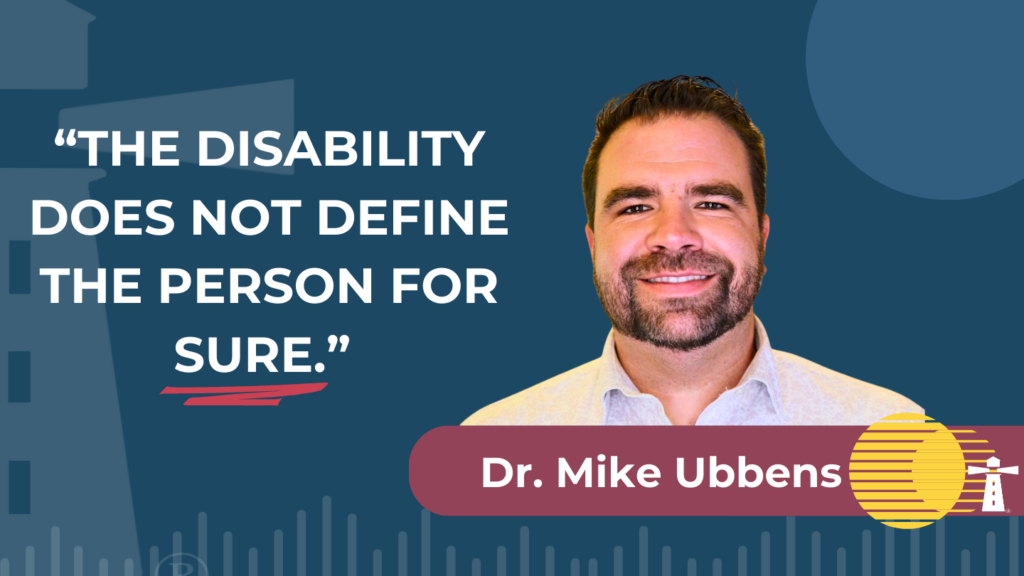
“The disability does not define the person for sure.”
“For me, [this work] turned into a passion of advocating for individuals with disabilities, having seen what institutionalization looks like on the other end of it.”
“Realizing that communication comes through in so many more ways than just verbalizations, and behavior is a lot more than what it looks like on the outside.”
Why This Matters Now
As districts nationwide grapple with transition services, limited resources, and the challenge of preparing all students for post-secondary success, this episode offers a roadmap for meaningful change. Dr. Ubbens’ journey from special educator to district leader reveals how one person’s commitment to dignity and inclusion can reshape what’s possible for an entire community.
Listen & Subscribe
Ready to discover how your district can build meaningful employment partnerships? Listen to this episode today and subscribe for more conversations with education leaders who are transforming outcomes for students with disabilities. Share this episode with your special education team, administrative colleagues, or anyone working to build more inclusive communities.
—
Subscribe for weekly episodes on special education, transition planning, and inclusive school practices.
FULL PODCAST Transcript
Lighthouse Therapy (00:01.144)
Hello everyone and welcome to the Brighter Together podcast. My name is Janet Courtney and my special guest today is Dr. Mike Ubbins. Mike is the supervisor of special education at Avon Grove School District and that’s in West Grove, Pennsylvania. Mike, thank you so much for being on the show today.
Mike Ubbens (00:19.574)
Thanks for having me.
Lighthouse Therapy (00:21.26)
So Mike, tell our listeners a little bit about your journey and about a little, maybe a little bit about Avon Grove, because it’s spelled like Avon and you already told me like, well, it’s Avon for a reason. And I was like, good. So tell us a little bit about it.
Mike Ubbens (00:33.996)
Sure, in terms of my journey, had a non-traditional pathway into special education. I went to college for political science and had the idea of going to law school. My dad essentially made me get a secondary ed minor so I could teach social studies. And I ended up in law school for a year in New York. I did not
Lighthouse Therapy (00:55.733)
my.
Mike Ubbens (01:04.062)
enjoy law school. didn’t find it fulfilling. I had already gone through student teaching and missed being with kids. And in the back of my head, I was also thinking, am I going to go through all of this and rack up this debt and then end up teaching? So I finished my first year, went back home. At that time, it was difficult to find jobs in education. So I ended up in alternative ed.
Lighthouse Therapy (01:18.678)
Mm-hmm.
Mike Ubbens (01:30.506)
where they hired me on the spot and they said, wear shorts and sneakers, you’re gonna be running. And that was the truth. And spent a year in alternative education. I loved it and was really getting interested in special education through that experience. And ended up getting my master’s at Lehigh University and they have programs where they’ll pay for your master’s.
Lighthouse Therapy (01:39.032)
Wow.
Mike Ubbens (01:55.628)
If you work in certain programs and they had a community program where you would go out in the community with your clients. I did that for a year and then I ran the group program that they had at Lehigh for my second year getting my masters. Then a lot of the individuals were adults with severe disabilities who were institutionalized. There’s a place called Pennhurst out here in Pennsylvania. It’s now a haunted house.
Lighthouse Therapy (02:14.754)
Mm-hmm. Mm-hmm.
Mike Ubbens (02:25.056)
But before it was, it was an asylum. And a lot of the individuals that we had that I had with me, they went in speaking as kids and came out nonverbal. Another one had his top row of teeth pulled out because he was biting. Someone else had cauliflower ears because they gambled on them fighting. And it really, for me, turned into a passion.
Lighthouse Therapy (02:25.518)
are.
Mike Ubbens (02:52.99)
of advocating for individuals with disabilities, having seen what institutionalization looks like on the other end of it. and people look to institutions as a solution, which they should be, but a lot of times they’re not, and they end up worse off than they would have been to begin with. So that’s something that’s really
Lighthouse Therapy (03:03.8)
Heartbreaking, it’s absolutely heartbreaking, yeah.
Lighthouse Therapy (03:12.643)
Mm-hmm.
Mike Ubbens (03:21.9)
Ben, a main principle for me moving forward in my career is advocating for those individuals to be included in their communities, in their schools, and, you know, trying to protect that right that they have. So that’s a little bit about me.
Lighthouse Therapy (03:37.241)
Cause it’s a person, there’s a person. Sorry, just wanna make a point here. That’s a human being with a disability, not an animal to be treated how you want them to be treated. yeah. yeah, anyway, anyway, yeah. The disability does not define the person for sure, yeah.
Mike Ubbens (03:52.906)
Yeah. Yeah, absolutely. I’m no, no. And that was a great lesson for me to learn firsthand through these individuals that I truly got to know so well. And most of the individuals that I worked with were nonverbal and, you know, realizing that communication comes through in so many more ways than just verbalizations and, you know, behavior is a lot more than what it looks like on the outside.
Lighthouse Therapy (04:10.178)
Mm-hmm.
Lighthouse Therapy (04:16.622)
Mm-hmm.
Mike Ubbens (04:21.196)
So that’s really, really been my big why. And in terms of Avondale Grove, you said, it’s based on the combination of Avondale and West Grove in southeastern Pennsylvania. We’re about, depending on where you are in the district, 10 or 20 minutes outside of Delaware. About 5,000 total students. We have four buildings.
Lighthouse Therapy (04:26.861)
Mm-hmm.
Lighthouse Therapy (04:42.51)
Okay.
Mike Ubbens (04:49.388)
You know, our special ed programs have definitely been growing in the last five years where we, you know, we’ve been lucky enough to create a transition program for 18 to 21 students in-house where we have a simulated apartment.
We’ve been able to create our own job coaching and job exploration program in the community. We have 30 community partners now where kids go to work. We started off with three. So it’s been really awesome to see that grow and see the students really flourish. was just today in a meeting where we had a student tour of the program with our parents and
Lighthouse Therapy (05:15.96)
Beautiful.
Mm-hmm
Mike Ubbens (05:33.684)
They asked about job placement and what’s the job placement when the students leave with us right now in Pennsylvania? You can stay until you’re 22 and actually the day before your 22 you you can stay and then you have to leave that day. It’s it’s caught up in court, so we’ll see what happens. But their question was, you know, what’s the job placement? Situation here and I usually answer that and.
Lighthouse Therapy (05:47.755)
Really? Wow.
Mike Ubbens (06:03.432)
one of our teachers answered that, our transition coordinator.
You know, said I’m really proud to share that our placement is 100 % and we have students leaving who have either competitive employment or volunteer opportunities if that’s what they want. you know, we’ve really been focusing on creating a sense of belonging for our students and creating an inclusive community. And we are able to do both of those things with the program, which has been just awesome to watch and then to see our transition coordinator take the reins of that.
conversation versus me was, you know, that’s what we want, right, is all of our teachers to step up as the leaders. And it was just awesome to see. So it was a proud moment to start the day today.
Lighthouse Therapy (06:38.552)
Hmm, right.
Lighthouse Therapy (06:47.82)
Yeah, congratulations. That’s amazing. And congratulations on 100 percent. Wow. You know, like I said at the beginning, it’s like these are and we’ve had we’ve I’ve had conversations with other educators about transition and how incredibly important it is. that piece of this is a person. This is not a disability. This is not a this is a person that has something that makes them different. It doesn’t mean that they’re not a human being. Excuse me. Under under that disability and
Mike Ubbens (06:53.269)
Yeah.
Lighthouse Therapy (07:17.08)
having, helping the community to see and understand that, as opposed to what you experienced and I’ve experienced it as well. Just the ugliness that institutionalization does is just, and yay, good for you. And that’s what a testimony to the leadership that you have given your team to show them that they can grow a program like that. So that’s amazing, it’s amazing.
Mike Ubbens (07:44.926)
Yeah, it’s my colleague, Nicole and I, we’ve really worked hard to, you know, find the things that our teachers love to do and let them do it, right? And they’re gonna be the happiest teachers that you’re gonna have in your district if you can do that. And in terms of like the community having all these partners, it’s been great to see and hear from parents who, you know, used to have trouble finding places to take their kids where they were welcome.
Lighthouse Therapy (07:54.254)
Mm-hmm.
Mike Ubbens (08:13.42)
not just tolerated, but welcome and creating all these partnerships. They’re working there. The parents know this is a safe and comfortable place for us to go. As we grow, I’m hoping that the community just becomes more and more inclusive. So that’s not something any parent has to worry about. Because I have three kids on the other end of the spectrum. Our oldest is seven and I can’t imagine feeling like I don’t know where to go.
Lighthouse Therapy (08:16.067)
Mm-hmm.
Lighthouse Therapy (08:32.429)
Mm-hmm.
Mike Ubbens (08:41.012)
for dinner tonight with our family or have to go to the grocery store. those are thoughts that a lot of our parents have to have and they shouldn’t have to do that. So hopefully we can get there at some point.
Lighthouse Therapy (08:54.334)
One of the things that I love, I’m a speech therapist, I will never stop being a speech therapist, but one of my most favorite things to do, and this is probably gonna make me cry, good grief, it’s a crying day, when I see a family out and an opportunity presents itself, because it does, if you give yourself the ability and the, just pay attention to have that conversation, not with mom.
Mike Ubbens (09:02.636)
I’m
Lighthouse Therapy (09:23.53)
Not with dad, with that person, with that person, just, you know, greeting them and saying hello and, and how are you? How’s your dinner? You know, how are you having fun or, know, whatever it is, whether, whether it’s in the mall or it’s at a restaurant or whatever, just because that person needs to know that there are people out there that see them and want to have a conversation with them. And it’s never been the wrong thing. Not one time.
Mike Ubbens (09:50.38)
Yeah.
Lighthouse Therapy (09:51.213)
has it ever been the wrong thing to do that? And I love doing it. I absolutely love doing it. And then my kids, you you do that and, and you’re, do it in front of your, your spouse and you do it with your kids and with their, and, and they, it, just, grows from there. You know, it just is something that, that is so, it’s just so critical to, to, to human beings, to the world that we live in, you know, to love on others matters. Yeah.
Mike Ubbens (10:16.121)
Yeah, absolutely.
Lighthouse Therapy (10:19.648)
So you have lots of knowledge when it comes to Pennsylvania and education and how it’s set up. And can you give us some insight into what you’ve learned over the years about Pennsylvania and the educational system there?
Mike Ubbens (10:36.448)
Yeah, I mean, we are very fortunate. We’re in Chester County, Pennsylvania, which is one of the, excuse me, more affluent counties in the state.
which allows us to have more resources available. I’ve had experience also in the Lehigh Valley and it’s interesting to see the difference in services. Not really school-based, but more home-based services or county-based services and what that looks like. But I have to say overall, Pennsylvania has been pretty strong when it comes to
special education. think they’re leaders in a lot of ways in terms of, you know, transition planning and programming. have, Patton is one of the statewide organizations that provides consultation services to school districts. And we are an autism initiative school, which means that they come out, they have a coach that will come out and help.
Our autistic support teachers work with students in the classroom with verbal behavior and implementing their programs with fidelity. So we have two classrooms at our K-1 building that are model schools through that autism initiative. So we have a lot of resources that are available.
Lighthouse Therapy (11:52.866)
neat.
Mike Ubbens (11:55.788)
in the state to be able to guide our teachers and support our teachers. So I think overall we’re very fortunate to have that support and it goes a long way with our families too.
Lighthouse Therapy (12:07.854)
So with your programs that you’re doing, what do you tell schools that want to get something like this up and running, but they’re always worried about funding? And 30 partners, how did you grow that to that level?
Mike Ubbens (12:28.672)
Yeah, I mean, the 30 partners that, you know, we, like I said, we had teachers who said they wanted to do this and we were able to say, okay, let’s do it. And we worked together to create, you know, work through some of the legal ramifications of what we would need to have an agreement with these partners and what kind of liability we would have to take on. That’s the job that I took on. And then we essentially did cold calls, me and the transition coordinator.
Lighthouse Therapy (12:38.05)
Mm-hmm.
Mike Ubbens (12:54.89)
for a year where we both kind of modeled to each other going to Walgreens or the mom and pop pet shop or hers chip company is around us and just reaching out to them, going to their offices, talking to management or the owner and talking about like, hey, this is something that’s gonna be beneficial for both of us, right? We’re gonna get our kids hands-on experience.
Lighthouse Therapy (12:55.214)
down.
Mike Ubbens (13:22.952)
In a field that they’re interested in, not just, you know, to say, hey, they stock shelves, which is great, but not everyone wants to stock shelves. Not everybody wants to be a greeter. You know, there are other things that that people want to do right. So our transition coordinator, Krista, does an awesome job of matching students. And our cell is look like we have someone who’s interested and they’re going to get hands on experience. We have a job coach, so they’re going to be the teacher.
Lighthouse Therapy (13:27.596)
Mm-hmm.
Lighthouse Therapy (13:35.554)
Mm-hmm.
Yeah.
Mike Ubbens (13:52.81)
You know, that’s not going to be your responsibility. Your responsibility is telling our job coach and the student what you need them to do. And then we’re going to do it. And we’re going to do it for free, right? And staffing is an issue. That’s not a secret to anyone in any industry. So if we can free up your staff to do the job they’re actually being paid to do, and we can do this for you, maybe you’ll find that, hey, like, I want to bring this student on as an actual employee and pay them.
Lighthouse Therapy (14:02.39)
Mm-hmm.
Lighthouse Therapy (14:08.846)
Right.
Mike Ubbens (14:22.492)
And that has worked out with us a number of times where it was just a good fit. They wanted to hire them. And we had other cases where students weren’t following the rules and they had to fire them. But they did that with us in a way that was safe for the student to fail and learn that. And then we’d find something else for that student. But having that experience now versus when they are not with the support that they need.
Lighthouse Therapy (14:37.186)
Mm-hmm. Yeah.
Lighthouse Therapy (14:51.032)
Mm-hmm.
Mike Ubbens (14:51.08)
is huge for that student. So through the cold calling experience, I think she and I both learned the way to do it. And then using our networks to grow the program, we have an appreciation breakfast at the end of the year, which is, think, most of our favorite events, everyone’s favorite event of the year. parents get to see their students talk about their
Lighthouse Therapy (15:06.294)
Mm
Mike Ubbens (15:15.212)
programs, even if they’re using a device, they go up and they talk about their program and what they love about the program and what they loved about who they worked with. And I think word of mouth is a big part of it, too, because there are parents that own businesses or parents that work in a place where like, hey, we could have someone. This would be a great fit for so and so. So that’s really what got from, you know, five years ago, three partners to today, 30. That’s how we got there.
Lighthouse Therapy (15:35.192)
Mm-hmm.
Mike Ubbens (15:44.904)
And, you know, like I said, we, because it’s just our school district, we have the benefit of being able to say, what’s your interest? And let’s find that for you. Like a student was interested in plants, we found a nursery that was interested in taking someone on. And we’ve had a lot of success with that and we’re growing a support network for the district and also all these students and families.
Lighthouse Therapy (15:55.192)
Mm-hmm.
Lighthouse Therapy (16:09.538)
Yeah, absolutely. Absolutely. I love that. So what would you say right now is your biggest challenge? What is the biggest thing that you’re struggling with right now?
Mike Ubbens (16:21.142)
Funding is definitely probably, and I don’t know if that’ll ever change or it has ever changed. We’ve been very fortunate in the county. We’re still fortunate. But, you know, looking at our budget and figuring out like how we’re tight trading, personal care assistance, PCAs, our one-to-one aids, like how are we fading them out? How are we determining when a student needs one?
Lighthouse Therapy (16:23.085)
Hmm.
Mike Ubbens (16:50.856)
We really have been supportive of of adding 1 to 1’s in and now we’re seeing the financial impact of that and how do we address that responsibly as stewards of the district, but also advocates for the students and making sure that it’s what they need. So funding is a big 1. we would love to have more job coaches. We’d love to have more district vans, but we’re.
Lighthouse Therapy (16:55.586)
Mm-hmm.
Lighthouse Therapy (17:08.738)
Yeah.
Mike Ubbens (17:18.316)
we’re pressed to find ways to economically get those students to the job sites that they need without using more than what we need.
Lighthouse Therapy (17:24.462)
Yeah, that’s it. That’s one of the things. Yeah. Yeah, sorry. I didn’t mean to interrupt you. One of the things that I’m excited about for the future and I don’t know if I think we’ll see it in my lifetime. I’m 58. So but who knows is the self driving cars are coming there. I’ve seen them and others in California, specifically when I was visiting out there. But the amount of access
Mike Ubbens (17:30.069)
No worries.
Lighthouse Therapy (17:53.279)
that that is going to give to people with disabilities is huge, absolutely huge. you know, having a person who cannot, you know, whether it’s a young person trying to get to a job or an old person trying to get to a doctor’s appointment or whatever it is, I’m really hopeful for that, that there will come a time when that is something that will open up AI is also gonna, you know,
open the world up for us as well. But, know, that access, that physical access to be able to get from point A to point B, there’s nothing worse. And I’ve worked in skilled nursing as well, know, giving up giving up your independence as an adult is the hardest thing as an adult to do, you know, whether you understand it or not, it’s something that you just see. And so giving these kids the ability to have a job, but then
the ability to get there when they can’t get there on their own, especially you live in Pennsylvania, it gets cold. It’s probably cold right now. It’s February 3rd right now, 2026 and it’s cold. So, you know, they can’t walk. So giving them that access, you know, right now it’s like, what do you have? You got the bus, right? I mean, or walking or not. So.
Mike Ubbens (18:56.246)
Yeah, it is,
Mike Ubbens (19:15.19)
Yeah, yeah, think, you know, technology is a huge part of it. And when we talk about funding, technology is going to be a big part about that too, and helping address some of those areas where, you know, we would otherwise need funding support. I mean, like you mentioned AI, we’ve really embraced AI at Avon Grove, where we have an AI agent that that responds to our special education teachers.
Lighthouse Therapy (19:24.28)
Mm-hmm.
Mike Ubbens (19:40.72)
And our procedure manual is baked into it. So if they have a question about, you know, what’s the process for transfer students out of state, instead of emailing or texting my colleague Nicole or I and waiting for us to be able to respond, they can get that answer immediately and consistently. And we know it’s not from CHAT GPT. It’s not from, you know, some kind of open source network. It’s from our system and our network knowing.
Lighthouse Therapy (19:44.398)
Hmm.
Lighthouse Therapy (19:58.326)
Immediately, yeah.
Right.
Mike Ubbens (20:08.649)
that they’re going to get the same answer every time, you know, so, and that’s saving time and money for us in the long run. So I agree, improvements in technology are definitely going to have a lasting impact in special education.
Lighthouse Therapy (20:10.772)
Every time, right? Mm-hmm, yeah. Mm-hmm, yep.
Lighthouse Therapy (20:24.002)
Yeah, and gratefully so, I’m grateful. know, there’s lots of things that you can say about technology, but that is an area where it’s like, yes, I like that, I like that so much. And we’ve got the same thing, we’re working on it here as well. And it’s exciting, it’s exciting new, and I didn’t know. It’s so funny, because we did, one of the things that I strongly believe in is goals, goals. And goals are not goals if you do not write them down. If you say you have a goal,
Mike Ubbens (20:26.282)
Yeah.
Lighthouse Therapy (20:53.1)
and you haven’t written it down, it’s not a goal. Write the goal down and then you have a goal. They’re back there on my wall. The goals are there right behind my, and there’s all kinds of stuff all over my computer. I am a strong advocate of that and there’s, we use the book called Traction. Geno Wickman wrote it and there’s the entrepreneurial operating system that we use here at Lighthouse and it’s all about helping your teams to have goals and to work on goals and to make sure
And even early on, even before I knew about that particular book, thank you, Mark Wallenwein, who’s my director of marketing. He told me he was already using it when he started here and he’s like, Janet, we really need to read this book. And so I finally did. And I’m like, we need to do this. I’m already, I will. was, but I was already doing annual goals and my own personal goals, you know, and stuff. But, it’s just so important to have those, those things.
All that to say, sorry, I went like down a rabbit hole here. We had put on our 10 year, cause I do one year, five year, 10 year goals, know, 10 year, Pisa sky, what do we want to do in 10 years? And one of them was have our own AI system. And that was 10, we put it on our 10 year. It’s, it’s now in our one year, cause it’s just going that fast. You know, AI is just moving, things are moving and I have amazing people. That’s the other piece of it too. So.
Mike Ubbens (21:52.587)
No
Mike Ubbens (22:11.03)
Wow, yeah. Yep.
Mike Ubbens (22:19.212)
Of course, yeah.
Lighthouse Therapy (22:19.63)
So I love hearing that you guys are using it as well, because it’s, yeah.
Mike Ubbens (22:22.452)
Yeah, I mean, it helps everybody, right? And we’re really trying to focus too, if we’re going to improve efficiencies, we’re improving it for everybody. I’m not taking something off of your plate and putting it onto mine. You we’re taking off all of our plates to move forward. I’ve really tried to focus on, you you mentioned annual goals. That’s something that Nicole and I are focusing on is like, if we’re going to improve our efficiencies, we’re not overfilling anyone’s plate.
Lighthouse Therapy (22:35.598)
Mm-hmm.
Mike Ubbens (22:50.762)
Right, we’re gonna make sure we’re taking it off of everyone so everyone can operate more efficiently. Otherwise, it doesn’t work. That’s great that you took it off so-and-so’s plate, but now you’re not able to do what you need to do and who’s gonna help you at that point. you know, when we talk about those things, if it improves everyone’s efficiency, that’s a win.
Lighthouse Therapy (22:51.064)
Mm-hmm.
Lighthouse Therapy (22:58.755)
Yeah.
Lighthouse Therapy (23:03.564)
Mm hmm. Right.
Lighthouse Therapy (23:12.396)
Yeah, for sure, for sure. So Mike, where do people go if they have questions? Because I know there are people that’ll have questions about what you’ve done and how you’ve done it. Tell them a little bit about where to go to find Avon Grove School District. And I’m sure there’s probably a link somewhere on there for you as well.
Mike Ubbens (23:14.07)
Yeah.
Mike Ubbens (23:32.768)
Yep, yeah, avangrove.org is the information about Avangrove School District. If you’re looking for me, I also have a LinkedIn page. It’s just Mike Obbins, my name. And you can find me on LinkedIn and I’d be happy to talk to anybody and collaborate.
Lighthouse Therapy (23:48.652)
Yeah, I love that the educators they love sharing their knowledge. I love that about nobody. Nobody’s putting a lid on what they’ve done. So thank you for that. And I’m going to ask you one last question. If you could fix anything, fix one thing in your world, in your world, your job, not money. We know everybody needs more money. What would that one thing be?
Mike Ubbens (24:00.534)
Sure.
Lighthouse Therapy (24:10.283)
Never have to worry about it again.
Mike Ubbens (24:12.348)
I would give teachers more time. I don’t know how to do it, but if I could, I’d give everybody more time. That’s what everyone asks for. And it’s the one thing we just can’t make out of thin air.
Lighthouse Therapy (24:14.564)
good one.
Lighthouse Therapy (24:22.348)
You know, I think AI is gonna help. I think AI is gonna help with that. I think that’s one that I’ve seen it, I’ve seen it do amazing things, get stuff done. Even the podcast, we use AI to package our podcasts and it’s two thirds of the time faster than it would have been otherwise. So it’s a good one. Yeah.
Mike Ubbens (24:25.866)
Yeah.
Mike Ubbens (24:41.002)
Yep, that’s what we’re hoping. But yeah, I think that’s the big one.
Lighthouse Therapy (24:47.16)
Well, Mike, it’s been a pleasure to have you on brighter together. Thank you for being here. Thank you for sharing your knowledge and just your passion.
Mike Ubbens (24:56.406)
Thanks, Janet, I appreciate it.
Lighthouse Therapy (24:58.455)
Absolutely.
Mike Ubbens (24:59.724)
Take care.





Mid-Year Report Card Comment Bank for Teachers