

How Wayne County RESA Cut Teacher Shortages Through Partnerships (And You Can Too)
The staff shortage crisis is real—and it’s hitting special education harder than anywhere else in K-12. If you’re leading a school or district right now, you’ve likely felt the sting of empty special education positions, skyrocketing turnover, and the cascade of challenges that follow. But what if there was a proven pathway out?
In this episode, we sit down with Elizabeth Santer, Executive Director of Special Education Services and Early Intervention Services at Wayne County RESA, to uncover how strategic partnerships and innovative practices are turning the tide on teacher shortages. Elizabeth brings years of experience navigating the unique staffing challenges of special education—where shortages span multiple specialized categories—and shares the concrete solutions that are working on the ground.
What You’ll Learn
Discover how Wayne County RESA is tackling one of education’s most pressing challenges through collaborative partnerships, sustainable staffing models, and a laser focus on least restrictive environments. You’ll walk away with actionable strategies you can implement immediately, whether you’re a district director, special education administrator, or building principal.
Key Takeaways
- Staff shortages in special education are acute and multifaceted. Unlike general education vacancies, special education requires specialized teachers and support staff across numerous categories—making traditional recruitment approaches fall short
- Where students are initially placed often determines where they stay. Early placement decisions have lasting consequences; intentional practices around least restrictive environment can open doors for students and optimize staffing
- Personal curriculums and modified standards pathways transform student trajectories. These waivers allow special education students to earn high school diplomas while accessing modified coursework—a game-changer for student outcomes
- Partnerships reduce burden and create sustainability. Regional collaboration distributes the staffing load and builds systems that retain talent and maintain consistency
- Consistency in staffing directly impacts student success. High turnover destabilizes systems; strategic practices that reduce turnover protect both students and staff morale
Notable Quotes
“If you asked any local director what their biggest challenge is, I’d be surprised if they didn’t say staff shortage. Staff shortage is alive and well, and especially in what we do.”
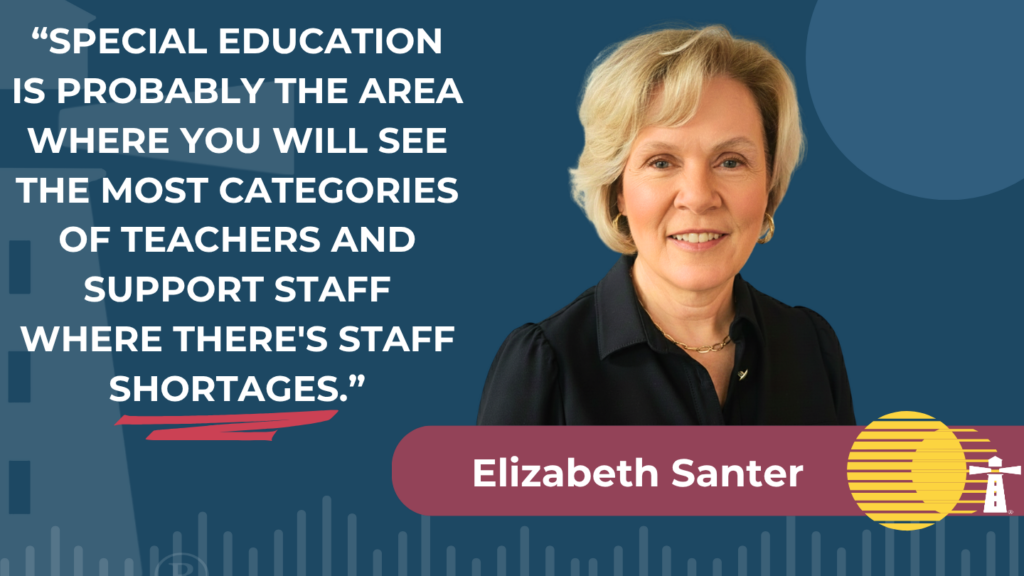
“Special education is probably the area where you will see the most categories of teachers and support staff where there’s staff shortages.”
“We’re very focused on least restrictive environment. We want to make sure that our students are not put into an environment with the kinds of supports and services that take them away from their general education peers without some serious thought.”
“Personal curriculums…can be a pathway for some of our special education students that may need modified standards in certain classes to lead them to a high school diploma, which can change the trajectory of a student’s life.”
Ready to explore solutions that are working in real districts? Listen now to hear Elizabeth Santer’s insights on building sustainable special education staffing models through partnership and purpose-driven practices. Subscribe to stay updated on strategies that move the needle on your biggest challenges.
FULL PODCAST Transcript
Lighthouse Therapy (00:01.294)
Hello everyone and welcome to the brighter together podcast. My name is Janet Courtney and my special guest today is Elizabeth Saunter. Elizabeth is the executive director, excuse me, for special education services and early intervention services for Wayne County, RESA and that’s in Wayne, Michigan. Beth, thank you for being on the show.
Elizabeth (Beth) Santer (00:24.751)
Well, thank you for having me.
Lighthouse Therapy (00:26.562)
So Beth, tell us what does an executive director with all of those things do? You must be incredibly busy.
Elizabeth (Beth) Santer (00:34.039)
Well, there’s a lot of things that we do. So first I’ll start with that Wayne County.
You mentioned it’s in Wayne, Michigan, but it is the largest county in Michigan. And so we service 33 local districts and 97 public school academies. So yes, you’re right. I’m busy, but our whole team is busy. It’s the biggest county in Michigan. So there’s a lot that we do and there’s a lot of opportunities that I’m lucky to have. I worked at a local district for many years. I just joined RESA, which is an ISD.
Lighthouse Therapy (00:49.23)
Wow.
Elizabeth (Beth) Santer (01:08.239)
last July and we get to work on statewide committees. We definitely want to make sure that our locals are feeling supported and that’s in compliance areas but it’s also in building systems and making sure that we also are putting priority goals in place that are put forth through Michigan Department of Education.
Lighthouse Therapy (01:36.494)
Gotcha. So, Risa, tell us what Risa, I know what Risa is in other States, but tell us what Risa actually stands for so that those, cause every state has their own, right?
did I lose you?
Elizabeth (Beth) Santer (01:51.347)
I am not… No, I’m just looking something up. Can you still hear me? You don’t video, right?
Lighthouse Therapy (01:56.119)
Okay, sure. Yeah, yeah, I can hear you.
Yeah, we have video.
Elizabeth (Beth) Santer (02:03.357)
okay, I’m sorry.
Lighthouse Therapy (02:05.12)
No, that’s okay. We’ll fix it. No worries. No worries at all.
Elizabeth (Beth) Santer (02:07.554)
Okay. I don’t know what RESA stands for. That’s why I’m looking that up.
Lighthouse Therapy (02:11.381)
that’s okay.
Elizabeth (Beth) Santer (02:15.978)
Okay, I guess I did know. I did know. I just didn’t know.
Lighthouse Therapy (02:16.215)
Isn’t that funny?
Lighthouse Therapy (02:21.814)
Okay, so I’ll give our editors a nice, easy cut, okay? So tell our listeners what recess actually stands for in Michigan.
Elizabeth (Beth) Santer (02:28.142)
Mm-hmm.
Elizabeth (Beth) Santer (02:35.054)
RESA stands for Regional Education Services Association.
Lighthouse Therapy (02:41.07)
Gotcha. Okay. So you guys are in charge of, and Wayne County, for those of you that don’t know, that’s Detroit, right? We’re talking about the city of Detroit. So this is, she’s a, she’s got a big area here. And, and so you guys are kind of helping manage and helping supply information to these schools. Is that right?
Elizabeth (Beth) Santer (02:48.564)
Yup. Mm-hmm.
Elizabeth (Beth) Santer (03:04.878)
Yeah, yeah, absolutely. There’s two major buckets, but then there’s a lot of things that fall into those buckets. So the first one would be that general supervision and accountability, which is more compliance of special ed. But then the other bucket is Act 18. So for those moderate to severe low incidence students.
Lighthouse Therapy (03:18.466)
Right. Okay.
Elizabeth (Beth) Santer (03:28.462)
How are we servicing them? How are we programming for them? And making sure that the funds are funneled to those local districts so that they’re able to support those students. Each of those buckets has different
sub units, if you will. So general services and accountability, it isn’t just compliance. I mean, that is obviously the main driver, but out of compliance becomes, it comes opportunities to support. So for example, you might be working with a district on state complaints and maybe the state complaint is on least restrictive environment and not following the IP and considering that. But as you
dig into things and as you’re working with that local district, that local district may have needs in other areas or they may have very serious needs in that area where RESA is also able to provide some consultation services and some professional development not just for the administration team but also for all of their special education staff. at RESA we
Lighthouse Therapy (04:38.242)
Right.
Elizabeth (Beth) Santer (04:40.278)
like to look at ourselves as a support for others and believe very much in that service leadership. again, that’s kind of a sub, an example of something that comes from general accounting and supervision. And then that other bucket, Act 18, there’s a lot of things that come from that too. So yes, it’s a funding source. And so we’re helping our districts and we’re looking at budgets and what they’re asking for to service their students that can be building expenses. It can be staff, can be curriculum.
But from that, you also have those students that are landing in those programs every day. And so it’s important that we make sure that those programs are supported. Maybe they have behavioral needs with specific students that they need some help with. And we have a behavior team that will go in and work with that team and to develop systems. We also have what we call our Watt team, which is basically our assistive technology team that’s also
kind of a subunit of that ACT 18 programming because a lot of students that are low incidence, you mentioned you were a speech therapist, I was a former speech therapist, they may have a difficult time with language or speaking or not have any verbal speaking system at all. Because we are such a big county and we’re an ISD, we also
We also have to look at things very much from a systems lens because we’re not gonna live in that district every day, all day. So we have to make sure that the support we’re giving is support that that district can actually pick up and then do. I like to say that we like to make sure we’re not writing checks that other people have to cash without some intentionality there.
Lighthouse Therapy (06:14.006)
Right, right.
Lighthouse Therapy (06:32.45)
Right, that makes so much sense that that’s so helpful because it just, there’s nothing worse, right, than going to somebody and saying, hey, can you help me? And then you get the advice, but it doesn’t apply to what you’re doing, right? So being that, so how does someone become the executive director? What was your career path? I know you said you were an SLP, but how did you get to where you are today?
Elizabeth (Beth) Santer (06:45.942)
Right, right.
Elizabeth (Beth) Santer (06:55.971)
Mm-hmm.
Yeah, so it was definitely a journey. And it was not something that I necessarily intended. It kind of found me. So I started out in college actually as a sports broadcast major.
Lighthouse Therapy (07:07.885)
Yeah.
Elizabeth (Beth) Santer (07:12.318)
and then took a very sharp left turn into speech pathology and was very happy being a speech therapist for 19 years. 15 of those years I worked part-time, raised my family, and after 19 years I had some opportunities to get into leadership and some of those leadership positions weren’t necessarily administrative. I was a teacher consultant, I was a program specialist.
Lighthouse Therapy (07:23.395)
Yeah.
Elizabeth (Beth) Santer (07:39.343)
Then I had the opportunity to become assistant principal at a middle school for a minute. And then I was a special education supervisor. And then I got the great fortune of being able to come to the district that served my kids and become the executive director of that local district. And then after about six or seven years of doing that, I had this opportunity to go to the county, which is kind of a natural outcome.
Lighthouse Therapy (07:56.088)
Love it.
Elizabeth (Beth) Santer (08:09.354)
of being in education for 33 years.
Lighthouse Therapy (08:09.582)
Mm-hmm.
Right, right. Yeah, you and I are similar. I’ve been a therapist for 32 years and so similar timelines. You went into the executive director in education and I went to therapy company. similar, yeah, just still in education, still serving, still making sure that kids are taken care of, right? Teachers are taken care of, 1000%, yeah.
Elizabeth (Beth) Santer (08:36.949)
Absolutely.
Lighthouse Therapy (08:39.958)
So what would you say are some of your biggest wins recently?
Elizabeth (Beth) Santer (08:44.664)
Hmm, that’s a great question. And you know, there’s wins in different areas, right? And how you define a win. I would say that some of the work that RESA is doing right now, and of course, you know, I’m the mouthpiece today, but I always wanna mention it’s the team. I mean, we’re all about our team. I’m just highlighting what the work that we’re already doing.
Lighthouse Therapy (08:51.438)
Mm-hmm.
Lighthouse Therapy (09:04.937)
Mm-hmm. Mm-hmm.
Elizabeth (Beth) Santer (09:11.246)
So at RESA right now, what we’re focused on is we’re very focused on least restrictive environment. We want to make sure that our students are not put into an environment with the kinds of supports and services that take them away from their general education peers without some serious thought. And so it happens to be one of Michigan’s priority items and Wayne County, we take that very seriously.
Lighthouse Therapy (09:12.312)
Love that.
Elizabeth (Beth) Santer (09:40.109)
We’re doing a lot of work on personal curriculums, which are basically waivers that can be a pathway for some of our special education students that may need modified standards in certain classes to.
lead them to a high school diploma, which can change the trajectory of a student’s life. So it’s important work. We also look at our entry exit criteria into our center programs that are for our low incidence or matter to severe students. We want to make sure that the kids that are getting those supports are the kids that really need those supports. We’re doing a lot of work on MTSS.
multi-tiered systems of support, making sure that we are addressing the academic, the behavioral and the social emotional, the whole child, and making sure that those are proactive and preventative interventions, not reactive, which is more like an RTI model. We wanna make sure we have community engagement under LRE. And we also…
Lighthouse Therapy (10:35.342)
Yeah.
Lighthouse Therapy (10:40.578)
Yes.
Elizabeth (Beth) Santer (10:50.956)
want to make sure that we are looking at early childhood very seriously. Because a lot of times when kids are first starting out, their special education progression, if you will, that’s an opportunity. So when you have that student that you’re evaluating and qualifies for an IEP, where that student is placed can sometimes determine where that student stays placed.
Lighthouse Therapy (11:17.174)
Mm-hmm. Right.
Elizabeth (Beth) Santer (11:19.052)
Now that’s not necessarily what’s supposed to happen. You have an IEP and you look at that every year. But that has been what has happened. So we have found that it is more likely that a student
will be in a center program if they start in a center program when they’re three years old. So we wanna make sure that when we’re making that decision, again, some students need that for their FAPE. But we wanna make sure that the students that are placed into that center program, which is usually, well, in preschool almost always away from general education peers, that we look at, does that student need that placement for FAPE? Or,
could they get services that they could have delivered in a preschool environment with their peers and their gen ed peers. And so we’re doing a lot of work on that and making sure that we’re thinking intentionally, being a little creative, think outside the box.
when we have students that we feel like could be in a lesser restrictive environment at a very young age. And so that’s all very exciting work that we get to also work at a state level and then that county level. In the past, there’s been a lot of things that we’ve done that I’ve done that is exciting with teams at the local level too, but that’s the current state of what we’re doing at RESA.
Lighthouse Therapy (12:49.1)
And it’s so important because those kids, they’re with their peers. They’re with, and being with a quote, normally developing child, there are things that we cannot teach that that just does, that just gives them, and it just inspires them too. think that there are, I love that because I think inclusion and.
Elizabeth (Beth) Santer (12:55.363)
Yeah.
Lighthouse Therapy (13:15.916)
where education is going with special education is so important for those students. So I love that you guys are doing that. I really do. It’s fantastic. Yeah, so neat, so neat. So you said you have lots of people under you. how do you, what does a typical day look like for you then?
Elizabeth (Beth) Santer (13:24.238)
Yeah.
Elizabeth (Beth) Santer (13:36.675)
Wow, that’s another great question. So I am gonna, I am gonna wordsmith a little bit what you said. I don’t think of it as a lot of people that work under me. I really believe that we all work together. And so I think it’s more working alongside with people because truly, whatever your title is, we’re all in this for the work.
Lighthouse Therapy (13:38.583)
Hahaha
Lighthouse Therapy (13:49.351)
there you go. True. Very true. Great answer there. Yeah.
Elizabeth (Beth) Santer (14:01.918)
It’s all about the work. It’s about serving kids. It’s about serving communities. And so we’re really all equal. Titles are just something that human resources use to processes your pay and your benefits and your paycheck and that kind of thing. I’m sorry. You’re going to have to edit. What was the question after that?
Lighthouse Therapy (14:23.06)
No, no, that’s totally okay. I said, what does a typical day look like for you? Because yeah, so, you know.
Elizabeth (Beth) Santer (14:28.694)
What’s typically okay. So knowing that I work alongside all of these great people, a typical day can look atypical, know, typical is a typical, especially in special education. I mean, I think that’s true even at the local level. I would say that there are days that I, I
Lighthouse Therapy (14:43.404)
Right.
Elizabeth (Beth) Santer (14:52.854)
I always at a local level wanted to be very building based and I would say it’s not that different at a county level. It’s just harder. It’s harder to be building based when you are servicing 33 locals and 97 public school academies. You’re not going to get to all of those buildings. But that being said, as I mentioned, we provide a lot of support to locals and the best support can be when you’re right there and you are making sure that you’re invested and learning.
Lighthouse Therapy (15:09.966)
Mm-hmm.
Lighthouse Therapy (15:19.022)
Mm-hmm.
Elizabeth (Beth) Santer (15:22.868)
all of the programs that each district has, meeting with directors, talking about what are your pain points? What are your glows and grows? And seeing where they need the help and where they need the support. So it could be that. It could be that either I’m providing professional development or one of our consultancies and I want to hop aboard their train and see what they’re working on with districts because that also gives me that doorway into what’s happening.
at that local level. It could be one of those paperwork days that we all know about in special education where maybe we’re working on some guidance docs and or compliance issues that we need to have shorn up. It also could be a lot of that work that came out of the least restrictive environment, the LRE committee at the state. could be meetings about that. And so it’s kind of a little bit of everything.
Lighthouse Therapy (16:01.024)
yeah.
Lighthouse Therapy (16:22.732)
Yeah, it’s fun, I think, when you have a position where you get to do lots of different things, where every day is something different, every day is something new. I love that. And you’re serving the kids, you’re serving your team. And I love the fact that you corrected me. That was really important because that tells me your heart, because it absolutely is true. And it’s true here at Lighthouse as well.
I tell people, was like, I just get to captain this ship. got lots of really, really smart people around me and they make me look good. They make lighthouse look good, but they lift us up and they make things better. And that is, and I can’t do it. I can’t do all of those different things that they’re doing. And it just is so important that when you’re leading, that you’re a part of a team and you’re not just dictating from above, right?
Elizabeth (Beth) Santer (17:18.114)
Yeah, and teams, I’ve always enjoyed teams and being a former speech therapist, you kind of learn that right away. I mean, you can’t do it all yourself and everybody brings something on that team. And I like it. I call it bringing and having friends to play with at work.
Lighthouse Therapy (17:18.168)
Super great.
Lighthouse Therapy (17:28.355)
Mm-mm.
Lighthouse Therapy (17:37.462)
Yeah, yeah. So what would you say is some of the biggest challenges in education right now? Because you’re seeing it from a global view. What are some of the biggest challenges that you’re seeing?
Elizabeth (Beth) Santer (17:52.845)
Yeah, well, I’m not sure if this is the case where you’re located, but in the state of Michigan and definitely in Wayne County, if you asked any local director what their biggest challenge is, I’d be surprised if they didn’t say staff shortage. Staff shortage is alive and well, and especially in what we do.
Lighthouse Therapy (18:08.994)
Yep. It’s everywhere.
Lighthouse Therapy (18:16.366)
Mm-hmm.
Elizabeth (Beth) Santer (18:16.566)
Special education is probably the area where you will see the most categories of teachers and support staff where there’s staff shortages. More so than if you’re an elementary general ed teacher. And I’m not saying that they don’t have staff shortages in that area, but there are more staff shortages.
Lighthouse Therapy (18:37.774)
Mm-hmm.
Elizabeth (Beth) Santer (18:38.478)
when you get into more of those specific roles. So I think that is the biggest challenge and that has a ripple effect because when you have staff changes going on and you know, if you have a team of 10 at a district and let’s say you have one or two new people, that’s pretty easy to absorb and
build consistency and sustainability because you have a lot of veterans there or mid-level and then veteran people that are working with those two new people. But when you have districts that have out of 10 people, maybe eight are new, then, and maybe the mentors have only been there a couple of years. So they’re not brand new, but they’re newer. That makes it really hard to build systems and sustainable systems.
Lighthouse Therapy (19:06.326)
Right.
Lighthouse Therapy (19:25.943)
Mm-hmm.
Elizabeth (Beth) Santer (19:32.098)
That is definitely something that RESA not only sees, but then it requires our support because those are districts that maybe are looking at, we need some help with building the system because you don’t want to chase the problem, you want to get in front of it.
Lighthouse Therapy (19:40.878)
Mm-hmm.
Lighthouse Therapy (19:51.033)
front of it. Yeah. Yeah, for sure. For sure. And it is it is a it is a problem. Is there are there programs that are going on in Michigan right now to address the shortages? I know I’ve talked to some people in the past. And I know there’s some I’ve heard some stuff about parapros and supporting and helping them. What is your experience been with those? Those kinds of programs? Not necessarily that one. But what’s your experience with programs?
Elizabeth (Beth) Santer (20:20.204)
Yeah, you’re right. And we have hopped on that train where Risa is supporting and partnering with universities. So we have a partnership with Wayne State University and Eastern Michigan University, and that partnership can follow different lanes. So we have a cohort of people, special education providers that want to become
Lighthouse Therapy (20:40.494)
Mm-hmm.
Elizabeth (Beth) Santer (20:49.838)
special education supervisors and directors. So we have some, we have a cohort of those, like that bucket of people. We also have parent to teacher programs, which is what you were referencing. So.
Lighthouse Therapy (20:59.246)
Mm-hmm.
Elizabeth (Beth) Santer (21:05.582)
And then we also there are some programs that RESA doesn’t necessarily host directly, but again, those universities we partner with do where they have student teaching and accelerated programs and some out of the box ways of looking at how can you get from A to B in the most thorough but efficient way so that
we can have more special education staff and teachers that are graduating.
Lighthouse Therapy (21:40.269)
Right? Yeah. Because it’s like when you don’t have enough and you’re constantly trying to find more people and supporting them and keeping them, keeping them excited about what they’re doing. And that’s all about support. That’s what we do too. I mean, it’s just, mentor your people, get, find good people and you don’t want them to go. You want them to stay with you and you want them, because the longer that you keep them, the better it is for the kids, right? Yeah.
Elizabeth (Beth) Santer (21:49.73)
Yeah.
Yeah.
Elizabeth (Beth) Santer (22:06.424)
Yeah, 100%. And that’s what it’s all about.
Lighthouse Therapy (22:09.612)
Yeah. The bottom line always. I love that every, every, every educator that I talk to, it’s always it. And it should be as it should be. Let’s take care of the kids. Let’s take care of the smart people that we have so that they can take care of the kids. Yeah. So, so where do people go, Beth, if they want to learn more about what you guys are doing or about you, where would they go?
Elizabeth (Beth) Santer (22:24.419)
Yeah.
Elizabeth (Beth) Santer (22:34.038)
So we have a great website at RESA. it’s, you Googled Wayne RESA, it would take you right to the site. And we have a lot of.
excellent resources on our site. It isn’t just special education. The one thing I didn’t highlight but is is true at RESA is that we also don’t want to work in silos. So in our department, we get the opportunity to work a lot alongside our general education leadership teams and consultants.
Lighthouse Therapy (22:57.506)
Yeah.
Elizabeth (Beth) Santer (23:07.806)
and also IT departments. do with ADA compliance working with our IT department right now. So we’re able to work together and all of those resources are captured on our website.
Lighthouse Therapy (23:15.362)
Mm-hmm.
Lighthouse Therapy (23:24.206)
Nice, very good, very good. Well, it has been an absolute pleasure, Beth. You guys are doing amazing stuff. I love what you guys are doing. I love that you’re an SOP in the past. I love that too. I don’t get too many of them that come on the show. you know, we do, we do. Even though you’re not, neither one of us are actually, well, I say I don’t do therapy anymore, but boy, it’s still such a.
Elizabeth (Beth) Santer (23:35.222)
Yeah. Yeah. Yeah. We stick together, right?
Lighthouse Therapy (23:52.078)
part of my DNA and supporting the therapists that are here is just so much so incredible and he never stopped. I don’t think you ever stop being in once you become an educator. I don’t think you ever stop being an educator. so thank you. Yeah, thank you. And thank you for Wayne County and what you’re doing there. It’s it’s our it was my raise my kids raise my kids in Michigan and Michigan is such a big part of my heart and where we and I still have one in Wayne County. So he’s there.
Elizabeth (Beth) Santer (23:53.966)
Mm-hmm.
Elizabeth (Beth) Santer (24:04.204)
Yeah, yeah, agree.
Lighthouse Therapy (24:21.976)
So keep up the good work. Yeah, absolutely. It’s been a pleasure.
Elizabeth (Beth) Santer (24:23.138)
That’s great. Well, thanks so much for having me on.