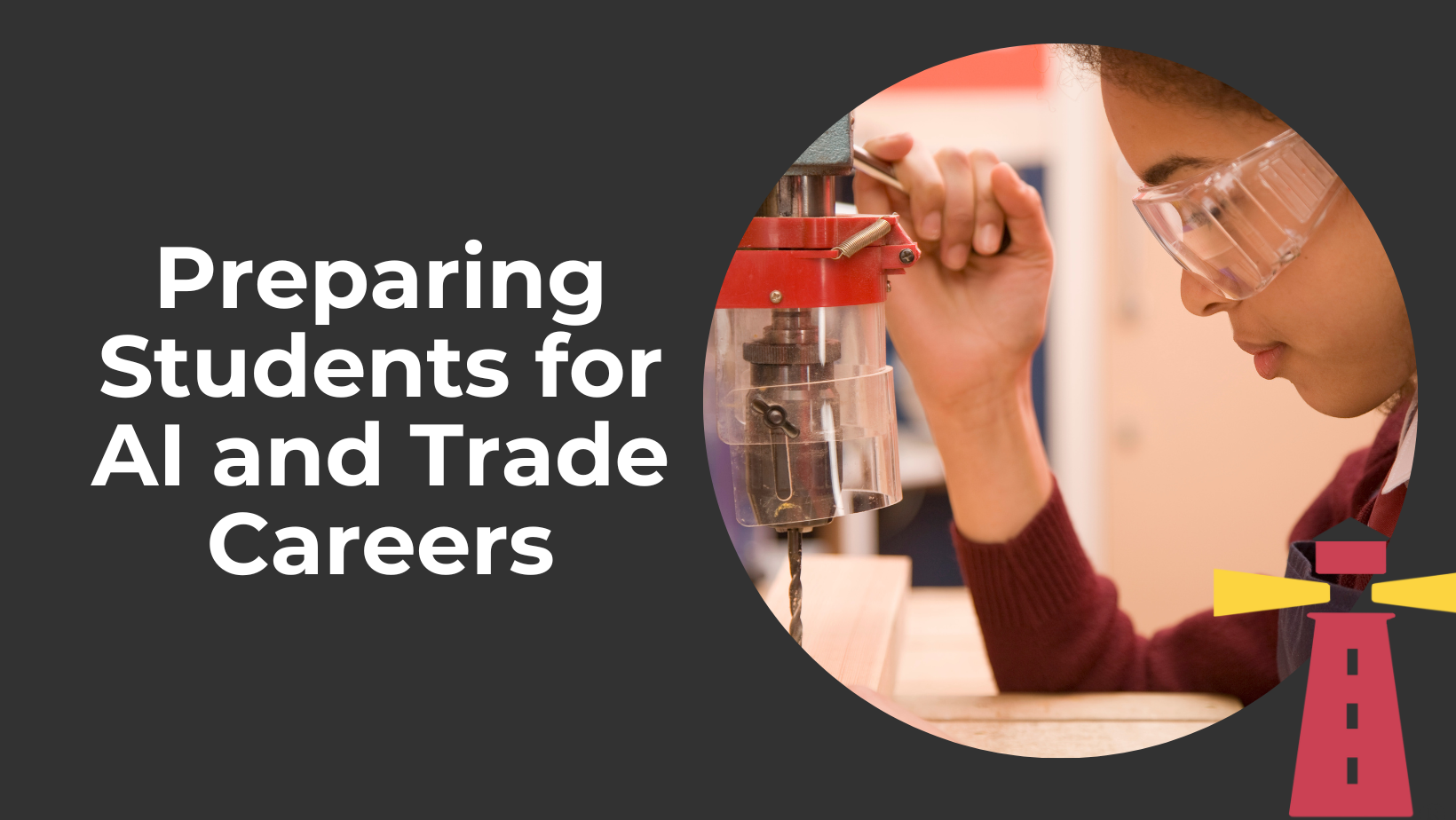
Preparing Students for AI and Trade Careers
Introduction: Schools at the Crossroads of AI and Trades
Walk into any school today and you’ll hear the same questions circling: What will the future look like for our students? What careers should we be preparing them for? It’s a fair concern. Artificial intelligence is reshaping the job market at lightning speed, while interest in hands-on trades is quietly climbing. Together, these shifts have placed schools at a real turning point: how do we prepare our students for AI careers without losing sight of the value of trades education in the AI age?
The momentum behind both paths is striking. Gen Z enrollment in trade programs has jumped 42 percent in recent years (New York Post), a clear signal that young people see opportunity and security in skilled work. At the same time, AI-related job demand has risen 21 percent (Arxiv), as industries everywhere seek talent to harness new technologies. Students are paying attention, and schools need to do the same.
The truth is, tomorrow’s workforce won’t run on tech alone, or trades alone. An electrician may be wiring smart homes. A mechanic may be troubleshooting vehicles with AI-driven diagnostics. A nurse may be leaning on digital tools for patient care, while still drawing on steady, hands-on skills. Preparing students for this world means giving them both digital fluency and practical expertise.
Students don’t need to view coding and carpentry, robotics and plumbing, as opposing choices. These paths increasingly connect, and understanding that overlap is where real opportunity lies. When schools teach both the value of AI innovation and the skill of timeless craftsmanship, they prepare graduates to step into a future where either direction, or a blend of both, can lead to success.
Why AI Is Forcing a Rethink in Career Preparation
AI and education can no longer be discussed in separate conversations. The rapid growth of workforce automation is changing how students, parents, and educators think about career paths. According to McKinsey, as many as 800 million workers worldwide could be displaced by automation by 2030. The World Economic Forum adds that nearly half of all current job tasks may be automated in the coming decade.
What’s striking is how quickly AI is moving into areas once thought safe: white-collar roles like data analysis, accounting, and even aspects of legal and medical work. While factories and manual labor jobs were long assumed to be at risk, it’s now spreadsheets, reports, and office-based tasks that AI tools are transforming at record speed. In contrast, many trades still require a level of physical presence, adaptability, and problem-solving that machines can’t replicate.
This shift also forces a hard look at the return on investment of a four-year degree. Rising tuition costs and stagnant entry-level salaries are colliding with the rise of skill-based hiring. More employers are asking not where someone went to school, but what they can do. For today’s students, future-ready career education means pairing adaptability with practical skills, ensuring they can thrive in a world where traditional career ladders are being rebuilt.
The Shift to Skill-Based Hiring
Skill-based hiring AI trends are already reshaping the workforce. Employers once considered a bachelor’s degree a baseline requirement for professional roles. Now, that expectation is loosening. Data from LinkedIn shows that degree requirements for many AI-related jobs have dropped by about 15 percent over the last five years. The shift shows that companies are now prioritizing demonstrated abilities such as coding proficiency, problem-solving, or AI tool fluency over a framed diploma on the wall.
For students, this change levels the playing field. A self-taught coder or a trade apprentice with a strong grasp of AI tools can stand shoulder-to-shoulder with someone who pursued a traditional four-year degree. As the AI workforce expands, the emphasis is shifting from pedigree to performance, and schools will need to adjust their programs to reflect that reality.
Which Jobs Are Future-Proof?
One of the biggest questions families and educators ask is: which jobs will survive the wave of automation? Research consistently shows that trades like HVAC repair, plumbing, and electrical work carry low automation risk. These roles rely on physical dexterity, on-the-spot decision-making, and face-to-face problem solving—areas where machines still fall short.
What’s more, the earning potential is stronger than many realize. Median salaries for skilled trades now rival those of college graduates, and the demand for these roles continues to climb as infrastructure ages and new technologies require installation and maintenance. While some white-collar jobs may be reshaped or replaced by AI, trades education offers a level of job security that feels future-proof in the AI age.
The Revival of Trade Education in Schools
For decades, teaching trades in schools took a back seat to the college-prep track. Shop classes were phased out, vocational training was seen as a “second-tier” option, and four-year degrees became the assumed path to success. But that narrative is changing. Modern skilled trades education is experiencing a revival, and schools across the country are rethinking how they prepare students for the future.
The Wall Street Journal has reported on this resurgence, noting a steady return of shop programs and the rise of new vocational training for the AI future. Middleton High School in Wisconsin, for example, recently invested in state-of-the-art labs where students can explore construction, welding, and advanced manufacturing. In Rochester, colleges are expanding their advanced manufacturing programs to meet industry demand, pairing hands-on training with coursework in robotics and automation.
This revival can be seen as a response to the realities of the workforce. Infrastructure-based trades like plumbing, HVAC, and electrical work remain essential to every community. These jobs are local, resilient, and hard to outsource. In the AI age, where algorithms can write reports but can’t repair a boiler or install a power line, the value of trades education has never been clearer. By bringing back vocational programs, schools give students a chance to develop practical skills that will remain relevant no matter how technology evolves.
Gen Z and the “Toolbelt Generation”
Today’s students aren’t blind to these opportunities. In fact, Gen Z choosing trades over college is becoming a noticeable trend. Surveys show that roughly 42 percent of Gen Z are considering or actively exploring the trades, drawn by a combination of stability, strong pay, and independence. For many, the idea of graduating without tens of thousands in student debt, and entering a field where work is in high demand, feels far more appealing than chasing a traditional degree with uncertain ROI.
This generation is sometimes called the “toolbelt generation,” and it’s not just a catchy phrase. It actually reflects a cultural shift where young people view vocational paths as a smart, future-forward choice rather than a fallback option. They’re looking for careers that allow them to build, repair, and innovate in tangible ways while still offering financial security.
Blending Tech into Trades
Of course, modern skilled trades education isn’t about dusting off old shop equipment. The best programs are integrating technology into training in exciting ways. AI in skilled trades and other technological interventions are helping students learn faster, safer, and with greater precision.
Take welding, for instance. Many schools are adopting VR welding simulators, allowing students to practice techniques in a risk-free environment before moving to live equipment. In HVAC training, AR tools are being used to overlay diagnostic instructions directly onto machinery, helping apprentices troubleshoot in real time. Even safety training is being enhanced by AI, with adaptive modules that tailor scenarios to a student’s strengths and weaknesses.
These innovations don’t replace the hands-on experience, but actually enhance it. By blending digital tools with traditional craftsmanship, schools are preparing students for a workforce where technology and trade skills go hand in hand. Vocational training for the AI future isn’t about choosing between hammers and headsets. It’s about teaching students how to wield both.
Building AI Literacy Alongside Trades
As schools revive vocational training, there’s a parallel responsibility of making sure that students graduate with AI literacy in schools. Understanding how artificial intelligence works, where it’s used, and how it intersects with everyday tasks is becoming just as essential as math or writing. An AI fluency curriculum doesn’t mean every student needs to code machine learning models. Instead, it ensures students can navigate AI tools, apply them responsibly, and adapt to an economy where digital skills complement hands-on trades.
AI-integrated learning in education is already taking shape. High School classrooms, technical training centers, and governments are recognizing that students will need both practical skills and AI fluency to stay competitive.
Global Examples of AI in Education
One of the clearest models comes from Estonia, a country often hailed as a digital pioneer. Its AI-Leap program introduces AI education in high schools and vocational schools, teaching students to understand algorithms, ethics, and real-world applications. By embedding these lessons into both academic and trade-focused pathways, Estonia ensures its graduates can troubleshoot a circuit board or use AI-driven diagnostics with equal confidence.
Saudi Arabia is also moving aggressively in this space, with plans to make AI part of its national K–12 curriculum by 2025. Students will not only learn the basics of coding but also explore how AI shapes industries like energy, logistics, and healthcare. This broad rollout reflects a recognition that AI literacy is not optional, it’s a national priority. These global case studies show how countries are tying AI curriculum in schools directly to economic goals and workforce readiness.
U.S. Examples and Policy Moves
In the United States, the conversation around AI in education is quickly gaining momentum. At the higher education level, Ohio State University recently announced that AI fluency will be a requirement across all majors, from engineering to the arts (The Guardian). The idea is simple: whether students are future nurses, architects, or electricians, they need a baseline understanding of AI to thrive in their careers.
At the federal level, new pilot programs are testing AI in STEM and CTE pathways, recognizing the overlap between technical education and digital fluency. These initiatives are beginning to fund AI-integrated learning in education, pairing AI tools with vocational training to modernize fields like advanced manufacturing and healthcare technology. By weaving AI into career and technical education (CTE), policymakers are signaling that the workforce of tomorrow will rely on both toolkits and tech fluency.
Together, these moves highlight a growing consensus: building AI literacy in schools must go hand in hand with modern skilled trades education. Preparing students for the future requires designing pathways where AI fluency and vocational training strengthen one another.
The Convergence: Future-Ready Pathways for Students
The future of work doesn’t belong exclusively to coders or carpenters. It belongs to those who can navigate both worlds. Therefore, schools that embrace dual-path education in AI and trades are creating future-ready career education models that prepare students for whatever direction they choose. By giving students the option to explore both AI and trade careers, educators are equipping them with a competitive edge.
Hybrid programs are already emerging with some schools pairing welding classes with training in digital design software, or offering carpentry alongside modules in 3D modeling. Others are blending coding instruction into traditional vocational labs, where students use AI-driven tools to plan, measure, and refine projects. These approaches recognize that skill-based hiring is on the rise, and when combined with AI literacy, students graduate with a clear advantage in the job market.
This convergence helps to expand students’ toolkits. For example, a graduate who can both troubleshoot HVAC systems and understand AI-enhanced diagnostics is better prepared for long-term success than one with only a narrow focus. Schools that design these future-ready pathways are preparing students for both their first job and for careers that will evolve over decades.
Role of Educators and School Leaders
Educators and school leaders are and will continue to be at the center of this transformation. How schools prepare students for AI careers will depend on the choices made today about funding, training, and curriculum. Expanding CTE (career and technical education) programs is one clear step, ensuring students have access to labs, equipment, and instructors who can teach modern trades. At the same time, professional development for teachers is essential, helping them integrate AI tools responsibly into their lessons and stay ahead of rapid technological change.
Pilot programs can also make a difference. By testing AI curriculum modules in small groups before scaling them schoolwide, districts can identify what works and adjust along the way. The goal isn’t perfection on day one, but steady progress toward building systems where vocational training and AI fluency coexist.
Balancing Technology and Human Skills
Even as AI takes on more routine tasks, there are abilities it cannot replicate. Creativity, empathy, problem-solving, and adaptability remain uniquely human strengths. Schools must balance teaching technical skills with fostering these qualities if they want graduates to thrive in unpredictable futures.
Hands-on projects, collaborative problem-solving exercises, and opportunities for students to innovate are as important as AI coding classes or trade certifications. By emphasizing both human and technological skills, schools prepare students to navigate a workforce where machines handle data, but humans still drive vision and purpose.
Preparing Students for a Dual Future
Preparing students for AI and trade careers is no longer an either-or decision. The disruption brought by artificial intelligence has made trades more attractive and secure, while AI literacy ensures students remain adaptable in rapidly changing industries. Together, these pathways form the foundation of future-ready students who can build, innovate, and lead in a hybrid workforce.
The challenge for schools is also an opportunity. By embracing vocational education and AI-integrated learning side by side, schools can create graduates who are prepared not just for today’s jobs, but for the evolving careers of tomorrow. The call is clear: invest in both toolkits and tech fluency, and equip students to thrive in a dual future where AI innovation and skilled trades go hand in hand.
AI, AI in Education, Education Issues, Trade School, Trade Skills