

Episode Description
Brandon Bernard, Director of Special Education at Heritage Academy in Mesa, Arizona, reveals why removing students from general education classrooms actually widens achievement gaps—and shares the inclusive co-teaching model that keeps special education scholars with content experts and age-appropriate peers while they earn associate degrees. Discover how treating special education as a service, not a place, transforms outcomes for students with disabilities.
Noteable Quotes
- “Special education is a service, not a place.” [00:20:02]
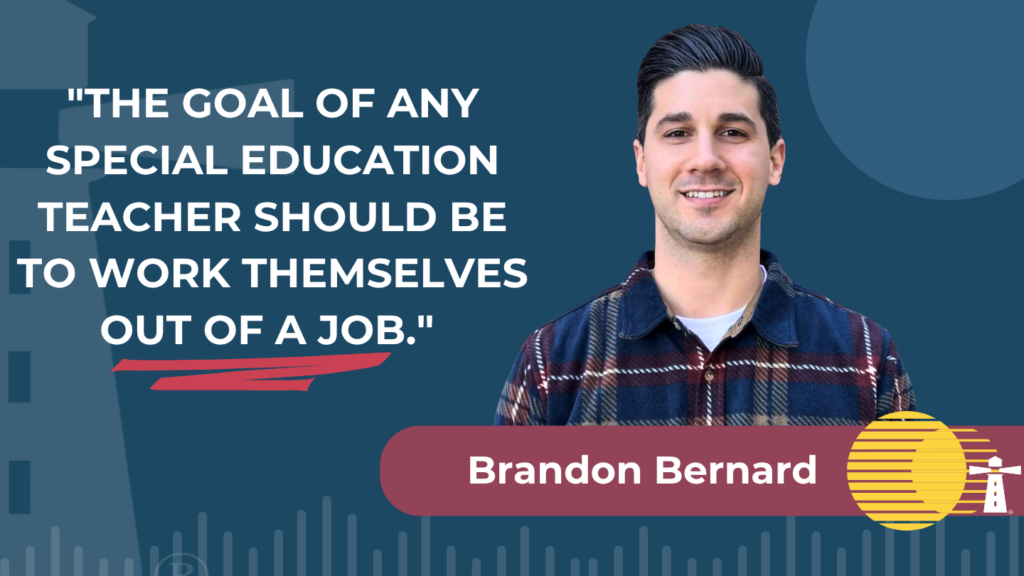
- “The goal of any special education teacher should be to work themselves out of a job.” [00:13:23]
- “Developing your toolbox, right? And so when you come across some of these different situations, you might have one kid that has some very, very unique needs.” [00:10:42]
- “All kids are gen ed students first.” [00:22:00]
- “We don’t lead from the back, right? We try to be in the classroom with the teachers, whether it be the general education teacher or the special education teacher, to really provide that support.” [00:06:49]
Full Podcast Transcript
Brighter Together [00:00:01]
Hello everyone and welcome to the Brighter Together podcast. My name is Janet Courtney, and my special guest today is Brandon Bernard. Brandon is the Director of Special Education at Heritage Academy, and Heritage Academy is in Mesa, Arizona. Brandon, thank you for coming on and welcome to the show.
Brandon [00:00:20]
Thanks for having me here today.
Brighter Together [00:00:22]
So Brandon, tell us a little bit about how you became the director of special education, kind of your journey, and then tell us a little bit about Heritage Academy.
Brandon [00:00:32]
Yeah, of course. So originally I’m from Buffalo, New York. So I did all of my early schooling out there. initially got my degree in social studies education, made my way up to Arizona, so I traded the the snow for the sun, but then was just teaching resources out here for a little bit. made a a couple of changes to different schools, became a department chair at one of the schools that I was working at. from there I transitioned to an instructional coach and this opportunity opened up and
Brighter Together [00:00:45]
Uh-huh.
Brandon [00:01:00]
didn’t feel like I was ready for it, but you know, took the leap of faith and and applied and and got the the position. So you know, we’re we’re really just trying to focus on really improving and helping just all kids with special needs and and really supporting them throughout their whole their their whole education. But Heritage Academy, we’re a a charter school, K twelve network out here in Arizona. So we have seven campuses all across what’s called the the Greater Phoenix Valley. So headquartered out in Mesa, but we have
Two additional campuses in Queen Creek, two in Maricopa, which one of which we’re opening up this year, so we’re excited about that. And then we have one out in Glendale and Levine as well. So just some surrounding areas of of Greater Phoenix.
Brighter Together [00:01:38]
Nice.
Brighter Together [00:01:45]
Awesome. So you said kindergarten through twelfth grade, right? And then how about how many students do you guys have enrolled right now?
Brandon [00:01:48]
Yeah. Yep.
Brandon [00:01:54]
Ooh, I mean it’s we’re going through that enrollment period right now over the summer. So I think we’re floating around somewhere about four to five thousand kids overall. And I checked on our our special education numbers and we’re upwards of of four hundred today with that new school opening. I think we’re over four hundred now and then we have approximately between two and three hundred for our our five four students as well.
Brighter Together [00:02:15]
Wow, wow, you’re busy. You are definitely busy. Wow, that’s amazing. So so how long has a heritage academy been a charter school? Has it been open, I guess?
Brandon [00:02:16]
Yeah.
Brandon [00:02:25]
So that yeah, so they’re actually one of the first the first few charters to be issued out in the state of Arizona. So our flagship campus out in Mesa opened about thirty years ago. We’re celebrating our thirtieth year this year, which is nice ’cause it’s in conjunction with the two hundred fiftieth anniversary of of America. So that works out really well. And then most of our other campuses have been founded within the last ten years. So we’re still growing right now. but you know, we’re we’re really starting to increase our footprint across the valley.
Brighter Together [00:02:43]
Yeah no.
Brighter Together [00:02:55]
Congratulations. That’s exciting. That’s amazing. Thirty years. That’s longer than my oldest child, which is pretty cool. I feel old. She’s twenty eight now and it’s like, gosh, where did twenty eight years go? But boy, when you when you look at that. Did it start out K twelve or did it like did you go from did they start like kindergarten and grow up? Some type of some of grow backwards. It just kinda depends.
Brandon [00:03:00]
Yeah.
Brandon [00:03:17]
Yeah, so our our founder actually started it out in Mesa campus as a seven through twelfth grade school. So it’s still a seven through twelve right now, but purchased an old church, renovated it and you know, real real just off the ground you know, story with our entire network.
Brighter Together [00:03:34]
Yeah. And you guys do some really amazing programs. Tell us a little bit about you know, the what what makes Heritage Academy unique?
Brandon [00:03:43]
Yeah, so we have a couple of things. So first and foremost with our academics, we really try to prioritize dual enrollment. so earning those college degrees as you’re going through your high school classes. So I I wanna say it was something like fourteen million dollars was saved in terms of tuition. you know, most of our kids graduate with at least an associate’s degree. We have some kids graduating with two. I think we had
Brighter Together [00:04:07]
Wow.
Brandon [00:04:09]
a handful of of students across all of our campuses that ended up with free associates degrees. So we have a really big focus on our dual enrollment, which is is huge for our our kids. but one of the other things for us is we really try to focus in on classical education, really try to focus in on, you know, American values and American exceptionalism as well too. So a lot of our curriculum is is is weaved through that lens. So you know we we try to teach the founding fathers and and
try to help our scholars, which is what we refer to as our students. So we try to teach our scholars just the things that the founders envisioned and how a lot of the the problems, whether it be you know forty years ago or forty years in the future, you know, they created a really strong document that’s going to, you know, help us navigate and solve these complex issues that we face every day.
Brighter Together [00:04:43]
Mm-hmm.
Brighter Together [00:04:59]
Mm-hmm. Mm-hmm. Yeah. Yeah. That’s awesome. there’s a lot of faith in those documents as well. I’m a Christian. I don’t I don’t I don’t I don’t shy away from it. So it’s very exciting to hear that because there’s just these men that found it. And I love that we’re talking about it. We’re just today is for those of you that are listening, this probably will be published after July fourth, but it’s today it’s June eighteenth, twenty twenty six. So
We are just on the cusp of the 250th anniversary of our of our nation’s birth. And I’m old enough that I remember I was young. that s 1976, I remember the two hundredth and and what a big deal that was back then. Now I was a child. Thank goodness I can say I was a child. I wasn’t a grown up in seventy-six, but I was at eight.
old enough to remember and to be excited about the fact that we were celebrating two hundred years and here we are fifty years later and it’s two hundred and fifty and it’s a big deal. Countries yeah, countries don’t live, don’t survive as long. And I think that that’s something that that is just a testament to the to the United States and who we are and you know, our our resilience and and our acceptance and anyway. so that’s exciting. Yeah.
Brandon [00:06:00]
Yeah, it’s really special.
Brandon [00:06:18]
Yeah. For sure I agree.
Brighter Together [00:06:21]
Yeah. So so but you’re the director of special education. So how with the excellence, the academic excellence, how do you in ingrain that into or meld those two things together? Because there’s it’s hard for special education kids, and I’m not saying that they can’t, please don’t hear that from me, but that that to that’s a fast pace. So how do you how do you guys manage that?
Brandon [00:06:49]
Yeah, no, it’s definitely complex. And I think that’s one of the things that, you know, you find in an e any any educational system is that right, you have these very complex issues and they’re difficult to solve, they’re difficult to navigate, but you try to, you know, figure out what’s gonna work best and what what what might work here doesn’t necessarily work everywhere else. But I think for us, right, all of our dual enrollment classes are actually our on level general education classes. So
We ha we have to really focus for us on building those systems and building those systems of support wherever they may be. So for us specifically, it’s really trying to integrate our services, really that kind of interdisciplinary studies, right? So I know when I was going in school, you know, we’d be reading a book in
language arts class, but it’s also history related and we’re trying to incorporate in that our history studies and things like that. So we really try to take that approach in our special education programming and try to really bring supports together. There’s a lot of different things that we need to do from a larger admin level down to the campus level. So there’s a lot of communication that’s going on constantly. There’s a lot of training, a lot of support. You know, one of the things that you know we always take pride in is we
We don’t lead from the back, right? We we try to take anything that comes up in these these situations that are are difficult or complex. we try to be, you know, in the classroom with the teachers, whether it be the general education teacher or the special education teacher, to really provide that support because I know for me and a lot of my colleagues at our administrative level.
We’re not going to ask teachers to do something that we don’t feel comfortable ourselves, or if we don’t feel comfortable ourselves doing it, right? We’re going to be there alongside of them and not expect them to have to do something that we’re unwilling to do ourselves. But yeah, it’s a lot of a lot of system developing and really just trying to find out where you know there’s crossover between ADA and IDEA, right? There’s crossover between
Brandon [00:08:54]
high school and post secondary, whatever that may look like. And I think that’s really the the beauty of, you know, special education is we’re having to be aware of all those things at all ti at all times, right? I know for transition planning and things like that, we’re constantly having to take those things into consideration, whether it be for future education, whether it be for workplace, whether it be for you know wanting to enlist in the military, we’re having to think about
these particular individual issues that a child might may struggle with, but how we’re gonna help them, you know, navigate them, cope with them, find resources outside of the school setting. So there’s a lot that goes into it for sure.
Brighter Together [00:09:35]
for sure. Yeah. so do they do you do a track that is specific for graduation versus maybe a certificate? How you how are you guys handling that?
Brandon [00:09:47]
Yeah, so in Arizona, we don’t have a certificate of completion. it’s just a a degree program. But you know, that’s one of the other challenges we do face. Arizona requires twenty-two credits for graduation. We require twenty-six. So again, we’re putting that little little extra bit on for that rigor. so we’re having to really kind of navigate some some complex issues, right? You know, we we have situations where you know.
Brighter Together [00:09:51]
Okay.
Brighter Together [00:10:05]
Right.
Brandon [00:10:14]
Kids may have a math disability and they’re gonna struggle in that college level class. so it’s not just about you know the instruction that takes place, whether it be in gen general education or in special education. you know, we offer tutoring every day after school for pretty much all subjects, but it’s trying to develop the things that kids need because one of my philosophies is really developing your toolbox, right? And so when you come across
Brighter Together [00:10:19]
Mm-hmm.
Brandon [00:10:42]
some of these different situations, you might have one kid that has some very, very unique needs. And you might not see those needs again for, you know, twenty, thirty years. But as an educator, we got to develop those tools because we can’t just say, hey, I know this child is really going to struggle. So we’re going to help them get along. But if they don’t make progress, you know, we’re we’re going to be okay with that. And that’s not at all what we want to do or whatever expect for a teacher to, you know, have that mindset. So it’s
Brighter Together [00:10:48]
Mm-hmm.
Brandon [00:11:11]
you know, what other tools and what other resources do we need do we need in terms of training, in terms of curriculum, in terms of adult support. and it’s also about that that home school relationship as well too. So we really try to be in contact with our parents, keep them up to date. And of course when we think see things coming up, you know, we’re we’re trying to be as proactive as we can to really address some of the issues. But at the end of the day it’s it’s really just trying to figure out what support you know we can provide.
to make sure that that that scholar is as successful as they could possibly be.
Brighter Together [00:11:45]
Mm, I love that. I love that. Because you’re really, you know, I IDEA and and IEPs is individual, right? We’re always looking at the individual. And that sounds like you guys have taken that up a notch to let’s make sure that all of our kids are moving in a direction that’s positive for them and helpful for them. And I love that. I love that. So
so do you do some so take us through like a little bit of like the some of the programs maybe that you have at the Littles and then maybe something how you do some of it in the higher higher grade levels. Just special education or like do you do you have specific like how do you identify? Well that’s a that’s a great place to start. Like how you how are you identifying kids that have
Brandon [00:12:22]
In terms of like curriculum.
Brighter Together [00:12:33]
disabilities or special needs. I’m sure some of them are coming to you with an IEP, but you know, if you have kindergartners, where is that where does it begin for for you guys?
Brandon [00:12:43]
Yeah, so obviously with with any enrollment, it starts with our our child find process. So you know, we have our our forty-five day screeners where we’re looking for any you know concerns that we’re trying to identify and and get a jump on it. So especially like with kindergartners, right? You don’t want to delay that potential need to provide support for disabilities. But ongoing, we also have something called our scholar study team. So in terms of
of systems like we were we were talking about a little bit. That’s one of those systems that we’re we’re constantly trying to revamp and and really make sure it’s attuned to not only our needs as teachers, as staff, as administrators, but also it’s meeting the needs of our our scholars, right? I know one of the things that I I heard very early on when I started teaching was, you know, the goal of any special education teacher should be to work themselves out of a job. because if if we’re doing that, we’re
you know, we’re teaching kids, we’re closing that skill deficit. We’re teaching kids how to cope and accommodate for their disabilities, and we’re also teaching them how to self-advocate. So you know, with that mindset, that’s also very much the mindset of our scholars our scholar study team is we’re trying to identify any concerns early on, whether they be, you know, just general concerns or there actually are, you know, potential special education needs, but trying to provide interventions and supports early on, but also getting teachers to recognize
you know, just because a kid is I is identified for scholar study team, or just because you know your classroom is struggling a little bit doesn’t mean that they’re necessarily going to qualify for special education services. But at the same time, you know, we could go through a whole process, and at the end of that process, as you know, for the the evaluation process, they still might not qualify. So that scholar study that scholar study team for us is really about
Brighter Together [00:14:32]
Right.
Brandon [00:14:36]
identifying some of the the different strategies or interventions or instructional approaches that a a student might benefit from and and applying them to the classroom. So again, how I was mentioning earlier, right, we’re we’re wanting to provide that support and add to your toolbox because one year you might have you know 10 10 scholars that enter in with you know they’re two grade levels behind in reading. but there’s nothing in their evaluation that indicates
a disability, the teachers don’t have a suspicion of disability, yet we’re still dealing with kids who are two grade levels behind in reading. So we gotta figure out different ways to, you know, close that gap. and that same mindset has also applied for our special education scholars as well.
Brighter Together [00:15:12]
Right.
Brighter Together [00:15:20]
Wow, wow, I love that. So, so you guys are doing are you d also doing like career and technical education? Like if they’re not going to go on to college, I someone said to me, We don’t want to graduate them to the couch. And I was like, Yeah, that’s such a great comment because it’s like where what kinds of things, what kind of programs are you guys working on at that level, at the high school level to get them
outside of the couch, right? I get them, what’s next after high school?
Brandon [00:15:54]
Yeah. And so for a lot of our kids, we we definitely serve that that niche of you know college bound bound scholars. And so even with with our own special education cohort, we do have probably I would say a higher instance of like that twice exce exceptionality where you know they they have a disability in one area, but they might be gifted in another, right? and so you know, we’re trying to navigate some of those issues. we’re definitely starting to develop a little bit more of career oriented
Brighter Together [00:16:00]
Yeah. Mm-hmm.
Brandon [00:16:24]
meet classes and things like that. But we definitely do have a a much more bigger focus on that college readiness and that college preparedness, which again is why it’s so critical for for me as a special education director in our department to really figure out how we build those systems and supports around. Because even one of the things that we kind of notice as we’re navigating dual enrollment currently, where we’re seeing, you know, the college requirements kind of buttheads with our our secondary requirements.
You know, the the colleges still expect the scholars, even if they’re in eleventh grade, to you know, advocate for themselves, speak about their accommodations and and things like that. So it’s trying to really help kids you know, navigate that in a a more scaffolded or structured setting. So as we go through the years, they’re able to self advocate better, they attend their IEP meetings, and then by the time they go, yeah, and by the time they go to college, whether it be online,
Brighter Together [00:17:17]
Mm nice.
Brandon [00:17:22]
in person wherever, you know, they know, hey, the first thing I need to do is find out where the Office of Disability Services is so I can submit my my evaluation or my IAP or my five four and and work to get some accommodation so that way the success I had here at Heritage can carry over into the that college.
Brighter Together [00:17:39]
Right.
Yeah. Cause sometimes it’s not it’s not cognitive ability, it’s it’s something else, right? It’s just you know, just difficulty attending or focusing or whatever or you take your pick. but it’s so so do some of your kids in special education, do you have some that graduate with an associate’s degree then? Wow.
Brandon [00:18:04]
Yeah. Yeah, quite a few. Yeah, mo most of our graduates do. obviously like I was mentioning earlier too, our our dual enrollment classes are our on level classes. but you know, we do understand we do have some scholars who either aren’t gonna be college bound or you know they have modifications or certain accommodations in their IEP that conflict with the the dual enrollment course that changes it too much. so it’s not it
Brighter Together [00:18:33]
Mm, okay.
Brandon [00:18:34]
it’s you know, the the things they need in high school alter the curriculum so much where they can’t earn that college credit, which is fine. But we, you know, we work through that and they’re still taking those same courses. So what I think is really great about especially our model is, you know, if you’re if we know you’re gonna struggle in math because you have a math disability, but you’re you know, you’re supposed to be taking calculus, we’re still gonna provide that support in order to help scaffold you to get to that next level once you do go to college or you go go on to your career, what have you. But
you know, you can take that course still for high school credit. You’re still with your same age peers, you’re still, you know, it’s it’s a really good embodiment of of inclusion for sure.
Brighter Together [00:19:18]
Inclusion, yeah. Yeah, I was just gonna say. So do are are all of your classes inclusive classes or do you have any that are specifically just special education? this is a special education class or whatever.
Brandon [00:19:30]
Yeah, no, that’s a really good question. So we do have special education. we call them resource classes here for for math, English. And then we have just a the standalone support class for for that resource level. So a lot of our kids who do require special education services are in that standalone resource class for their direct support. in terms of, you know, if they like 20 minutes a week for reading comprehension, they don’t need to be in a special education class for you know.
Brighter Together [00:19:36]
Mm-hmm.
Brandon [00:19:59]
three hours a week to get that 20 minutes. and you know, and their their abilities are on level with their peers. It’s just that reading deficit or or things like that. So we’re really trying to work now as we build our systems out to to be more inclusive, have co-teaching, because again, one of the things I I took from a different experience was you know, special education is a service, not a place. So we’re really trying to work on on on bringing those services to kids and where they’re at because
Brighter Together [00:20:02]
Right. Mm-hmm.
Brighter Together [00:20:22]
Mm hmm. Very good.
Brandon [00:20:28]
You know, we we know especially too if we’re pulling kids out of class or we’re we’re scheduling them for a standalone resource class, you know, we’re just only increasing that gap because, you know, the the content isn’t as rich or in depth. And you know, I I always tell my teachers this too, like I I’m not a math teacher, so I can teach math, but you know, some of the nuances or the things that make it click for kids in their head.
I probably I’m probably not gonna be able to speak to. So we really wanna keep kids with those content area experts because they have all those different strategies and and you know, instructional tools to really help make things click for for our scholars.
Brighter Together [00:21:02]
Okay.
Brighter Together [00:21:07]
Nice. I love that so much. That is fantastic. And I love the fact that you have kids that graduate with an associate’s degree. I I that’s that’s so impressive. I love that. I love that for the kids. I love that for the parents. And and what a boost for children. And you know, you said it’s not a it’s not it’s also not an identity, you know, like your your label doesn’t label you as that thing. That’s just what you struggle with, and and that’s what we’re gonna help you with.
But there’s a human being that is that has desires and wants and needs and and it’s so important for Jen Ed people and others to understand. I think as I think as special education people, a teachers in general, I think they get that. But when when you really embrace that this is just a part of who I am, it’s not, it doesn’t define me, right?
Brandon [00:22:00]
Yeah, no, for sure. I that was another saying that I heard all the time too is, you know, all kids are gen ed students first. So you know, ignore the disability, ignore the labels, ignore the supports. How do you how do you support kids? Because you know, that’s one thing we we really do firmly believe in is that, you know, you you can put in the work and the effort, you know, pull yourself up by your bootstraps, you you can accomplish things despite your dis you know, your disabilities, your challenges. You’re gonna have different challenges, everyone does. And it’s you know, it’s not necessarily about
Brighter Together [00:22:23]
Mm-hmm.
Brandon [00:22:29]
identifying what your challenge is, but really it’s about identifying how do I overcome my challenge.
Brighter Together [00:22:33]
Yeah, yeah. I’ll tell you, I am not I am not a person that is I don’t learn from reading. I never have been. I love to read. I’m I’m I’m an avid reader, but I don’t I can’t sit down with a manual. You know, like don’t give me a man hand me a manual and expect me to learn how my car works. No, I’m not gonna do that. I’ll hand it to my husband and have him tell me. I’m an experiential and an auditorian and and a visual learner. I’m I’ve never been a give me the instruction. Tell me, tell me the instruction and I’ll I’ll do it. Or
Brandon [00:22:49]
No.
Brighter Together [00:23:03]
Show me how to do it and I’ll do it. But don’t, don’t, I swear, I I went to grad school and I’d buy the books and the only time I cracked those books was when I had to look something up. Tell me to read a chapter. No, no, tell me about the chapter. Let me, you know, tell me what it’s about. Lecture on the chapter for me. I’m not gonna if I had a teacher that just wanted us to go in and read, I was, I was, I was dependent on my class,
colleagues to help me to get through those classes because that was not how I learned. I don’t and I never I’m forty, fifty eight years old now and I’d like to say I’m forty eight, but I’m not. I’m fifty eight years old and I I just don’t learn that way and I never will. So yeah, I love that you can identify that. Sorry. Go ahead.
Brandon [00:23:43]
Yeah. Yeah and I
Yeah, no, and I think that’s the one thing too. I always try to, you know, especially being in a leadership role, I try to you know, relate to our staff, our teachers, our kids. And so, you know, I’ll I’ll always say like, I never took chemistry. I know if I if you drop me in a chemistry classroom, I’m going to struggle. reading is is difficult for me as well too. I’ve learned different strategies and and you know, just tricks and shortcuts to, like you said, find the information, access the information.
Brighter Together [00:24:13]
Mm-hmm.
Brandon [00:24:13]
but yeah, if you stuck a five hundred page novel in my face, I’m gonna struggle. Not because I I you know I not because I struggle with reading, but I have, you know, endurance issues with reading and and things like that. So, you know, we like we all have issues, so
Brighter Together [00:24:25]
Yeah, we all have. Yeah. Yeah. We all have our our our ways. And I love that I love that that’s where education is going, because it’s critical and it doesn’t slap a label on you and identify you and put you in that box. And and that’s fantastic. So so one thing one one thing I want to ask you about just personally between us is Lighthouse is my company, as you know, and we started working with you guys this year. So
Tell us a little bit, if you can, just what how Lighthouse became something that could help? You know, and I know we’re doing we’re doing special education for you guys with a deaf and hard of hearing teacher. We call them DHH teachers here, as you guys do as well. but how how have we as a company helped? How did we how did we help you guys?
Brandon [00:25:17]
Yeah. No, it’s a great question. So kind of just touching back a little bit on our story, right? If you know, even though our our flagship campus has been open for for thirty years, we’re still in that growing phase and and building out. So you know, as you build out, new students enroll. and then as you hear about new students enrolling, other scholars wanna come. So we’re growing a lot. And I think that’s one of the things that again, as we’re building our systems, you know, we’re we’re having scholars enroll that
you know, have different needs that we weren’t used to or prepared for, right? so, you know, in a perfect world, I would love to have a a position, you know, every single possible position under the sun staffed and when you need it, right there and you just pull them. But obviously that’s not the reality funding, all that, all that jazz. But so what ended up happening is you know, as I I took on this role, we had a need a growing need for for deaf, hardy hearing. So
Brighter Together [00:25:52]
Mm-hmm.
Brighter Together [00:25:58]
Right.
Right.
Brandon [00:26:15]
we were supporting that through a different provider and we were just looking at, you know, how do we you know maximize the support and look for, you know, different opportunities to to really capture that that necessary support because that’s one of those challenges too is you know we have to have a a specialized person in that role able to provide that service and that instruction. So you know, as we were looking around, there just wasn’t
Brighter Together [00:26:34]
Right.
Brandon [00:26:42]
you know, options that were gonna work for us out in this area, just based on our needs. We we don’t have a a big need, but it’s still a need. And and being a public charter school, we still have to address that need. So you know, in just doing a a search, I or a phone call came across my desk and it was, you know, that that message that I was looking for because I was r really, really struggling trying to find a a provider. And you know, what I love about Lighthouse is just that flexibility. So for us
the the DHH services were virtual. and that was super helpful just because for you know our campuses are very spread out. So not only do we not have a high instance of need, we also have a lot of geographic barriers that that make it difficult for us. So you know at our farthest point some of our campuses are are close to an hour and a half apart. So to to have one person provide all that support, you know, you’d be driving more than you’re actually teaching. So so
Brighter Together [00:27:13]
Mm-hmm.
Brighter Together [00:27:37]
Right, right.
Brandon [00:27:39]
That wasn’t something that was going to work for us. But yeah, so in partnering with Lighthouse, it was great because we have that DHH support. You know, it’s it’s just constant. It’s there. We have the the tools that allow our our scholars to access it. And what is is really helpful too is you know, we have that that ongoing communication, that ongoing support. the the provider that you guys assigned to us was was great in terms of collaborating with teachers, collaborating with me.
working with the students. and so it was just a really great experience for us.
Brighter Together [00:28:05]
Love
Brighter Together [00:28:10]
Awesome. One of the things about us that that I truly love is we’re never afraid to step into a new service. you know, I’m a speech pathologist. I’ve our our mission is to be a therapy company run by therapists for therapists for the betterment of students, and that has expanded into special education teachers. And so when we decided we’re gonna do this, we always want to do it well. We never want to just
provide it. You know, it’s like it’s not just another another checkbox. we do this now. we do this now. we do this now. If we’re gonna do it, we want to do it with expertise and and knowledge because I’m not a DHH teacher. I’m not so making sure that we have really strong providers, but we also don’t limit our schools. One of one of the other beautiful things I love about us is we don’t have an investors. We’re a family
Brandon [00:28:38]
Mm-hmm.
Brandon [00:28:49]
No, yeah.
Brighter Together [00:29:03]
run and faith is our center core value. So we do everything from the lens of how can we serve? How can we serve our schools? How can we make sure that our schools are getting exactly what you need, right? So we don’t have any minimums. We don’t have, you know, you don’t have to give us 10 kids. You don’t have to spend $25,000. You can come to us and say, hey, I need this one thing or I need this one assessment and we will provide it. And I love the fact that we we found you and you found us.
And we now have a partnership that gives your children as long as you need us an opportunity. There’ll there’ll come a time when you don’t need us for that, but maybe something else, who knows? And and I love that we have that partnership because it really makes a difference. And now you got some your children, your students, your scholars got the services that they needed and we were able to provide those and it just it’s it’s a beautiful thing. Yeah.
Brandon [00:29:56]
Yeah. Yeah, and j and just even speaking to that, I mean that was exactly our issue is just we had such a few number of kids in minutes, so we had other providers that were unwilling to do it. But I think that’s also the great thing that you just talked about there. It’s not just about checking the box that, hey, we did provide it. You know, that that’s also something that I’m also, you know, looking for in in this relationship too is right, you know, having someone who’s willing to communicate with another teacher or
you know, go outside of of kind of the the bare minimum of expectations, right? Like their their expectation is to provide those services, whether it be 30 minutes a month, an hour a month, or what have you. But you know, like you said, you you do try to provide those that staff who is who’s willing to help and and go above and beyond and not just, you know, check the box off, hey, I did my assignment this month and move on. So I I I’m very appreciative of that. Cause that’s probably one of the and one of the more harder things on my end is is dealing with the the financial side of
Of education. So
Brighter Together [00:30:54]
Mm-hmm. Yeah, and it’s a struggle. I I I we know that too. We know that too. We have and we’re and we’re we’re for profit. We’re not a nonprofit. So we have margins and all of those things. But you know, at the end of the day, if we have and and and this goes back to my faith, at the end of the day, it’s a human being that we’re serving. So if we are doing it well, honest honest to goodness, God blesses us. Because if you take care of humans and you do it right and you love on them and make sure
I always tell people the rest of it comes. It really does come. And and it’s just been we’re well, by the time this June seven, ten, eighteen was when Lighthouse was established. So we are just after our birthday, you know, six days after our two hundred and fiftieth, we’re gonna turn eight. And it’s just an exciting time to be to be eight years in. And and you know, people say, you know, first year is this many businesses fail, and then there’s three years, and then there’s five years, and then there’s seven years, and I’m like, Whoop.
Brandon [00:31:37]
my gosh.
Brighter Together [00:31:54]
Well, well, we beat all of those. It’s exciting. Yeah. So sure.
Brandon [00:31:55]
Yeah. Yeah. No, it’s awesome. Yeah, and and just to touch on the one thing that you were saying there with, you know, you you love these kids and you you put the the good out in the world and you get good back. I mean, that’s one of the things our director of education always talks about too is when you’re, you know, teaching these scholars, love like your own because, you know, you are leaving an an impression and an imprint on these these young minds, and you’re, you know, you’re really trying to again going back to our mission mission and our core values and and you know, connecting it to our
the the founding values of our country and things like that. Right. We’re wanting to put, you know, good civic you know, civically responsible citizens out there. And so you know, you gotta, you know, really just pour yourself into you know, what you do and and and into the scholars and just really help them be as successful as they can because at the end of the day, right, if we can make everyone more successful, we just are better off, you know, as a society.
Brighter Together [00:32:27]
Right.
Brighter Together [00:32:47]
Mm-hmm. Yeah, absolutely. Yeah. And we are, we are training up the next generation and they need to they need to know that they are that they can and that they that they’re capable and that they’re loved and that someone cares about them. There’s so many of that, so much of that that needs to happen. Okay. So we’ve been 30 minutes in. I was like I told him, I told him, I said, 20, 25 minutes. We’re already 33 minutes in. It’s been a great conversation, Brandon.
Brandon [00:33:11]
That’s for sure.
Brighter Together [00:33:11]
Where do people go if they wanna learn a little bit more about Heritage Academy? Because I’m sure we sparked some people’s interest and I wanna make sure they can find you guys.
Brandon [00:33:20]
Yeah, let’s hope so. so if you want to find out any more information about us, you can just go to HeritageAcademy A Z dot com. you know, we’re we ha like I said, we have seven campuses across the Greater Phoenix Valley. it is summer break right now, but in just over four short weeks we’ll we’ll be starting for some of our campuses the twenty sixth, twenty seventh school years. So you know, I I know we’re like I said, we’re still looking, we’re still growing, we’re still you know, looking for enrollments. we’re opening new schools, so definitely check us out and you know
you know, we have tons of information. You can do campus tours. you know, we have a wide array of just great opportunities, so definitely check us out.
Brighter Together [00:34:00]
Well, Brandon, thank you so much. Thank you for being willing to come on and tell us about your about your experience, about your kids’ experience, about your passion. It’s it’s definitely you’re making the world a better place. And so and we’re brighter together. So so thank you so much.
Brandon [00:34:14]
Appreciate it. We are for sure. Thank you, Janet.