

Episode Description
Greene Local School District transformed student behavior and school climate by shifting from punishment to prevention through Positive Behavior Interventions and Supports (PBIS)—and Joya Mitchell, Director of Student Services, shares how they achieved over 90% student success with tier-one supports alone. Over a decade of deliberate implementation across all pre-K through 12 buildings created a unified culture where 98% of parents now reinforce the same expectations at home. Discover the administrative buy-in, data-driven strategies, and slow-rollout approach that made PBIS stick when most school initiatives fade.
Noteable Quotes
- “We’re going to use positive expectations and acknowledge kids when they’re doing the right things.” [00:00:37]
- “The biggest roadblock to overcome first is staff buy-in.” [00:19:14]
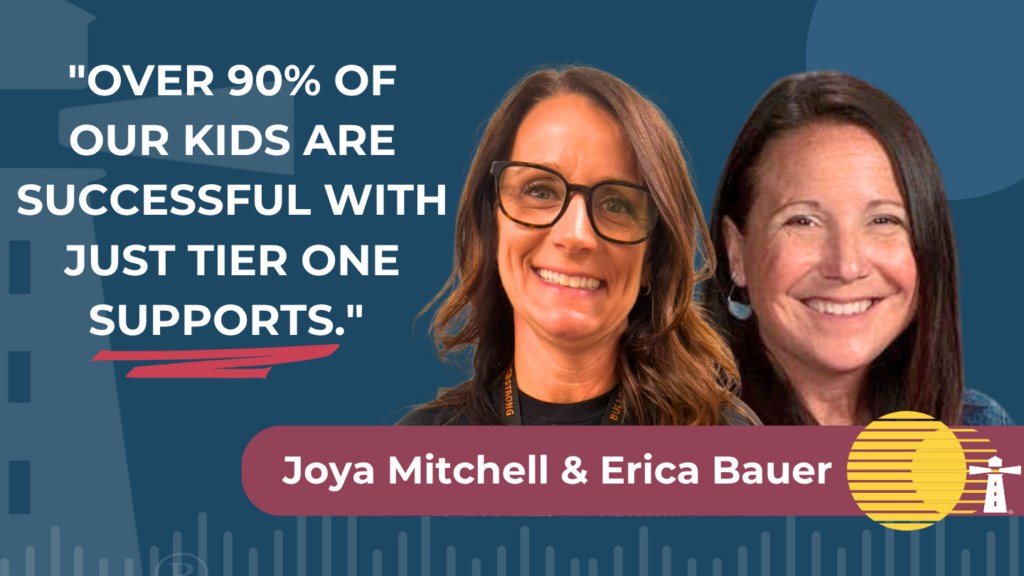
- “Over 90% of our kids are successful with just tier one supports.” [00:21:36]
- “I’ve seen a huge improvement in climate and reduction of behavior reports.” [00:22:07]
- “We spent an entire year learning about PBIS and planning before rollout.” [00:09:03]
Full Episode Transcript
Janet Courtney [00:00:01]
Hello everyone and welcome to the Brighter Together podcast. My special guests today are Joya Mitchell and Erica Bauer. Joya is the Director of Student Services and Erica is a school counselor and the PBIS administrator. And they are at Greene County School District and that’s in Union Township, Ohio. Joya and Erica, welcome to the show.
Joya Mitchell – GLSD [00:00:27]
Thank you. Thank you.
Janet Courtney [00:00:30]
So I’m gonna start with Erica. Erica, what is PBIS? So our listeners know.
Joya Mitchell – GLSD [00:00:37]
So PBIS stands for Positive Behavior Interventions and Supports. And that is a framework that we use here in Green School’s pre-K through grade 12 to help support our students. And basically that means we’re going to use positive expectations and acknowledge kids when they’re doing the right things.
Janet Courtney [00:01:00]
Awesome, awesome. Okay, so tell us a little bit, Joya, about how you became a director of student services, a little bit about your background, and then, Joya, the same, and then tell us a little bit about Green Local School District.
Joya Mitchell – GLSD [00:01:15]
Okay, so I started as an intervention specialist.
At Cuyahoga Falls High School, was in a multi, at that time called multiple disabilities classroom for grades nine through 12. I spent a few years there at Cuyahoga Falls High School and then I transitioned over to Hudson Middle School. And I was in Hudson Middle School that was a six, seven, eight building special education, range of students and abilities and disabilities. And I was there for
I think I was there for 14 years prior to coming over to Green Local. When I came over to Green, I was the assistant principal at the high school for four years, which I loved. I loved interacting with the kids. at that point, at that time, I was doing the PBIS work at the high school with one of our counselors there. And then I was still doing a ton of special ed work at the high school. So we had some shifting here at the
Janet Courtney [00:01:54]
Wow.
Joya Mitchell – GLSD [00:02:20]
central office and the director of student services at that time was being promoted to the assistant superintendent and she called me and just knew my extensive background in special education and my work at the high school. We had worked closely together at the high school and she asked if I would actually ask but told me that I she really
Janet Courtney [00:02:49]
Hahaha!
Joya Mitchell – GLSD [00:02:50]
The central office as the new director of student services so gladly accepted and have been here ever since so. gosh, so I have four. I think this is my eighth year, seventh year, seventh year in this role. Yeah, yeah, so yeah, it’s.
Janet Courtney [00:02:58]
And how long have you been in that role then?
Janet Courtney [00:03:09]
Awesome, fantastic.
Joya Mitchell – GLSD [00:03:11]
Yeah, so it’s been great. Our district is we have four we have four buildings. are like Erica said, we are pre K through 12. We just built the building so we have two beautiful new buildings. Our primary school is pre K KM1. Our new elementary is grades two through five. Our middle school is 6, 7, 8 and then our high school is obviously 9 through 12.
Janet Courtney [00:03:22]
Mm-hmm.
Janet Courtney [00:03:40]
Night 12, yeah, awesome.
Joya Mitchell – GLSD [00:03:41]
We’re around, I think we’re around close to 4,000 students.
Janet Courtney [00:03:47]
Erica, how about you? Tell us a little bit about your background.
Joya Mitchell – GLSD [00:03:50]
So I was a second grade teacher for three years at the beginning of my career and I loved being a teacher. I have been a school counselor for about 20 years and I have worked primarily in the younger grade level. So right now I’m in the pre-k, K1 building. I’ve worked up to fourth grade in my school counseling experience. With the PBIS, I’ve been able to work across the
Janet Courtney [00:04:04]
I am.
Joya Mitchell – GLSD [00:04:20]
entire district and it’s been really cool to just see how similar and different those age levels can be. So it’s been a really wonderful experience.
Janet Courtney [00:04:31]
Awesome. So how do you guys collaborate? mean, we’re here together. So I want to understand the reason that we wanted to interview you both together, because it’s really important to discuss that. And then let’s dive in a little bit.
Joya Mitchell – GLSD [00:04:48]
Sure, I’ll start. And Eric and I do a really good job of kind of going back and forth. So when I was approached with doing this podcast, I met with, sorry, don’t, yes. So were, know.
kind of talking about all the same things, you know, we initially started talking about, but then it, we started talking about a lot of the work that we’re doing in this district right now, which is surrounded by PBIS, our positive behavior interventions and supports, our MTSS model, our students who, you know, our, our mental health, crisis that we have going on with our students who are just needing so much support in that area. So we talked a lot about that and Erica and I,
only work together and have for the last, gosh, I don’t even know, forever I feel like. But we’re also, and we really work well together.
Janet Courtney [00:05:41]
Ha ha.
Joya Mitchell – GLSD [00:05:45]
the PBIS work that we are doing. just both so really, so very proud of, we’ve, we’ve done podcasts about what we’re doing for PBIS. We’ve gone to the national conference and presented at the national PBIS conference. we here in our district, mean, like Erica’s known as our like PBIS guru and queen. So we just like, we work so well together. I just felt it was really important for her and I to do this together. because really around like,
Janet Courtney [00:05:59]
Love it.
Janet Courtney [00:06:08]
haha
Joya Mitchell – GLSD [00:06:15]
what’s going on in our district is because of the work that we’re doing in all of those areas.
Janet Courtney [00:06:22]
And it’s so important. I don’t mean to cut Erica off, but you know, you guys talk about what you’re what’s going on in your district. It’s not just your district. It’s across the United States. So it’s really important to get as many people to hear. How are you managing it? What are you doing? Positive behaviors. What? How are you? How are you getting there? And how can I as?
Joya Mitchell – GLSD [00:06:30]
My. Yeah, yeah.
Janet Courtney [00:06:45]
an administrator as a counselor somewhere else or somebody that or a special ed teacher or a teacher that’s just dealing with these behaviors all the time, how can we make it better? What can we do? So, Erica, please go ahead.
Joya Mitchell – GLSD [00:06:58]
So I would say it kind of all started for Joya and I with the PBIS road. My building, which is an early learning center, was a demonstration site for the state of Ohio in PBIS, which meant we were able to get grant funding and a lot of coaching from our local state support team on PBIS and how to implement with Fidelity. And we had a lot of success with that. We had a ton of support, again, from the state.
Janet Courtney [00:07:11]
okay.
Joya Mitchell – GLSD [00:07:28]
and I had a lot of administrative support from my principal. We were doing good things at our building and we really saw a good reduction in behavior. so, know, then Joya and I started talking about why aren’t we doing this across the district? This is easily translated and scaled up to all of our buildings in the district level. So for me, the reason this is such a huge success is the administrative support we’ve had. So Joya fully supported and saw the importance of
Janet Courtney [00:07:44]
Mm.
Joya Mitchell – GLSD [00:07:58]
addressing behavior, addressing climate, addressing mental health, and really poured into the opportunities for our staff to learn more about it and for us to build teams at each building and really build our capacity to support the framework.
Janet Courtney [00:08:18]
So you started out, how long ago was that?
Joya Mitchell – GLSD [00:08:25]
It was probably about 10. Yeah.
Janet Courtney [00:08:26]
Was it 10 years ago? 10 years ago. So, 21, 2016 maybe, somewhere around there. Pre-pandemic. Pre-pandemic, okay.
Joya Mitchell – GLSD [00:08:35]
Yes. And we started super slow in our building.
We spent an entire year learning about PBIS and planning before we ever rolled anything out to our staff. And then I tried to take what I learned and what I was coached in and create that same model for our buildings. So we took it slow. We made sure that we were doing things with fidelity. We used data sources like the tiered fidelity inventory to drive our work. And we really tried to make it
strategic and and carefully planned. One thing that touched on too was how important that was that slow rollout. In our other buildings we were doing PBIS the same time they were but we didn’t we weren’t doing it to the extent they were in terms of doing it the right way and with fidelity. all had different we all had different expectations we all had different
Janet Courtney [00:09:14]
Mmhmm.
Joya Mitchell – GLSD [00:09:39]
rules and we just we were not streamlined at all. So when I came on board in this role, that was one thing that was really important to Erica and I is that we really streamlined this across the board. Our school expectations of being safe, being kind, being responsible are now in all of our buildings. I was going to say five buildings, but four now in all four of our buildings. And it looks obviously a little different at each building because preschooler and high schoolers aren’t doing the same thing to being safe and kind and responsible.
Janet Courtney [00:10:01]
Yeah.
Janet Courtney [00:10:06]
Yeah, right.
Joya Mitchell – GLSD [00:10:08]
But we were able to really work with our building teams to come up with those definitions for what those meant. And now our kids pre K to 12 know what the expectations are. We have families that are supportive of that and use that language at home. It’s out in our community. So that is one thing that we really, really felt strongly on that wasn’t aligned that we had to do right off the start.
Janet Courtney [00:10:31]
Nice.
Joya Mitchell – GLSD [00:10:38]
So.
Janet Courtney [00:10:41]
So this is not like MTSS where a child, multi-tiered system of support, where a child is identified and they go into a tier one situation or a tier two, depending on their needs. You are doing this across all students. that help me to understand how you’re implementing it?
Janet Courtney [00:11:05]
All right, so let me ask the question. I’ll start over again. I don’t know what you heard and what you didn’t hear, so we’ll just, we’ll cut it together, right? So my question was, you guys are implementing PBIS across all students, is that correct?
Joya Mitchell – GLSD [00:11:27]
Yes, so we you know, we do use a tiered level of support, but what we started with and what we were talking about with our district wide expectations is really our tier one level of PBIS. So yes, we want all students to access that tier one level of support and we’ve used that as leverage to build community so that by having those clear expectations and making it really simple that really in our district
Janet Courtney [00:11:42]
Okay.
Joya Mitchell – GLSD [00:11:57]
That’s what PBIS means. Now, clearly PBIS is a lot more than that, but for our families and kids, they’re like, yeah, be safe, be kind, be responsible. And that is a great foundation because we have to have those expectations explicitly out there if we want to have any success.
Janet Courtney [00:12:04]
Mm-hmm.
Janet Courtney [00:12:18]
So then how do you get how are they referred to a tier two or beyond?
Joya Mitchell – GLSD [00:12:24]
So we have a referral process in each building and we have tier two teams. So when students, we have certain thresholds, if they have so many behavior reports based on the data from that building, then they would be referred to tier three. And then we have continued thresholds and they would be referred, or tier two, and then they would be referred to tier three if they hit the next threshold. So we really try and make our decisions data driven instead of just saying, this is a problem.
We’re looking at is Tier 1 being implemented with fidelity? If it is and they’re still having trouble, then what can we do at the Tier 2 level to support them?
Janet Courtney [00:13:07]
So with your tier two students, do you see it being like more of a crisis, a short term thing that’s going on or is it more of a behavior that may turn into an IEP or a combination of both?
Joya Mitchell – GLSD [00:13:26]
I mean, I think it might be a combination of both, I don’t I don’t think it’s like the it’s not we’re not in crisis situation yet. I think we’re trying to put some extra supports in place so we’ve you know, we’re we’re really focusing on those tier one supports. We’re going to put a couple more things in place to support that kiddo to make sure we’re doing the best that we can to make sure their needs are met. And then we’re going to take some data on those things that we put into place and then if they work great. We’re going to continue on and if not, then we’re going to
Janet Courtney [00:13:36]
Okay, gotcha.
Joya Mitchell – GLSD [00:13:56]
tweak some things, maybe add another intervention before we move on to tier three. Really the goal of tier two is to prevent tier three. We don’t want students to get to that tier three level, so if we can put a few simple things in place then we’re preventing having a lot of escalated behaviors.
Janet Courtney [00:14:05]
Gotcha, so.
Right, right, exactly.
Janet Courtney [00:14:21]
okay, good, okay. All right, so, so I, Erica, I’d like to go back, because I feel like I kind of jumped the gun a little bit. So how foundationally did you guys set this up and how do you move it forward? And I’m thinking of people that are listening as well, like, I wanna do this. where does it begin? I know you said you did training and you had a grant, but how would you see that?
How would you tell somebody or what advice would you give to somebody about how you set it up?
Joya Mitchell – GLSD [00:14:54]
So I think a couple things, we definitely relied on the tiered fidelity inventory. So that is a valuation tool and action plan that can be downloaded by anyone free of charge. And that drove our team to answer questions. as Joya said, we were all kind of doing PBIS a little bit, but we weren’t utilizing the tools that they had. And we were trying the best we
Janet Courtney [00:15:03]
Okay.
Janet Courtney [00:15:23]
Mm-hmm.
Joya Mitchell – GLSD [00:15:24]
we could, but it was…
not as good as it could be. by using that tool, it really helped us answer a lot of questions. We also had a team. I think it’s so important to have a team that includes all the key roles in your building. You definitely need administrative support. You need teacher input. You need to be asking paraprofessionals for their input. You really need a well-rounded team to start and starting slow. So really taking the time in the beginning to out
any kinks that could happen with your system before you roll it out to staff. We were lucky enough that what we rolled out about 10 years ago is still in place and working well. So in education, I don’t see that happen a lot with anything sticking around for 10 years. So that’s something I’m really proud of. we’ve been able to scale it up to all our buildings, which is an awesome accomplishment too. And we also started
Janet Courtney [00:16:13]
Right.
Janet Courtney [00:16:23]
Absolutely.
Joya Mitchell – GLSD [00:16:23]
We started slow with those buildings as well. We started with creating the tier one teams at each building. We made sure that those teams were solid. The process was solid before we moved on to establishing tier two and tier three teams.
Janet Courtney [00:16:41]
Okay, okay. And then what kinds of I know you’ve you’ve you’ve kind of touched on it a little bit, but what kind of roadblocks or what kind of difficulties, you know, I you guys have been clear, you need to start slow. Why? Tell me tell me why I would need to what what am I going to run into that’s going to make it hard for me to have this program be successful.
Joya Mitchell – GLSD [00:17:05]
think the biggest roadblock to overcome first is staff buy-in. you know, anything that you implement that’s new is extra work and everybody’s very busy. So we really made it a point to not make this so challenging that nobody could do it. We needed staff buy-in from the beginning. So that’s why it was important to have those teacher voices on our teams because then they can share out with their fellow colleagues, hey,
Janet Courtney [00:17:19]
Right.
Janet Courtney [00:17:26]
Mm-hmm.
Joya Mitchell – GLSD [00:17:35]
why we’re doing what we’re doing. And so having that staff buy-in is probably the first obstacle. Once you have their buy-in, it’s much easier to get student buy-in, which would be the next obstacle in my book, and then community buy-in. you know, we really were thinking about those groups and how can we achieve that? What can we do to support our staff? know, teachers have a really hard job. They’re with kids all day and I want to
My role is to help make it a little bit easier. So what can I do for them so that they can implement this well?
Janet Courtney [00:18:14]
Okay, very good, very, very good. So you guys have been doing this for over 10 years. So what, know you and you’re doing the measurements. So what kind of success are you seeing? like, can you, do you have a comparison to what maybe is happening other places?
Joya Mitchell – GLSD [00:18:35]
I know about, I do want to say we have a lot of local districts that reach out to us all the time that want to know what we’re doing and know our process. Probably 10 districts maybe that have reached out and want to know what we’re doing, especially when it comes to our community partnerships. So we’ve had a lot of that. think that would be one.
Yeah, so our district, the state of Ohio provided recognition for PBIS and our district has historically gotten recognized at the district level and at each building level for the work that we’re doing, which means we’re implementing with fidelity at 80 % or higher. So that’s another piece of it. So in that we had to answer to.
Janet Courtney [00:19:21]
Nice.
Joya Mitchell – GLSD [00:19:27]
data points proving that what we’re doing is working. And to me, that’s the best kind of recognition to see that the work we’re putting in is giving the output that we want. So over 90 % of our kids are successful with just tier one supports in our buildings, which is huge. And when we have an effort like that, then it’s much easier to manage kids in the tier two or tier three level because it’s a much more manageable number.
Janet Courtney [00:19:48]
Yeah.
Joya Mitchell – GLSD [00:19:56]
not hard data, but just as a school counselor in a building, I’ve seen a huge improvement in climate, in reduction of behavior reports, and just the general feel of my building, it has improved greatly. The language that teachers are using is common. The kids know what we expect. There’s no confusion with that. There’s a clear system for when there is a behavior and what’s going to happen next. Parents know what’s going on and they
Janet Courtney [00:19:58]
for
Joya Mitchell – GLSD [00:20:26]
have also started to implement what we do in our schools and home. those are the things that are most important to me. We do a parent survey every year and I think 98 % of our parents last year knew the expectations. They knew our be safe, be kind, be responsible. That in itself is huge, just that they are aware of what we’re looking for in our students.
Janet Courtney [00:20:52]
Yeah. You’ve changed your culture. You’ve changed the culture of your school. You really have. That’s amazing.
Joya Mitchell – GLSD [00:20:57]
and
At the middle school and high school level that that is hard to accomplish because middle school and high school kids, you know, you’re rewarding them and good job being safe and kind and all and responsible. But sometimes they’re they’re too cool for school in high school. Right. But we have had and in some of our teachers, you know, some of them, I would say the large majority of our teachers at the middle school and high school are really buying in and doing the work. We have some that don’t. I mean, every district is going to have that.
Janet Courtney [00:21:03]
Mm-hmm.
Joya Mitchell – GLSD [00:21:27]
But our kids are also buying in and they love the rewards. They get some, I think, I believe it’s at the middle school. The kids are giving ideas like we would like to see more candy. We would like to see this in the store or whatever. So they have some input so then the buy-in is there. So most of the school can be challenging.
Janet Courtney [00:21:54]
Yeah, yeah, you want to, if I want to do this, yeah, if I’m going to do this, I want to get the good stuff, not just some trinket that I don’t care about, right? Absolutely. We all love what we do and we all work, but it’s nice to get paid. It really is nice get paid. Yeah, exactly. 100%. So where, so I know people are going to be interested. So,
Joya Mitchell – GLSD [00:22:00]
Yes. Exactly. Yes. That’d be the good stuff.
Joya Mitchell – GLSD [00:22:11]
Yes,
Janet Courtney [00:22:21]
Tell people where they can go to find out more information about Green Local and how they can reach out to you guys if they have questions, because I’m sure there will be. You’ve had 10 local. I’m sure you’re going to have some others.
Joya Mitchell – GLSD [00:22:31]
Sure, so our our website is greenlocalschools.org.
So anybody can find us there. Both of our contact information will be there. Our email addresses are just our first name, last name. So it’s MitchellJoya at GreenLocalSchools.org. Erika’s would be the same thing. BauerErika at GreenLocalSchools.org. When we were at the national conference, we obviously gave our contact information out and we have multiple people from all over reaching out about the work that we were doing.
We’re happy to we’re happy to talk to other districts and to other folks about What we have going on here, so
Janet Courtney [00:23:20]
I love it. I love that you’re willing to come on to the show to spend your time with me to explain it and to be willing to share. It’s the beauty of educators. know, none of us silo our stuff or have this like we’ve got to keep it for ourselves. Everybody wants what’s best for kids. And I think that that that embodies the name of the show, which is brighter together, right? Because we we work together.
to help these kids, to help the students. So if you have a district that is, if you’re in a district that’s struggling with these things, these ladies know what they’re doing, obviously. So thank you, thank you so much for being on the show. Thank you for your work that you’re doing and just keep it up. I’m so impressed with you guys, so thank you.
Joya Mitchell – GLSD [00:24:09]
Thank you.
Janet Courtney [00:24:12]
All right.