


Episode Description
Is your IEP process feeling like a burden—or serving as the powerful protection it was designed to be? Most educators approach IEP meetings as another box to check, another form to complete. But what if we’ve been looking at this all wrong? In this eye-opening conversation, Julian Duffey, Special Education Director at Teton County School District 401, reveals how reframing IEPs as ongoing conversations and critical protections—not paperwork—can transform your school’s approach to special education and, more importantly, the lives of students who need support.
About Our Guest
Julian Duffey serves as the Special Education Director for Teton County School District 401 in Driggs, Idaho. With deep expertise in special education policy, inclusive practices, and team-based decision making, Julian is passionate about helping educators understand that special education is fundamentally about relationship, communication, and meaningful protections for students and families.
What You’ll Learn
This episode challenges conventional thinking about IEPs and special education processes. You’ll discover how to:
- Reframe IEPs as protections and services rather than administrative paperwork
- Build truly accessible Tier 1 instruction that works for all learners
- Create collaborative team environments that honor parent partnerships
- Help students see their differences as part of what makes them unique, not as defining limitations
- Transform the IEP meeting from an intimidating bureaucratic process into a genuine conversation about student success
Key Takeaways
✓ IEPs are protections, not paperwork. When staff view IEP meetings as ongoing conversations focused on critical services and relational support, the entire process feels more meaningful and purposeful.
✓ Accessibility starts with Tier 1 instruction. Before referring students to special education, ask yourself: Is our core instruction truly accessible to English language learners, students from low socioeconomic backgrounds, and students with disabilities?
✓ Parents are critical team members. Special education intentionally shifts educational decision-making from individual parents to a team—which is why transparent communication and genuine partnership are non-negotiable.
✓ Student identity matters. There’s a crucial role for all educators in ensuring students don’t define themselves by their disability or service category. Help them understand their differences as something unique to navigate, not something that limits them.
✓ Communication is everything. The reason special education processes are “well telegraphed” is because they’re consequential. Clarity, consistency, and transparency aren’t bureaucratic overhead—they’re ethical necessities.
Notable Quotes
“What we’re really focusing on this year is a lot of tier one instruction. So there’s a big difference like, this is our tier one instruction, but is it really accessible to our English language learners, our kids from low socioeconomic backgrounds, our special ed kids?”
“I really like to think of an IEP meeting and an IEP as really just a continuing conversation… we’re providing a critical service. We’re having this ongoing conversation how to best serve the student.”
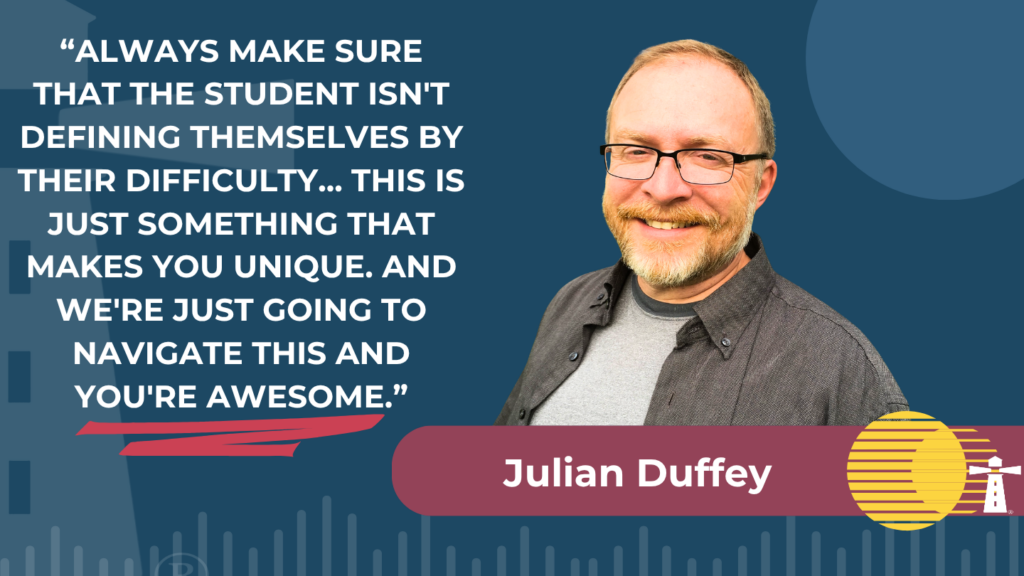
“Always make sure that the student isn’t defining themselves by their difficulty… this is just something that makes you unique. And we’re just going to navigate this and you’re awesome.”
“Special education does something rather poignant. It takes away a parent’s educational decision making to a certain extent and replaces it with a team. Do not underestimate the power of the team and working with the parent is absolutely critical.”
Ready to transform how your school approaches special education? Listen now to this conversation with Julian Duffey and discover how shifting your mindset about IEPs can create better outcomes for students and families. Subscribe to stay updated on future episodes exploring the most pressing challenges in K-12 education leadership.
FULL PODCAST Transcript
Lighthouse Therapy (00:01.455)
Hello everyone and welcome to the brighter together podcast. My name is Janet Courtney and my special guest today is Julian Duffy. Julian is the special education director at Teton County School District 401 in Driggs, Idaho. Julian, it’s great to have you on the show today.
Julian Duffey (00:20.32)
It’s great to be here. Thank you.
Lighthouse Therapy (00:22.101)
Absolutely. Tell us Julian a little bit about you and about Teton. Is it Teton or is it Teton? Teton, right? Teton. Teton. Yeah, tell them. Tell us. I had it right, but I, know, then I was questioning myself. Teton Community School District. Tell us a little bit about that too.
Julian Duffey (00:29.678)
T-Titan.
Julian Duffey (00:39.362)
Yeah, yeah. myself, I once upon a time was a naval officer, and I’m actually a disabled veteran. That’s how I got into education. Welcome. I got my master’s of top technology for a while and then moved across to Idaho. I was in Maryland at first.
Lighthouse Therapy (00:50.937)
Well, thank you for your service.
Lighthouse Therapy (01:06.437)
That’s a big move.
Julian Duffey (01:08.29)
Yeah, I went to high school in Idaho, so I at least got to go back. When I moved back to Idaho, I recertified special education because I connected with those students, especially the students that had more mild to moderate disabilities. And frankly, some students that just didn’t, I guess, fit in Gen Ed. I really liked building those relationships. And then from there, I just continued.
got another master’s to be an administrator, got my special education director endorsement. Worked as an assistant principal in a few districts. District 93 special education director for eight years in Idaho Falls. Started a little business on the side doing some disability consulting. Worked in Jefferson County for a little and now I’m…
in Teton County School District. I’m a special education director and it’s actually my first year here but my 14th as a special ed director.
Lighthouse Therapy (02:13.231)
Wow, wow, that’s amazing. Okay.
Julian Duffey (02:15.149)
The county is, the district is small, so about 250 kids with disabilities.
Lighthouse Therapy (02:21.541)
Okay, I’m gonna stop us for just a second. You sound muffled and you weren’t before. I don’t know what happened. Let me see. Okay, say something to me again. Just, that’s better. I don’t know what you did, but it was weird. It was like, you were really clear when we started and then it got really muffled and I was like, that’s bizarre. So I don’t know what happened. So.
Julian Duffey (02:37.42)
Okay.
Julian Duffey (02:42.413)
I think they just shifted out of my ears a little bit. So I just did a shove-em back in there.
Lighthouse Therapy (02:46.565)
gotcha.
Lighthouse Therapy (02:51.341)
Okay, okay, so we’ll say, okay, so two, we’re gonna say, give it till three.
Lighthouse Therapy (03:00.151)
Okay, so tell us a little bit about Teton County now. did what kinds of how big give us some demographics and just some information about about the school itself.
Julian Duffey (03:11.885)
So the school district is smaller, closer to 3,000 students. There’s an upper and lower elementary. So K-3-3 go to two different, actually three different elementary schools. And then there’s a larger 4-3-6. And there’s a middle school and a high school. The demographic is interesting.
Lighthouse Therapy (03:37.71)
Okay.
Julian Duffey (03:41.688)
There’s a pretty significant mix because Drake’s where the district is is very close to Jackson Hole. And so there’s been a lot of influx, a lot of growth. Property value has gone up several hundred percent over the over the years. So it has a very interesting demographic as far as we have folks that are English language learners. We have a lot.
Lighthouse Therapy (03:49.22)
Okay.
Julian Duffey (04:10.999)
folks that are from sort of socioeconomic status, but then we have folks that have lived here, their families have been here their entire lives. And then we have people that have moved in and bought fairly expensive houses and live in, they’ve just really enjoy the area and the outdoors. It’s an astoundingly beautiful location right at the foot of the Tetons, the Grand Tetons.
Lighthouse Therapy (04:37.229)
Okay, so it is the Teton Mountains we’re talking about, right? Yeah, I guess I should have clarified that before we even went on the air, but because I was like, make sure. Yeah, so very cool. Awesome. So you are the director, are you over all special education and then you have coordinators under you? How does that work? What’s your structure?
Julian Duffey (04:40.141)
Yeah,
Yeah.
Julian Duffey (05:00.309)
Yeah, so in a larger district, I’ve had coordinators and all that here. It’s actually been kind of fun because I’ve had to learn all the things I’ve forgotten. I’m pretty much a one man show. So I’m my own director, Medicaid biller, coordinator, everything. So from staffing, training. So I pretty much do everything here. And then we have school psychologists. We have
Lighthouse Therapy (05:08.645)
Gotcha.
Julian Duffey (05:28.845)
kind of a 0.75 and a half. So we make do and we have five SOPs. So about 16 special education teachers. So still pretty small, but the thing that we do have is a lot of heart, which is nice. So they’re a good team to work with.
Lighthouse Therapy (05:49.285)
Yeah.
That’s important. Yeah, that’s nice. So you don’t have to be at every single IEP meeting, do you?
Julian Duffey (06:00.435)
No but I do to get to know the teachers and to get to know the administrators I’ll cover for them because because I can be pretty darn mobile when when the district is there is a about a 20-minute drive from one end to the other because it’s fairly big but but I attend as many as I can and spell the administration school administrators there so I can hang out with the teachers especially our New York teachers so I can.
Lighthouse Therapy (06:17.253)
Gotcha. Okay.
Julian Duffey (06:29.121)
kind of monitor their IEP process, give them some feedback if they needed the meetings, get to know some of the parents, but mainly just get to know everybody.
Lighthouse Therapy (06:35.877)
Right.
Lighthouse Therapy (06:40.473)
Yeah. And you said, do you start at kindergarten or do you have a pre-K program as well?
Julian Duffey (06:44.045)
We have a very, very nice preschool. Yeah, we just had an astoundingly good preschool teacher. But I shouldn’t say that too loudly so nobody comes to try and take her away. But yeah, we do have a really, really nice preschool. And yeah, we go all the way through to high school.
Lighthouse Therapy (06:48.334)
nice.
Lighthouse Therapy (07:04.709)
through the high school. Yeah, yeah, that’s fantastic. So what would you say are, obviously the team is really a strength. What other things do you think are strengths that you bring to the table for the parents? And I know you have some, we talked a little bit before the show went on about helping them understand the whole process.
Julian Duffey (07:27.957)
Yeah, I’ve worked extensively with parent groups over the years and parent advocates trained as many people as I can because I really believe that the more parents know actually the more everybody knows that the less likelihood there is of actual conflict because a lot of it I think is related to just simply not understanding special education process quite as well. And so being as absolutely transparent as it possibly can be.
Lighthouse Therapy (07:45.807)
Mm-hmm.
Julian Duffey (07:57.582)
is a big priority. Working with, I have several friends that run a Facebook group that has, I don’t know, about 1,700 parents at this point. And we communicate as much as we possibly can and just try to share as much knowledge as possible. So being a smaller district, the district has had several special ed directors throughout the years.
But it’s, you know, I’ve been bringing a fair amount of experience with me. So I think I’ve been happy to have that. And it has been fun as far as adjusting because it’s smaller. So I’ve had to adjust my viewpoints as well. So it’s actually been fun. You figure out where all your blind spots are, you know, and you forget to assume anything like some.
Lighthouse Therapy (08:36.226)
Of course.
Lighthouse Therapy (08:51.269)
Yeah.
Julian Duffey (08:55.725)
processes you might be familiar with don’t exist or they’re going to look different, especially when most of the administrators are wearing multiple hats and that is something that’s kind of unique to small districts.
Lighthouse Therapy (09:06.373)
Mm-hmm.
Lighthouse Therapy (09:10.787)
Yeah. So, how long did you say you’ve been at this particular school? Is this your first year? First year. Awesome. So you’re definitely in that learning, but you’re it’s March. You’re you’re you’re there. March. So those of you that are listening, it’s March 11th, 2026. It will be probably May when this comes out. So, and you’ll definitely have your one year under your belt, but you’ve also got all of this knowledge and experience that’s following you.
Julian Duffey (09:16.417)
This district is actually my first year here.
Julian Duffey (09:25.665)
Yeah.
Hahaha.
Julian Duffey (09:35.629)
Mm.
Lighthouse Therapy (09:39.875)
behind it, right? That’s awesome. You guys have one of the hardest jobs I think on the planet.
Julian Duffey (09:41.589)
Yeah, yeah.
Julian Duffey (09:49.881)
It’s definitely, it’s very hard to communicate how to be a special ed director. I know basically, sped directors, when we all get together, we can’t stop talking because it’s like we found our people. But it’s definitely one of the more specialized areas, I think, of district administration. And we’re always, I usually like to say, we’re always the inconvenient truth people. Like, you know, if there’s something that’s gonna…
Lighthouse Therapy (10:02.341)
Mm-hmm.
Julian Duffey (10:14.877)
throw a wrench into the works is going to be something with special education or a process piece, student discipline, student attendance. It could be a billing piece. It could be funding. But I do appreciate all the checkpoints that are in special education because they’re all designed to protect students and to protect their rights. And so even though sometimes those things are inconvenient or can be annoying, they
They have a really good purpose. I usually say everything in special education has a telegraph to it. There’s usually a warning. If an action is coming, you’re sending a written notice, you’re sending an invite, you’re having a meeting. So everything in special education is always very well telegraphed and communicated. And I usually explain to people that’s because special education does something rather poignant. It does take away a parent’s
Lighthouse Therapy (10:47.427)
Mm-hmm.
Julian Duffey (11:14.527)
educational decision making to a certain extent and replaces it with a team. And so I always tell people like, do not underestimate like the power of the team and working with the parent is absolutely critical because, you know, we’ve done this rather poignant thing and we’re trying to best serve the kids. So always have that good telegraph, that good communication and be as open as you possibly can be.
Lighthouse Therapy (11:20.601)
Mm-hmm, mm-hmm.
Lighthouse Therapy (11:44.858)
Yeah, and sometimes it’s so overwhelming for parents, especially when they’re little, know, that first IEP meeting where we’re doing the identification and getting them qualified for services and just, can be, it can, it can’t, and it’s so critical at that point that they understand exactly what you’re saying, right?
Julian Duffey (11:59.758)
Mm-hmm.
Julian Duffey (12:07.159)
Yeah, and for parents, of course, that first meeting can be terrifying because you get to walk in and there’s people maybe you haven’t met before. I try to communicate to teams that treat it like you’re, when you’re a patient, you’re going to have surgery, like someone comes in and introduces themselves and tells you what their function is and tells you what’s going to happen and kind of primes you along the way. And I really think that like with IEP meetings,
we should work a lot harder at like, hey, you know, this is what we’re going to do. And these are the people that you’re going to see. And this is what their purpose is and sort of pre, you know, prime the pump before, you know, for a parent gets to walk in as a table full of people all wandering, know, trying to look at data about their student. So definitely, you know, that initial part can be very intimidating. But if anything, I could say to parents is ask as many questions as you possibly can.
because the more you ask, the better off it is.
Lighthouse Therapy (13:09.999)
Yeah, yeah, for sure. Because even if we do everything we can to tell you it’s still a long meeting and there still is a lot of information that’s thrown at you. So make sure that you remain a part of that team and don’t go away going, I can’t do this. You’re the parent. don’t really have a choice anymore, right? It’s your child. Let’s make sure that. And then there’s others that just grasp it and get it. And it’s a spectrum for sure of parents even.
Julian Duffey (13:12.066)
Mm-hmm.
Julian Duffey (13:20.053)
Mm-hmm.
Julian Duffey (13:30.828)
Yeah.
Julian Duffey (13:37.865)
Mm-hmm. Yeah. Yeah.
Lighthouse Therapy (13:39.493)
Yeah, for sure. I love that that you that you’re putting them in, you know, that that your focus is making sure that they understand because they’re no matter what they’re the first line for the kids. They’re their first teachers, right?
Julian Duffey (13:53.774)
Yeah, and it’s really critical. I really like to think of an IEP meeting and an IEP is really just a continuing conversation. The more we think about like the plan and the goals and those things as protections and services and a relationship.
To be honest, I think it makes the processes feel a little better because sometimes we just, oh my gosh, another piece of paperwork. Oh, we’ve got this, we’ve got this piece. I think sometimes we just need to look at it in terms of, yeah, we’re providing a critical service. We’re having this ongoing conversation how to best serve the student. It shouldn’t be something that we’re just.
or that we view as an inconvenience and just consider it a constant conversation, I think is the best way to look at it.
Lighthouse Therapy (14:46.245)
Mm-hmm.
Lighthouse Therapy (14:50.553)
Yeah, yeah, for sure. Helping them understand the plan and what’s next and, you know, and bringing the kids in too. I mean, one of the things as a therapist I always did was, because I don’t get to see kids anymore. It’s one of the hardest parts of my starting a company and being where I am. But one of the things I always did when they were old enough was, okay, you’re in speech therapy. Why are you in speech therapy? You know, if they don’t understand why they’re there,
Julian Duffey (14:55.042)
Mm-hmm.
Julian Duffey (15:18.413)
Mm-hmm.
Lighthouse Therapy (15:19.349)
you’re not going to make it. You may make goal, you may make progress, but you’re going to make more progress if they understand. And then I talked to them about their goals. So this is what we’re going to work on. And this is why it’s important. And this is what I want, you know, want, we want for you to help you to be able to speak better or to understand better or whatever, and putting it into terms that they understand at the level that they’re at. And I just felt, yeah, it’s so important.
Julian Duffey (15:27.917)
Mm-hmm.
Julian Duffey (15:38.625)
Mm-hmm.
Julian Duffey (15:44.534)
Yeah.
And always to make sure that the student isn’t defining themselves by their difficulty. I think there’s a job in there for service providers and special ed teachers and gen ed teachers to work that in that they’re not somehow using a student’s disability or their category or their service as a way to define them and helping them kind of understand that like this is just
Lighthouse Therapy (15:54.275)
Mm-hmm.
Julian Duffey (16:15.539)
something that makes you unique. And we’re just going to navigate this and you’re awesome. And there’s a lot to be said in there as far as how we approach how we approach the kiddos.
Lighthouse Therapy (16:17.689)
New key, yeah.
Lighthouse Therapy (16:21.507)
Yeah, exactly, exactly.
Lighthouse Therapy (16:28.483)
Yeah. Yeah. The other thing is always like, what do you love to do? You know, that was always my fun thing. My husband used to say, you just get to play for a living. And I was like, heck yeah, it’s great. Cause I would always make, try to make it as fun as possible for the kids. And, I always talk about that hook, you know, the thing, what is that thing that that child loves that we can talk about that we can work on that we can, whatever, to get them excited about coming and being there. And sometimes you can see it right away. And sometimes you have to kind of.
tease it out, you know, of them. And I’ve had 32 years of this. So it’s the same kind of thing, you just you just really and to know that they are awesome and that we love them and we want them to do well and that no matter what they are an amazing human being. yeah, so awesome. Okay, so what about early intervention? Do you guys have, do you do?
Julian Duffey (17:18.709)
Yeah.
Lighthouse Therapy (17:27.915)
MTSS, multi-tiered system of support, there we go. How’s that program going for you guys?
Julian Duffey (17:30.38)
Yes.
Julian Duffey (17:35.438)
So like any district, you sometimes you just need a good reset. You know, I think the place where people usually get hung up on MTSS is how do we collect good relevant and actionable data? And I think that, you know, a lot of that starts with training the general education teachers. So there’s not this sort of creep into special ed, because special ed will always sort of flow to fill a gap if it can, because we all want
trying to help. What we’re really focusing on this year is a lot of tier one instruction. So, and the big piece is not just like what you’re teaching, but making it as accessible as you possibly can be. So there’s a big difference like, this is our tier one instruction, but is it really accessible to our English language learners, our kids from low socioeconomic backgrounds, our special ed kids? Like, are we really accessible? So that’s the big.
Lighthouse Therapy (18:06.117)
Right.
Julian Duffey (18:33.869)
push this year. Early interventions we’ve been working on, we’ve worked a lot with speech in the kindergarten. There’s, and I don’t know if you felt it as well, but there’s COVID possibly kind of created a bubble of kiddos that potentially just didn’t interact with as much language as they might have normally.
Lighthouse Therapy (18:52.345)
Yep.
Julian Duffey (19:03.009)
We’ve had a few it wasn’t just in this district but a few times where you might have you know out of 90 kids you know they’re saying 30 of them have speech issues. So we spent a lot of time with our SOPs trying to get them into doing early interventions with the kindergarten teachers providing some instruction in the classrooms and then looking at sort of
tier two partial kind of group pullout in the second try. And then when we hit third try, if they’ve had those good tier one, tier two, and we’re still worried, then we’ll probably go into like a full blown assessment at that point. Yeah. But there’s so many little developmental things that happen along the way, but it has become very important to look at early and with some of those speech and language issues right off the bat.
Lighthouse Therapy (19:36.54)
Mm-hmm, yep.
Lighthouse Therapy (19:46.081)
I assessment and an IP. Yeah. Yeah. Yeah.
Lighthouse Therapy (19:53.306)
Mm.
Lighthouse Therapy (20:01.539)
Yeah, and it’s something that we do here as well at a couple of our school districts is we have MTSS speech therapists that are doing similar to what you’re talking about and intervention cycles and making sure that we identify as needed and then, and sometimes it’s all they need. All they need is those six weeks or maybe 12 weeks depending on the child, but it keeps them off of an IEP, gives them a hand up.
you know, and and helps them to to move forward and not be stuck. Right. And that’s I really love that.
Julian Duffey (20:37.087)
Mm-hmm, yeah. And there’s a little give and take, think, sometimes looking at, you know, with the IEP teams when, you know, sometimes we look at related services, there’s always a piece of how do you balance taking a student out for speech and how do you, you know, with how much time they’re spending in general education. But sometimes, you know, the therapist will make a really good case on, if I…
do intensive work with the students on an IEP for three months, three times a week, I can change their life. And we’ll fold that sort of thing into a plan, to a program, and then have a checkpoint already set up at three months to see where we’re at and how well that sort of really intensive piece helped. So sometimes I think we want to make sure we aren’t too cookie cutter with our services. Occasionally,
Lighthouse Therapy (21:12.997)
Mm-hmm.
Lighthouse Therapy (21:30.052)
Right.
Julian Duffey (21:30.765)
You know, there’s that piece that comes along, you’re like, okay, I can really make a difference if we, you know, we focus on this for a bit. But yeah.
Lighthouse Therapy (21:39.214)
Yeah, it’s great that you guys have that too, because, you know, giving the therapist, one of the things that we say here always, and I’ve worked for other companies and heard this from other therapists that I know, where they’ll work for a company and they’ll say, well, every kid is 30 minutes twice a week. And it’s like, what? No, that’s not individualized education plan. That’s a…
Julian Duffey (22:00.408)
Yeah.
Lighthouse Therapy (22:06.277)
you’re trying to increase revenue and it has absolutely nothing to do with the child’s needs. And I hate it when I hear that because it’s like one of the things we always, you our mission is to be a therapy company run by therapists for therapists, but for the betterment of students. So I have always told my therapist, do what’s clinically appropriate for the children that are assigned to you. I, as the CEO, I’m never gonna tell you how to see a child.
I’m never gonna, I can attend an IEP meeting if I’m licensed in that state and give you a general, I mean, can look at an IEP and tell you, but I’m not the one who’s working with that child. So, you you have to decide within the bounds of the team and that parent and working in conjunction with them. We always consider our therapists when we contract with the school.
Julian Duffey (22:32.172)
Yeah.
Lighthouse Therapy (22:55.491)
That therapist may work for Lighthouse, but that therapist is yours. That’s somebody that you have hired us to give you so that they can be a part of your team. And that’s critical. And it has to be because, you know, there are going to be people that are making decisions on students that you work with every single day. And we want to make sure that as a company, we take care of that piece of it. And it’s got to be if you don’t keep it up front, it gets lost.
Julian Duffey (23:20.543)
Yeah, I usually just tell my therapist, look, it really comes down to making a good logical argument or a logical case, because I know better than to argue with an SLP. just won’t. No, don’t ever argue with a speech pathologist, occupational therapist, physical therapist, or school psychologist. But I do really value the highly trained specialists that work with students.
Lighthouse Therapy (23:28.517)
Yeah.
Lighthouse Therapy (23:32.671)
Haha
Lighthouse Therapy (23:39.167)
You
Julian Duffey (23:47.978)
And so usually it’s like, okay, let’s look at the data or the testing, like what does research suggest might be helpful. And then, you know, at that point, it’s, you know, go for it. Like it’s, like you said, yeah. They said it’s individualized. So I think that’s one of the pieces was, you know, sometimes we can work, there’s no real rule book. You sometimes we just work what we know is best.
Lighthouse Therapy (23:54.789)
Yeah.
Lighthouse Therapy (23:58.862)
Yeah, we are a passionate bunch, aren’t
Lighthouse Therapy (24:09.582)
Yeah.
Yeah. And I love that about that’s been individualized and it sounds like you guys are doing an amazing job. And I love that for your kids because you know, when the kids, when the kids get what they need, the kids win and the school wins and society wins because you know, we are creating the next generation. We’re, training up the next generation. So awesome. So, Julian, if you could, if you could fix just one thing in your world,
And it can’t be money. know no schools have enough money. We know that. But if you could miraculously say in my job right now, if I never had to deal with this one thing again and it was just fixed, what would that one thing be?
Julian Duffey (24:55.373)
It’s only one.
Lighthouse Therapy (24:57.293)
Yep. You got to pick one. Which one comes to mind first.
Julian Duffey (25:00.301)
You know, I think if I could fix one thing very quickly would be to make sure that gen ed teachers knew a bit more about how to differentiate instruction. Yeah, so because I think sometimes like there has been, can think over the years, just more of a habit to sort of, okay, these are the sped kids, they go over here.
Lighthouse Therapy (25:14.661)
That’s a good one.
Lighthouse Therapy (25:28.494)
Hmm.
Julian Duffey (25:28.525)
And really the best way to make progress was the special ed students is that partnership. The special ed teacher gives the gen ed teacher ideas that gen ed teacher can implement. And that true back and forth partnership, think, where, I think that’s probably the lowest hanging fruit in special education. Like just getting together and problem solving and trying to forget about
Lighthouse Therapy (25:34.159)
Mm-hmm.
Lighthouse Therapy (25:48.634)
Yeah.
Julian Duffey (25:57.133)
I’ve got this standard or that standard or you go here, you go there and just get creative and work together to reach the students. think that’s probably where.
Lighthouse Therapy (26:04.665)
Mm-hmm.
Yeah, in 32 years, I have never found a single student that perfectly fit into a box. Not one of them because they’re because they’re all individual, they’re all human beings, right? They’re all amazing little people that that need our help. But it doesn’t. And that was, know, as an early therapist, they teach you theory and they teach you all of these cool things. And you want to go out gung ho and apply them. And all of sudden you get in the real world. It’s like
Wait a minute, that’s not what they told me. How do I figure that out? And that’s the learning process I think that’s so incredible as you become a better therapist is understanding that each one of these children is a child that needs you in a certain way, but also has all their own stuff as well. And that’s what makes them so incredible is that every single one of us is different, right? So it’s beautiful, beautiful. All right, Julian, where do people go if they wanna learn a little bit more?
about what you guys are doing.
Julian Duffey (27:08.012)
For as far as Teton or just in general.
Lighthouse Therapy (27:10.669)
Yeah, Teton or it can be. Yeah, Teton. Yeah, Teton and special education, your department. I’m assuming it’s on your website, but that’s a big assumption on my part.
Julian Duffey (27:18.156)
Yeah, I mean, for us, yeah, for us, it’s just Teethon School District, just go to the website, you’ll find my contact information, emails. You know, if parents are looking to learn a bit about special education, there’s tons of resources out there, but Idaho has a very good statewide training group called SESTA, and they have
a website where they put all the trainings called the Idaho Training Clearinghouse. So if they just Google that and there’s a ton of resources that pop up as far as, know, IEPs, services, you know, things for parents, paraprofessionals, for teachers, et cetera. So there’s a lot of interesting resources that have been collected together. So that’s a good spot.
Lighthouse Therapy (28:10.341)
So how do you spell SESTA just so people that are not watching can know?
Julian Duffey (28:14.898)
It’s I’m going to get it wrong, but it’s S E S T A, but I believe it’s special education statewide technical support and assistance. So, but yeah.
Lighthouse Therapy (28:25.071)
Okay, that’s cool. Yeah, yeah, just so they know when they’re looking. Google’s pretty good, but I always wanna make sure people have all of the information, especially if you’re recommending it, it’s important that they be able to find it, right?
Julian Duffey (28:30.732)
Yeah.
Julian Duffey (28:39.38)
Yeah, well, the best resources sometimes are free resources. So I know that they all work their hard out getting things together. And they do a pretty good job of training us special ed directors. And then they work in cooperation with the State Department. So yeah, and then they all work at a Boise State University.
Lighthouse Therapy (28:42.573)
Yes. Yeah.
Lighthouse Therapy (29:00.331)
neat. Very, very cool. Very good. All right. Well, Julian, it has been an absolute pleasure to have you on brighter together. I know that your department is brighter because of what you guys are doing and the kids are the kids are benefiting from it. And that’s such a great thing to see. So thank you.
Julian Duffey (29:17.165)
Yeah, thanks very much.
Lighthouse Therapy (29:20.282)
All right.








First 9 Weeks Report Card Comments: 100+ Examples