

Episode Description
What if the missing piece to dramatically reducing dropout rates wasn’t a new curriculum or more funding—but a fundamental reimagining of what school looks like? In this transformative episode, we sit down with Jill Hudgel, Senior Director of Special Education at Buckeye Community School District, to uncover how her team cut dropout rates in half by removing the barriers that keep at-risk students from succeeding.
Guest Introduction
Jill Hudgel brings over a decade of experience in special education and alternative school models. As Senior Director of Special Education at Buckeye Community School District, she has spearheaded a revolutionary approach to education that prioritizes student individuality, removes logistical barriers, and delivers exceptional results—with graduation rates consistently in the upper 80s and low 90s.
What You’ll Learn
Discover the counterintuitive strategies that transformed Buckeye’s alternative school into a diploma-attainment powerhouse. From personalized learning plans tied to real-world career goals to creating an environment so inviting that students *want* to attend, you’ll gain practical, implementable insights that challenge traditional schooling models and prove that every student—regardless of their circumstances—deserves a pathway to graduation.
Key Takeaways
– Personalization is non-negotiable: Individual learning plans that connect education directly to each student’s post-secondary goals create clarity and motivation
– Remove friction, not students: Address transportation, meals, and logistical barriers head-on so students can focus entirely on learning
– Environment shapes outcomes: A welcoming, open learning center fundamentally changes how at-risk students experience school
– Word-of-mouth spreads when you deliver results: Buckeye’s success has created a built-in referral network with traditional schools
– Culture shifts culture: Empowering staff to eliminate barriers creates an ecosystem where student success becomes inevitable
Notable Quotes
“Every student that enrolls with us has an individual learning plan that outlines their goals and desires for careers after high school. That really is the basis of helping them succeed with earning their high school diploma.” — Jill Hudgel
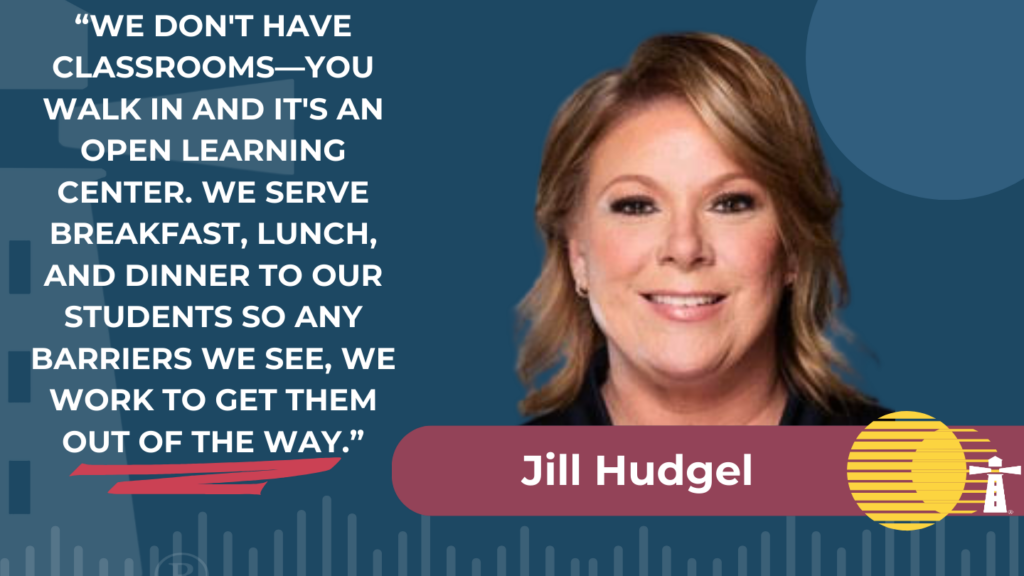
“We try to make it very inviting. We don’t have classrooms—you walk in and it’s an open learning center. We serve breakfast, lunch, and dinner to our students so any barriers we see, we work to get them out of the way.” — Jill Hudgel
—
Ready to discover how alternative models are redefining success in K-12 education? Listen now and subscribe to stay updated on episodes that challenge the status quo and inspire transformational change.
FULL PODCAST Transcript
Lighthouse Therapy (00:01.323)
Hello everyone and welcome to the brighter together podcast. My name is Janet Courtney and my special guest today is Jill Hudgel. Jill is the senior director of special education at Buckeye Community School District and they started in Mansfield, Ohio. So Jill, welcome to the show.
Jill Hudgel (00:19.586)
Thank you. Thank you for having me.
Lighthouse Therapy (00:21.989)
Absolutely. So tell our listeners a little bit about your journey in education as a a senior director of special education and then a little bit about Buckeye Community School.
Jill Hudgel (00:33.674)
Yeah, initially started in education with my middle childhood math and language arts. Went on to get my master’s in special education and joined with Pete, Mary and Sasho. I’ll reference them.
frequently, they are our management company that started Buckeye. We started in the fall of 2020 in Mansfield with only about 200 students. And Buckeye is a, were designated as a dropout prevention and credit recovery high school. So we service students ages 14 up to the age of 22. It’s a very non-traditional model.
very individualized. Every student that enrolls with us has an individual learning plan that kind of outlines their goals, their desires for careers after high school. And that really is the basis of helping them succeed with earning their high school diploma. So we started in Mansfield and have since expanded to Marion.
London, Fremont, Springfield, and then Tiffin and Lima are our two newest locations. So all in Ohio and actually yesterday we enrolled our 3,000th student across all locations. Yeah, so we’ve had tremendous success for students that the traditional model, just, it’s not a fit for them. Maybe they’re working or
Lighthouse Therapy (02:00.543)
All in Ohio, right? All in Ohio. Yep.
Lighthouse Therapy (02:08.809)
Ow.
Jill Hudgel (02:20.898)
Maybe they’re a teen parent or some students have medical conditions. So it’s very individualized. So whenever they need to make arrangements to come in and meet with their teacher, they can do so.
Lighthouse Therapy (02:34.965)
Wow, wow. So what is your success rate with? Because that’s a you’re dealing with really high risk, high needs kids, right?
Jill Hudgel (02:42.764)
Yes, yep. The majority of our students have at least one or two risk factors. Some have more. But you know, we have had tremendous success. About 50 % of our students graduate the traditional route. earning that end of course, which is one of our requirements here in Ohio. And every student graduates with some kind of a credential.
We have construction programs, automotive programs, boutique services, hospitality. So we really focus on that post-secondary piece as well, making sure that even though their diploma is the same diploma that they would earn at their traditional high school, they’re also graduating with something that’s gonna enhance what they’re able to do for a career.
and hopefully give them a leg up.
Lighthouse Therapy (03:41.973)
Yeah, so do some of them, like if they have a job, do they get some credits for working?
Jill Hudgel (03:48.623)
Yes, so students, a lot of our students work full-time, part-time, but yeah, they can earn up to three elective credits per year. We have a CBI or a career-based intervention program that we have implemented, and a lot of our students come to us wanting to get a job, but don’t know how to go about getting a job, so we have…
family engagement specialists, we have student support specialists, which are basically school social workers. We just frame it a little bit differently. But a lot of people on staff that is part of their job to work with those students, figure out what they would be good at, what their interests are, to help them find a job while they’re in high school. So…
Lighthouse Therapy (04:23.509)
Mm-hmm.
Jill Hudgel (04:42.358)
One thing that I didn’t touch on is we are open Monday through Thursday to students from 9 a.m. to 6 p.m. So we have those extended hours so that if there is a student working a full-time job, maybe first shift, they can still get that one-on-one time with their teacher that we know is so crucial for them to be successful. And then Fridays are…
Lighthouse Therapy (04:51.325)
wow.
Mm-hmm.
Jill Hudgel (05:07.566)
remote work from home day where teachers can make arrangements to meet with students at a local library. Maybe they’ll do like a Google meet. Some of our students transportation is an issue getting into the school building. So when we know that as a barrier, we go out to meet them so that they’re still getting the same benefit of working with their teacher one-on-one so that they can be successful.
Lighthouse Therapy (05:21.739)
Hmm.
Jill Hudgel (05:36.138)
any of those barriers that we see, really encourage our staff and have employed a lot of people to get those barriers out of the way so that when they come in, they can just focus on education.
Lighthouse Therapy (05:48.341)
Right.
Yeah, yeah. So how did how did they find you?
Jill Hudgel (05:55.199)
Well, we don’t advertise. We, ironically, it’s all word of mouth. The last couple of years, yeah, we have really, really started to build some great relationships with the traditional schools though. When they have tried everything that they can to work with students, maybe it’s a behavior issue and they’re up for expulsion.
Lighthouse Therapy (06:03.197)
Hmm. That is the best form. The best form.
Lighthouse Therapy (06:24.053)
Yeah.
Jill Hudgel (06:25.294)
we’ve gotten to the point now where they reach out to us and say, hey, I think this student would really benefit from what Buckeye provides. Can we send the family over and they come in and get a tour of the facility? Because we don’t have classrooms. You walk in and it’s an open learning center. Our teachers are stationed around the perimeter and they have a desk.
Lighthouse Therapy (06:41.355)
Mm-hmm.
Jill Hudgel (06:49.086)
and chairs, students are able to get up and get a snack whenever they want to. We serve breakfast, lunch, and dinner to our students. So we try to make it very inviting. We don’t see a lot of behavior issues either, because if a student is having a bad day, they just don’t come that day. They communicate with their teacher and say, hey, not going to happen today. I’ll be in tomorrow or touch base with you next week.
Lighthouse Therapy (06:56.843)
Bye.
Lighthouse Therapy (07:09.939)
They all come. Yeah.
Jill Hudgel (07:19.022)
It’s very cool. I love being a part of it. Yeah.
Lighthouse Therapy (07:22.175)
Yeah, yeah. So how do you deal with like regulations and so many school days and all of that to get a high school diploma? How does that work for you guys?
Jill Hudgel (07:36.025)
So we operate on a traditional school calendar. So for us, students need to have a minimum of 920 hours of instruction. So our school calendar is set up, I think we’re at like 1040 or something. they get, we always start the Tuesday after Labor Day and get out like the first week of June, but students really appreciate
the flexibility and because we’re designated as a credit flex model, that allows students to, who take advantage of the credit flex to have the ability to work outside of the school building itself. So they can complete their schoolwork at home and then turn in their completed exams each week. So attendance wise,
Lighthouse Therapy (08:32.106)
at you.
Jill Hudgel (08:34.734)
because we have to follow state law that if a student accrues 72 consecutive hours of non attendance, which is basically about 14 school days, we have to withdraw them and then they go back to their home district. our attendance, have to, the target is a minimum of three exams per week that keeps them on track to graduate. But we also have students that
Lighthouse Therapy (08:59.083)
Okay.
Jill Hudgel (09:03.436)
enroll at 18, 19 years old that are behind on their credits. So we can figure out a really good plan that’s, hey, you’ve got to pass five exams or six exams per week to get you done by your goal date. So that’s where that individuality really comes into play and meets the needs of students no matter what they’re coming with.
Lighthouse Therapy (09:25.643)
So do some of them end up with getting a GED then or no?
Jill Hudgel (09:29.838)
We do not offer a GED, strictly just a Tier 1 High School Diploma.
Lighthouse Therapy (09:36.667)
Awesome, awesome. Okay, so tell me a little bit on the special education side. Obviously, you’re the senior director of special education. How does that fit into what you guys are doing?
Jill Hudgel (09:42.574)
Mm-hmm. Yeah. Mm-hmm.
Jill Hudgel (09:49.367)
Yeah, so I’m very, very proud. have a total of 10 school psychologists on staff, nine active with working with students. The other one, she’s kind of an oversight position, but very, very proud to have those ladies on staff. They do an excellent job. We have about…
Lighthouse Therapy (09:56.553)
Wow.
Lighthouse Therapy (10:05.054)
Mm-hmm.
Jill Hudgel (10:13.902)
26 % of our total enrollment are students that receive special ed services and it plays very nicely with you know their IEPs coming in. We follow state compliance guidelines as far as accepting you know documents. We feel like whatever they’re coming in with we really try to continue providing. Sometimes there’s a little bit of a difference with like a provider title or something like that but
Lighthouse Therapy (10:43.058)
Mm-hmm. Mm-hmm.
Jill Hudgel (10:43.822)
Because it’s so individualized, we find that students get more specially designed instruction. Sometimes that’s what is listed in their plan.
they beam because you can just see them grow in confidence. Another item that I forgot to touch on is students only do one course at a time. So they can really focus on, know, our core credits as a freshman, we’ve got physical science, algebra one. So we’ll give them a choice. Do you want to start with math or science? Very rarely is it math, but.
Lighthouse Therapy (11:12.381)
okay.
Lighthouse Therapy (11:25.587)
Yeah.
Jill Hudgel (11:27.97)
But knowing that, they might need 20 hours of one-on-one instruction to get half of the course completed. And that’s OK. We can provide that for them. If they’re really good in social studies, they might not need as much one-on-one time. So we can kind of target what we’re doing for our SDI minutes. But it’s really.
beneficial. It has proved to be very successful and then our model we are actually funded on how many credits students earn per year. So if they earn four out of five credits we get 80 % of our funding for that student. If they earn five out of five they get 100 % so but we average
Lighthouse Therapy (12:07.467)
I don’t know.
Jill Hudgel (12:22.074)
Normally every year, we’ll never get 100 % because we have students withdraw and re-enroll and things like that. But we average upper 80s, low 90s percents every year. Our students are very, very, they produce and they do very well.
Lighthouse Therapy (12:28.031)
Right, right.
Lighthouse Therapy (12:41.119)
Yeah, it’s not your traditional model and it’s something that they need in order to be successful. Yeah. So what kinds of, so is there work study? you do things like, I mean, I know you said that they end up with a diploma, but they also end up with, what does that look like? How do you determine that? And what are some of the options that they might have?
Jill Hudgel (12:45.358)
Yeah. Yeah.
Jill Hudgel (13:02.231)
Yes.
Yeah, so we’re continuing to explore new CareerTech programs every year. so all of our locations, we’ve got pretty consistently a construction program, an automotive program, and hospitality, and law and public safety. And those are scheduled classes that they come in two times a week, maybe from 10 to 12, one to three.
Lighthouse Therapy (13:09.803)
There you go.
Jill Hudgel (13:32.987)
There’s a classroom component and then a lab component where they get to do all of the things that they’re doing for that program. So our construction and automotive programs were our first programs and those we’ve actually expanded to multiple sessions throughout the week because we have such a high interest with our students. And I mean they’ve done everything in construction from
Lighthouse Therapy (13:53.877)
Mmm, mm-hmm.
Jill Hudgel (14:00.163)
Birdhouses to desktop phone holders to I just saw they made an American flag out of wood and stained it red, white and blue. They built benches for out front picnic tape. I mean, it’s amazing what they do. And we’ve got just very dedicated instructors that love what they do. And when you love what you do, it doesn’t feel like work, you know?
Lighthouse Therapy (14:12.523)
me.
Jill Hudgel (14:29.826)
So I just, love talking about it so much because it’s so non-traditional and our kids are just great, great kids that get to have a really great experience with education.
Lighthouse Therapy (14:40.779)
Mm-hmm.
Lighthouse Therapy (14:45.001)
I’m curious too, you’ve talked about traditional male roles. Is there a larger majority of male students versus female students? That’s just kind of what popped in my head. Is it? Okay, cool.
Jill Hudgel (14:50.584)
Mm-hmm.
Jill Hudgel (14:57.294)
It’s about 50-50. Yeah. Now we’re seeing a trend of younger and younger students coming to us where actually the state of Ohio just this year dropped the age requirement for dropout prevention and credit recovery. It used to be 16 years old. They’ve now dropped it to 14.
Lighthouse Therapy (15:20.509)
wow.
Jill Hudgel (15:21.07)
So sometimes that gets a little challenging because 14, my son’s 14, sometimes he’s really responsible and other times I’m like, ooh, we gotta work on that. But they don’t have a lot of that intrinsic motivation to be disciplined and okay, if I’m not going into the building today, I’ve gotta carve out enough time to get my schoolwork done so that my attendance is good. So that becomes a little tricky with the younger kids.
Lighthouse Therapy (15:31.061)
Mm-hmm.
Lighthouse Therapy (15:50.187)
Instead of playing video games all day.
Jill Hudgel (15:51.522)
but.
Right, right. But that’s a great thing. Sometimes kids, the students will be like, oh gosh, I’m so tired today. I’m like, well, what were you doing? Well, I was up playing video games until 2 a.m. I’m like, wow, good thing you didn’t have to be here until 11 today. you know, whereas with the older students, the 17, 18, 19, they’re…
Lighthouse Therapy (16:05.515)
2 a.m.
Lighthouse Therapy (16:09.801)
Right? Yeah.
Jill Hudgel (16:18.584)
kind of getting into that very young adult real world. They might have a job, maybe some kids, or they’re a little bit more focused and driven, like, okay, I’ve got to get this done, you know? And sometimes our students, they get withdrawn for lack of attendance and they re-enroll. And then they’re withdrawn because life is happening. Last year, one of our graduation speakers withdrew and re-enrolled five times.
Lighthouse Therapy (16:41.291)
Yeah.
Jill Hudgel (16:47.778)
But she did it. It finally clicked and she was like, I need this diploma. And thank goodness, it’s always okay. We can pick up right where we left off and we’ll just continue pushing forward.
Lighthouse Therapy (16:51.434)
Mm-hmm.
Lighthouse Therapy (16:59.947)
Yeah.
Whereas they can’t do that in a traditional public school, can they? No. Wow.
Jill Hudgel (17:04.974)
No, we serve a very unique group of students and it’s not for everyone. Sometimes students come and they’re like, I need more structure and that’s okay. That’s okay, you know? So we try to find the most appropriate place for everyone.
Lighthouse Therapy (17:13.419)
No, of course not, yeah.
Lighthouse Therapy (17:18.557)
Mm-hmm, mm-hmm. Yeah.
but you’re making such an incredible impact. 3,000 kids, wow, wow, congratulations, that’s fantastic. Yeah, it’s just everything that we do in education is just when you can help the kids. So I’m wondering, you talked about kids having kids of their own and they’re coming to your program. How do you deal with that? Like I’m thinking about nursing mothers and little tiny babies and yeah.
Jill Hudgel (17:26.926)
Yeah, yeah, thank you, thank you.
Jill Hudgel (17:38.371)
Yeah.
Jill Hudgel (17:49.743)
they bring the babies in. They bring their kids in. We’ve got play areas. It is not uncommon to see staff members walking around holding the baby while mom or dad is off completing their STAAR test or end of course test or biology assessment. It’s part of life. Sometimes you don’t plan for things to happen and well, now we’ve got this little tiny baby that
Lighthouse Therapy (18:09.547)
Mm-hmm.
Mm-hmm.
Jill Hudgel (18:18.998)
I’ve got to be even more motivated for, and we don’t want that to be a barrier to their education. So we support and do everything that we can to make sure that we’re supporting student and mom or dad.
Lighthouse Therapy (18:25.353)
Right. Mm-hmm. Yeah.
Lighthouse Therapy (18:36.977)
Mm-hmm, mm-hmm. My mother, I don’t remember a lot of it. My sister is seven and a half years older than I am, but she went back. Now I’m not talking about high school, but she went back to college. And I remember she went to, I think it was a Catholic nursing school, because I remember her, the only thing I remember, I was five maybe.
Jill Hudgel (18:47.66)
Yeah. well.
Lighthouse Therapy (18:59.659)
her walking down the aisle of the church or wherever it was and dad put me on the end so he could see, so I could see, because I was little, I was the youngest of all of us, to see mom walk down the aisle and graduate from college with her RN. She was an RN. And my sister being older and my sister’s incredibly intelligent was helping her with her math, helping her get through college math.
Jill Hudgel (19:06.062)
Yeah.
Yeah.
Jill Hudgel (19:23.754)
wow. Yeah.
Lighthouse Therapy (19:25.739)
You know, it’s just crazy things like that. But that’s it’s the same kind of things you’re talking about where it’s just like there is such a desire to better yourself and doing whatever you need to make sure that you can get you know get that degree because they knew you know, they knew that if she could get because she was a I think she she had back problems too because I think she had hurt her back be as a scene as an as an aid and then Became a nurse my dad and my mother
Jill Hudgel (19:31.501)
Yeah.
Jill Hudgel (19:34.979)
Yeah.
Jill Hudgel (19:40.12)
Mm-hmm. Yeah.
Jill Hudgel (19:48.172)
Yeah.
Lighthouse Therapy (19:54.534)
met in San Antonio, San Antonio, Listen to me, I’ve lived in Ohio and Michigan and Texas, but they met in San Antonio. He was in the military and she was in nursing school, but then they got married and started having kids and she dropped out and life happened. And same kind of thing just at a little bit older, because he was 21 and she was 20 when they married. So yeah, so it’s the same kind of thing. got to get through, you push through, you make sure.
Jill Hudgel (20:04.643)
Okay.
Yep. Life happens. Yeah. Yeah.
Jill Hudgel (20:16.397)
Yeah.
Figure it out. There’s no other choice.
Lighthouse Therapy (20:22.279)
Yeah, figure it out. That’s what they did. They figured it out. Yeah, yeah. And I don’t, you know, I don’t remember it. do remember too, my dad at one point he was working three jobs so that they could, I remember he had, he worked at a bakery in the evening so that, and he only did it for a short time so that they had money for Christmas.
Jill Hudgel (20:30.158)
Yeah.
Wow.
Lighthouse Therapy (20:43.755)
And the only thing I remember about that was he would get burned. He would have burns on his arms. I remember saying, and that was the only thing that I cared about. Daddy, did you have any burns today? Crazy things like that. he, yeah, you know, he did that so that we would have Christmas money. OK, I don’t need to talk about that anymore. I’m gonna cry. But, know, the things that you sacrifice for your kids, you know, and that’s what these that’s what they’re doing. Yeah.
Jill Hudgel (20:43.79)
Oh, my gosh.
Jill Hudgel (20:51.01)
Yeah, wow. Yeah, it’s, yeah.
Jill Hudgel (21:01.614)
Yeah, well, that, yeah, and you know,
We know that the holidays are always a difficult time, sometimes for our families. So we actually provide a kids Christmas for anyone that has young kids or students that want to come in with their parents. We do a big pancake breakfast and then we’ve partnered with goodness, the local Goodwill police and fire where they either.
Lighthouse Therapy (21:13.798)
Yeah.
Lighthouse Therapy (21:20.075)
Aw, neat.
Jill Hudgel (21:37.004)
buy toys and donate or provide money that we go out and then shop. And we always send home one or two gifts with every child of our student and our students so that they’ve got something to celebrate their kids and themselves. But we also do home food deliveries and just try to think of everything.
Lighthouse Therapy (21:52.903)
neat.
Lighthouse Therapy (21:58.005)
Mm-hmm.
Jill Hudgel (22:07.168)
that could be a barrier and how can we stay ahead of that?
Lighthouse Therapy (22:10.859)
Overcome that barrier. Yeah. Yeah, so it isn’t a barrier take the barrier down before it becomes a barrier Nice. Yeah. Well Jill Yeah, embrace it. Absolutely. Yeah. I’m sure that I would be the one holding that baby. Give me that baby. Give me that baby I want to be a grandmother so bad. My kids aren’t quite there yet. Come on guys. Let’s go. I’m 58 years old. I’m ready. We have friends that are grandbabies grandparents already in a
Jill Hudgel (22:14.604)
Right. Yep. Take it down. Yep. Or embrace it. Yeah.
Jill Hudgel (22:33.102)
you
Lighthouse Therapy (22:40.723)
I would never want them to do anything. You know, only want what’s best for your kids. mom’s ready. Mom’s ready to be a grandma. So where do people go, Jill, if they want to learn a little bit more about Becci Community School and what you guys are doing? Because it sounds really amazing.
Jill Hudgel (22:42.754)
Yeah. Right. yeah. Yep. Yep.
Jill Hudgel (22:57.602)
Yeah, so they can visit our website which is www.buckeyecs.org.
Lighthouse Therapy (23:08.849)
Awesome, awesome. Well, thank you for what you’re doing. Thank you for serving these kids because you guys are making the world a brighter place by what you guys are doing. So keep up the good work. I appreciate that you’re doing this for these kids. Yeah.
Jill Hudgel (23:22.05)
Well, thank you. Thank you for having me and allowing me the time to share about what we do and who we are.
Lighthouse Therapy (23:31.408)
Absolutely, absolutely. Thank you so much. God bless you guys.
Jill Hudgel (23:35.673)
Thank you.