

Opening Hook
What if the IEP meeting you’re running this week is actually *limiting* your students’ potential instead of maximizing it? In this transformative conversation, we uncover the practices that separate thriving special education programs from those stuck in outdated models—and why the best districts are rethinking everything about how students with IEPs access their education.
Guest Introduction
Kristen Davis is a Special Education Coordinator at a leading school district south of Atlanta, Georgia, where she’s pioneering collaborative approaches to special education that are reshaping outcomes for students with IEPs. With deep expertise in co-teaching models, IEP facilitation, and specially designed instruction, Kristen brings both data-driven insights and the real-world wisdom of someone working in the trenches every day.
Episode Overview
Most districts unknowingly sabotage their special education programs in three critical ways: they hold IEP meetings that exclude rather than engage families, they assign special educators to support roles rather than specialized instruction, and they pull students from peer groups based on labels instead of actual learning needs. In this episode, Kristen Davis reveals what top-performing districts do differently—and how you can start implementing these changes immediately.
You’ll discover why co-teaching partnerships require the same intentionality as any high-functioning team, how to recognize when special education teachers are being misused, and why family relationships might be the most overlooked lever for educational transformation.
Key Takeaways
– IEP meetings should be collaborative conversations, not information dumps. When parents feel heard and valued, the entire special education program strengthens.
– Special educators must provide specially designed instruction, not general support. When they function as paraprofessionals, students lose access to the expertise their IEPs promise.
– Co-teaching done right is invisible. The best collaborative classrooms are ones where students don’t know—or don’t care—who has an IEP and who doesn’t.
– Peer interaction and social-emotional development shouldn’t be sacrificed for service delivery. Pulling students from general education based on disability labels contradicts what we know about inclusion and belonging.
– Family relationships are foundational. Supporting the whole child means recognizing and addressing the family struggles that impact learning, even when those challenges feel “impossible to fix.”
Notable Quotes
“This is an impossible fix, but if I could fix some of the family relationships that my kids have… If I could fix that, I think that would change education by leaps and bounds.”
“I feel like there’s a lot of special education teachers just kind of functioning as a paraprofessional, just going in and providing support, but they’re not providing that specially designed instruction.”
“Co-teaching is hard. I mean, it’s like a marriage and you’re stuck with a person. You can be stuck or you get to be with that person every day.”
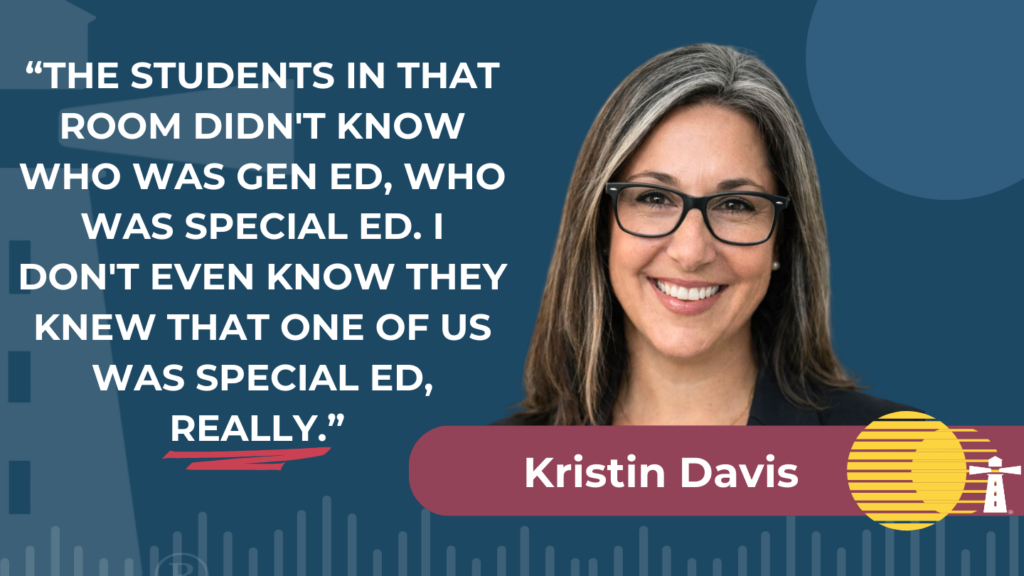
“The students in that room didn’t know who was Gen Ed, who was Special Ed. I don’t even know they knew that one of us was Special Ed, really.”
Call to Action
If your special education program isn’t delivering the results you expect, this episode is essential listening. Whether you’re an administrator, special education director, or instructional coach, you’ll walk away with concrete, implementable practices used by districts that are actually closing gaps and building belonging.
Listen now and subscribe so you don’t miss future conversations about what’s really working in K-12 education. Share this episode with your special education team—it might just spark the conversation that changes everything.
FULL PODCAST Transcript
Lighthouse Therapy (00:01.08)
Hello everyone and welcome to the Brighter Together podcast. My name is Janet Courtney and my special guest today is Kristen Davis. Kristen is a special education coordinator at a school in Noonan, Georgia, which I think you told me is just north of Atlanta, is that right? south, see I didn’t even get it. Where are you going? South of Atlanta, there you go. So it’s warm, are you warm right? No, not really.
Kristin Davis (00:18.582)
The south of Atlanta. Mm-hmm, yep. Well, not right now. It’s been very cold and we’re not used to this.
Lighthouse Therapy (00:30.382)
I’m in South Texas, too. I’m in Corpus Christi and it’s been in the 40s in the morning and 60s during the day. I don’t like that. I don’t like that.
Kristin Davis (00:33.035)
Mm-hmm.
Kristin Davis (00:37.164)
Yeah, we had 17 degrees last week and I was not liking that. That’s not his tooth. Yes.
Lighthouse Therapy (00:41.442)
That’s too cold. That’s too good. For those of you that are listening and it’s six weeks from now, we are talking and it is February 4th. So we’re still smack in end winter and with tux upon tuxacani, whatever his name is, Phil said six more weeks of winter. just passed Groundhog Day. was like, I don’t like that either. So anyway.
Kristin Davis (00:54.036)
Yes.
Yeah, we even just had a snow day, which was really a nice day.
Lighthouse Therapy (01:01.78)
wow. Yeah. Wow. Wow. Okay. Well, tell us a little bit as I take us off track, tell us a little bit about you and your position and what you do.
Kristin Davis (01:07.468)
That’s okay.
Kristin Davis (01:15.308)
Sure.
Well, I have been in education for 22 years. My degree is in special education and I started in special education as a collaborative teacher down in Savannah. And I worked in special education for several years and I remember being really young and thinking, you know, that the burnout for special education teachers was in five years and within five years, I don’t know if I planted that in my head or, but in five years,
Lighthouse Therapy (01:44.238)
Mmm.
Kristin Davis (01:46.116)
I was ready to just kind of take a step back. That was a time where we didn’t have all the checks and balances in our IEP systems like Go IEP to really prove that you were doing things by the dates. And I just felt like I was being asked to do things that I didn’t find ethical. I was like, I don’t want to do this legal paperwork anymore. so I stepped away and I taught math at the middle school level for two decades, almost.
Lighthouse Therapy (02:14.958)
Wow.
Kristin Davis (02:15.949)
and
But the special ed part has always been near and dear to my heart. I’ve always wanted the collaborative classes. I always wanted the students with IEPs over like a gifted class. Those were my passion projects. I love them. And then a few years ago, our special education coordinator position came up and I had several friends say, you’d be really good at that. And my whole thing was, I don’t want to leave the classroom. I love working with children.
Lighthouse Therapy (02:46.734)
Mm-hmm.
Kristin Davis (02:48.279)
Our special education coordinator at the time always had children in her office. She was always working with kiddos. so I jumped ship from teaching math for so long and came back to my roots. not much has really changed. Honestly, in special education, things look a little different as far as how we write our IEPs. And I love my checks and balances and the time stamps and all of those wonderful things.
Lighthouse Therapy (03:05.057)
Hmm.
Kristin Davis (03:18.229)
I’ve been in this role now for two years. I’ve learned a lot, but also I feel like I’m bringing a lot of things that I really pushed for when I was younger, and now I can put them into practice. And it’s funny, because I’ve always complained about different things with special education as a gen ed teacher, and now I can put my money where my mouth is. So I love it.
Lighthouse Therapy (03:43.097)
There you go. There you go. Awesome. So one of the things that we talked a little bit about was how you conduct your IEPs and how you really put the parents first. So I’d love to have our guests here about your philosophy.
Kristin Davis (03:55.934)
Okay. Absolutely.
Well, my first year in this role, there were a lot of meetings where we sat with the parent and somebody sat with an IEP and did this and read straight from the IEP. And I felt like I was constantly stopping my case managers to say, hold on just a second, let me explain what you just said to the parents because a parent doesn’t understand, you know, working memory score of 72. That means nothing to them. And so I was constantly stopping them to say,
Lighthouse Therapy (04:09.355)
Aw, Red.
Lighthouse Therapy (04:21.955)
Right.
Kristin Davis (04:29.229)
Alright, well let’s explain this part. And the team was very disengaged. I’ve had, you know…
teachers just kind of check out and I felt like there needed to be more collaboration among the team. And so through our West Georgia RESA program, which is our local regional training center, we get a lot of resources from them. They did a training several months ago, about six months ago, I say, and about just kind of revitalizing your IEP meetings. And it was really to focus on the new push of all these advocates that are getting involved
in education and really to just kind of de-escalate those situations. And we didn’t really have a lot of situations to de-escalate. We have a really great community here.
Lighthouse Therapy (05:10.38)
Mm-hmm.
Kristin Davis (05:21.289)
But I took some of those things and applied them here at our school. And what it really is is we sat down and created an agenda that has all the main components of the IEP. But instead of going in with a completed draft of an IEP to tell the parent this is what we’re going to do, we start the meeting with some group norms. And then we jump into the student strengths. And I actually write on the board.
write all this stuff down as the team is talking. And I’m just facilitating it. And if I know the kid really well, I give my input as well. because especially our eighth graders, I see them sixth, seventh, and eighth, and I grow up with them a little bit. So we go through the strengths, and we let the parents and the teachers, and it becomes this really great conversation. It’s a great way to start. So if a parent comes in angry, that kind of disarms them a little bit because we’re saying all these wonderful things. And then we move in.
Lighthouse Therapy (05:56.376)
Mm-hmm.
Lighthouse Therapy (05:59.907)
Right.
Lighthouse Therapy (06:04.899)
Mm-hmm.
Lighthouse Therapy (06:15.788)
Right, yeah.
Kristin Davis (06:21.069)
instead of weaknesses, call it challenges, and we walk through those challenges, and that’s where we can throw in, well we noticed in this testing that, you know, we noticed that short-term memory was a challenge for them, and what does that look like in the classroom? And it just becomes a lot more collaborative instead of one-person reading. And so again, I’m writing everything down for everybody to see, either on chart paper, or we have the clear touch boards that we can write on.
Lighthouse Therapy (06:24.536)
Mm-hmm.
Lighthouse Therapy (06:42.36)
Mm-hmm.
Kristin Davis (06:51.035)
And so that’s been really great. And then the only thing I put on this agenda as far as what’s in the IEP is I list their goals and their most recent progress report update on that. And I list all of their current accommodations and their current services. And then as a team, we talk through, okay, well, we just talked about all these challenges. What goals do we need to put into place? Let’s look at the goals we have and what are some proposed goals? And we’ve been able to clean up a lot of IEP.
where it’s just been the same goal over and over and over because it’s just been pushed forward and nobody’s really talked about it. It’s been a case manager writing an IEP. And so I’ve really helped my case managers to not put so much in the draft going in. Let’s talk about it. Let’s have a kind of a baseline of what we’re going to talk about. But then all of the meat of our IEPs comes from that team. And it’s been a game changer for our
Lighthouse Therapy (07:24.844)
Mm-hmm.
Lighthouse Therapy (07:29.432)
Right.
Kristin Davis (07:50.782)
and for our parents. We’ve gotten a lot of really great feedback, especially from the families who have been with us since sixth grade and they’ve seen this transition from sit and read and listen to this kind of really cool conversation about the kid.
Lighthouse Therapy (08:01.41)
Mmm.
Kristin Davis (08:07.871)
what they need that in that year. And then there’s some things that pop up, know, somebody might ask, we have a really great vocational high school here. And so like, if that pops up, we put it on what we call a parking lot and we hold that to the end because it’s not really about the IEP, but I want to address those concerns. So we make sure to address all of that with the parent. Like that’s a really good thing. Let’s put this here. And when we’re all done, we’ll come back to it. So it’s really just revitalized the way
Lighthouse Therapy (08:27.086)
Okay.
Kristin Davis (08:37.845)
we hold our meetings.
Lighthouse Therapy (08:40.046)
So how do you then at the end, how do you get signatures? How does that, it’s a, you know what I mean? I think that I love it. Please don’t hear I’m not being critical, but it’s like, gosh, where’s the signature go? How do we get the signature? How do you make that work so that you get a, okay. Okay.
Kristin Davis (08:51.722)
Yeah.
Kristin Davis (08:56.543)
Right. So we still print the signature page and we just like we print the draft and usually our case managers will load in present levels. They’ll go ahead and load the impact statement. They will load.
the existing accommodations and the existing goals and then we go back in and yes so we open everything we print the meeting notice and then we head back in and I always let parents know you know give your case manager a couple days they’re gonna pop all this information in and then we send parents a draft for them to preview before we go ahead and finalize it out.
Lighthouse Therapy (09:17.646)
so you can edit tweet. Yeah. Gotcha.
Lighthouse Therapy (09:34.831)
Gotcha. But they sign it at the meeting then do they sign it at the meeting as meeting attendee? Yeah, that’s good. That’s right. Okay, very cool. I love it. I love it. It’s it’s it’s I wish all of them were that way. That’s one of the things you get in in a rut sometimes, you know, you just get in a place where you’re just like, okay, so this is what we’re going to do. This is what we do. This is what we do, you know, and it just is it’s so important that and I think for me when I realized more so
Kristin Davis (09:37.705)
They sign in as a meeting attendee. Yes. Mm-hmm. Yeah. Yeah, that’s good. Thank you.
rest.
Lighthouse Therapy (10:05.282)
once I was my own parent, know, once I was a parent, it made, it made such a difference, you know, to know, and then having friends that had students that are children that were on IEPs also, you know, it’s just enlightening when it, when it, just makes it more real, right? So yeah, very cool. Very cool. Yeah, that’s a good, that’s a great game changer. Yeah. So tell me, you also have some experience with co-teaching.
Kristin Davis (10:07.389)
us.
Kristin Davis (10:20.373)
Right? Yeah, I agree. It’s been a game changer.
Yeah.
Kristin Davis (10:33.268)
I did.
Lighthouse Therapy (10:33.334)
So I’d love to hear about what your experiences and how do you go about implementing and making that successful?
Kristin Davis (10:41.599)
Yeah, co-teaching is hard. mean, it’s like a marriage and you’re stuck with a person. You can be stuck or you get to be with that person every day.
Lighthouse Therapy (10:49.282)
Right, right.
Kristin Davis (10:50.443)
I was really blessed in my early career as a special education teacher to teach with a woman named Kelly Mahaney. She’s from Savannah. She’s probably 20 years older than me, maybe not quite that much older than me, but she was a veteran teacher and I was straight out of college. You come straight out of college with all these grand ideas and we just, gosh, we should have written a book. We worked so well together.
together that the students in that room didn’t know who was Gen Ed, who was Special Ed. I don’t even know they knew that one of us was Special Ed, really. I had a desk in that room and I worked in that classroom for several periods a day. It wasn’t something that I popped in on. We were a team.
Lighthouse Therapy (11:26.99)
Neat.
Lighthouse Therapy (11:37.26)
Mm-hmm.
Kristin Davis (11:42.289)
I graded, I conferenced with kids, I taught, I didn’t just work with students that had IEPs, I worked with everybody and it was just, it was really magical. And so that’s kind of where my thinking comes when it comes for collaborative teaching. Because right now I feel like there’s a lot of special education teachers just kind of functioning as a paraprofessional, just going in and providing support, but they’re not providing that specially designed instruction.
And I also think a lot of our special education teachers pull their kids into a small group out of the collaborative room and they pull because, you have IEP, you have an IEP, you have an IEP, all of y’all come with me. And it should be more about what skill that they need to work on. And it might not be all kids with IEPs. And that’s the whole point of collaborative instruction is so that they can be with their peers and get those social skills.
Lighthouse Therapy (12:30.69)
Right, yeah.
Kristin Davis (12:42.072)
So that’s been a really big push by me in my building this year is to really change how that looks.
We’ve got some scheduling things because I had the opportunity to be with the same teacher almost all day, whereas our teachers are having to move a little bit more. So we’re trying to brainstorm some ways to change that and to try some pilot programs that might look a little different than what’s traditionally been done in this building for 20 years. And that takes time. And that takes a lot of people to get on board before we can make a lot of changes. But we’ve got small changes already happening.
Lighthouse Therapy (13:11.06)
Mm-hmm. Mm-hmm. Yeah.
Kristin Davis (13:19.63)
within classrooms which is really cool to see.
Lighthouse Therapy (13:23.758)
So is there any hurdles when it comes to the finances of that? Is that part of the hurdle or is it more just the…
Kristin Davis (13:32.372)
Yeah.
I so. I think that’s always kind of a hurdle in education is money. Trying to have enough people in the right place and you know we live in a very transient area. We’re very close to the airport so we have a lot of people coming and going. We’re really close to another military base so and we have a lot of industry coming out of Japan and various countries. So we are an ESOL school.
Lighthouse Therapy (13:36.568)
Yeah.
Kristin Davis (14:02.859)
we have kids who speak all kinds of different languages within our special education program as well. And people are constantly moving. And so we might start the year with 650 kids and by December we have like 680 and you know, our funding comes from the previous year and it’s ever changing and it’s
Lighthouse Therapy (14:22.668)
Hmm, which is which is which is so upside down and backwards. So so Esau I’m assuming I want to make sure
Kristin Davis (14:30.111)
I’m sorry, thank you guys. English as a second language. These kiddos are coming to us unable to speak English. In fact, my last year in the classroom, I had five different languages I was using. Yeah, it’s fun though. It’s neat.
Lighthouse Therapy (14:45.102)
Yeah, I figured that’s what you were saying and I just wanted to make sure you know, I want to make sure you were talking about languages and I’m like that’s I think that’s what you meant, but just just to be sure. So yeah, wow, wow. So how do you deal with? How do you deal with that when you have somebody that comes in and speaks Mandarin and nobody else speaks Mandarin?
Kristin Davis (14:49.737)
Yeah.
Kristin Davis (14:53.503)
Yeah, absolutely.
Kristin Davis (15:03.889)
Lots of just immersion.
Lighthouse Therapy (15:08.216)
Okay.
Kristin Davis (15:10.047)
The philosophy in that department is that you just throw them in and let them start learning the language. the woman that is over Esau in our building is amazing. And she actually speaks a couple different languages. And she’s really been pushing the English language instruction. And our kids are growing, my goodness, by leaps and bounds. And it’s really neat, because it’s hard for, we’ve had a couple kids come from Puerto Rico and different, mostly Spanish.
Lighthouse Therapy (15:31.181)
Nice.
Kristin Davis (15:39.934)
Spanish speaking countries with an IEP. And that’s been hard. mean, we’re having to use Google Translate quite a bit. We’re teaching our kids how to use Google Translate. We’ve taught the teachers how to devices like, or programs like Canva or Brisk to change the languages and be able to lower the reading level as needed in the different language, which has been, because we have, I have one little boy who
Lighthouse Therapy (16:03.982)
Mmm. Gotcha. Yeah.
Kristin Davis (16:09.867)
He has a learning disability, but he also struggles with English. So it was hard to determine, is this a language barrier or is this part of the disability? so it’s been hard, but we kind of work together with our ESOL teacher. We do a lot of Google Translate, a lot of ChatGPT. Can you please translate this for the parents?
Lighthouse Therapy (16:23.405)
Yeah.
Lighthouse Therapy (16:36.746)
AI, yeah. I was just, I was thinking that AI is gonna do a lot of that for you in the future. Yeah.
Kristin Davis (16:40.875)
Yeah, it’s been great. Yeah. So they’re growing and we’re getting there.
Lighthouse Therapy (16:46.594)
Yeah, I love that now they have these little headphones too that you can put in and kind of interpret on the fly for you as you go. like, that’s really cool. I get get to go to get my nails done and they all speak Vietnamese there. And I’m one of these days I want to wear it because I know they’re I don’t think they’re saying anything bad about me. But but you know, it’s just one of those things where it’s like all this language is happening and I understand none of it. You know.
Kristin Davis (16:56.254)
So crazy.
Kristin Davis (17:05.183)
You
Kristin Davis (17:12.299)
Well, we’ve had IEP meetings where we’ve had to have a translator. We have a Spanish translator. But for other languages, Google Translate has a conversation piece where you can turn it on and it will just go back and forth translating for you. It’s very cool. So we’ve used it a lot here in this building for our kids.
Lighthouse Therapy (17:17.794)
Mm-hmm. Mm-hmm.
Lighthouse Therapy (17:29.088)
Yes.
Yeah, when we went to Cabo a couple of years ago for the summer and I had a translate on my phone. It was beautiful because it did. I could talk to it and it would type it out and then it would translate it in Spanish and then it would speak it in Spanish. And they were like, And there was…
Kristin Davis (17:52.81)
Yes!
Lighthouse Therapy (17:56.515)
Cause I was trying to communicate with that cause I don’t speak Spanish at all. I mean a little bit. I had a little bit in high school. I kind of know enough to be dangerous, but tell me where the bano is. I know how to get to the bathroom, right? I know God bless you. Dios de bendiga. That’s a good one, right? But that’s about it. You know, there isn’t a time and I live in South South Texas. Corpus Christi has tons of some of really good friends of ours. Their first language is Spanish and they laugh at me because I’m like I I know what you’re talking about, but I can’t I.
Kristin Davis (17:59.531)
Right.
Kristin Davis (18:03.581)
Yeah
Yes. That’s a good one to mouth.
Lighthouse Therapy (18:25.24)
couldn’t tell you like to translate the words, but I can get the gist, know, so it’s so funny. they’re, know, it’s like anything else. It’s a language and you know it or you don’t and you still got to help the kids, right? Yeah, it’s a beautiful thing. And I love that for those kids that now we have this technology that will help them in a way that 20 years ago you didn’t have that.
Kristin Davis (18:30.411)
Hello.
Kristin Davis (18:49.535)
I can’t even imagine even just 10 years ago trying to come into an English speaking school and trying to learn. I mean, that’s tough. Yeah.
Lighthouse Therapy (18:52.536)
Mm-hmm.
Lighthouse Therapy (18:59.072)
Yeah, sink or swim, right? Yeah, sometimes it was just sink or swim, which is sad. Sad that that’s what it was. But, you know, we live in a technologically advanced society, which we’re grateful for. It has its drawbacks. It does, it’s also, so that’s awesome. So what would you say is the one thing that if you could just fix it, like never have to worry about it again in your world and your job?
Kristin Davis (19:12.491)
It does.
Lighthouse Therapy (19:28.692)
Miraculously, I never have to worry about that again. I never have to deal with it again. What would that be?
Kristin Davis (19:33.708)
Cool. That’s tough question. This is an impossible fix, but if I could fix some of the family relationships that my kids have.
Lighthouse Therapy (19:50.562)
Mm-hmm.
Kristin Davis (19:52.16)
Just seeing what kids go through today, and it kind of gives me, I guess, a form of survivor’s guilt because I know I grew up with like the Joneses and just seeing how many kids are struggling and how many families are struggling. If I could fix that, I think that would change education by leaps and bounds. But unfortunately, we have to worry about what we can control. So we just keep loving on them and make them part of our family.
Lighthouse Therapy (20:09.037)
Mm-hmm.
Lighthouse Therapy (20:14.442)
Yeah. Yeah. But that question just always goes to your heart, right? It’s the thing that that is like what where where is your heart in education and it’s for those kids. And that’s that’s why I asked the question, because I know I always will get a heart answer, you know, because because we as educators love what we do love our kids love the love that to see them be successful and it’s tough.
Kristin Davis (20:22.261)
That’s us.
Kristin Davis (20:31.819)
Mm-hmm.
Lighthouse Therapy (20:42.092)
when they’re struggling for something that you can’t fix. Having them well-fed and groomed and clean and emotionally ready for school to learn, Sometimes those selfs feel insurmountable at times. yeah. But.
Kristin Davis (21:01.439)
Yes, it does. It’s like nothing we can do to fix those things. So we do what we can here and make those relationships.
Lighthouse Therapy (21:06.56)
No. Yeah, yeah, you just do. You just do. So Kristen, where should people go if they want to learn a little bit more about you? Are you on LinkedIn? Are you on? I don’t know what this.
Kristin Davis (21:20.871)
I am on LinkedIn. I, about six, eight months ago, ditched all social media. So I have like gone radio silent. It was really just for mental health. I felt like I was wasting too much time on it and just seeing all the things is so negative all the time. So I left and it’s been really great. I’m kind of…
Lighthouse Therapy (21:28.217)
good for you.
Kristin Davis (21:47.919)
not in a virtual world, but I am on LinkedIn. So you can find me there for sure.
Lighthouse Therapy (21:50.912)
Okay. Okay, cool. Well, cool. Thank you. Thank you so much for being here. And thank you for being brighter together with us because we are right. We’re brighter together. So God bless you and have a great second semester. I know we’re full swing, right?
Kristin Davis (22:00.812)
in case that’s not being made. That’s right.
Kristin Davis (22:08.842)
We are, we are. Well, thank you for having me, Janet. I appreciate it.
Lighthouse Therapy (22:13.389)
Mm-hmm