

The Grace Gap: Why Your Best Teachers Are Leaving (And How to Stop It)
America’s classrooms are hemorrhaging experienced educators—and the reasons might surprise you. In this eye-opening episode, we dive deep into the teacher retention crisis with an expert who’s actively reversing the trend in Georgia’s schools.
About Your Guest
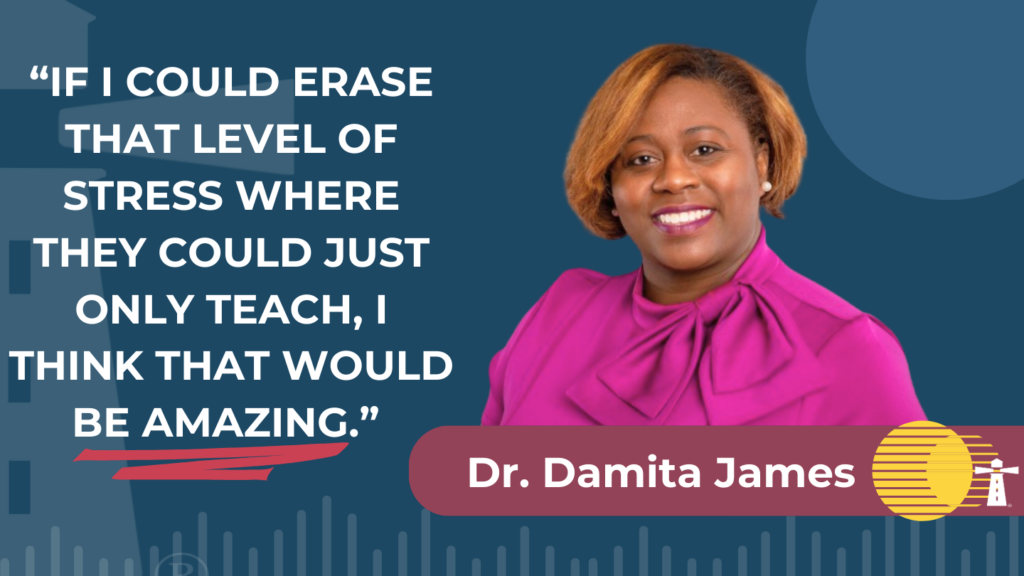
Dr. Damita James serves as Director of the Georgia Learning Resource System (GLRS) and Assistant Executive Director at the Middle Georgia Regional Education Service Agency (RISA) in Warner Robbins, Georgia. With a passion for supporting educators and transforming teaching environments, Dr. James brings practical, evidence-based strategies to address some of education’s most pressing challenges.
What You’ll Learn
Teacher burnout isn’t just about low pay—it’s a perfect storm of overwhelming workload, behavioral management demands, and unrealistic expectations. In this episode, Dr. James reveals how to reduce educator stress, create supportive onboarding systems for new teachers, and foster environments where teachers actually want to stay. You’ll discover actionable strategies for building compassionate school cultures that recognize teachers as whole people with lives beyond the classroom.
Key Takeaways
– Invest in New Teachers Early: Intentional mentoring and support systems during a teacher’s first years dramatically improve retention and set them up for long-term success
– Reduce the Stress Multiplier: Teachers juggle instruction, behavior management, and external pressures simultaneously—prioritizing what you can remove creates space for teaching excellence
– Grace is a Leadership Strategy: Demonstrating empathy and compassion for educators isn’t “soft”—it’s essential infrastructure for sustainable school improvement
– Safe Spaces Drive Growth: Create confidential, judgment-free zones where teachers can learn, struggle, and develop without fear
– Reading Crisis Requires Collective Action: Over 50% of students in some areas read below third-grade level—solving this requires resourced, supported teachers working collaboratively
Notable Quotes
“We kind of get to mold those teachers and make sure that we’re setting them up for success. So that’s one of the things that I really think that is a win for Georgia.”
“If I could erase that level of stress where they could just only teach, I think that would be amazing.”
“Give people grace and be compassionate, have some empathy, because just like teachers are people and they have lives and things going on as well.”
—
Ready to transform your teacher retention strategy? Listen now to discover how one Georgia leader is closing the grace gap and building schools where great teachers thrive. Subscribe to never miss an episode that gives you real solutions for real challenges in K-12 education.
—
FULL PODCAST Transcript
Lighthouse Therapy (00:00.952)
Hello everyone and welcome to the brighter together podcast. My name is Janet Courtney and my special guest today is Dr. Damita James. Dr. Damita James is the Georgia learning resource system director at the Georgia regional education service agency, which is in Warner Robbins, Georgia. And that’s not a mouthful. So Dr. James, thank you so much for being on the show today.
Dr. Damita James (00:30.011)
Thank you so much for having me Courtney, I appreciate it.
Lighthouse Therapy (00:33.378)
So tell us a little bit about what the Georgia Learning Resource System is and your role and a little bit about your agency.
Dr. Damita James (00:45.769)
So I serve as, and so just to keep it from being a mouthful, the Georgia Learning Resources System, GLRS for short, is a regional special education support system for the districts in the various regions throughout Georgia. In Georgia, there are 18 GLRSs, and we just support anywhere
between five to maybe even 20 school districts, depending on the size of the districts, and there’s programs that they are providing for students with disabilities. So we do training, professional learning, and technical assistance, you know, when it comes to making sure that things are being done according to IDEA and compliance. But we also, you know, really work on
Lighthouse Therapy (01:22.744)
Mm-hmm.
Dr. Damita James (01:43.993)
working with the teachers and the leaders within those districts and providing them with that level of support that they need in order to be effective in their jobs that they are doing.
Lighthouse Therapy (01:54.462)
Awesome, awesome. So when I think about like Atlanta, like is there multiple systems in Atlanta or is it is that like because the land is just so big. I just am curious about how they how did they divide that up and how did they decide to divide that up?
Dr. Damita James (02:12.315)
So we’re all the way through Georgia. So from the north part of Georgia to the south, to the coast, to the west. So Atlanta, of course, is separated in those places as well. Atlanta actually is only separated, like the city of Atlanta is really kind of small, but the metropolitan part of Atlanta, yeah, is really probably separated in three, you know,
Lighthouse Therapy (02:17.006)
Mm-hmm.
Mm-hmm.
Lighthouse Therapy (02:34.28)
Polytenary,
Lighthouse Therapy (02:40.775)
gotcha. Okay.
Dr. Damita James (02:41.905)
parts. So there is a Metro West, there’s a Metro East, and then there’s a Metro South for the Atlanta area. And so then there are GLRSs in those areas. But then we have, like I said, throughout the state. So 18 across the state of Georgia.
Lighthouse Therapy (02:49.377)
Okay.
Lighthouse Therapy (02:57.774)
Gotcha.
Yeah.
Lighthouse Therapy (03:05.856)
And I’m not, please don’t, anybody who’s outside of Atlanta, I’m not excluding you. I was just curious because Atlanta is so big. That’s why I was wondering. So I got the privilege to go to the G case. Okay, now G case is Georgia, tell me.
Dr. Damita James (03:11.345)
You
Dr. Damita James (03:26.683)
Council, Georgia Council of Administrators of Special Education.
Lighthouse Therapy (03:31.584)
Yeah, thank you. I should know that it should run off my tongue, but I was I got to go to Savannah and that’s where Dr. James and I met and Savannah is beautiful. Absolutely gorgeous. It was it was such a lovely trip. So please please Georgia. Don’t think that I’m all I only know Atlanta because I had a beautiful state. It’s an absolutely gorgeous state and it was such a lovely trip and and just to see the people there and to meet them and to just you know, it’s like you can always tell.
Dr. Damita James (03:34.086)
Yeah.
Lighthouse Therapy (03:58.478)
At least I think I can tell, know, I’m making assumptions, but when I’m at these conferences and the people that just are so passionate about special education and about serving kids, and that was so evident in Georgia, it was just, and it was a great time. We had so much fun. You guys know how to play as well. It’s hard work, so we work hard, we play hard, but it was super, super fun to be there.
Dr. Damita James (04:18.865)
Yeah, yeah, that’s right.
Lighthouse Therapy (04:27.768)
So that’s how Damita and I got to know each other a little bit and now she’s on my show. So I love that. So I’m still learning. So tell me a little bit about what would you say are some of the biggest wins that you guys are having right now?
Dr. Damita James (04:44.645)
Well, one of the things that we are doing across the state is we’re supporting those new teachers, those new special education teachers. So we kind of work in conjunction with the Georgia Department of Education. And with that, we have been given funding to provide teachers with coaching and professional learning.
for those teachers who are coming new to the field of special education. So we are really targeting those zero to three year teachers because we know one, the retention rates of teachers are really low. And so we’re really trying to give them the tools and the support that they need as new people coming into the field.
that they would want to stay in and be able to really be able to do the job that we’re asking because we know special education is tough. working with those new teachers have been a win. That’s one of the things that I really enjoy most because I feel like just like when we were working with our students, we kind of get to mold those teachers and make sure that we’re setting them up for success. So that’s one of the things that I really
Lighthouse Therapy (05:44.792)
Mm. Yeah.
Lighthouse Therapy (06:00.845)
Yeah.
Dr. Damita James (06:07.675)
think that is a win for Georgia. Another thing that we’re doing is really, I think this is going across the country as well, is the literacy movement. know, literacy has been a really big push, especially after COVID. And so trying to get everybody on that, you know, that mode of being able to do what they need to do as far as assessing those students.
and then providing them with the level of interventions that are needed in order for them to be effective and be proficient readers.
Lighthouse Therapy (06:44.734)
Yeah, yeah, you have to learn to read before you and then you read to learn right? Yeah, it’s a big one. It’s a big one. Yeah, absolutely And I was it I was actually believe it or not I struggled when I was a little this is school long long long time ago 70s, but I remember after I think it was second grade going into third grade. They had me do summer school because I wasn’t
Dr. Damita James (06:49.669)
Yeah, that’s right.
Dr. Damita James (06:59.611)
Yeah.
Lighthouse Therapy (07:10.03)
reading as well. And I never loved to read. never was my my I remember my brothers being big readers. I’m a huge reader now. And as an adult, I, you know, I became well, but I went through that, you know, I went through that and I didn’t love to read and then because I didn’t love to read, but I was smart. It was it was one of those things that I struggled with as a as a child and then learned it got better learned became an adult realized how incredibly important it was and became a fanatical reader.
And now my kids are all excellent readers because I’m a speech therapist and I wanted to be a good reader. But I get that struggle. I mean, it’s something I’m 58 years old and I still remember. And I didn’t know what was wrong. I didn’t know there was anything wrong with me. just knew I had to go to summer school. didn’t know it was specifically related to having trouble reading. But yeah, even back in, no, that would have been in early 70s, like 72, 73, something like that. So I don’t know.
Dr. Damita James (07:44.187)
Yeah.
Dr. Damita James (08:08.209)
Yeah.
Lighthouse Therapy (08:08.462)
But you know, just they it was it was a problem. It’s it’s a problem that needs to be addressed and we need our kids and to be literate. Right. It’s just yeah, it’s like you have to do that before you know, we talk about making sure they graduate from high school. Let’s make sure they can read first. Right. Yeah. Yeah.
Dr. Damita James (08:25.393)
Right, yeah. mean, the statistics are alarming when you really think about it. The number of, the percentage of kids who literally are not able to read beyond like a third grade level, you know, and so when you’re talking about it’s over 50 % in some places. And so it really is a big initiative that we are definitely having to tackle.
Lighthouse Therapy (08:41.272)
Mm-hmm.
Dr. Damita James (08:53.425)
So that’s one of the new things that I know that we are really kind of working on in addition to just trying to make sure that the teachers have, like I said, the level of support that they need in order for them to be able to have the skills to teach that as well.
Lighthouse Therapy (09:07.022)
Yeah, it’s a vicious cycle, isn’t it? It is a vicious cycle. If we can’t keep the teachers and we can’t, because you get teachers in and then they leave, you train them and then they leave and then you have to train them again. yeah, so yeah. I don’t have all the answers. I wish I did, but I don’t know. Yeah, so yeah.
Dr. Damita James (09:14.193)
Mm-hmm.
Dr. Damita James (09:28.197)
We’re still figuring it.
Lighthouse Therapy (09:30.348)
But you are, mean, and that’s the thing that, and that’s part of the reason why we’re here, why we’re talking about it, because we’re brighter together, right? That’s the whole point of the podcast is talking about the wins, talking about the struggles, talking about what you guys are doing and showing the world, or at least the United States that, hey, it’s like people talk about how bad education is and what a bad job education is doing and blah, blah, blah, blah, blah, blah, but there are.
people every single day that are fighting this fight, you know, and it’s a good fight. It’s a fight for our next generation. yeah, so kudos to you and the work that you are doing. So is it working? What some of that? What kind of outcomes are you guys seeing from what you’re doing?
Dr. Damita James (10:01.126)
Right.
Dr. Damita James (10:08.667)
Yeah.
Dr. Damita James (10:19.173)
We are, I don’t have my exact numbers, I will say, but the teacher retention program that we’ve been doing, I’ve been a part of that for the last six years. And so I can, I’m real big on relationships with, you know, with people period. And so I do feel that
Lighthouse Therapy (10:34.99)
Mm-hmm.
Dr. Damita James (10:46.413)
it has allowed us to develop those relationships with teachers in our various districts that we would not have normally probably worked with. But then it becomes a part of them being able to trust, you know, and then they know that you’re a viable resource for them, which is hence the Georgia resources, you know, system. And so that, so they, you know, they do,
Lighthouse Therapy (10:54.744)
Mm-hmm.
Lighthouse Therapy (11:05.294)
Right. Yes, absolutely.
I love that.
Dr. Damita James (11:15.365)
tend to kind of come back because we become a trusted source for them. So when they have questions, when things come up that they don’t feel always comfortable, you know, talking to someone in their district because they don’t want to make it seem as if they are, you know, not as smart or, you know, you know, they, they, feel like they have somebody and some people who they can rely on.
Lighthouse Therapy (11:33.194)
Mm-hmm, mm-hmm, mm-hmm.
Dr. Damita James (11:39.907)
And then with that is that we see a lot of them are repeaters for various trainings that we may offer. So yes, as far as the retention, couldn’t give you, like I wouldn’t necessarily say that was 95 % of our people have been retained. But at the same time, I do feel that we have developed that sense of purpose in those teachers. And then they get to see and work with people who they
Lighthouse Therapy (11:54.572)
No, I get that, yeah.
Dr. Damita James (12:09.165)
that, you know, like my team and I, we have over, you know, 150 years of educational experience. So they see us as viable resources for them and they see what could be, you know, like, and we talk to them all the time about the power that we have as an educator and how important our role is as an educator and
the difference that we are really making in the lives of, you know, not only our students, but, you know, the community and the world that we are serving in. And so I see that impact. So when you ask about, you know, what does it look like? It’s more than just the numbers. It’s more, you know, it’s, yeah, it’s about the impact that we’re making as a whole and what those teachers are being able to take back.
Lighthouse Therapy (12:53.861)
yeah, it’s yeah, kids, yeah.
Lighthouse Therapy (12:59.916)
Mm-hmm.
Dr. Damita James (13:05.261)
in their various schools or districts and their support and work with their students.
Lighthouse Therapy (13:10.92)
One student, one teacher, one, it doesn’t matter one at a time, right? It’s like the guy on the beach where all of the starfish have been, know, what are they called? Washed ashore. And the little kid goes up to the guy and says, you know, he’s tossing them back out into the water one at a time. And he’s like, why are you doing that? Right? Why are you doing that? can’t, surly can’t save them all. He’s like, nope, but I just saved that one.
Dr. Damita James (13:13.542)
Lighthouse Therapy (13:40.596)
And I just saved that one and you know every single every single one counts every single one. It’s such a yeah. So one of the things I wanted to tell you about I had a couple of guests on the other day and it just really correlates exactly with what you were talking about. Doctor Ashley Kolb and Doctor Valerie Herm. They are directors of special education and pupil services at Nina Joint School District in the.
Yeah, Nina, Wisconsin, I’m looking at it. I looked it up because I just like three podcasts prior to you. Same thing. You know, it’s like you’re in Georgia doing this thing. They are they are piloting a program and they’re actually inviting the special education teachers off site. Like because what you were just talking about not wanting to feel like, oh gosh, I don’t want to ask because I don’t want to be seen as not having the answer. And so they have they’ve developed this program and it’s they’re they’re trying to
Take away some of that stigma and that concern that teachers have that, gosh, I should know, I should know, I shouldn’t need this. And yet by giving them that ability, what you were just talking about, giving them an opportunity to have that relationship and that trust. And by taking the worry of, someone’s gonna overhear me at the school that I’m not doing a good job or that I’m struggling, they’ve taken it off site and they’re starting. It’s an infancy program, but.
Dr. Damita James (14:41.979)
Mm-hmm.
Dr. Damita James (14:58.481)
it.
Lighthouse Therapy (15:03.192)
But it’s the same kind of thing. So I love the correlation there that people are just seeing that our new teachers and even the teacher, even some of our seasoned teachers are just struggling because there’s constant change. There’s constant abuse and not. And I don’t mean that in a physical abuse, like abuse from society, you know, of the things that, you’re you’re a teacher. You guys are failing. And I’m sure people feel that. And I mean, that’s why podcasts, why we’re doing this, right?
Dr. Damita James (15:04.282)
Yeah.
Dr. Damita James (15:13.743)
huh.
Dr. Damita James (15:30.223)
Right.
Lighthouse Therapy (15:32.59)
to get the good things out there. But it’s just, it’s really encouraging to me as just somebody that’s also in the industry, but I don’t get the day to day like you do to help them. It’s critical.
Dr. Damita James (15:39.791)
Mm-hmm.
Dr. Damita James (15:46.799)
Right. Yeah. One of the things that we always say whenever we’re meeting with groups of teachers and the induction level teachers are just one group. I do have another group of teachers that I meet that are seasonal teachers because like you said, we saw the need that they are needing, you know, some more enrichment than just
maybe just curriculum things that are happening in their districts or procedural things that they’re happening. But let’s get down to some real strategies and practices that you can actually implement in your classroom. but we tell them when they come into this setting is that we’re like Vegas. So what happens in here stays in here and that this is a safe space. And so like, even if you’re in here with some other colleagues from your district or your school,
Lighthouse Therapy (16:34.39)
Mm-hmm. I hate.
Dr. Damita James (16:42.031)
this is not a place for you to go back and say, I can’t believe I heard Sharon said, da da da da da da da da. Because that’s not what we’re here for. We’re all here and we’re learning together. So, you know, and I think that that’s it kind of gives them a sense of relief as well to say that, okay, no questions are stupid. And I may make a little joke, you know, with them.
Lighthouse Therapy (16:46.701)
Yeah.
Dr. Damita James (17:07.517)
And I’m like, my gosh, you y’all are like killing me, you know, but then they know that it’s coming from a place of love, you know, but, but yeah, you know, they, feel that when it’s all over and when they leave there, they know like, okay, I know you said this, but you know, but what about this again? You know, so they, have individual coaches that they can reach out and, like I said, I have a team, so it’s not just me.
Lighthouse Therapy (17:11.438)
Right.
Lighthouse Therapy (17:20.45)
Mm-hmm.
Lighthouse Therapy (17:27.81)
Mm-hmm.
Lighthouse Therapy (17:35.054)
Mm-hmm.
Dr. Damita James (17:35.585)
It’s me and my team of coaches who are going out supporting this work.
Lighthouse Therapy (17:40.878)
That’s great. That’s really, really great. you can tell too, mean, you’re the California, listen to me, Georgia. I don’t know where California came, but Georgia Department of Education is funding this, is helping. mean, it’s like you, there is a recognition at higher levels that there is a need that is not being met that you guys can hopefully meet so that we can retain.
Dr. Damita James (17:50.179)
Yeah.
Lighthouse Therapy (18:08.364)
these teachers and show them that it’s okay to stay in education. Nobody’s going to be a millionaire by choosing to be a special education teacher, are they?
Dr. Damita James (18:13.221)
Yes.
Dr. Damita James (18:18.935)
No, but you know, and but what we tell them is that there are a lot of great rewards. So, you know, I don’t know what other states offer as far as their retirement system, but Georgia has a really good retirement system, you know, for educators and they’re because of that change and that need of retaining teachers, they have done a lot of different things and really trying to work on retracting. I mean, sorry, attracting.
Lighthouse Therapy (18:24.322)
Yeah, yeah.
Lighthouse Therapy (18:46.667)
Attracting, yep.
Dr. Damita James (18:47.569)
you know, attracting teachers and retaining those teachers. So even if you are a retired educator, there are places where, and opportunities for you to come back and even work full time while you’re still getting your retirement. Like, so it’s various things that they have put in place. So, you know, we have this whole teach in the peach program.
Lighthouse Therapy (19:04.692)
Wow.
Lighthouse Therapy (19:15.671)
Charge your peach.
Dr. Damita James (19:17.369)
Yeah, so if anybody wants to look at like what Georgia is doing, go to the Teach in the Peach. You can search that and you will find all about our teacher retention. And that’s on the general ed side and you know, the special ed side. So you can just kind of see those numbers and everything about what we’re doing here in Georgia.
Lighthouse Therapy (19:36.782)
Very cool, very, very cool. So one other question I have is if you could, this is the last one I promise, if you could fix just one thing in your world of what you do, just miraculously fix it, can’t be money, we all know that there’s never enough money in education, but if you could fix one thing, Damita, what would that one thing be?
Dr. Damita James (19:58.897)
I think that one thing would be taking some of the stress off of our educators. And I say that because I think that not only are they inundated with the workload, but they also have to deal with behavioral issues.
And then they also have to deal with the expectations of others, you know, and thinking that they are not doing what they need to do as an educator. So that pressure of, you know, what parents are looking for and what maybe the leaders are expecting and, you know, and then the truth of what is happening or in that classroom setting on a day-to-day basis, if I could erase
Lighthouse Therapy (20:34.83)
All
Lighthouse Therapy (20:51.416)
Mmm.
Dr. Damita James (20:56.739)
that level of stress where they could just only teach. I think that that would be amazing.
Lighthouse Therapy (21:00.845)
Yeah.
Lighthouse Therapy (21:04.206)
Yeah, because it is not, it’s not the same. mean, you know, it’s like what they’re dealing with today, you know, even if we go back to the seventies when I was a kid, being in education and being a teacher, not the same, not the same as, mean, that’s 40 years ago now, it’s probably more than that. Someone’s going to do my math for me and go, no, that’s 50 years. Yeah, it is 50 years ago. Okay. I’m an old, I’m an old woman. What do you want from me? 50 years ago, but, 50, 50. I mean,
Dr. Damita James (21:22.129)
Yeah.
Lighthouse Therapy (21:33.912)
But if you think about like the time of history and you think about just even the last 50 years, the amount of change and the amount of difference in our society and in the kids and what they’re confronted with versus what we did in the 70s, it’s a different world. It’s a totally different world.
Dr. Damita James (21:40.336)
Mm-hmm.
Dr. Damita James (21:57.456)
It is.
Lighthouse Therapy (21:58.752)
And you know, you can be a teacher for 40 years and go, I get it, I’m done, I’m ready to retire. I understand that. But we value the people that are fighting the good fight and working to keep teachers. And for the teachers, thank you. You I don’t know if I’ve ever said that on this show, but thank you teachers for all of the hard work, because it’s hard. It’s a hard profession.
Dr. Damita James (22:12.607)
huh.
Dr. Damita James (22:23.547)
Mm-hmm. Yeah.
Lighthouse Therapy (22:25.046)
Makes me emotional. Look at me, I’m getting emotional about something because it matters. It just really matters. Yeah.
Dr. Damita James (22:29.317)
Yeah. Yeah. Yeah. I mean, and when you see the struggles, you know, and those are the things that you can’t control. You know, like you try to help them build some resilience, you know, but the truth of the matter is that they’re walking a really hard path. And I think that that level of compassion from society as far as what a teacher is and what a teacher brings to the table.
Lighthouse Therapy (22:40.558)
Mm-hmm.
now.
Lighthouse Therapy (22:48.706)
town.
Dr. Damita James (22:58.979)
is so important. And I think that, you know, when you’re walking into a role where you almost feel like nobody is supporting you, you know, it’s hard to keep going when things are already hard. And so if I had one message that I would say to, you know, people out in the world, I would say, give people grace and be compassionate, have some empathy, you know, because just like teachers are people.
Lighthouse Therapy (23:00.334)
Yeah.
Lighthouse Therapy (23:11.138)
Mm-hmm.
Lighthouse Therapy (23:21.624)
Mm-hmm.
Lighthouse Therapy (23:28.503)
Yeah.
Dr. Damita James (23:28.695)
and that they have lives and things that are going on as well. And so we have to just be great, know, give some grace as to what that may look like on everyday basis. So that will be my final little word, I guess I would say.
Lighthouse Therapy (23:45.046)
Yeah, absolutely. It makes me think of it’s a wonderful life. And when he yells at the teacher for sending her sending poor Zuzu home without a jacket and and her her husband rightfully is not happy and punches him in the face for being a jerk. He was quite a jerk. Now he’s going through something, but still, it doesn’t give him the right to be a jerk. So I love that because it was just like he’s he’s he’s like
She’s out there fighting for your kids and you’re balling her out, you know? So it’s true. that’s older than me. That show’s older than me. So, but more than 50 years ago. But yeah, it’s never been an easy job. It’s never been an easy job. in February 3rd, 2026, it’s harder than ever. So thank you. Thank you for fighting for our teachers. Thank you for what you’re doing and just…
Dr. Damita James (24:17.498)
Mm-hmm.
Lighthouse Therapy (24:42.774)
So where do people go? If they, know you said teach the teach in the peach, teach in the peach. Yeah. But so where do they, where do you can please plug that again? But also where do people go to just find out more about you and about what’s happening in Georgia?
Dr. Damita James (24:48.613)
Teaching a peach. Teaching a peach is,
Dr. Damita James (25:02.773)
So if they want to know a little bit more about me and my organization, Middle Georgia RISA, they can go to mgresa.org and that is going to talk about all the things that we do at our RISA. Just like districts, all RISAs are kind of made differently and what we offer are, we have some similarities, but we do offer some specialized things.
So from there they could kind of find me. I serve in a durable role there. I’m also the assistant executive director for the organization. So, you know, I wear a lot of different hats. I wear a lot of different hats. But, you know, but special education is still, you know, my number one priority.
Lighthouse Therapy (25:41.602)
Why am I not surprised?
Dr. Damita James (25:55.171)
And so that’s one place. And then from there, there is a website that is my website for my GLRS that they could go in and kind of learn more about the work that we’re doing. But of course, the Georgia Department of Education website also connects all of our websites from there. So they typed in Georgia Learning Resources System, GLRS, Georgia. They probably could find all of the different GLRSs as well.
Lighthouse Therapy (26:25.166)
Well, I’ll tell you, it has been an absolute pleasure to have you on the show, Dr. James. I’m so impressed with what you guys are doing and your passion and just your willingness to come and talk about the amazing things that are happening in education where we’re trying to support our teachers. And so thank you so much.
Dr. Damita James (26:47.985)
Thank you so much for having us, having me, not us. It’s only me, it’s only me.
Lighthouse Therapy (26:51.744)
It’s okay. It’s okay. It’s okay. Well, God bless you. God bless your work and have a great second semester.
Dr. Damita James (27:02.769)
Thank you.