

Episode Description
Marshall High School in Middletown, Ohio isn’t a traditional school—it’s a credit recovery program serving 410 students aged 15-22 who fell behind in traditional settings, many facing poverty, trauma, and attendance barriers. Malcolm Pittman, Student Success Coordinator, reveals how his team doesn’t just help students graduate; they guarantee job placement, career certifications, or military service pathways before students leave the building. Discover how one Walmart cashier became a Miami University nursing student, and why relationships—not lectures—are the foundation of breaking generational poverty through education.
Noteable Quotes
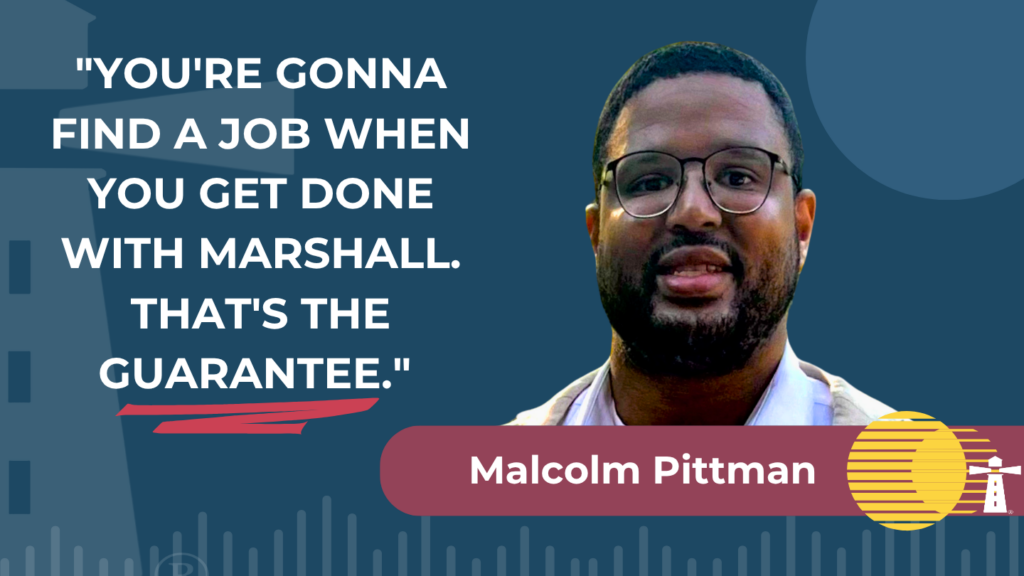
- “You’re gonna find a job when you get done with Marshall. That’s the guarantee.” [00:10:05]
- “They don’t need a lecture about algebra two. They need somebody to talk to about their trauma.” [00:14:29]
- “I could be whatever they need at the moment. I could be that for them.” [00:15:11]
- “She had no idea what she wanted to do. Now she’s at Miami University studying to be a nurse.” [00:17:15]
- “First person in their family to graduate high school. I guess there’s more than is possible.” [00:21:56]
Full Podcast Transcript
Janet Courtney [00:00:01]
Hello everyone and welcome to the brighter together podcast. My name is Janet Courtney and my special guest today is Malcolm Pittman. Malcolm is a student success coordinator at Marshall High School in Middletown, Ohio. Malcolm, welcome to the show.
Malcolm Pittman [00:00:19]
Thank you for having me.
Janet Courtney [00:00:21]
So Malcolm, tell us a little bit about how you became a student success coordinator and then tell us a little bit about Marshall High School.
Malcolm Pittman [00:00:30]
So my whole dream, I mean, I’ll go all the way back, is my dream since I was 14 years old to work in education. I started working with kids at that age and I started to find a real passion for working with kids. that, know, ever since then I had a dream of, know, I want to play college basketball and then move on to play, to coach and also teach. So ever since then I’ve been preparing for that, which led me after playing
know, playing college basketball, grad performance in college in Ohio, go Quakers. We, after I was able to graduate and then go into work in Dayton Public Schools as a Algebra 1 teacher, I left that to be a eighth grade teacher at Dayton Early College Academy and then went from there to Southwest Ohio Prep, which was a
a little bit of a charter school in Cincinnati. And I went from there and I got to Marshall High School. I started at Marshall as a math teacher. I went from math, then I did math and social studies. But in the midst of that, my mentors, my principal, Mr. Hall, Chuck Hall, and one of our principals at the sister school in Hamilton, Kelvin Moss, they…
really got in my ear about, you know, I needed to be a, my masters as long as, as well as my dad and my mom. So along with them and my whole family getting on me about getting my masters in education and administration. So one of the myths of that are because we’re a charter school, we’re able to relabel positions. So instead of saying this is an assistant principal, they may say, you know, this is student success coordinator, dean of students or.
Janet Courtney [00:02:03]
Mm-hmm.
Malcolm Pittman [00:02:24]
you know, whatever different position is. And so what ended up happening is the person who was in my position before he stepped down. So when that position opened up, they already knew that I was in the midst of studying for my masters. They were like, well, if this is open, you know, we had a conversation and I’m getting, you know, taking that position. So it’s kinda how I got to be student success coordinator ever. And that was back in, this is my third year.
Janet Courtney [00:02:27]
Right.
Malcolm Pittman [00:02:54]
as student success coordinator at Marshall High School. Marshall, we’re a credit recovery school in Ohio. So we’re geared towards kids who, not even just kids, we go from 15 to 22. And then we’ll have kids from all over, just a waffle walks of life. Midtown is a huge poverty problem. And we got a lot of kids who come from that area who, know, a traditional education just didn’t.
Janet Courtney [00:03:09]
Okay.
Janet Courtney [00:03:17]
Yeah.
Malcolm Pittman [00:03:23]
just work for them. So they go to us and we give them a flexible schedule, and the opportunities for them to get a career tech certification so that when they leave out of here, they’re able to get a job and move on. So we just give them opportunity to be able to succeed. So I love what I do. I’ve been here since 2019 and I just absolutely love it here. And I feel like I do a lot of good and cool things here, like coach basketball, do
clothing dry or do clothing pantries do help with food drives things like that so you know a lot of huge chance kind of serve you know our sort of our students.
Janet Courtney [00:04:05]
Nice, yeah. I love that. they have, you have, Middletown is the home of our vice president, J.D. Vance. And if you’ve read Hillbilly Elegy, it’s, Middletown is just such a Middletown America. I mean, it just is Middle America. It’s halfway between Cincinnati and Dayton. And they always called it a bedroom community when I lived there.
So to have that legacy there for your kids too is just anybody, anybody. He came from poverty in Middletown. These kids that you’re serving, that could easily have been him had it not been for his grandma and the support he had, right?
Malcolm Pittman [00:04:44]
Mm-hmm.
Malcolm Pittman [00:04:53]
Yep, he’s been a huge inspiration in this community. We have different clubs and different things the programs work with. And one of the programs we have is Middletown Youth Council. then the Youth Council, where they have their meetings, that is actually right by one of JD Vance’s offices in Middletown. So it’s pretty cool to be able to have the kids be able to see that, to be able look up to people like him, not just professional athletes, but also different people around.
different walks of life they can look up to.
Janet Courtney [00:05:25]
Yeah, yeah, that’s fantastic. So about how many kids do you have at Marshall?
Malcolm Pittman [00:05:31]
We have about 410 kids. We have…
Janet Courtney [00:05:35]
Not a small school. You’re not a small school then.
Malcolm Pittman [00:05:38]
but as funny as we, we are because we typically serve, because these are kids with poverty issues, with academic issues, attendance issues. We have kids with various stories coming around. And, so we do, we kind of meet them where they are. We do have a small school field to us because we’ll have, you know, we typically have about six to seven academic classrooms and they’re filled with about.
Janet Courtney [00:05:59]
nice.
Malcolm Pittman [00:06:08]
13 kids each. So, and then we also have career tech areas and they have about five to six kids each session. So typically, we have around 100 kids each session. We have two different sessions. We have a AM, so we have an AM session and a PM session. AM is from 7 AM to 11 AM and then PM is from 11 30 to 3 30. So we get kids who know, we’re just trying to adapt and meet them where they’re at.
Janet Courtney [00:06:23]
I see. Okay.
Janet Courtney [00:06:38]
Mm-hmm.
Malcolm Pittman [00:06:38]
We also offer online programs, tutoring. We try to just meet them where they’re at because these kids go through, I just dropped off a few kids at their house and they live in very rough neighborhoods and we just wanna make sure that we provide every possibility for them to be successful.
Janet Courtney [00:07:00]
Yeah, yeah. I’ll take the 1130 to three, please.
Malcolm Pittman [00:07:05]
Well, I’ll take a 70 to 11. The kids know that.
Janet Courtney [00:07:10]
You’re a morning, I’m an afternoon. That’s awesome. I’m not a morning person. Never have been. My husband and I, I mean, I’m awake. I get up at 630 in the morning, but I’m not functioning well until about nine. Don’t ask me to make any major decisions before nine in the morning. That’s funny.
Malcolm Pittman [00:07:30]
Okay.
Well, I’m normally a little tired after about 2.30. That’s when most of our kids are out the building. like, all right, we made it. We’re almost there.
Janet Courtney [00:07:41]
Yeah.
Janet Courtney [00:07:44]
Yeah, exactly. Awesome. So what, so you’re helping them to get caught up because they’re behind in credits and you’re helping them to graduate from high school, but also you’re helping them to find a next, right? What’s next after high school? Not just doing high school and being done, but finding a path for themselves. Is that correct?
Malcolm Pittman [00:08:08]
Yeah, we have a career navigator, that’s his title. And what he does is we have connections with various community organizations, different companies, things like that. So between me and our community navigator, we have worked with different organizations, different companies, along with our career tech teachers, they work with different companies to find opportunities for these kids after high school.
Janet Courtney [00:08:12]
Okay.
Malcolm Pittman [00:08:38]
So, you know, for instance, we have different career tech tracks. We have culinary, which is ran by our chef who’s actually on season 21 of Hell’s Kitchen. name is Mindy Livinggood. She does a great job. And I know we have our construction teacher, Mr. Goyer, our healthcare teacher, Mr. Jessica Shoemaker. You know, we give them, our business teacher, Ms. Leslie Reese, we give them ample opportunity.
to give them a chance to get a job. Those teachers I named off, as well as our former construction teacher, Tim Warhoyt, they will sit down with these businesses, along with a career navigator, form these partnerships so that when a kid is to a certain point in their career tech, they’re already working for somebody. Before these were graduate high schools, we had people working for furniture stores already, for manufacturing plants already.
Janet Courtney [00:09:29]
Mmm.
Malcolm Pittman [00:09:36]
for nursing homes, they’re already working now. as soon as they sign the paper saying they’re graduated, they’re already in the field. So we try to give them an opportunity to do that as well as our career navigator, Joe Snipeley, also gives a huge, one of the biggest things he does is after he follows you up with our graduate students, even up to a year after graduation. So they have a,
Janet Courtney [00:09:46]
Nice.
Malcolm Pittman [00:10:05]
So we make sure that our doors are always open. We have kids that graduate, that come back to Marshall and want to look for a job and they’ll sit down with our career navigator and see what job is available. So we don’t want leave anybody behind. We even allow kids to finish their medical assisting certification after they graduate. So we have our health care. You can finish your phlebotomy certification.
I got physician assistant, no patient care, sorry, patient care. You finish the patient care certification and after that, you we have our medical assisting certification, but some of the kids will be graduated by then and some of them, we will allow kids to come back and finish those too. So, know, the kids are gonna, you’re gonna find a job when you get done with Marshall. You’re gonna find one. That’s the guarantee that, you know, not just us, but also Oakmont, the company we work for, we’re under.
Janet Courtney [00:10:40]
Okay.
Janet Courtney [00:10:53]
Nice.
Malcolm Pittman [00:11:05]
Overall, all our schools are built like us, that you’re designed for, you’re graduate and we’re gonna find you a job, we’re gonna find you, you’re next, you’re not gonna do this alone.
Janet Courtney [00:11:16]
All right. That’s amazing. That’s amazing. So what what is your graduation rate look like then?
Malcolm Pittman [00:11:24]
Typically, so that is one of the toughest questions I know people ask me all the time because we have, it’s a dropout recovery school, as far as we do use cohorts to track different groups for graduation, typically it’s just because it’s such a passive thing, we really don’t necessarily don’t track the graduation rate. more track, one of the things, the measurements we take is the amount of kids do graduate total.
Janet Courtney [00:11:34]
Right?
Malcolm Pittman [00:11:53]
because Marshall is designed to graduate at your own pace. We’ve had kids come in at Marshall at 15 and graduated at 15. We have kids who graduate coming at 16 and graduated 17. We’ve had kids coming at 15 and graduated 22. It just depends on the situation on that kid. So typically like last year was our biggest graduation with over 100 kids graduated.
Janet Courtney [00:11:56]
Right.
Malcolm Pittman [00:12:21]
Typically, the last few years I’ve been at Marshall, we’ve had a typical graduation would be around 60 kids, around 60 kids. This year we’re anticipating around 80 kids. So because the way Marshall is structured too is there’s kids that won’t find out they’ll graduate until maybe a day of. Because there’s still so many requirements to fill out that you need to do that at traditional school.
Janet Courtney [00:12:36]
Nice. Yeah.
Malcolm Pittman [00:12:50]
You’re already doing those requirements, so it’s not really a big deal. But our school, you’re doing it in such a rush, you have to go get these things done. Because if not, you can still stay here for longer.
Janet Courtney [00:12:57]
Mm-hmm.
Janet Courtney [00:13:01]
Right? Yeah. But these kids would not have a place if it hadn’t been for schools like you. So how long has Marshall been there?
Malcolm Pittman [00:13:11]
It has been open since 2013 and it used to be a school called Life Skills. And then I will not be sure what actual date, but they moved from Life Skills on one side of town, of Middletown to this building I’m in right now. used to be Aldi’s and they moved to this building here. around, I want to say, I think it was 2016, 17.
Janet Courtney [00:13:19]
Okay.
Janet Courtney [00:13:33]
No kidding.
Malcolm Pittman [00:13:40]
So this building has been through a lot. It’s been a lot of changes. We’ve added rooms. used to be like four or five classrooms and then we had our CareerTech areas and we moved on. Now we have, our manufacturing is built like a mini factory right now. Our healthcare room is built like a doctor’s office. We have latest technology right now at Marshall. So this building has been…
Janet Courtney [00:14:03]
nice, yeah.
Malcolm Pittman [00:14:08]
through a lot in the last few years, but yeah, we started on Mr. Hall, our principal, he started this off and got 213.
Janet Courtney [00:14:19]
Nice, very nice. So what would you say is your favorite part? What is the thing that you love that you get to do the most?
Malcolm Pittman [00:14:29]
just build relationships with the kids. mean, it’s a, it’s not, a way, it’s very different than a traditional school. I don’t have to go in there and, know.
One thing I explain to people is the boundaries things that you would normally have to go through as traditional school, those, yes, you have boundaries and, know, professional boundaries and things like that, but these kids, they don’t need necessarily a personal lecture at them about algebra two. They need somebody to talk to about what just happened to them last night. You know, why am I dealing with these trauma? Why am I dealing with all these things? So, you know, I’ve, I love that I can wear various hats. I can be,
Janet Courtney [00:15:02]
Bye.
Malcolm Pittman [00:15:11]
I could be the guy that’s on them heavily. I could be the nice guy. I could be their uncle. I could be, you know, I could be whatever they need at the moment. I could be that for them. And that’s where the cool thing that Lovell Marshall is. Mr. Hall gives us the opportunity in a to do that. You know, I’ve been able to see kids at their worst. I’ve been able to help provide for families. I’ve been able to…
You know, do a lot of good for the community as a whole, but we’ve been able to like, you know, get food for kids. We’ve been able to get clothing for kids, help them with housing, help them with jobs. We’ve been able to help a lot of different kids and, you know, it’s been a great, it’s been amazing experience at Marshall. I would not, you know, give back for anything in the world because I could, you know, really help a lot of kids. You know, we’ve had a kid’s debt.
We had one girl in particular that she had no idea what she wanted to do after high school. She worked at Walmart and she figured after high school, I’m going back to Walmart. It doesn’t. I’m just trying to this diploma. And we’ve got her to be in student council. We to be here to be the captain of our basketball team. We got her to go to prom with all these things that she didn’t want to do. And then she ended up now, she’s at Miami University.
Miami University right now finishing studying to be a nurse. And she would never have, and we have a ton of kids who are just like that, where they would never have thought they would do more than what they’re doing now if it wasn’t for Marshall to be able to build relationships.
Janet Courtney [00:16:38]
Nice.
Janet Courtney [00:16:50]
Yeah, so you get to be a mentor. You get to be somebody that they can look up to and somebody who who’s been through college and has, did you, have you finished your masters? Did you finish your masters yet?
Malcolm Pittman [00:17:00]
Yep.
I guess I did, so I do, I have finished my masters, and I have my principal license, so that was a big burn off my shoulders. It is.
Janet Courtney [00:17:08]
Yeah, that’s hard. It’s hard work. It’s hard work. But, but you know, kids see that too. They, they see that you’re doing it just as much as, as there’s their life is hard. Your life is hard, but yet you just keep doing it. You keep stepping into it, right? You just, you just don’t, you don’t quit. You don’t quit. Even when it’s hard, you don’t quit. Yeah.
Malcolm Pittman [00:17:15]
and
Malcolm Pittman [00:17:30]
Exactly. Exactly. The kids do see that. So it’s pretty cool if you’re going to learn those lessons.
Janet Courtney [00:17:38]
Do some of the kids also go into the military through you guys? Is that something that they can do or no?
Malcolm Pittman [00:17:43]
Yes, we do. have, I’m really proud of those kids too. We’ve had two kids in the past two years that went to the Marines. And we’re starting to get a lot of kids are interested in going to the Army. Those are two biggest branches we partner with, but we’ve had a lot of kids that are coming, that are interested, especially in the Marines.
Janet Courtney [00:18:06]
Yeah, yeah. That’s awesome. My son right now, it is April 28th guys, for those of you 2026, cause this will come out in six weeks. But my son right now is in basic military training at Lackland in San Antonio. He’s joined the air national guard and he, but he wants to, he wants to go back to school and he wants to fly. So, but you can’t
Malcolm Pittman [00:18:15]
It’s been.
Malcolm Pittman [00:18:30]
me
Janet Courtney [00:18:32]
go into flight school unless you have a degree. So, you know, and he, and he’s, he’s one of those kids he, he worked for me for a while. Didn’t really, he was a COVID grad, right? So 2020 didn’t, didn’t love online school. Yeah. So, and now he’s, know, he’s about to be done two weeks from today. We’re heading over to San Antonio, to cheer him on as he, as he graduates. So super exciting. Yeah. Yeah.
Malcolm Pittman [00:18:45]
Yeah.
Malcolm Pittman [00:18:58]
Congratulations, that’s a huge accomplishment.
Janet Courtney [00:19:02]
It’s fun. I’ve been, I’m one of those crazy moms. I’ve been writing him a letter every day. It’s hard to know what to write every single day. I told him, said, mama’s going to give you a verse and a joke because you need God and you need some laughter.
Malcolm Pittman [00:19:06]
I’m
You’re a piece of
Malcolm Pittman [00:19:14]
Amen
Janet Courtney [00:19:17]
So he’s and he’s got a girlfriend and she’s real serious and they’re up in they both live up in Michigan, but he’s down here right now. Well, she’s flying in and we’re just super excited. so, you know, I’m so proud of him. So proud of him. That’s it. Just, yeah, it is. is. So seeing those kids at the same thing, I’m sure you guys, you guys have that same pride. You work so hard with these kids. You’ve, you know, you see them coming from awful situations and they
Malcolm Pittman [00:19:33]
That is super exciting.
Janet Courtney [00:19:47]
and they persevere through it and then they’re successful and they stay successful. And that makes it, that absolutely makes it all worth it, doesn’t it?
Malcolm Pittman [00:19:53]
Zoom.
Malcolm Pittman [00:19:59]
It does. It’s one of the things that keeps me coming back to Marshall. It keeps me motivated. Especially at this time, this is our push to get kids to graduate. And honestly, it’s one of the best feelings in the world. see, like, our kids can get done at different points. So we have kids who, they can be credit complete, as we call it. They can be credit complete by, you know, in the middle of the year. And so that kid is done with school. And those are the best feelings in world when a kid comes to us and says, you know, I’m done. I finished.
You know, and those are one of the best feelings in the world is a kid comes in and says, finished. I just want to say, you know, I want to say thank you for everything you’ve done. And you know, thank all the teachers that helped them in a normal way. And one of the other best feelings in the world too is like, are Marshall, our graduation is very different than most people. We, instead of getting a graduation speaker, we have what’s called a rose ceremony. So a kid will grab a rose and they will be able to go to the mic and say,
who really impacted them. And a lot of them will say, you know, what makes me really happy is they’ll say the teacher. I’m like, one of teachers I work with closely, I’m like, okay, that’s pretty cool. Or they’ll say, you know, their parents and things like that. And it’s really cool to see, know, to know their story and to know that this kid went through and to know, okay, these people are the people that really did have an impact on them. So it was really cool. I get to see, you know,
A lot of kids walk the stage. get to see a lot of kids conquer a lot of things that have been going on with them and get a lot of wins. So I can suck cock all day at Paul Marshall, but I love just what we get to do and what I’ve been blessed to be able to be in position to just help these kids do more in their lives because a lot of them wouldn’t even think that this was even possible. We’ve got a lot of kids who, this the first time.
Janet Courtney [00:21:39]
Yeah.
Janet Courtney [00:21:52]
Right, yeah.
Malcolm Pittman [00:21:56]
They even get to, I mean, it’s the first person in their family. They might be the first person in their family to graduate high school. We get a few kids like that. And so it’s really cool to see those kids be like, you know what? I didn’t think it was possible, but I guess it is possible. I guess there’s more than is possible.
Janet Courtney [00:22:12]
Yeah. Yeah, absolutely. So, Malcolm, where do people go if they want to learn a little bit more about Marshall or have questions for you? How can they find you?
Malcolm Pittman [00:22:25]
You can look us up at Marshall High School Middletown. You can also look up Oakmont Education. That’s where you’ll find a lot of things about us. We also have a Facebook page under Marshall High School Middletown. we have various… Oakmont’s an overarching company that’s in charge of us. So if you want to find anybody like us, you go under Oakmont Education. But if you want to just look up Marshall Middletown…
Look on Marshall High School, Middletown, Ohio and you’ll find us. Or our sister school, Marshall High School, Hamilton. They’re the same thing as us, our sister school. Ran by Kelvin Moss who does a wonderful job over there as well. are, two, those are both of us are under the same, under the same Marshall name.
Janet Courtney [00:23:14]
Awesome. Yeah. And Oakmont, is it O-A-K-M-O-U-N-T?
Malcolm Pittman [00:23:20]
O-A-K-M-O-N-T.
Janet Courtney [00:23:23]
M-O-N-T, okay, good, good. Yeah, because we have, wasn’t 100 % sure. And if you’re listening, I want you to have the right, because spelling was never my favorite. Me too, spell check, grammarly, gotta love them, gotta love them. For sure, for sure. Well, Malcolm, it has been an absolute pleasure. Keep doing the hard work that you’re doing because you’re changing the world.
Malcolm Pittman [00:23:32]
Hey, neither is mine. That’s why I love the bill check. Hey, Graham really been my best friend. So.
Janet Courtney [00:23:53]
You are just, yeah.
Malcolm Pittman [00:23:54]
Not just us, our whole staff is doing a great job. Our staff, all our teachers do a wonderful job of being in these kids’ lives and having so much of positive impact on them. Even before they even get to me, the teachers are doing a wonderful job of not just providing education through our… Because we use online curriculum so kids can get through them faster.
So teachers not only are just assisting them through online curriculum, but they’re also just providing life advice, giving them opportunities to get out the building, find new things like field trips. Like our teacher, Mr. Russ, has taken them to, what did he take them to? He took them to the Underground Railroad Museum before, Duke Engineering Museum before, our other teacher Ms. she gave to, she the kids to Newport Aquarium.
We’ve had another teacher who took on the kids fishing for fishing club, Mr. Feltes. So we have a lot of cool things teachers get to do that are really helping the kids just get out of their shell and do a lot of cool things around.
Janet Courtney [00:24:58]
Awesome, awesome. Well, it’s so great to hear and I just love the fact that you guys have such passion for those kids and giving them an opportunity that they wouldn’t have without you for sure. So thank you. Yeah, absolutely. And I’m glad that Brighter Together could be here to help you guys get that story out there because it’s a story that needs to be told. It absolutely does.
Malcolm Pittman [00:25:12]
Exactly. Exactly. Yes. I love it. love it. So thank you.
Janet Courtney [00:25:24]
And thank you for your time and being willing to come on and tell this story because it’s an excellent story for people to hear. So thanks.
Malcolm Pittman [00:25:32]
and no problem. Thank you for having me.