

Episode Description
Here’s the surprising truth that could transform your district’s approach to school psychology staffing: there’s a federally mandated, federally funded position that comes with ironclad job security—yet most districts aren’t leveraging it strategically. In this eye-opening episode, we explore why the school psychology shortage is reaching a critical point and uncover the one staffing model that could ease the burden on your leadership team.
Joining us is Denise Rahe, a part-time school psychologist with Colorado River BOCES, who brings decades of experience in special education assessment and a refreshingly candid perspective on what works—and what doesn’t—in today’s staffing landscape. Denise shares her journey from full-time burnout to a more sustainable part-time model, and reveals the hidden advantages (and trade-offs) that most district leaders don’t realize exist.
What You’ll Learn:
In this episode, you’ll discover:
- Why school psychology positions are federally protected and funded differently than other district roles—and how to use this to your advantage
- The critical staffing ratio that most districts aren’t even close to meeting (and what it means for your students)
- How to structure part-time school psychology roles for maximum impact without sacrificing collaboration
- The real cost of losing institutional knowledge and day-to-day relationships with staff
- Practical insights into attracting and retaining school psychologists when salary isn’t your strongest selling point
Key Takeaways:
✓ Federal funding provides true job security: School psychology positions are mandated and federally funded, insulating them from district budget cuts—a stability many educators crave.
✓ The shortage is severe and growing: With recommendations of one school psychologist per 500 students, most districts fall drastically short, creating unsustainable workloads.
✓ Part-time flexibility has real appeal: For experienced professionals, part-time arrangements can improve work-life balance and retention—but require thoughtful implementation.
✓ Collaboration suffers in isolation: Remote or part-time models create communication gaps that ripple through special education processes and staff relationships.
✓ Job security may matter more than salary: In a competitive market, the guarantee of federally-protected employment could be your strongest recruitment tool.
What Denise Has to Say:
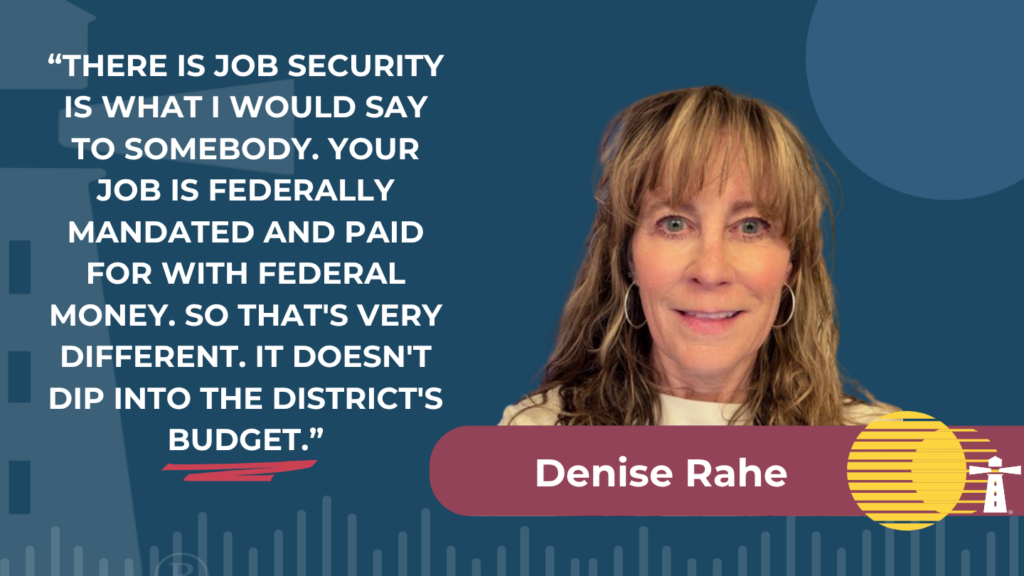
“There is job security is what I would say to somebody. Your job is federally mandated and paid for with federal money. So that’s very different. It doesn’t dip into the district’s budget.”
“We definitely need more people in the field. The recommendation is one in 500, which we’re not even near that with our social workers, let alone us providing just the assessment piece.”
“Not having that day-to-day contact with the staff, you miss out on some things. Sometimes things get lost in translation through emails, and like 10 emails down the road you finally get to where you think, ‘Okay, we’re both on the same page,’ but things like that.”
If you’re a superintendent, special education director, or district leader wrestling with staffing shortages, this conversation will challenge how you think about school psychology positions. Denise’s candid insights into the real benefits—and real challenges—of creative staffing models could be the strategic advantage your district needs.
Don’t miss this episode. Listen now and subscribe to stay ahead of the staffing solutions that matter most.
FULL PODCAST Transcript
Lighthouse Therapy (00:01.048)
Hello everyone and welcome to the brighter together podcast. My name is Janet Courtney and my special guest today is Denise Ray. Denise is a school psychologist at Colorado River Boces in parachute Colorado. Denise, welcome to the show.
Denise Rahe (00:17.808)
Thank you.
Lighthouse Therapy (00:20.246)
So Denise Teller, I’m sorry, go ahead.
Denise Rahe (00:25.444)
I wasn’t going to say anything.
Lighthouse Therapy (00:27.206)
okay. Okay, so tell our listeners a little bit about you and about Colorado River Boces.
Denise Rahe (00:36.38)
Okay. So as you said, I’m a school psychologist. I retired about three years ago. Previously I was a special ed director for the Colorado River Boces. And prior to that, a director for one of our member districts. Prior to that, school psychologist. So I’ve come full circle.
The BOCES covers multiple school districts and BOCES stands for Board of Cooperative Educational Services. And they’re set up around the state of Colorado in order to provide specialized services for ruler districts, know, like psychs, speech, OTs. But over the years, the concept of the BOCES has expanded a little bit.
Lighthouse Therapy (01:16.535)
Okay.
Denise Rahe (01:33.79)
Right now the Colorado River Boces covers the parachute district which is in Colorado called Garfield 16 and then also covers Garfield RE 2 which is the towns of Rifle, Silt and Newcastle. Additionally the Boces we have our own alternative high school.
We used to also cover more districts but larger districts as districts have gotten larger they’ve pulled out and established their own administrative unit so now we just we just cover two districts but we have a little hands and a couple others but just the two are fully in if that makes sense.
Lighthouse Therapy (02:27.81)
Gotcha. Yeah. It makes sense that bigger schools as they’ve gotten bigger would be able to cover all those services on their own. Right.
Denise Rahe (02:36.25)
Yes, yes, definitely. Yeah.
Lighthouse Therapy (02:38.946)
Yeah. So you retired and you went back to school psychology. So easier, better, different. What is it? What do you think? What would you say?
Denise Rahe (02:50.684)
Maybe all of the above? Definitely, because I’m not working as much for one thing. I’m part-time now, so that’s nice. I have more flexibility in my schedule, which is what I wanted.
Lighthouse Therapy (02:53.358)
Okay.
Lighthouse Therapy (03:00.078)
Okay.
Denise Rahe (03:09.574)
for my children and I am, guess you, I’m not dealing with the big problems or the big issues, not necessarily just problems, but I’m not dealing with those big.
overarching developments and everything. Now I just go in I get a list of kids that need to be tested. I’m I’m only testing and I just go and I test. mean I’m also consulting with schools and I’ll help. I help do FBA’s and develop BIB’s behavior intervention plans those kinds of things and I’m.
Lighthouse Therapy (03:37.483)
okay.
Denise Rahe (03:51.482)
And teachers will ask me questions and consult with them to help them figure out next directions and things like that. But I’m not involved with the program development anymore. And so it is definitely less responsibility, which is exactly what I wanted.
Lighthouse Therapy (03:59.459)
Mm-hmm.
Lighthouse Therapy (04:10.286)
Yeah, yeah, being a director of special education is hard work. It really is very stressful and hard work for sure, for sure. So is it is it a little bit weird for you though? Like you used to be the one that was the director because it’s the same. It’s the same Boses, correct?
Denise Rahe (04:30.682)
Yes. Initially, I think it was a little weird for everybody because they would ask me questions and everything and I would be like, guys, I’m not the director anymore. You have to go ask, you know, your director. And I’ll.
I’ll tell you what the law says, but you need to check and see. Because in Colorado, we’re a local control state, so each district can make decisions for themselves. And the rule of thumb is you have to follow the federal law, but you can be tighter than the federal law. So sometimes we are a little tighter in what we want paperwork wise and process wise.
So that’s why I say this is what the law says but you you need to go talk to your director and find out if this is exactly or they’re doing something a little differently.
Lighthouse Therapy (05:33.795)
Right? Yeah, yeah. That’s interesting. I’m sure, cause I’m the CEO of Lighthouse and my daughter, we’re grooming her to take over. And I’m like, when I leave, do I just cut that cord completely? like, not, but it’s my baby. You know, I’ve been the one from day one. She was there from the beginning. Don’t get me wrong. She’s amazing. And I know when I completely pull out a hundred percent, she’ll do a great job too.
Denise Rahe (05:34.704)
Yeah.
Lighthouse Therapy (06:02.85)
But it’s a hard balancing act to figure out, you know, but I’m six or seven, eight years from now. They keep teasing me and saying, mom, you’ll never retire. But who knows? I told them, give me some grandbabies and I’ll retire.
Denise Rahe (06:10.044)
Please, I tried to. Yeah. Yeah.
fair. Definitely. Is she also a speech therapist?
Lighthouse Therapy (06:23.884)
Yeah. No, actually she is not. is, she’s our COO right now. she has all of our billing and payroll and many, many other things and supports me and, and she’ll tell everybody she’s a glorified PA for me, but it’s way more than that. So, but she does an amazing job and, it’s something that just makes us a little bit different where we’re totally a family owned and operated. We have other employees, obviously there’s five Courtney’s, but
Denise Rahe (06:30.373)
Okay.
Denise Rahe (06:39.26)
Yeah.
Lighthouse Therapy (06:52.398)
And actually we’re losing my youngest. is actually going on to he’s in the Air National Guard in his last days in a month So he’s gonna be in basic training and doing all of that. Yeah, so So big changes there. Yeah. Yeah, he wants to fly he wants to fly
Denise Rahe (06:52.422)
So, good.
Denise Rahe (07:04.636)
Well good for him. Yeah, very. wow, awesome. Yeah.
Lighthouse Therapy (07:10.796)
Yeah, yeah. So, so now that you’re retired and you’re only doing testing, what would you say to somebody who is considering going, get it either getting out and retiring like you did, or just getting started?
Denise Rahe (07:29.712)
Well, if someone was just thinking about getting started, I would say, please, please, please do it because there is a national shortage of school psychologists and we’ve had to be creative in our districts. mean, most, I think big cities, they’re…
Lighthouse Therapy (07:36.31)
Yeah. Yes.
Denise Rahe (07:48.664)
Okay, but at least in the state a lot of people they prefer they want to work in Denver. They don’t want to come up here and so we have a hard time in our districts. What we’ve done is we have social workers that carry their in about two or two to three schools and they provide the direct services and then the school psychs. We do the testing. We’ve also trained
the social workers to do social emotional testing primarily the BASC. Yeah, but we do pretty much the other psycho educational type testing. The special ed teachers in our area do do the academic testing which helps. That’s how it is everywhere though.
Lighthouse Therapy (08:24.792)
Gotcha.
Lighthouse Therapy (08:38.722)
Right.
Right.
Denise Rahe (08:42.746)
Yeah, so right now we started out with, well right now we have one full-time psych and she does everything and she’s just in one district. Then we have a part-time psych and she’s retired too and came out and she does everything in that same district, in the parachute district. And then myself and two other psychiatrists, psychologists are also retired.
and work part-time and just do the testing. So right now like 90 % of the school psychologists that are high that work within the Colorado River Boces are retirees that have come back to which is I mean it’s not a bad deal because in Colorado you can double dip so you can get paid and get your retirement so
Lighthouse Therapy (09:37.816)
your retirement benefits it, yeah.
Denise Rahe (09:39.44)
Yeah, which that’s nice. And then because we’re not tied to a specific school, we have more flexibility in our schedule and can like, you know, say, OK, I’m going to get all these kids tested and then I’m going to be out of town for a few days. And so you can kind of, know, you know what you got to get done, you know, when you have to get it done by and plan accordingly.
But if someone was thinking of getting into the profession, I would just really encourage them because we do need more school psychologists because when I originally started, I was doing everything, providing services, doing all the testing, sometimes doing academic as well, not all the time. you know, and that was a while ago. So.
We pretty much did everything with every child. That was the kind of the thought process back then. Now we’ve kind of gotten away with that, away from that I mean. We don’t have to give a cognitive to every child. Although lately I’ve seen the pendulum kind of swinging back to everybody wants a cognitive again.
Lighthouse Therapy (10:57.966)
Mm-hmm.
Denise Rahe (10:58.716)
And so we definitely need more people in the field. the recommendation is one in 500, which we’re not even near that with our social workers, let alone us providing just the assessment piece. There is job security is what I would say to somebody.
Lighthouse Therapy (11:21.632)
Yeah. Yeah.
Denise Rahe (11:24.942)
You know, your job is federally mandated and paid for with federal money. So that’s very different. It doesn’t dip into the district’s budget. So there is definitely job security. know, I guess a con is that the pay working in public education isn’t always the highest.
Lighthouse Therapy (11:30.019)
Yeah.
Denise Rahe (11:55.29)
You know, there’s usually ways built into the system to grow your salary. You know, after you get so many CEUs, most districts will give you more money. Continuing education units, sorry for the viewers that aren’t sure what all my acronyms mean. Yeah, but.
Lighthouse Therapy (12:15.65)
That’s good, thank you. Appreciate that.
Denise Rahe (12:20.442)
You know, it’s also very rewarding because you’re making a difference in little one’s lives and
I mean, even just testing them is, I’m just so glad to still have that touch point with them because they say the funniest things. I was testing this little one, I don’t know, maybe a month or so ago. And I don’t know if you’ve heard the new craze, but once I say it, you might know what I mean.
I was testing him and I said something about do six and seven and he was like six seven six seven six seven and he was like five years old and I was like you’re kidding me with this right?
Lighthouse Therapy (13:00.078)
yeah.
Lighthouse Therapy (13:06.796)
don’t know what it is, but I have heard of it. I’m just aging myself here. My kids brought it. We’re talking about it a couple of weeks ago and I was like, I don’t know what that is, but okay, whatever.
Denise Rahe (13:17.636)
It’s kind of funny for sure. They’re kind of goofy. But yeah, I mean, so that made me laugh. I was like, okay, that’s the funniest thing. I can’t even believe this child has heard of that. But yeah.
Lighthouse Therapy (13:33.432)
Well, and that’s just it. Social media and and all of the access they have to anything that’s electronic, you know, computers and TVs and tablets and everything. It all changes the world that we live in, doesn’t it?
Denise Rahe (13:47.963)
Yes.
Denise Rahe (13:51.644)
100%. Yes, in many ways. Many ways positively, many ways negatively. But yes.
Lighthouse Therapy (13:58.967)
Yeah, yeah, I don’t. The thing is, we’re to have to learn how to figure it out and because it’s not going away. We know it’s like AI. It’s not going away. We just have to learn how to how to use it productively for kids, I think, you know. Yeah, for sure, for sure. Yeah. So what would you say is one of your biggest challenges about not being specifically at the school all the time?
Denise Rahe (14:13.168)
Yes. Yeah.
completely.
Lighthouse Therapy (14:28.45)
I know the flexibility is great and you have the, can make your own schedule and all this, but what would you say is a drawback?
Denise Rahe (14:35.292)
Not having that day-to-day contact with the staff. You miss out on some things and sometimes I would say things get lost in translation through emails and so like 10 emails down the road you finally get to where you think, okay we’re both on the same page, we both understand, but things like that. And we’ve created a system as in we as school psychologists where we have an assessment request for
Lighthouse Therapy (14:40.78)
Yeah.
Lighthouse Therapy (14:47.462)
yeah.
Denise Rahe (15:05.486)
that people fill out and sometimes that doesn’t always get done and we’ll get a email that says, so-and-so’s meeting is in two weeks and we’re all like, who’s so-and-so? We didn’t know that. So it’s that, that just in the hallway conversation of.
Lighthouse Therapy (15:22.179)
Right.
Denise Rahe (15:26.97)
popping by and going, hey, I’m just checking in. Where are we? What’s up next? So that’s definitely a con.
Lighthouse Therapy (15:27.17)
Mm-hmm.
Lighthouse Therapy (15:35.692)
Right, right. Yeah. Awesome. Okay. So
Denise Rahe (15:39.182)
I hate to interrupt real quick. My computer’s about to die. I know this has been just one mess up after another. Can I run and get my plug because I didn’t do it? All right, I’ll be right back.
Lighthouse Therapy (15:48.63)
Yeah, no, go right ahead. I’ll make a note of it. I’ll make a note of it.
Denise Rahe (16:20.892)
Okay, let me plug it in.
Denise Rahe (16:30.19)
Okay, there we go. Sorry, of course, I didn’t grab the plug when I came up.
Lighthouse Therapy (16:34.904)
That’s okay. That’s okay. Okay, so let me just 16 about 1645. So I guess the the the next question would be, we talked about your challenges, we talked about the pros and cons of going into school psychology. How about being a director of special education? How would what would be some of your
recommendations for somebody who might be looking into that. Or did you already touch on it broke up a little bit so I might have missed some of it. So if I’m repeating my questions, please let me know.
Denise Rahe (17:07.676)
I think that.
Denise Rahe (17:14.918)
We’re not, you’re not. I think the original reason that I went into being a director, and I think that if someone else has the same mindset, that’s great. I just felt like I wanted to kind of do more, you know, and hit things from a bigger picture, not just individual schools, individual students. And…
Lighthouse Therapy (17:17.559)
Okay.
Denise Rahe (17:42.348)
and make some systems changes is what I hoped would eventually happen. And that’s why I went into it. I think that if people want that bigger picture and that amount of responsibility, that’s great because we need people. We need people in those positions.
I would recommend that you have several years of special education experience in any way, shape or form, but just within the field, not going from gen ed, getting your license and then into special ed because it’s very nuanced and there are so many laws and there are so many rules and so it can be overwhelming.
Lighthouse Therapy (18:27.032)
Mm-hmm.
Lighthouse Therapy (18:32.461)
Yeah.
Denise Rahe (18:37.15)
you don’t have that background already for it. And I’d also say, be prepared that there are going to be, there’s gonna be wins and there’s gonna be difficulties. There’s gonna be the kiddo that you see five, 10 years later that is doing so good that melts your heart and…
and you know that you helped make a change for that individual’s life. And then there’s gonna be some more challenging situations where people don’t see eye to eye. And just being prepared for that and knowing that.
If you’re following the law and you’re doing your best, things can probably be worked out. And just keeping that child in mind as to this is why we’re here and this is what we’re working on. But I think that being in the special ed realm is very rewarding. And I would encourage anyone that’s interested to pursue it.
Lighthouse Therapy (19:41.155)
Yeah.
Lighthouse Therapy (19:50.818)
you
Lighthouse Therapy (19:56.653)
Yeah, yeah, it’s definitely it’s definitely it’s not an easy job, but it’s definitely rewarding. And you’re right, there are there are days where you just feel like you’re kind of banging your head against the wall, don’t you? Yeah, but I think there’s more good days and positives, especially if you’re in it for a while, because just like you were saying, it’s like seeing a child succeed that you work so hard to help is such a reward and such a it’s almost like a
Denise Rahe (20:10.138)
Yeah.
Lighthouse Therapy (20:25.166)
adrenaline rush you just go yay, you know, it’s like you just see that success and there’s maybe it’s dopamine or something that floods your system and you just go yeah, I did it and you know, and all of those things and they keep us going don’t they they really keep us going for sure. Yeah. So Denise, where can you give us? Where should people go if they want to learn a little bit more about Colorado Colorado River Bozey’s and
Denise Rahe (20:31.931)
you
Yes.
Denise Rahe (20:41.31)
Definitely. Yeah, definitely.
Lighthouse Therapy (20:54.998)
And if they wanted to ask you some questions, where would they go?
Denise Rahe (20:59.248)
So we have a website.
And it’s C as in Colorado, R as in River, B as in Boy, O as in Orange, C as in Cat, E as in Edward, S as in Sam. So CRBosses.org. They can go there. I believe my contact information is on there, but you can also reach out to me at D as in Denise, and then my last name, R as in Ralph, A as in Apple, H as in Henry, E as in Edward. So it’s DRay at CRBosses.org.
Lighthouse Therapy (21:19.704)
Great.
Denise Rahe (21:32.03)
haha
Lighthouse Therapy (21:33.487)
There you go. Awesome. Awesome. Well, Denise, thank you for coming on the show and giving us your perspective and, you know, both sides of that coin. It was great to hear both sides of that coin as you as you’ve been a director, as you’ve been a school psychologist, as they’ve been full time, as you’ve been part time. It was really a great conversation. So keep up the good work. Keep doing what you’re doing. Enjoy your retirement as much as you can. But I
Denise Rahe (22:01.296)
Thank you.
Lighthouse Therapy (22:02.094)
praise you for helping out even when it’s hard. So appreciate that.
Denise Rahe (22:06.896)
Thank you. Thank you very much. Thanks for having me on. Thank you for spotlighting education in a positive way.
Lighthouse Therapy (22:14.934)
Yeah, absolutely. That’s what brighter we’re brighter together for a reason, right? We are definitely brighter together. So. All righty. Great.
Denise Rahe (22:21.702)
Definitely, definitely.