

The Leadership Shift That Closes Learning Gaps (and Keeps Teachers)
What if the key to closing learning gaps—and preventing teacher burnout—isn’t working harder, but working differently? In this transformative conversation, we discover how a fundamental shift in leadership philosophy can turn around both student achievement and staff retention in special education. Dr. Jibby Brown shares the mindset changes that are reshaping how her district supports struggling learners and the educators who champion them.
Meet Your Guest
Dr. Jibby Brown is the Special Education Supervisor for Grades 4-8 at Winton Woods City School District in Cincinnati, Ohio. With over 13 years of combined classroom teaching and leadership experience, Dr. Brown brings both heart and data-driven insight to the persistent challenges facing special educators and the students they serve.
What You’ll Discover
Still grappling with post-pandemic learning gaps? Watching your best special educators burn out under compliance demands? This episode tackles the real barriers—from insufficient early literacy preparation to the emotional weight of the job itself. Dr. Brown reveals how reframing leadership as *partnership* rather than hierarchy, establishing strong home-school literacy foundations, and maintaining educator wellness can simultaneously close achievement gaps and keep talented teachers in the classroom where they’re needed most.
Key Takeaways
– The True Purpose of Special Education: A special educator’s ultimate goal is to narrow learning gaps so effectively that students reach grade level—which means working themselves out of a job in the best possible way.
– Leadership as Partnership, Not Hierarchy: Supervisors who see themselves as teammates rather than managers create psychological safety and collaborative problem-solving that benefits everyone.
– Early Literacy Begins at Home: The foundation for closing learning gaps is laid years before kindergarten through consistent, phone-free family reading time and shared experiences.
– Addressing Post-Pandemic Cascading Effects: Students need multifaceted support to recover socially, emotionally, and academically—and it requires whole-system buy-in.
– Teacher Wellness as an Equity Issue: Protecting special educators from burnout directly impacts their capacity to serve students equitably and with full presence.
Notable Quotes
“It is a special educator’s job to work themselves out of a job because it’s our job to narrow that learning gap and make sure that they reach grade level.”
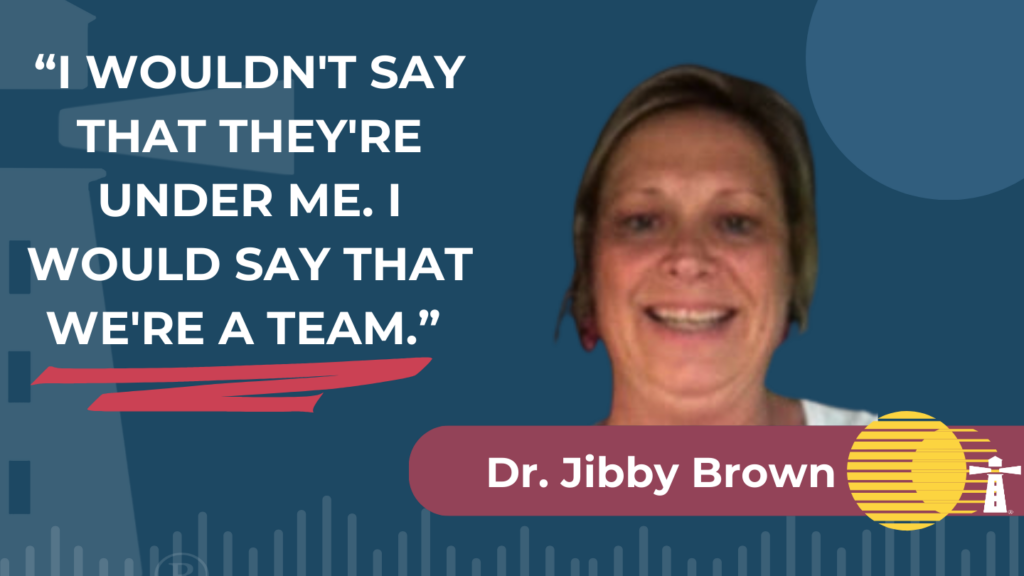
“I wouldn’t say that they’re under me. I would say that we’re a team.”
“The staff is amazing. And when I say staff, I mean all the 60 people that I work with and that includes genuine teachers, general education teachers as well.”
“Make sure that you’re okay with not being in the classroom. Because even after 13 years of leadership, I still miss the classroom. I still miss working with the kids because you’re always a teacher.”
—
Ready to rethink what leadership can accomplish for your most vulnerable learners? Listen now and discover the practical strategies Dr. Brown’s team is using to close gaps, retain talent, and honor the calling that brought educators into this profession.
Subscribe to stay ahead of the latest research, strategies, and voices shaping K-12 education leadership.
FULL PODCAST Transcript
Lighthouse Therapy (00:00.918)
Hello everyone and welcome to the brighter together podcast. My name is Janet Courtney and my special guest today is Dr. Jibby Brown. Dr. Brown is the special education supervisor for grades four through eight at Winton Woods City School District in Cincinnati, Ohio. Dr. Brown, thank you so much for being on the show.
Jibby Brown, Ed.D (00:23.694)
Well, thank you for having me.
Lighthouse Therapy (00:25.866)
Well, I love the fact that you’re in Cincinnati. I told you a little bit when we before we started that Cincinnati is near and dear to my heart. We had our first child when we were living in Cincinnati 28 years ago in Ohio. Go Buckeyes. My husband will be happy. I said that is it’s a special place. So tell us a little bit about your role and your career and maybe a little bit about how you got to where you are.
Jibby Brown, Ed.D (00:55.694)
Wow, okay, so it’s been 33 years as a special educator. My career started in Covington Independent across the bridge, because I live in Northern Kentucky. After about 12 years, I crossed the bridge because I had worked in one school district and I wanted to…
Lighthouse Therapy (01:07.446)
Kentucky.
Jibby Brown, Ed.D (01:19.266)
be professionally relevant and continue to be professionally relevant. And I needed some new information. I needed to find out what methods and strategies other districts were using. So I branched out, I crossed the river, came to Cincinnati.
I was in no kills for four years as an intervention specialist and gifted specialist because my master’s is in the gifted instruction. From there, I went back to school to get my doctorate. I spent two years in Gary, Indiana with Indiana State University at a grant. We were reframing their special education framework. From there, I…
Lighthouse Therapy (02:06.134)
Wow.
Jibby Brown, Ed.D (02:08.054)
Yeah, it was one of the best professional experiences I’ve ever had. And it taught me a lot about structures, taught me a lot about when we make decisions, especially educational decisions, that we need to make decisions for…
Lighthouse Therapy (02:08.854)
neat.
Lighthouse Therapy (02:12.64)
Neat.
Jibby Brown, Ed.D (02:29.334)
our circle of influence, everybody that that decision is affecting, not just a student, not just a family, not just me, but the entire picture, who is it affecting? I think that was my biggest takeaway to see how systems work within a school district.
Lighthouse Therapy (02:30.891)
Mm-hmm.
Mm-hmm.
Lighthouse Therapy (02:39.968)
Yeah, that makes sense. Yeah. Mm
Lighthouse Therapy (02:50.86)
you
Jibby Brown, Ed.D (02:51.054)
From there I came back to Cincinnati and became the assistant principal at Margaret B. Rust. I was there for five years and then Winton Woods recruited me and I’ve been there for six years.
Lighthouse Therapy (03:01.952)
Nice.
Lighthouse Therapy (03:05.689)
Very cool, very cool. So so why just grades four through eight? Is it a really big district? Tell us a little bit about the district.
Jibby Brown, Ed.D (03:13.642)
It’s not a big district, however, it’s a very diverse district and that’s what I love about it. We have 16 different languages in our district. We have students from all over the world, from all the nations. So that’s the beauty of Winton Woods is that the diversity.
Lighthouse Therapy (03:21.288)
okay.
Lighthouse Therapy (03:27.787)
my, wow.
Jibby Brown, Ed.D (03:43.137)
As far as grades four through eight, my background is mostly intermediate and middle school. I’ve taught every grade level except 11th and 12th grade, but I specialize in that intermediate and middle school levels.
Lighthouse Therapy (04:00.141)
Okay, okay. So, go ahead. I’m sorry. No, no, go right ahead. Right ahead.
Jibby Brown, Ed.D (04:03.566)
I have a very strong background in applied behavior analysis, autism, and literacy. So those areas of expertise are very needed in those ages because we all know grades 6, 7, and 8, that’s a stepping stone.
for kids, especially for teenagers because they have a lot going on at that time. And so my experience and all my knowledge just helps create a really great foundation for those kids and families.
Lighthouse Therapy (04:50.956)
Mm hmm. Mm hmm. So, so you’re the special education supervisor. So you have, people that are under you, right? So what are some of the biggest wins that you guys have seen in your department?
Jibby Brown, Ed.D (05:07.982)
Well, I wouldn’t say that they’re under me. I would say that we’re a team. I have three separate teams. And I work with all the intervention specialists, the principals, the building administrators, counselors, therapists. I work with occupational therapists, physical therapists. I work with speech and language pathologists.
Lighthouse Therapy (05:12.926)
A team. Yeah. Okay.
Lighthouse Therapy (05:18.571)
Okay.
Jibby Brown, Ed.D (05:38.071)
I think our greatest wins is that if we have a kiddo that goes through, that starts at Winton Woods when they’re little, and they go through Winton Woods until they get to high school, they’re very successful because we monitor three early warning indicators consistently for all students and their attendance, grades, and discipline.
Lighthouse Therapy (06:07.687)
okay.
Jibby Brown, Ed.D (06:07.694)
And if any of those are showing at risk markers, we make sure that we apply strategies, interventions, accommodations, supports to make sure that they’re successful. It is a special educator’s job to work themselves out of a job because it’s our job to narrow that learning gap and make sure that they reach grade level.
Lighthouse Therapy (06:25.108)
Right. Yeah.
Jibby Brown, Ed.D (06:36.736)
and once or excel and go beyond grade level because once they hit grade level and they’re performing at the same level of their same age peers, then we can exit them from special services and they no longer need the individual education plan that we develop and create for them on an annual basis.
Lighthouse Therapy (06:48.523)
Mm-hmm.
Lighthouse Therapy (06:53.984)
Right.
Lighthouse Therapy (06:59.338)
Right, right, awesome, awesome. So what would you say is some of the biggest challenges that you face right now?
Jibby Brown, Ed.D (07:09.836)
The biggest challenges came from COVID. Being out of school for as long as we were, we have a lot of kiddos that are still catching up socially and emotionally. We have a lot of families that need additional support. So a lot of our families are single parent homes.
Lighthouse Therapy (07:22.303)
Mm-hmm.
Jibby Brown, Ed.D (07:39.607)
and they require a lot of support. And we provide, a lot of our wins is that we actually have a clinic where parents and families can come and get mental health services, they can get dental services, they can see a medical doctor when they’re sick. We provide all nutrition.
You know, so the kids get free lunches and free breakfast, no matter who they are or their socioeconomic status. I would say those are the greatest barriers is that we don’t manage traditional families any longer. A lot of our families
Lighthouse Therapy (08:20.075)
Mm-hmm.
Lighthouse Therapy (08:34.602)
Mm-hmm. Yeah.
Jibby Brown, Ed.D (08:38.418)
are they kind of like remind me of the Brady Bunch, you know. So we, the nucleus is, looks very different. But one of the greatest things that we have is our embrace of technology. All of our kiddos are assigned school Chromebooks.
Lighthouse Therapy (08:46.836)
Yeah.
Jibby Brown, Ed.D (09:01.89)
They take them home with them to extend their learning. We have after school tutoring at the middle school three days a week at no cost to the family. We have all of the sports programs that are provided to all of our kids, including students with disabilities. In fact, we have a lot of our girls.
Lighthouse Therapy (09:24.736)
Nice.
Jibby Brown, Ed.D (09:29.09)
that are wrestling this school year. And that’s been fun to watch them advance throughout the couple of years that they’ve been in training and working with coach. That’s been amazing. So I would have to say that the greatest asset that Wenton Woods has is their staff. I work with three different staffs.
Lighthouse Therapy (09:40.428)
Mm-hmm.
Jibby Brown, Ed.D (09:58.359)
in three different buildings and I cannot say enough about these individuals and how hard they work. They show up on snow days when I have meetings and say we’re not canceling them. They’re there, they log in. They’re always supportive of the students and they’re problem solvers.
Lighthouse Therapy (10:10.092)
Nice.
Jibby Brown, Ed.D (10:25.582)
When we have a student that’s not being successful, that’s the first thing they’ll do. They’ll come to me and say, okay, this is what we’re doing. What else can we do to support this student and this family to make sure that they’re successful? The staff is amazing. And when I say staff, mean all the 60 people.
Lighthouse Therapy (10:36.384)
Mm-hmm.
Lighthouse Therapy (10:47.425)
You know.
Jibby Brown, Ed.D (10:52.588)
that I work with and that includes genuine teachers, general education teachers as well.
Lighthouse Therapy (10:53.919)
Bye.
Lighthouse Therapy (10:57.92)
Yeah, yeah. And you know, one of the things that you said is so telling of how you lead because you said, I don’t have people under me. I have a team of people that work with me. And that’s so, so indicative of a leader who understands that you’re a servant leader and that the people that work with you and you’re not lording over your superior position with them, you’re a partner with them for the kids and
That’s it. When you have that, the kids win and your teams win and you end up with really strong teams that that work together because people are not afraid to take risks when they feel like they’re valued in it. And that is such a beautiful thing to see. You we’ve talked about here in light at Lighthouse Conflict Resolution and understanding how to be a leader and all of those things in many different ways. And it’s just it’s something that I’ve learned to look at.
and people and go, yep, yep, good leader, good leader right there. So kudos to you. I know you’re humble and you don’t take credit for it probably most of the time, but they’re successful because they have you leading them, I’m sure.
Jibby Brown, Ed.D (12:12.002)
Well, thank you. I appreciate that.
Lighthouse Therapy (12:13.724)
Awesome. Well, and you’ve to do it for a long time, you know, and, and yeah, yeah.
Jibby Brown, Ed.D (12:17.236)
It’s been a while. Yeah, I can, I mean, I’m a fossil. Your special educators, they don’t stay in the business very long because of, it’s a hard job. Not only do you have to devote all your time to the students, but then the paperwork that you have to complete in order to stay compliant with federal regulations can be daunting.
Lighthouse Therapy (12:21.557)
Yeah.
Lighthouse Therapy (12:25.772)
Mm.
Lighthouse Therapy (12:37.654)
Mm-hmm.
Lighthouse Therapy (12:44.78)
Mm-hmm. yeah, yeah. I’m hopeful that as AI moves forward, because it’s not going away. We know technology is not going away. I have seen, personally seen some amazing advancements that AI can do to help. Now you have to be careful. And I know that, you know, like.
Jibby Brown, Ed.D (12:46.67)
especially for new teachers.
Jibby Brown, Ed.D (12:56.343)
No, it’s not.
Lighthouse Therapy (13:09.468)
HIPAA compliance and FERPA compliance and where you put stuff and all of that. And I get that. But I’ve seen, my goodness, we even use we use AI specifically for the podcast production. It’s a part of how we do the final bit, you know, and it takes it takes a process that would take six to eight hours down to less than two, you know, and thus. I think that I’m hopeful. I’m hopeful that AI as schools.
begin to embrace AI that it becomes a tool that is a positive, not, I mean, there’s lots that we can get, we don’t need to get into all of it, but I just have seen and I’m like, I’m excited to see where it’s gonna go, because I think there are things that are gonna, AI is gonna make our lives easier in some pretty significant ways, hopefully, so.
Jibby Brown, Ed.D (13:59.213)
Yeah, I use AI for one specific purpose, and that’s to, I’m very direct, and sometimes I need to soften my message. So I use AI and say, okay, make this not sound so assertive. And it does. Yeah, it does.
Lighthouse Therapy (14:10.273)
Mm. Mm-hmm.
Lighthouse Therapy (14:19.678)
huh. huh. And it does, doesn’t it? It does it for you, which is, which is amazing. And it’s, it uses words and you can, I mean, my daughter showed me like on chat GPT, how you can tell it like, give this is me, this is who I am. This is the things that matter to me. And this is how I think and how, know, the things that the way that I approach leadership and all of those things. And it’s incredible. It’s incredible. The things that we’ve seen out of it. And we have an amazing team as well who have
who have just, you know, our technical marketer and the marketing team just have taken AI and ran with it. And I’m so, I’m blessed. I’m just blessed. It’s an amazing time of life to be living, even though it’s hard. We know it’s hard as an educator. It’s still kind of cool. So, yeah.
Jibby Brown, Ed.D (15:06.958)
You definitely have to be flexible and adaptable. Special education is always on a learning curve. It changes sometimes on a daily basis. So you have to be able to, you know, to roll with the punches with it. Yeah, so it…
Lighthouse Therapy (15:10.442)
Mm-hmm.
Lighthouse Therapy (15:17.877)
Mm-hmm.
Lighthouse Therapy (15:24.204)
So, so what with your experience, what advice would you give to maybe somebody who’s new, first of all, in in the profession, and then somebody who’s thinking about stepping into more of a leadership like I’ve been I’ve been an intervention specialist for 10 years, and I’m thinking about becoming a special education supervisor.
there’s a position that’s opening and I’m considering it. What kind of advice would you give those two groups specifically?
Jibby Brown, Ed.D (15:58.127)
To somebody that wants to enter the leadership role, I would first say to them, make sure that you’re okay with not being in the classroom. Because even after, let’s see, seven, 13 years of leadership, I still miss the classroom.
Lighthouse Therapy (16:10.784)
Mm.
Lighthouse Therapy (16:20.62)
Yeah.
Jibby Brown, Ed.D (16:21.422)
I still miss working with the kids because you’re always a teacher. Whether you’re a leader, you’re always a teacher. So make sure that you’re ready to leave the classroom. The second is…
Lighthouse Therapy (16:26.572)
Mm-hmm.
Jibby Brown, Ed.D (16:40.576)
to remember where you came from and before you make any judgments or decisions that you always consider where you came from and what that person is doing before you make any decisions there. The third is that be prepared to work really hard.
Lighthouse Therapy (17:09.567)
Yeah.
Jibby Brown, Ed.D (17:09.902)
And it’s, I put in 10 to 12 hours a day, depending upon the season, depending upon which month it is.
Lighthouse Therapy (17:21.132)
Mm-hmm.
Jibby Brown, Ed.D (17:22.444)
because you always have IEP meetings, individual education plan meetings for the kids. They have to have them every year. October is a really busy month. November is busy. December is busy. And then you have all the holidays in between there. And the last piece of advice I would give is that don’t assume that everybody thinks like you.
Lighthouse Therapy (17:49.931)
good one. Yeah.
Jibby Brown, Ed.D (17:53.613)
because I have made that error many times, assuming that a teacher knows what I know or assuming that they’re going to handle a situation the way I would. So always make sure that you have those…
those difficult conversations about, okay, next steps, what do we do? What’s the best place for us to be at to make sure that this kiddo is successful?
Lighthouse Therapy (18:27.296)
Yeah, and it’s amazing how how we as human beings just do that. You know, I’ve seen that I’ve made a mistake as well. Just. OK, that wasn’t what I was talking about after they after they’ve moved forward, it’s like.
Really? Okay. That isn’t how sometimes it’s okay. You know, people can, can approach a problem from multiple different directions, but sometimes it’s like, wait, no, no, no. I missed, I missed. I know when I, when that happens to me, I’m like, I missed communicating something. You know, it’s like, if I asked you to do something and you, and I didn’t communicate it well, if, if I didn’t, I’m, I get it. Yeah, absolutely. So, and it’s, it’s important. It’s important to,
Jibby Brown, Ed.D (18:45.708)
Yeah.
Lighthouse Therapy (19:11.47)
to know we’re all different, but and we all have, we all have that our own bias, right? Everybody comes with a with their own set of bias and personal bias is something that I don’t, I don’t care who you are, you have it, you can’t get, you can, you can deal with it and deal with it appropriately, but it’s, it’s always going to be there. It’s not something that you can just turn off. So for sure. So okay, so
Dr. Brown, if you could just fix one thing in your world, like magic wand, miraculously, never have to deal with that one thing, and it can’t be money. We all know schools need more money. What would that one thing be?
Jibby Brown, Ed.D (19:54.058)
in special education.
Lighthouse Therapy (19:55.701)
Yeah, in your career, in your job right now that you have right now, if you never had to deal with that one thing and just fixed it, it’s never going to be a problem again. What would that one thing be?
Jibby Brown, Ed.D (20:07.495)
I would ask every parent
to read to their kids over and over and over again. When they’re little, put them on your lap. Have them turn the pages to a book. Read over and over and over the same book. Put down your phones. Spend quality time with your family. Have the whole family put down their phones.
Lighthouse Therapy (20:15.252)
Mmm.
Lighthouse Therapy (20:21.898)
Mm-hmm.
Lighthouse Therapy (20:29.9)
Mm-hmm.
Lighthouse Therapy (20:33.888)
Mm-hmm.
Lighthouse Therapy (20:41.259)
Yeah.
Jibby Brown, Ed.D (20:41.486)
But the reading piece, the literacy piece is so important, making sure that when our kids do come to kindergarten, that they are fully prepared. They know their letters. They know their
number correspondence, that if I show them can they count from one to two, two to three, do they know the values as far as is four smaller than seven, is seven bigger than four. Making sure that they have all the ready skills and they’re ready to learn and to value education. I think sometimes if we didn’t have a really good experience in education, sometimes we don’t value
Lighthouse Therapy (21:18.688)
Mm-hmm.
Jibby Brown, Ed.D (21:28.08)
as much as we need to value. And always support your kids. When you have a student with a disability…
Lighthouse Therapy (21:32.715)
Yeah.
Jibby Brown, Ed.D (21:46.701)
there’s really never a good time to exit from that advocacy part. And that you’re always advocating for your child. You show up at all the meetings, even…
Lighthouse Therapy (21:53.982)
Mm-hmm, right.
Jibby Brown, Ed.D (22:05.92)
if it’s inconvenient, even though as teachers and as staff, we are obligated to make sure that whenever we schedule a meeting, it is mutually convenient for both parties. But always be there for the student and know their programming and don’t hesitate to ask questions as a parent.
If you don’t understand something which is totally understandable because special education can be very, very confusing at times. And understand that all we want is to work with you as a team. We…
Lighthouse Therapy (22:43.456)
Mm-hmm. Mm-hmm.
Jibby Brown, Ed.D (22:51.052)
We value you as a team member and when parents are involved and schools are working side by side, our kids are always successful. That’s that number one factor.
Lighthouse Therapy (23:05.472)
Yeah, the number one teacher for any child is that parent. Yeah, that person that they spend the most time with is that parent, you know, and then yeah, I get it. I totally get it. Yeah, it is. It absolutely is. And I love the reading part because it is that’s critical. And I you don’t know how many times I’ve said that in an IP meeting, people, parents will say to me, how can I help my child? I was like, honestly, read to them, read to them, read to them, read to them.
Jibby Brown, Ed.D (23:10.519)
Yes.
Jibby Brown, Ed.D (23:15.916)
Most important job in the world.
Lighthouse Therapy (23:32.267)
read over and over and over and over and over. And it doesn’t matter how young they are. It doesn’t matter how old they are. We were doing read alouds with my kids in high school. We were still, you we did The Hobbit and The Lord of the Rings and and and all of those. Watership Down, one of my favorite. My daughter was like, why are we reading this book? She did not like it. And it’s a little slow to get started. And then we got to the middle of it. And she’s like, this is a really good book, Mom. And I was like. See? Yeah, so.
Jibby Brown, Ed.D (23:43.311)
yeah.
Jibby Brown, Ed.D (23:48.878)
Oh, well, I’d love water shipped down.
Lighthouse Therapy (24:01.44)
We have absolutely I remember I think my husband has pictures of me four days old. My daughter was four days old when I started reading to her. So sitting in her little bassinet or a little little car seat. yeah. So read to your kids. Absolutely. One thousand percent. Great. Great. Great pieces of advice. Absolutely. So where do people go if they want to learn a little bit more about Winton Wood City Schools or about your programs?
Jibby Brown, Ed.D (24:12.799)
Absolutely. Yeah.
Jibby Brown, Ed.D (24:30.35)
They can actually come to our website. They can just type in Winton Wood City School District and and visit the website. It has all the schools on there. It has our programming, the fact that we’re a tech district. It has all the curriculum on there as far as if you ever thought about sending your child. It explains the technology piece. Yeah.
Lighthouse Therapy (24:57.1)
Awesome, awesome. All right, well, Jibby, it has been a pleasure to have you on Brighter Together. Keep doing what you’re doing. I know the world and those kids and your team is a better place because of what you’re doing. So keep it up and congratulations on doing 33 years. That’s really amazing. I’m not quite there. I’m a little bit behind you, yeah. And the other piece of it I didn’t say and.
was the hardest part for me was stopping at once I started Lighthouse was stopping seeing kids. Because that was, you and I’m you’re always you’re always a teacher. I always identify as a speech therapist first. What do you do? Well, I’m an SLP and I happen to have my own company. You know, it’s like that’s like one of those. I don’t just say, well, I’m a CEO, you know, whatever. That’s not who I am. I’m an educator, And that’s why brighter together is is so important to me because we are.
Jibby Brown, Ed.D (25:43.736)
Sir.
Lighthouse Therapy (25:50.879)
we the world is better and brighter because of what all of the educators do every day, every single day for kids across the United States. And I’m so grateful. so thank you. Thank you so much.
Jibby Brown, Ed.D (26:00.673)
Absolutely.
Thank you.