

What if the students struggling most in traditional classrooms are actually thriving in a completely different learning environment? In this eye-opening episode, we discover how virtual learning has become an unexpected game-changer for students with special needs—not because of technology, but because of what it removes from the equation. Join us as we explore the remarkable transformations happening at Great River Connections Academy and learn why the families making this commitment are witnessing their students truly blossom.
Meet Our Guest
Jennifer Geyer is the Director of Special Education at Great River Connections Academy, where she has pioneered approaches to virtual learning that go far beyond the “Zoom classrooms” many families remember from COVID-19. With deep expertise in special education and student-centered instruction, Jennifer shares how personalized virtual environments are helping students access support that traditional brick-and-mortar settings simply couldn’t provide.
What You’ll Learn
This episode challenges common misconceptions about virtual learning while revealing the specific conditions under which students with diverse needs thrive. You’ll hear directly from an educator on the front lines about the human elements of teaching that technology can never replace, the family commitment required to succeed in virtual environments, and the remarkable outcomes when students finally get what they need to succeed.
Key Takeaways
✓ Virtual isn’t “COVID learning” – Understanding the critical differences between emergency remote learning and intentionally designed virtual programs that serve students with special needs
✓ The power of removing barriers – How eliminating sensory overload, social pressure, and environmental stressors allows students to access their actual potential
✓ Human connection matters most – Why the relationship between educator and student—and the ability to read a child’s needs in real time—remains irreplaceable, regardless of setting
✓ Family engagement transforms outcomes – The surprising ways virtual learning opens communication with families and creates space for honest, vulnerable conversations about student needs
✓ Students leaving special education – Real evidence that when the right support meets the right environment, students can overcome challenges previously thought permanent
Notable Quotes
“The individualized things that have to take place for students’ needs to be met—that AI is not going to be able to capture—are the relationships with students and their individual needs in the moment. That is the human element of education that I don’t think can ever be replaced.”
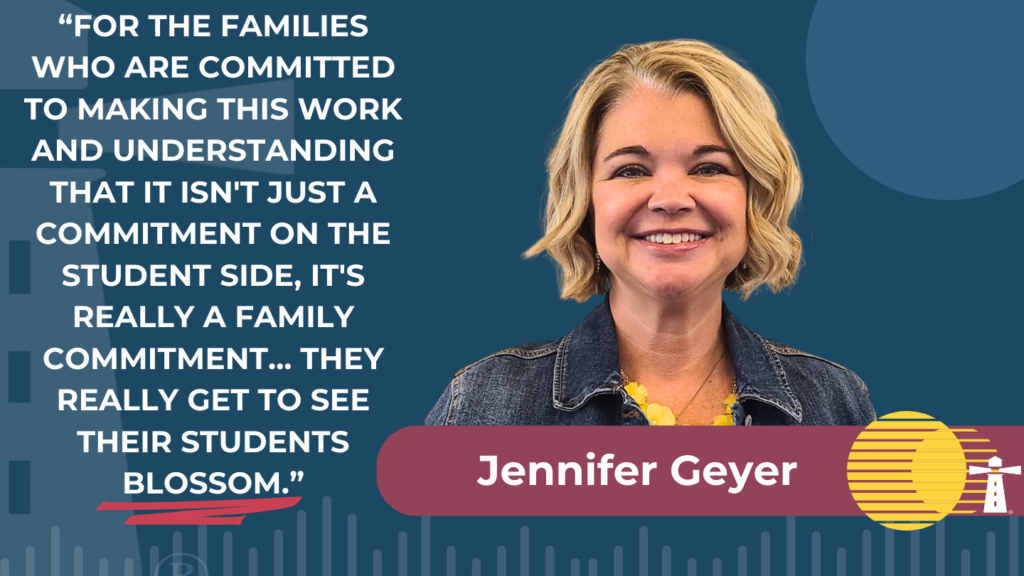
“For the families who are committed to making this work and understanding that it isn’t just a commitment on the student side, it’s really a family commitment… they really get to see their students blossom.”
“We have kids who aren’t qualifying for special education anymore because they’ve gotten what they need. We removed all those extraneous things that were standing in their way in school, and they’re thriving.”
—
Ready to hear about the students nobody expected to thrive? Listen now and discover how reimagining the learning environment—not the instruction—can unlock potential in your most struggling learners. Then subscribe to stay updated on episodes that challenge conventional wisdom in K-12 education.
FULL PODCAST Transcript
Lighthouse Therapy (00:00.976)
Hello everyone and welcome to the brighter together podcast. My name is Janet Courtney and my special guest today is Jennifer Geier. Jennifer is the director of special education and that she is at great river connections Academy. And before we went on air, we discovered she remembered me from when I worked at connections Academy in Ohio. So Jennifer’s so excited to have you on the show.
Jennifer Geyer (00:26.306)
Thank you, excited to be here.
Lighthouse Therapy (00:27.972)
So tell everybody a little bit about your journey and a little bit about Great River.
Jennifer Geyer (00:36.866)
Gosh, my journey. Okay, so this is my 20th year in special education. My career started out in a pretty typical brick and mortar school here outside of central Ohio. After three years, I was told that I was moving to a different school and I was gonna be doing different things and I was like, well, I don’t really love that. So I started looking and I found Ohio Connections Academy.
Lighthouse Therapy (00:59.589)
Right?
Jennifer Geyer (01:02.51)
So I started working as an intervention specialist. I was there for seven years working with a variety of students and ability levels. After seven years, I was promoted to the assistant manager of special education. I was there for two years in that capacity. And then in 2018, Great River Connections Academy opened. So I came over here and helped start GRCA in 2018. I’ve been here since.
Lighthouse Therapy (01:27.542)
Awesome. So when you say 17 years, let’s, I want our, our, our audience to really understand virtual education. Virtual is not new. I mean, this is, you’re talking 17, 20, 25 years ago. And so we’re talking 2000. So way, way before the pandemic, this was already happening, right?
Jennifer Geyer (01:52.354)
Yes, yes, absolutely.
Lighthouse Therapy (01:54.278)
And so one of the things that I, one of the things I said when, cause of course we started in 2018, two years before the pandemic. And I’m like, God knew what he was doing. And it was like, to help, we really wanted to help, know, really. And there were schools that listened and schools that didn’t. you know, and I was like, I remember being in this forum with superintendents and I was like, guys, there are superintendents.
that have been doing virtual for over 20 years. And the next forum that they had, they had a superintendent at a virtual school. And I was like, it’s already being done. And so what was your, I know we really weren’t gonna go there, but what is a little bit, just give people a little bit about what that time was like for you guys.
Jennifer Geyer (02:32.108)
Yeah.
Jennifer Geyer (02:42.257)
goodness.
It was kind of interesting because really the only thing that changed for us was our enrollment definitely increased, but it really was no big hiccup in our day to day because we were already doing it. So there was no flounding around trying to find lessons and you know, how do we deliver this service? We it was just another day in our virtual world with the caveat that now all of our children were also home and our spouses were home and things like that. So we all of course had to deal with those types of
Lighthouse Therapy (02:49.838)
Increased, yeah.
Lighthouse Therapy (02:54.98)
Right.
Lighthouse Therapy (03:03.289)
Right.
Lighthouse Therapy (03:08.483)
Mm-hmm. Mm-hmm.
Jennifer Geyer (03:13.2)
stressors, but and the enrollment changes that we experienced, know, kids who
know, a variety of situations where the district they lived in just wasn’t, I mean, no district was prepared for COVID. There was just no preparation for that. But some districts I think managed maybe a little bit better than others and families were just not happy with what they were getting. So they came to us and some stayed. Some have been with us and they just realized this is really just a better setting and better fit for my family and my student. And then there were others who were like, yeah, no, as soon as those doors open, we are
Lighthouse Therapy (03:28.675)
No, no, of course not, yeah, yeah.
Mm-hmm. Mm-hmm.
All right.
Yeah.
Lighthouse Therapy (03:44.677)
Mm-hmm.
Lighthouse Therapy (03:50.375)
Yeah, and that’s the beauty, right? Yeah, and that’s the beauty of education is like, you can do brick and mortar and have kids thrive, absolutely thrive. Yeah, we homeschooled for a part of our year, part of our children’s academic career, started out in public school and then did homeschool for several years.
Jennifer Geyer (03:50.584)
back in that school building. you know, we saw that kind of flux too.
Jennifer Geyer (04:01.454)
Yeah, absolutely, yeah.
Lighthouse Therapy (04:13.496)
And then they all eventually for whatever part of their high school went back to public school based on what my children’s needs were, not based on what I wanted them to have. But I was, mean, I mean, obviously I’m their mother, but it was really about, and that’s the beauty of it, of education. And what I’m, the shift that I’m seeing in education is child centered, you know, education based on the needs of that child as special ed has been all along.
Jennifer Geyer (04:21.838)
Mm-hmm.
Lighthouse Therapy (04:42.746)
you know, we’re really seeing, let’s tailor the education to each child’s needs and their likes and their interests and whatever. And so, you know, we, and part of that career for my kids was Connections Academy. That’s why I was connected with Connections Academy was we tried that and, and did that for a couple of years. So, you know, it was like, was, my kids got a very eclectic education, but it was what worked for them. And so having the opportunity and
Jennifer Geyer (04:54.723)
Mm-hmm.
Lighthouse Therapy (05:08.272)
having parents have an opportunity. And I say, you there’s lots of bad about COVID, but I think that was one thing where there were children that were not thriving in public school that went to virtual school, took all of those stressors of being around all those other kids and maybe the bullying was happening or whatever it was. And all of sudden you went from a failing kid to an A student because they were able to focus on their academics.
And it didn’t, mean, there’s lots of arguments around, but it’s incredible, really. Yeah.
Jennifer Geyer (05:41.134)
Yeah, setting matters. I educational setting matters, absolutely.
Lighthouse Therapy (05:45.027)
Absolutely, so Great River started, I know you said, but tell me again, when did Great River start? 2018, so you had a couple of years already under your belt for that one. Why, why did they open Great River versus just Ohio Connections Academy?
Jennifer Geyer (05:51.086)
2018.
Jennifer Geyer (05:55.565)
Yeah.
Jennifer Geyer (06:01.228)
So I think OCA had grown to the capacity that they wanted to at that point because there was another larger e-school in Ohio that had closed a few years prior to that. So they had seen a major influx in students and there was still a need. There were still kids who were families who were looking for online schools. They liked Connections Academy because of the history and you know they were had a very good reputation in the state. And you know Pearson our parent company saw a need for opening another school so.
Lighthouse Therapy (06:15.238)
Okay.
Jennifer Geyer (06:31.152)
Our school leader is actually from Ohio Connections Academy. I came from Ohio Connections Academy. One of our other school leaders, and two of our school leaders actually, have other experiences from Ohio Connections Academy. So we have that foundational understanding of what it takes to start, to get started with a new school.
Lighthouse Therapy (06:52.016)
And how do they, how do they like, how do you attract students? Like if you’re already got Ohio Connections Academy, they, what did they do to increase enrollment? Obviously, enrollment’s not been an issue because you’re growing like crazy, but how did they manage that then?
Jennifer Geyer (07:05.675)
No. Yeah.
Jennifer Geyer (07:09.952)
So OCA put some enrollment caps in place for their own school. So then it became not necessarily we were just overflow, but the way that it was marketed and what marketed at that time was this is a new school, very small classes, very individualized attention because the classes are smaller. So we attracted some students that way and families and then they’ve just been coming back.
Lighthouse Therapy (07:13.121)
okay.
Lighthouse Therapy (07:17.616)
Mm-hmm.
Lighthouse Therapy (07:33.92)
Awesome, awesome. Yeah, and and so now you’ve got wow almost eight years under your belt, right? Fantastic. So, so what are some of your your biggest challenges then would you say?
Jennifer Geyer (07:47.534)
I still think there is some false understanding of what a virtual learning environment is for both students and families. And we still get families who come to us and say, well, during COVID, you know, we had online learning. know what that’s like. Well, no, you really don’t. So, you know, we have those conversations. Well, you know, that was that. And this is going to look very different. understanding what the expectation is, because, it is a flexible learning environment, but that does
Lighthouse Therapy (08:00.103)
Mm-hmm.
Lighthouse Therapy (08:09.126)
Bye.
Jennifer Geyer (08:17.588)
mean you have the entire semester to do all of your schoolwork and you train everything on the last day and you know you get to remain enrolled and you get your grade you know it’s not like that and especially in special education where we’ve got service minutes that have to be provided and there are related services that have to be provided it’s not as flexible as I think people come in thinking it will be you know we can do all of our schoolwork on one day a week mmm maybe but is that really benefiting your student?
Lighthouse Therapy (08:30.758)
Right.
Lighthouse Therapy (08:41.904)
Mm.
Lighthouse Therapy (08:45.915)
Right.
Jennifer Geyer (08:46.616)
So I think just battling those misconceptions is probably still our biggest challenge.
Lighthouse Therapy (08:53.124)
Yeah, yeah, for sure. And then, you know, with special education, then how what does an IEP I mean, I know the answer to this question, but I mean, I want you to answer for me. But how does an IEP look different in a virtual setting versus maybe what’s what a family or a school would experience in brick and mortar or charter school that’s not virtual?
Jennifer Geyer (09:18.166)
So really not a lot of differences other than the way that the services are provided. You’re not sitting one-on-one all the time with an intervention specialist in a resource room necessarily or in a small group with an intervention specialist. There are small group interventions provided on a weekly basis, multiple times a week in most cases. There are still one-on-one services provided. So the way the services are provided and maybe those service minutes might look a little different in our virtual setting just because of the different schedules.
Lighthouse Therapy (09:48.248)
and the kids still go to regular classroom classes as well.
Jennifer Geyer (09:53.822)
Yes, all except our alternatively assessed students, their courses look a little bit different. So they have access to the standard courses. They still have access to go to the live lessons with their peers, but the majority of their education happens a little more in a more restricted setting.
Lighthouse Therapy (10:11.61)
Right, right, yeah. So what would you tell somebody is the biggest strengths that come with doing a virtual school?
Jennifer Geyer (10:22.562)
Gosh, there are a few. think…
For the families who are committed to making this work and understanding that it isn’t just a commitment on the student side, it’s really a family commitment, especially for those younger kids who need to have that support at home. They really get to see their students blossom. The things that were struggling in the brick and mortar setting, whatever those things were, if it’s the social aspect of it, seeing some of those walls come down and letting them enjoy school, I think that we see that a lot.
Lighthouse Therapy (10:33.574)
Absolutely.
Lighthouse Therapy (10:53.648)
Mm-hmm. Yeah.
Jennifer Geyer (10:56.464)
That happens a lot in our IEP meetings. Families say, I wish I would have done this sooner. I didn’t realize what a positive experience this would be. We have kids who aren’t qualifying for special education anymore because they’ve gotten what they need. We removed all those extraneous things that were standing in their way in school, and they’re thriving. So I think just the first seat, that first row experience for the parents to see exactly what their students are doing on a daily basis.
Lighthouse Therapy (11:00.901)
Mm-hmm.
Jennifer Geyer (11:26.404)
is huge for a lot of families.
Lighthouse Therapy (11:28.986)
Well, and you have, and this is something that when I first started doing virtual schools was intimidating to me because I only done brick and mortar, but you have access to the parents. I know you guys call it a learning coach, which typically is a parent, but not always, but they’re there.
Jennifer Geyer (11:46.051)
Mm-hmm.
Lighthouse Therapy (11:47.847)
They’re right there. And that was something as a therapist, I went, yes, once I figured it out, I’m like, instead of being intimidated, I was like, this is the person that’s teaching this child the most. And this is the person I need to follow that needs to follow up with whatever strategies or whatever we’re working on so that they can generalize it into their everyday speech. I’m a speech therapist, but yeah. Um, and so
Jennifer Geyer (11:53.547)
Right.
Jennifer Geyer (11:57.634)
Mm-hmm.
Jennifer Geyer (12:05.932)
Right. Absolutely.
Lighthouse Therapy (12:10.808)
Explain to somebody who like maybe has has a misconception that their child is going to sit in front of the computer for eight hours a day and sit there all day long and listen to instruction. And that’s going to be what school is going to be look like. Can you give us an idea of what a typical day for maybe an elementary school and then maybe a middle school, high school kid?
Jennifer Geyer (12:30.36)
Mm-hmm.
Sure.
So elementary school, know, our live lessons, what we call live lessons, that’s the synchronous, you know, learning that the student does right with the teacher in, we call it live lesson. Our platform is class, so it’s a setting, you know, through Zoom. Their first live lesson of the day maybe starts at nine o’clock. So we encourage students, you know, maybe have, there needs to be some consistency. There has to be some sort of schedule that they’re following. So maybe they’re getting up at 830 and they’re eating some breakfast and they’re
Lighthouse Therapy (12:48.326)
Mm-hmm.
Jennifer Geyer (13:03.92)
getting ready for the day and you know they’re going to their first live lesson which for an elementary student is probably between 30 and 45 minutes focusing on either language arts, math, science, social studies, whatever the content is. Then there’s usually a little bit of a gap between the next live lesson so maybe they’re gonna go ahead and start their daily classwork which when they log in to our system everything they need to do for that day is right there on their planner. It’s a click of a mouse and they’re right into their lessons. So maybe they get a lesson done and then maybe it’s time for
Lighthouse Therapy (13:30.616)
Mm-hmm. Awesome.
Jennifer Geyer (13:33.802)
another live lesson a little bit later in the day. So usually, you know, two to three
Live lessons a day and I would say that’s usually a busier day. But then you know the requirement per the state is a student has to have 27 and a half hours of online time per week. Well, our setting is our schedule is Sunday to Saturday. So you know if a family says OK, we’re going to do all the live lessons on our planner for the week, but we’re going to save some of these bigger assignments for the weekend when maybe mom or dad or somebody is available to sit with them. They have access to do that and that time is tracked in our system so it all counts towards
Lighthouse Therapy (13:44.229)
Yeah.
Jennifer Geyer (14:09.936)
So really they can tailor their daily schedule around the live lesson schedule. If they want to do all of their schoolwork after you know four o’clock after mom or dad is home or somebody is more available they have the flexibility to do that but that the live lessons are still on the planner for them to engage with for their time with their teachers and peers. And I would say middle school looks very similar to that.
Lighthouse Therapy (14:10.608)
Mm-hmm.
Lighthouse Therapy (14:32.016)
So what happens if it, okay, yeah. No, go ahead. I’m sorry, I didn’t mean to interrupt you.
Jennifer Geyer (14:37.674)
no. you know, high school also, you there are more classes, obviously, so more live lessons for high school. But all of our live lessons are recorded with the for the teachers, the recordings as well. the students, even if they can’t attend or if they’re in the middle of a project, they really just want to power through and get it done. They can go back and watch that recording anytime.
Lighthouse Therapy (14:47.334)
I was just gonna go there. Yeah, exactly.
Lighthouse Therapy (14:56.964)
Mm-hmm.
Lighthouse Therapy (15:00.58)
Yeah, which is fantastic because even you know the the one thing that you’re missing when you have that is it is the interaction you know you don’t get the the direct interaction but you can get the content you can go back and listen. Johnny was sick you know he didn’t he he woke up and he was puking and you know just could not do school that day well he doesn’t miss that day of school he just goes in after when he’s feeling better and does it then I’ll tell you one of the things that.
Jennifer Geyer (15:11.982)
Absolutely, yeah.
Mm-hmm. Mm-hmm.
Jennifer Geyer (15:22.957)
Right.
Jennifer Geyer (15:27.608)
Mm-hmm.
Lighthouse Therapy (15:29.68)
blew me away as a teletherapist was how much the kids really wanted to come to therapy. Now, part of that is just, know, a good therapist is gonna grab them and want them to be there. It doesn’t matter if you’re in a brick and mortar or virtual, whatever, you know, cause virtual is a modality. It’s a modality. Education is education is education, right? Speech is the same way. Yeah, it’s a vehicle to it. And I actually had one child, his dad logged him on.
Jennifer Geyer (15:45.208)
Mm-hmm.
Jennifer Geyer (15:48.62)
Yes. It’s a vehicle. Yeah.
Lighthouse Therapy (15:58.555)
And I think this was when I was at Connections Academy from the ER. He fell down, hurt his wrist and was waiting in the ER for the doctor to come and it was his time for speech and he was like crying to his dad, I don’t wanna miss speech.
Jennifer Geyer (16:03.022)
Jennifer Geyer (16:13.896)
That is dedication.
Lighthouse Therapy (16:16.118)
said, honey, let’s read a book. We’ll read a book until the doctor comes. We didn’t do therapy. You know, he was, but it was so sweet because he just did not, this child did not want to miss his speech. And he loved, mean, that was like that warmed my heart. I, I think I’ve told that story 20 times, but it was just, it was so sweet.
Jennifer Geyer (16:22.382)
Jennifer Geyer (16:26.254)
Mm-hmm.
Jennifer Geyer (16:32.028)
yeah.
It’s people think you can’t make connections with students. How do you really get to know the students when you’re online? The families open up to us in a different way than they do
Lighthouse Therapy (16:39.269)
Yeah.
Lighthouse Therapy (16:42.842)
Mm-hmm. Mm-hmm.
Jennifer Geyer (16:44.012)
to a teacher when you’re sitting at a parent-teacher conference, which can be a little intimidating for families. when you kind of give a little bit of space, it is sometimes heartbreaking, the things that are shared with us. And it’s very clear why these families have chosen to come here. Some of these kids, the experiences these kids have had, I just can’t even, I can’t even wrap my head around some of the things these kids have gone through.
Lighthouse Therapy (16:49.392)
Mm-hmm.
Lighthouse Therapy (17:06.118)
Yeah.
Lighthouse Therapy (17:10.182)
But what a blessing it is that they have that option, right? That we have, we live, I don’t know what God has placed on my heart lately, but I live in 2026. This is February 10th, four days from Valentine’s Day. My Valentine’s nails even, but four days from Valentine’s Day. But 2026 is,
Jennifer Geyer (17:13.324)
Yeah, absolutely.
Lighthouse Therapy (17:34.247)
I think it’s a year of innovation, a year of change. You we’ve seen AI come in and all of these different things, but even medical stuff and just there are things that we have today and online education is definitely more and more and more becoming a part of that. That wasn’t there. It just wasn’t an option. You go back 30 years ago, wouldn’t even I’m in a therapist since
Jennifer Geyer (17:58.819)
Yeah.
Lighthouse Therapy (18:01.126)
I’ve been a therapist for 31, 32, almost 32 years now. Oh, gosh, I it when I say that. I’ve been saying 31 and I realized, oh, no, it’s 32 next month. Dog on it. It does creep up on us, doesn’t it? But 32, 32 years ago in 1994, when I started doing therapy, this was not even something that I would have even considered doing. And here we are.
Jennifer Geyer (18:10.542)
Time creeps up.
Lighthouse Therapy (18:28.11)
You know, you and I are having this conversation and doing a podcast virtually, right? You’re in Ohio, I’m in South Texas. And the kids are, it just it just blows me away how how much in those 30 years things have changed and how how incredibly blessed we are to live in this time, you know.
Jennifer Geyer (18:28.686)
I’m here.
Right.
Jennifer Geyer (18:42.136)
Mm-hmm.
Jennifer Geyer (18:46.038)
Yeah, it’s crazy, you know, even just to think since GRCA opened, how the technology just within our platform has changed in the last few years. mean, I mean, I mean, it’s been wild to see the growth that has changed just within our system. So I’m really excited to see what’s going to happen in the next few years where, you know, we’re already, we’ve already got these live tutors within our lessons where it’s like a chat bot that pops up.
Lighthouse Therapy (18:54.758)
Mmm.
Lighthouse Therapy (19:09.114)
Mm-hmm.
Jennifer Geyer (19:16.032)
You’re still you’ve been sitting on this lesson for a while. Can I help you with something? You know, it’s it’s interactive now. It’s it’s wild
Lighthouse Therapy (19:19.558)
Bye.
Yeah, yeah. And and you know, people are afraid of that some of that. And, you know, talk about that just a little bit about why people should not be afraid of that. Why is technology so from your perspective? Because, you know, I’m excited about it. I’m sitting here going, yeah, I love it. But but understanding why you shouldn’t be afraid of it. And I mean, instruction is still a person. So, yeah.
Jennifer Geyer (19:27.072)
Yeah.
Jennifer Geyer (19:37.036)
Mm-hmm. Sure.
Jennifer Geyer (19:48.462)
Yeah, absolutely. Yeah, that will never go away. There’s still going to have to be a human element to education, know, especially even in a virtual setting because there just too many things, too many.
Lighthouse Therapy (19:51.461)
Mm-hmm.
Jennifer Geyer (20:05.605)
individualized things that have to take place for students needs to be met, that AI is not going to be able to capture. You know, the relationships with the students, their individual needs in the moment, those specific moments when you go into a one-on-one session with a student and you can tell by the look on their face, today is not the day where we’re going to be talking about math. Something else is happening and we need to address that first. That is the human element of education that I don’t think can ever be replaced.
Lighthouse Therapy (20:15.756)
Mm-hmm. Decisions. Mm-hmm.
Lighthouse Therapy (20:23.642)
Right?
Lighthouse Therapy (20:27.014)
Mm-hmm.
Lighthouse Therapy (20:31.49)
No, and it shouldn’t be. I was listening to a book. I love audio books. It’s one of the things I do in the evenings. I crochet and I do audio books because it’s it’s downtime for me. And for the first time I did a virtual, a virtual audio book where AI had read the book and it was like $3 for this book. I’m on Audible, but it was, I was like, ooh, out of curiosity, I just want to see what it’s like.
Jennifer Geyer (20:52.334)
Ooh.
Lighthouse Therapy (21:01.37)
The prosody is missing. There is errors in prosody. was really interesting as an SLP to listen to it and go, most of it was really good. You know, it like really, it was, engaging. It was, and if the story was good, I enjoyed the story, but there were times multiple times throughout the book where I was like, that is so not how you say that, you know, and the pauses and the commas and the, we’re, not in the right places in it. And you know, it’s like, I can figure that out as,
Jennifer Geyer (21:05.454)
Alright.
Jennifer Geyer (21:15.17)
Mm-hmm.
Jennifer Geyer (21:22.126)
Yeah.
Lighthouse Therapy (21:30.702)
as an SLP going, that’s, and as an adult, yeah, absolutely that this is, but that is not something that a child who is learning will be able to make that distinction. understand that’s a piece of it that is really important to understand that, you know, we have to, there are, it’s great. It’s a great tool. It’s a tool like anything else. It’s a tool. Yeah.
Jennifer Geyer (21:31.394)
As an adult, yeah.
Jennifer Geyer (21:39.118)
No.
Jennifer Geyer (21:50.594)
It is. It is a tool. Yes. And it’s interesting, know, just my own son is 14 and a freshman in high school and is very passionate about physics and very much wants to pursue a career in physics. But, you know, we’re having to have conversations with him already. Like, you need to look ahead to figure out what careers in your interest are really going to be available to you because science and all these things are just being…
Lighthouse Therapy (22:12.198)
Mm-hmm.
Jennifer Geyer (22:15.948)
I don’t want to say taken over, nothing’s really being taken over, but sometimes that human element is kind of being removed from certain careers. So we’re trying to encourage him to do his research and trying to help him along the way to make sure he’s not pursuing a career that won’t be available in 10 years. So, you know, it’s a lot to think about.
Lighthouse Therapy (22:23.3)
Yeah.
Lighthouse Therapy (22:29.892)
Right, right, right. Yeah, and certainly in the tech world, I know that they’re feeling that as well. I’ve heard lots of stories from tech people, and I have tech people. we’re even looking at, from our perspective of the first level, we have live tech support right now for us. And that first tier is eventually gonna go to a bot. It makes much more sense to have a bot do that.
Jennifer Geyer (22:35.97)
Yeah.
Jennifer Geyer (22:47.415)
Mm-hmm.
Jennifer Geyer (22:52.194)
Yeah.
Lighthouse Therapy (22:55.31)
that will free up them so that they can learn and adapt to the technology so we can incorporate it even more. That’s a big switch. I never thought I would do that. one of two of the three people in our tech department, one is my husband, who’s who’s our CTO, who is is like chasing after this as fast as we can because it seems like it’s turned it’s changing every time we turn around. And then the other one is my son, who has been with me since day one with Lighthouse and has been doing live tech support for
Jennifer Geyer (22:58.083)
Great.
Jennifer Geyer (23:04.172)
Yeah.
Jennifer Geyer (23:09.838)
Mm-hmm.
Jennifer Geyer (23:21.059)
Mm-hmm.
Lighthouse Therapy (23:25.094)
eight, almost eight years now. So I’m like, and I was talking to him about it the other day and I’m like, honey, it’s gonna change your your job. And he’s not a kid that late. And he’s not a kid. He’s 26. But I said, it’s not your job is going to change. There just is not it is not going to stay the same. The world is not going to stay the same. And he’s he’s one of my he’s my neurodivergent kid. You know, he doesn’t want change. He doesn’t like so I’m trying to get him to the place where it’s like understand that
Jennifer Geyer (23:35.982)
you
Jennifer Geyer (23:43.662)
Great.
Jennifer Geyer (23:48.621)
Mm-hmm.
Lighthouse Therapy (23:54.043)
This is something that’s coming whether you like it or not, right? Wow. Yes, yes. Be flexible, yeah, be flexible. And I would say that to any school, any school, you’ve got to have some, I’ve had some schools who have said, we don’t want any AI at all. And it’s like, okay, well, we’ll respect that for today.
Jennifer Geyer (23:56.854)
Yeah, absolutely. It’s all about adapting, you know? We have to be flexible. Yeah.
Jennifer Geyer (24:17.614)
Yeah, that’s so funny we’re having this conversation because our leadership team was just, I mean, not 10 minutes before we started this conversation, putting out more guidance for our teachers because we’re finding kids who are of course using AI for the things they shouldn’t be using it for and how we need to address that, how we’re communicating it with families and trying to be not accusatory, but helping them learn. know, when you use this, you’re actually hurting yourself. You’re not…
Lighthouse Therapy (24:32.934)
Mm-hmm.
Lighthouse Therapy (24:42.767)
Mm-hmm.
Jennifer Geyer (24:47.638)
you’re not getting that repetition of the material that you need to make this a concrete concept for you. And explaining to the parents who are also new to all of this, you know, how I don’t understand what you mean. You put it into chat GPT and got an answer. What does that even mean? So we’re, you know, we’re educating students, we’re educating teachers, we’re educating families on how all of this works and trying to.
Lighthouse Therapy (24:52.368)
Right, skill, yeah.
Jennifer Geyer (25:09.966)
you know, trying to stay on top of it as much as we can and trying to encourage respectful and appropriate use of it because it’s not going anywhere. So we might as well figure out how to embrace it and use it the right way and you know use it. The teachers are using it. They’re cutting planning time in half because you know, you don’t have to go through and modify everything. You can drop it into a tool and it gives you something that is you know at a different reading level or you something like that. So there are definitely good uses for it.
Lighthouse Therapy (25:19.044)
Mm-hmm. Mm-hmm.
Lighthouse Therapy (25:37.671)
And it can be HIPAA compliant and it can be FERPA compliant. What we’re testing right now is definitely, it’s such an important piece of it, the HIPAA and the FERPA compliance. So when they came to me, they’re like, the first thing they said to me was it’s HIPAA and FERPA compliant. I was like, okay, okay, that’s cause it’s gotta be, it’s just, cause you can’t just put student data out there.
Jennifer Geyer (25:43.084)
Mm-hmm. Yes.
Jennifer Geyer (25:57.198)
Yeah, absolutely.
Jennifer Geyer (26:03.63)
You know, right.
Lighthouse Therapy (26:04.258)
and into the whatever and say, I’m complaining, I gotta, so yeah. I didn’t know this was where this conversation was gonna go, Jennifer. I really didn’t. It’s okay, yeah. So what would you say if there was one thing and one thing that you could just fix? Never have to worry about it in your world, in your sphere of things that you deal with. Can’t be money, can’t be money, can’t be money.
Jennifer Geyer (26:07.342)
No. Yeah.
Jennifer Geyer (26:15.2)
Me neither, but that’s okay.
Jennifer Geyer (26:25.806)
Yeah.
Lighthouse Therapy (26:31.366)
But if there was one thing, yeah, I know, everybody needs more money, right? We all need more money. But what would you say is that one thing, like if you could like make it make the world a better place for these kids because they never had to or you had never had this problem ever again, what would that be?
Jennifer Geyer (26:49.825)
gosh.
Jennifer Geyer (26:57.418)
I, this is so hard because I feel like there are so many kids who…
if they had the proper support at home would thrive here. So if I could take a handful of my top tier learning coaches and caretakers and just clone them for every family, I think we would see so much more success and possibilities here. I think the possibilities would be endless for the kids to be successful. think there’s just unfortunately a misunderstanding of what is necessary on the parent end for students who are enrolled here.
Lighthouse Therapy (27:09.36)
Mm-hmm. Mm-hmm.
Lighthouse Therapy (27:18.159)
Mm-hmm.
Lighthouse Therapy (27:34.47)
Mm hmm. Yeah. And then and that’s and that’s it. That’s the whole point of that question. Where’s your heart? You know, it really it really gets that. Where’s your heart? And your heart is the kids. And that’s very clear. You know, we love the kids. That’s why we do what we do. Right. We’re here because we want to take care of those kids because they are the future and the world is brighter together because we’re here trying to do it together. So we’re.
Jennifer Geyer (27:35.904)
That’s unfortunate.
Jennifer Geyer (27:49.687)
Yes.
Jennifer Geyer (27:54.37)
Mm-hmm.
Yeah.
Lighthouse Therapy (28:00.984)
Where Jennifer do people go if they want to learn a little bit more about Great River and maybe about the special education services that you guys provide there?
Jennifer Geyer (28:09.536)
Yeah, you can go directly to our website, GreatRiverConnectionsAcademy.com.
Lighthouse Therapy (28:13.483)
Awesome, awesome. Well, it has been an absolute pleasure to have you on the show. We went through 28 minutes in nothing flat. So thank you so much for being here. I really appreciate you and your time and your passion and your consistency. I love that. And the fact that you remembered me, I appreciate that too. So thanks so much. Absolutely.
Jennifer Geyer (28:17.998)
thank you.
Jennifer Geyer (28:22.926)
I know.
Thank you.
Jennifer Geyer (28:36.27)
Thank you for the opportunity. Thanks again.