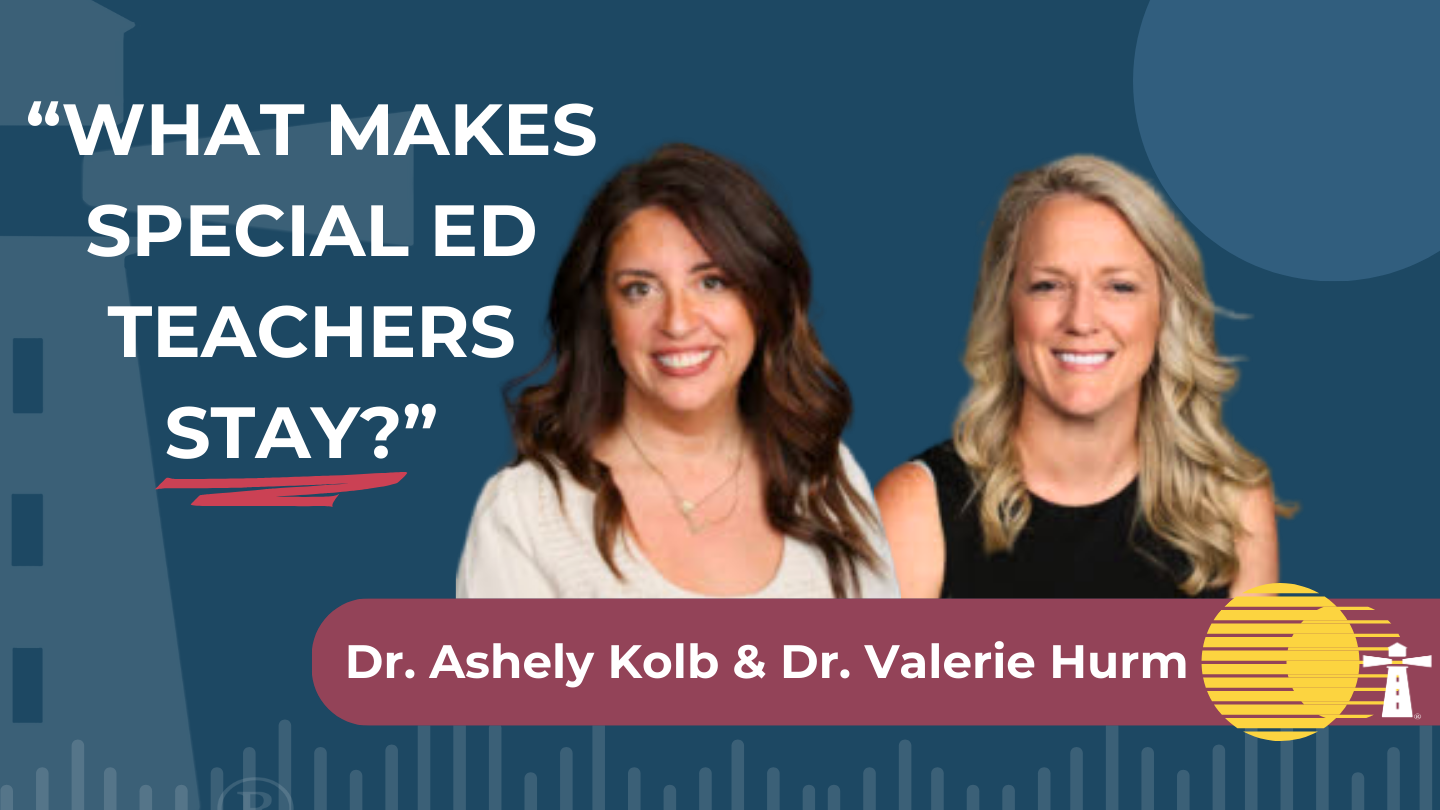
What Top Districts Know: The Secret to Keeping Special Ed Teachers – Dr. Ashley Kolb & Dr. Valerie Hurm
In a profession where burnout is all too common, what if you could create a workplace that not only retains special education teachers but makes them thrive? The Neenah Joint School District has cracked the code, and they’re ready to share their transformative approach.
Join us as we welcome two extraordinary educational leaders: Dr. Ashley Kolb, Director of Pupil Services, and Dr. Valerie Hurm, Director of Special Education. These pioneering administrators have developed a groundbreaking strategy that’s reversing the trend of special education teacher turnover.
In this powerful episode, you’ll discover:
- Why traditional support models are failing special education teachers
- How targeted, just-in-time professional development can revolutionize retention
- Practical strategies for creating a supportive, collaborative work environment
- The critical elements that transform isolation into inspiration
- Actionable steps to reimagine teacher support and professional growth
Provocative Quotes:
“What makes special ed teachers stay?” – Dr. Ashley Kolb
“We’re creating the environment and the space, and that’s all you need for this magic to happen.” – Dr. Ashley Kolb
This episode is a must-listen for district leaders, school administrators, and educators committed to supporting and empowering special education professionals. Learn how to build a workplace where teachers don’t just survive—they genuinely excel.
Don’t miss these insights that could transform your district’s approach to teacher retention. Subscribe now and join the movement to support our most dedicated educators.
FULL PODCAST Transcript
Lighthouse Therapy (00:01.017)
Hello everybody and welcome to the brighter together podcast. My name is Janet Courtney and I am so excited about this episode that we are about to record. Today I have two lovely educators that are here. Dr. Ashley Kolb is the director of pupil services and Dr. Valerie Hurm is the director of special education at Neenah Joint School District and that’s in Neenah, Wisconsin. Ladies, thank you so much for being on the show.
Dr. Valerie Hurm (00:27.098)
Thank you.
Dr. Ashley Kolb (00:27.96)
Thank you.
Lighthouse Therapy (00:30.623)
Awesome, so we agreed beforehand. We’re going to let Ashley start. So Ashley, if you can give us a little bit about Nina and about what you guys are doing, kind of give us the. The 10,000 foot and then we’ll go down from there. How’s that sound?
Dr. Ashley Kolb (00:34.86)
haha
Dr. Valerie Hurm (00:35.073)
the
Dr. Ashley Kolb (00:47.714)
That sounds great.
As you said, I’m Dr. Ashley Kolb. A year ago, I received my doctorate and I’ve always been really passionate about the work that I do. I started off teaching students with autism. So before the show, we were talking about we’re always who we started as or who our teacher. So this has kind of come full circle. I work with my colleague and I’m so thankful to work with her.
Lighthouse Therapy (00:55.883)
Yay, congratulations.
Dr. Ashley Kolb (01:19.108)
And we are trying to tackle, the question that I had, and maybe it was like a little bit of self-discovery, what makes special ed teachers stay?
for all of the challenges and the hard parts of the work and a lot of what I do is on the mental health side, my master’s degrees in counseling. I see what our staff go through. I see the challenges that they face every day, the asks on the curricular side. And so that was really my dissertation and my work. And although sometimes people look at a dissertation as just completing the process and getting the title, it was more of a
Dr. Valerie Hurm (01:45.774)
Thank you.
Dr. Ashley Kolb (01:59.51)
passion of figuring out the actual answer. And so the work continues. And I found someone in my colleague that felt the same way about her work. And luckily, our topics and our themes were actually the same. And so we’re putting together a project just to see how can we make our staff stay based on the study that I did, and the research that I found this theory we’re trying to put into action, and see if it can affect
own school district and what I know from the research is it would be cost beneficial to do this. It would be such a great opportunity for the students and the parents and just our staff knowing that they’re supported and they have each other and strengthening that is really the focus and the hope. So I’ll pass it off to Dr. Hurm now.
Lighthouse Therapy (02:36.311)
Yes.
Dr. Valerie Hurm (02:56.825)
Yes, I’m Dr. Valerie Hurm and I finished, I was a little behind Dr. Kolb, but I just completed mine, gosh, the start of the school year. But my work.
certainly supported the work that she had done as well. Hers were on why special education teachers stayed. Mine was more focused on how do you develop or how do you choose professional development for special education teachers or any teachers that are teaching students with special education needs. And so we found that when we sat and worked together that they really went hand in hand with each other.
Lighthouse Therapy (03:26.635)
Mm-hmm.
Dr. Valerie Hurm (03:38.838)
One of some of the big reasons that teachers stay are when they’re feeling supported and that professional development is provided. Where mine was more targeted to what type of professional development and how do we determine what they need. It really was set up as more of a triage situation. We all know as a special education teacher myself at some point in my career that we.
You don’t know what’s coming through your door necessarily all the time. It’s really difficult. Sometimes daily, right? So we don’t know. And so it’s really difficult to like choose one coin system that is going to provide the professional development for your entire district. And so our challenge was to come up with something that did not only support teachers and their needs, but also provided that.
Lighthouse Therapy (04:06.985)
Mm. Changes every year, right? Yeah. Yeah.
Dr. Valerie Hurm (04:32.121)
kind of triage system of I need to provide you the professional development that you need when you need it and what that needs to look like really on an individual school basis, an individual classroom basis and how we would make that work. So Dr. Colburn and sat down together just through many, conversations and came up with a system that we feel like meets both of our research bases and really
gives the teachers the support that they need on both ends. And so do you wanna talk about what that system looks like? I am too. We both have kind of our spot in it, but I’ll let Ashley start.
Lighthouse Therapy (05:08.503)
Yes, please. I want to hear about it. I’m excited to hear because boy, this is yeah. Yeah, absolutely, absolutely. And it’s just so let me just say really quick, man, this is exactly, exactly what we need, you know, to keep the amazing people that we have. So love that you guys are doing this and the kids when when you know, I’ll always always go back to the kids, the kids when when the when the teachers stay and when you have teachers that feel like they’re being supported. So
Dr. Ashley Kolb (05:10.23)
Yeah.
Dr. Ashley Kolb (05:30.122)
Yes.
Lighthouse Therapy (05:37.987)
So yeah, Ashley, tell us about it.
Dr. Ashley Kolb (05:40.47)
All right, so we partnered with just a local establishment that actually one of our teachers owns. They have an upstairs venue where we put on once a month. We call it a tier one behavior support.
But the experience is that any staff can come. We have experienced staff on hand. have ourselves. But they experience a coaching triad where we have protocols to walk through whatever behavior situation they’re going through so that they can really sit down and process with someone else the things that they’ve tried and established and done in kind of a non-judgmental place. From there,
we can problem solve and try and figure out in-house how do we support that teacher past that. They’re going to set a goal, but if it’s about going to observe another school or having the time to, we always have manipulatives and special ed or things that we have to create, how do we make sure that we as directors, as coordinators, as an entire district are giving the opportunity for those things to happen?
so that they can be successful. The effort to have it off-site was really to kind of take down the pressure of it feeling like work and having it be more about networking.
a part of my research was about those professional support networks and teachers that maybe work at a different school, but not they don’t know each other well, or they have different experiences that they can add, but they they have a new connection. So from the upstairs site, we can go and socialize downstairs and just get to know each other better. Because as directors, we know everyone in the district, we know how amazing they are, they don’t always interact in that way. So we were trying to
Lighthouse Therapy (07:37.602)
Mmm.
Dr. Ashley Kolb (07:40.508)
strengthen networks of people, of support, and of experience that has previously been there. And then from that,
Dr. Valerie Hurm (07:45.719)
Thank you.
Dr. Ashley Kolb (07:48.27)
From the director kind of coordinator side, we wanted to listen to the feedback and kind of be in the room monitoring what are the themes that are coming out. For example, we had a really hard kindergarten group this year. So if you can predict it, you can prevent it. Are we going to anticipate kindergarten is going to be hard next year? So what are some things we can anticipate and put in place? But if that still isn’t meeting the mark and they’re needing more support, then it would rise up to the level.
Dr. Valerie Hurm (07:57.835)
if all.
Dr. Valerie Hurm (08:10.154)
it.
Dr. Valerie Hurm (08:17.176)
It’s not enough.
Dr. Ashley Kolb (08:18.313)
that Dr. Hurm has and really supporting and doing that professional learning. So maybe talk about the tier two side of it.
Dr. Valerie Hurm (08:24.688)
Yes, absolutely. So once they’ve tried the interventions and the things that their coaching triad has helped and assisted with, if they feel like it still isn’t enough, like I’m still stuck, I still feel like I need additional support, then I have a team of very carefully selected. Some of them are special education teachers, some of them are speech therapists. It’s just a team of
people that are very good at their area. So we tried to have somebody from a secondary level that is like in a resource setting, somebody that’s in more of a cross cat setting at every level so that there’s somebody that’s really kind of an expert in their area that have many years of experience, things like that. So then if they’ve said, need more, then it…
Lighthouse Therapy (09:12.803)
Right.
Dr. Valerie Hurm (09:19.026)
reaches that level. So then we wrap around them as a group and we provide opportunities for mentoring observations. So we may have a teacher go into their classroom, do some observations, have that teacher then go into the classroom that that teacher currently teaches, and really a gradual release program. So if we say, I think we let’s try a
token economy or a system, then that teacher may go in and actually teach the other teacher how to use it, what it looks like with the student that they’re struggling with or the group of students they’re struggling with until they’re ready to take that on. And so it’s really been so far a very effective form of communication, of training, and then they feel supported.
Lighthouse Therapy (09:55.033)
Right.
Dr. Valerie Hurm (10:15.576)
but they also make a connection with the teacher that they may not have under different circumstances. And so now they have yet another resource or another tool in their tool bag.
Lighthouse Therapy (10:26.007)
Right? Yeah. Well, and two things just really quick. One, I love the fact that you took it off offsite. Offsite is so just that that struck me right off the bat because it’s like you take the pressure of the school and of feeling like I have to be perfect off of them when you do that. So I love the fact that you guys have done that. And secondly, when you get to tier two and this gives me chills, I love this.
is implementation. You know, how many times have we gone to a professional development or to a conference and we go, that’s so cool. that’s so neat. I think I’ll be able to implement that. And then you get back and you go, don’t know if I can do it or I don’t, know, you lose confidence because you don’t have that expert right in front of you telling you, yes, encouraging you. Yes, you can do this. Yes, you can make it work. So having, having somebody come and walk alongside them, that’s beautiful. Love it.
Dr. Valerie Hurm (11:08.871)
and
Dr. Ashley Kolb (11:15.201)
Mm-hmm.
Dr. Valerie Hurm (11:15.256)
Thank you.
Lighthouse Therapy (11:22.158)
Love it.
Dr. Ashley Kolb (11:24.714)
I really think coaching is at the heart of all of this, like people really uncovering what works for them and we’re trying to teach some of our people that are in that mentorship, you have the experience that worked for you, but it might not work in this situation, or they might be bringing different strengths to it that just makes it that much better. coaching is the model through and through that we’re really hoping for.
Lighthouse Therapy (11:42.711)
Mm-hmm.
Lighthouse Therapy (11:53.081)
and those nuances of that particular classroom or that particular disability that is being affected by it or whatever. Yeah. Yeah. Awesome.
Dr. Ashley Kolb (11:55.836)
Yes.
Dr. Valerie Hurm (11:57.08)
Thank you.
Dr. Ashley Kolb (12:01.748)
Yep, yep.
Dr. Valerie Hurm (12:03.081)
And I think the team members are truly learning from each other as well. Even when we all sit down to, I’ve learned so much just myself listening to them coach each other, right? Because they’ve all come from such different backgrounds and have just different levels of expertise. And so it’s been really eye-opening to see all of that come together. And so it’s really that internal professional development and then building those relationships with their
Dr. Ashley Kolb (12:23.851)
Yeah.
Dr. Valerie Hurm (12:29.9)
with their peers and parents. mean, I would love to see this expand into, because another part of mine was really involving other stakeholders as well. really could bring in, you know, administrator, let’s see if I can spit it out today, administrators, parents, different organizations, maybe a boys and girls club that would like some support. And so it really is an opportunity for
growth to provide that support for all stakeholders, not just teachers.
Lighthouse Therapy (13:04.418)
Yeah, yeah. And the principles are the same, you’re doing it just, yeah, expanding it beyond. a little bit, a question I have, and I don’t know, what are, first of all, what is the size of your district? Like, is this something that, like, would you recommend this for a particular size of district? or I can see, I can see naysayers, that’s great for them, but you know, we’re tiny and that would never work for us and blah,
Dr. Valerie Hurm (13:07.607)
and
Dr. Ashley Kolb (13:31.808)
Mm-hmm.
Lighthouse Therapy (13:33.141)
So just speak a little bit to that for me, if you wouldn’t mind.
Dr. Ashley Kolb (13:38.425)
so I would say in this state, excuse me, we’re probably like a medium sized district. our high school and middle school have 2000 kids in each one.
Lighthouse Therapy (13:51.779)
Mm-hmm.
Dr. Ashley Kolb (13:54.373)
So I think that it honestly would work in any capacity because the the premise of at least tier one is the the coaching triad. So truly you need three people and you just set up the protocol for how the one person is prompting and questioning and asking questions at the right time. But it’s really
working out those listening skills and almost that motivational interviewing that gets where we want it to go. I mean, that’s kind of the premise of what we’re wanting. And then the third person is the encourager, kind of that third eye that might ask questions at the time to encourage the conversation as well. I’ve experienced it in the past, and I know Val has too. And we just thought that would be the right tool or the mechanism to kind of reach as many people as we want.
Thank
And then if there’s people that come that there’s a large group but only one person has a problem they want to work out, then we could do a Socratic circle and have a large group on the outside and then that person in the middle with a couple of people. So we’ve definitely thought through that and we’re ready for as small or as large as we can go. I think the one thing that I keep thinking of is like how to be as timely as we can to when the problems arise because I know it feels so urgent.
Lighthouse Therapy (14:58.777)
Mm-hmm.
Lighthouse Therapy (15:17.305)
Mm.
Dr. Ashley Kolb (15:19.406)
So that’s the part that we’re doing these cycles once a month. We just began the other day and there was only a few people that came, which was great.
Word is spreading, hopefully, that this is a great opportunity. Our principals were really on board. But I want it to be that safe space that they can come and I want it to be as timely as we can make it so that they feel like they’re not waiting too long to find this as an opportunity.
Dr. Valerie Hurm (15:47.383)
and.
Lighthouse Therapy (15:49.977)
Yeah, and when you have that really bad day, there’s somebody that I can go, this happened today. How do I help me help me figure out how to fix it, right?
Dr. Ashley Kolb (15:56.553)
Yes. And that’s really, really, I hope that networking of people also comes into that. That’s what builds off of coming to this opportunity and experience is like, I know they talked about this, I can reach out to them. So yeah.
Lighthouse Therapy (16:02.328)
Yeah.
Lighthouse Therapy (16:10.883)
Yeah.
Dr. Valerie Hurm (16:12.603)
And then my my background is I talked about this prior to our meeting, but I did move here from Wyoming and within Wyoming are some very, very small districts. And I know one of the things that they’ve talked about, because you might be the only special education teacher in your district or even in their, you know, an area. And so what they did to combat some of that is think.
Lighthouse Therapy (16:20.419)
All right.
Lighthouse Therapy (16:33.25)
Right?
Dr. Valerie Hurm (16:37.963)
goodness for virtual options that you really could have the same triad with other districts or other teachers within districts. And so I really don’t think that there are any limitations to size. You may just have to get creative and think outside the box as far as can I, can I partner with, you know, three or four other districts that maybe
have some expertise in those areas and meet monthly and really expand that networking if they’re so tiny that they don’t have the resources that some of the bigger districts would have.
Lighthouse Therapy (17:13.891)
So for this program, I’m assuming you have support from your admin team and is there funding? Is there some funding that you’re having to tap into? How is that? Because that’s always the issue. I don’t have any money, right?
Dr. Ashley Kolb (17:27.763)
Yes, yes.
Dr. Valerie Hurm (17:28.565)
Yes, so I’ll talk a little bit about my part because it is, mean funding is always a conversation when we talk about professional development and things like that. So I do offer the team of mentors that do, because it’s a tremendous amount of work outside of their normal day. I do offer them a small stipend for their time.
And we’ve found other ways, and I’ll let Dr. Culp talk about, there are some other ways that aren’t necessarily attached to money that encourage them to attend. And if they’ve attended, then they can have some other options within their building. So I’ll let Dr. Culp talk about those things.
Dr. Ashley Kolb (18:11.7)
Yeah, so being creative with money is the name of the game when you don’t have any so That’s where when we took it off site. It was Someone we knew that is in our district. She’s an amazing math coach at our middle school and She let us use that space for free We just purchased some snacks because food always brings people into and we want We we really wanted people to feel like professionals and that they have the professional
Dr. Valerie Hurm (18:15.639)
I’m
Lighthouse Therapy (18:17.251)
Yep.
Lighthouse Therapy (18:36.016)
yeah, yep, yep.
Dr. Ashley Kolb (18:41.854)
support. The other thing we tried to do too is if you participate, know, we’ll trade time for time. So it would be an opportunity to leave early on Friday or, you know, an opportunity to work with our principals to support this effort to come a little late or, you know, just the support from our principals to say, hey, if they want to go and observe another classroom that would build their capacity, could you allow that and make sure that that happens? And everyone’s
been so supportive. What Dr. Hurm reminds me of is this district coming into it she said everybody’s so excited and willing to learn and sometimes we get bogged down with the stuff of our our jobs but it’s such an awesome reminder that we do have some people that want to do really great things for kids and they’re very supportive of our passion projects.
Lighthouse Therapy (19:22.777)
Mm-hmm.
Lighthouse Therapy (19:36.653)
Yeah. it ultimately, you know, for them, for, for admin, for people like me, you know, it’s like turnover, turnover costs. There’s a, there’s a, there’s a cost for turnover. And it’s not just, it’s not just, there’s a financial cost, obviously, but there’s also, talked a little bit about the, about the cost to the kids and the cost of the families and the cost of the schools and, and how, and how difficult it is when you can’t even find anybody to fill that hole. and
Dr. Ashley Kolb (19:44.438)
Yeah.
Dr. Valerie Hurm (19:53.975)
Thank you.
Dr. Ashley Kolb (19:56.534)
Yep.
Dr. Ashley Kolb (20:04.523)
Correct.
Lighthouse Therapy (20:05.397)
And so, you know, it’s a win when you, it’s better to put a little bit of money into this thing than having to, you know, spend the money to replace that person. So it’s a smart, it’s a smart move if you can get it to work and make it be successful. And have you guys given it a name? Do you have like a name for your program?
Dr. Valerie Hurm (20:13.268)
Thank
Dr. Valerie Hurm (20:24.726)
Thank
Dr. Valerie Hurm (20:29.012)
Hahaha!
Dr. Ashley Kolb (20:29.804)
Oh God, we have, I think we called it just a behavior support framework at this point and kind of a two tiered behavior support framework. At first it really was just focused on special education based on our dissertation. But what we found is that sometimes it’s not just the special education teacher that is struggling with behaviors.
Lighthouse Therapy (20:31.418)
Ha ha ha ha!
Lighthouse Therapy (20:37.059)
Okay.
Lighthouse Therapy (20:46.19)
Mm-hmm.
Lighthouse Therapy (20:53.133)
yeah.
Dr. Ashley Kolb (20:53.676)
You know, it’s our classroom teachers that are maybe dealing with or handling different students. So at the tier one level, we really opened that up and made sure that anyone that really needed that support could access that. So we’re excited for the future and spreading the word. And I think principals are excited to have something to offer to teachers to say, hey, you should check this out. This would be a really great opportunity. Or you’re new to Neena, like go and network.
Lighthouse Therapy (21:15.993)
Yeah.
Dr. Ashley Kolb (21:23.83)
and just kind of get to know what’s available and who can support you. Because when you’re interviewing candidates, that’s usually one of the questions they ask coming in, is would I have a mentor and who’s going to support me? Almost every single time. to have something now that we can say, we have all of the things that typically happen and we have these great networks that will get you involved in.
Lighthouse Therapy (21:36.599)
Mm-hmm. Mm-hmm.
Lighthouse Therapy (21:49.709)
Yeah, at Lighthouse, have a, everybody gets a mentor. You come here, it can be isolating if you’re a virtual therapist and, you know, feeling like you’re on an island all by yourself, even though you’re interacting with kids and people all day long, it still can feel that way sometimes. And so having somebody that we always tell our therapists and our teachers now, because we are doing some SPED teacher stuff, is there’s no stupid question.
Dr. Ashley Kolb (21:57.707)
Yeah.
Lighthouse Therapy (22:16.237)
The only stupid question is the one that you don’t ask. So ask questions, make sure, and that’s why we give you a mentor. So you have somebody that I’ve had. I’ve had great mentors in the past. I went from skilled nursing and medical back into education at one point in my career, and I’ve kind of hopped back and forth. I can now happily say I’ve done more education than I did medical, but.
Dr. Ashley Kolb (22:18.698)
Yes.
Dr. Valerie Hurm (22:20.31)
Yes.
Dr. Ashley Kolb (22:33.643)
Mmm.
Dr. Valerie Hurm (22:41.59)
Thank
Dr. Ashley Kolb (22:42.378)
Yeah.
Lighthouse Therapy (22:44.025)
But that switch that that switch made me feel like a new therapist all over again. I was like, I don’t I’m a therapist for 18 years and I don’t know how to do this. This is ridiculous, you know, or whatever. I don’t remember how long it was, but you know what I mean? And you just feel like in like, I don’t want to ask somebody because I don’t want them to think that I don’t know what I’m doing. Right. That feeling. Yeah. So having that is cool. Yeah, I’m sorry. Go ahead.
Dr. Valerie Hurm (22:46.006)
Thank
Yes.
Dr. Valerie Hurm (22:54.134)
Thank
Dr. Ashley Kolb (22:54.568)
Yep.
Dr. Ashley Kolb (23:02.987)
Correct. Yep.
Dr. Valerie Hurm (23:03.116)
Right. Well, and this one. Yep. Well, and it provides that it provides that mentorship to have any this program provides that mentorship, at least those relationships and that opportunity for question. Even if I have been I a teacher for 20 years, I might have a student that comes into my classroom and you know, we we set up we typically in education set up mentors for those new people.
But what about the people that are like, I’ve done this for a long time and I don’t know what to do. And so this really provides that opportunity for them as well. It doesn’t matter how many years they’ve been in it. They’re all more than welcome to attend and just gain those ideas and interventions and things to try.
Lighthouse Therapy (23:34.521)
Yeah.
Lighthouse Therapy (23:48.801)
And in a way that doesn’t make them feel like, gosh, I’m at school. need to, yeah. Yeah. Yeah. Yeah. Yeah. Yeah. Open up. Give them an opportunity to open up in a much more relaxed setting is, is I think that’s a, that’s a big piece of, of the success that you guys are going to see is that piece right there. So awesome. Awesome. So, so, so what is next for you ladies? What is, where, where does this go? Where do we go from here?
Dr. Valerie Hurm (23:50.582)
Yes.
Dr. Ashley Kolb (23:53.205)
Yeah. Yep.
Dr. Ashley Kolb (24:08.563)
Yeah.
Dr. Ashley Kolb (24:15.924)
I think from my perspective just the rollout of trying it. So like I said, we just had our first,
offering of this word is starting to spread. hope to have more opportunities for our staff to kind of see the benefits of this experience. So by the end of the year, we’ll hopefully have five different sessions that we can look at and reflect on. If there’s a need for more, we would love to do more. We would love the community support to see if we can have funding. And that was our big dream in the beginning when we were really brainstorming. We’re like, and what if we could
have community partners that would understand you know how important special ed is and they would provide funding so that we could make our staff feel even more like prized like we just went and went and went it was really fun so we are starting small but dreaming big so what else are you Dr. Hurm?
Lighthouse Therapy (25:04.099)
Mm-hmm, yeah. Dream big, you have to, absolutely, yeah.
Dr. Valerie Hurm (25:08.854)
Thanks.
Lighthouse Therapy (25:11.897)
Yeah.
Dr. Valerie Hurm (25:13.974)
I think it’s a good opportunity for all of us to really look at those themes. I know there’s a lot of times, just like we talked about earlier, I’m not in the classroom every day. And so this is also an opportunity for me to learn and look at those themes and the things that we can then provide support. And so I really want this to not only support our teachers, but guide us in our decision making as far as how can we help them.
Lighthouse Therapy (25:24.995)
Yeah.
Dr. Valerie Hurm (25:43.536)
district-wide or what kinds of resources can I then provide where I might think they need something, but that’s not truly what they need. And so I really, I hope it’s an opportunity for me to listen and learn as well so that I can guide some of those decisions more appropriately.
Lighthouse Therapy (26:01.197)
Fantastic.
Dr. Ashley Kolb (26:01.597)
And actually the other day for our first event, so it was a middle school special ed teacher and a behaviorist from our elementary school. And they were, she said essentially that, like when we’re out of the classroom, we don’t have that experience. So they really look to other people that are in it to get that advice. She’s like, yeah, we love you, but you know, we want to take advice from other people. And then they just started talking and they were sharing resources
Lighthouse Therapy (26:29.561)
Yeah.
Dr. Ashley Kolb (26:31.521)
And she goes, see, that’s why we come, because they were ideas that they were doing that just automatically sparks that. So we’re creating the environment and the space, and that’s all you need for this magic to happen and hopefully set them up in a really successful way.
Lighthouse Therapy (26:48.099)
Yeah, because teachers care. Teachers want to help their kids. are teachers because it’s a calling. It’s a gift that they’ve been given. It’s amazing. And to get them together and know that they’ve got other people that support them. And the fact that you guys are doing this from a perspective of a leader, and it shows that you value them. know, that Lighthouse Therapy is our mission is to be a therapy company run by therapists.
Dr. Valerie Hurm (26:50.965)
Thank
Dr. Ashley Kolb (26:53.579)
Yep.
Yes.
Lighthouse Therapy (27:15.821)
for therapists for the betterment of students and that by therapist piece, by my leadership team, by the people that care and make the decisions, that’s a critical piece of it. And it has brought success. It has brought stability for us. We as a company have an 80 % retention rate in our therapists. That’s amazing. But it doesn’t come.
Dr. Ashley Kolb (27:21.887)
Mm-hmm.
Dr. Ashley Kolb (27:39.231)
Wow. Yes, it is.
Dr. Valerie Hurm (27:39.753)
Thanks for watching.
Lighthouse Therapy (27:43.885)
just because we sat on our laurels and hired people and said, Hey, we’re therapists come work for us. It doesn’t work that way. You still have to support them. You still have to put your money where your mouth is, especially when you have a mission like that. And you guys have, you guys are, are, are missional as well. You’re working towards keeping those. And I don’t know if it’s defined that way for you, but that’s what I see. You I see you guys really are doing something that is going to help continue to keep people in a position and, and
Dr. Ashley Kolb (27:48.821)
Yeah.
Dr. Valerie Hurm (27:49.289)
Thank
Dr. Ashley Kolb (27:55.882)
Yeah.
Dr. Ashley Kolb (28:04.81)
Yeah.
Dr. Valerie Hurm (28:06.207)
Thanks.
Lighthouse Therapy (28:12.683)
Again, like I’ve said three times already, the kids win. That’s what we want. We want the kids to win. so fantastic. So where ladies do people go? Cause now we’ve, we’ve sparked interest. I know there are other people that are going, that’s it. I want to do that. That’s amazing. I want to make sure that my team has that. So where did they go? Where do they go to find you guys and pick your brains? Cause you know, you guys are going to be mentors for others as well.
Dr. Ashley Kolb (28:15.679)
They do.
Dr. Ashley Kolb (28:23.677)
Hahaha.
Dr. Valerie Hurm (28:24.261)
Ha ha ha ha ha.
Dr. Ashley Kolb (28:37.667)
that’s awesome. I would say we have our district website. You can find our names and contact information. I think there’s a little tab there. Nina spelled N-E-E-N-A-H. We always get that confused when we’re telling people where we are. But from there, we would be super happy to mentor and help. I know with Val’s experience in another…
state. mean, there’s a lot of networking and experiences. We would love to spread the word and help and kind of the same idea. Like, we make iron sharpens iron and we would love to learn from other people too. And whatever we can provide and do we would we would love to or if there’s other ideas to make ours better, would I would love that.
Dr. Valerie Hurm (29:04.127)
for this.
Lighthouse Therapy (29:05.987)
Mm-hmm.
Lighthouse Therapy (29:13.293)
Mm-hmm.
Lighthouse Therapy (29:22.769)
Yeah, yeah, I love that you guys are open to open to other ideas as well. That’s a beautiful thing about educators and about people that are administrators and education and teachers as well. We just share you guys. It’s so yeah, it’s beautiful. It’s absolutely beautiful. I’d love to see I’m I have a feeling that this is something that’s going to grow and grow and grow. I’d love to see you guys present this at a national conference somewhere. And if you do,
Dr. Valerie Hurm (29:23.765)
Yes.
Dr. Ashley Kolb (29:35.519)
Yeah. There’s no gatekeeping. Yeah. Yeah.
Dr. Valerie Hurm (29:39.166)
No.
Lighthouse Therapy (29:50.315)
I need to get an invitation. So if that’s something that’s in your future, you need to let me know. because it is, it’s, it’s key to, keeping and supporting and growing human beings. And that’s, that’s what we’re all about. We’re brighter together, right?
Dr. Ashley Kolb (29:51.755)
You absolutely would.
Dr. Valerie Hurm (29:53.013)
Great, absolutely.
Dr. Ashley Kolb (29:56.619)
For sure.
Dr. Ashley Kolb (30:04.351)
We are brighter together.
Dr. Valerie Hurm (30:05.023)
Absolutely.
Lighthouse Therapy (30:06.349)
Well, ladies, thank you so much for being on the show. Thank you for sharing your heart and your passion and just keep keep it up. I’m I’m I’m proud of what you’re doing. I’m excited for it. So thank you. Absolutely. You bet. Take care.
Dr. Ashley Kolb (30:16.651)
Thank you so much for the opportunity.
Dr. Valerie Hurm (30:19.081)
Thank you. Yes, thank you for having us.