

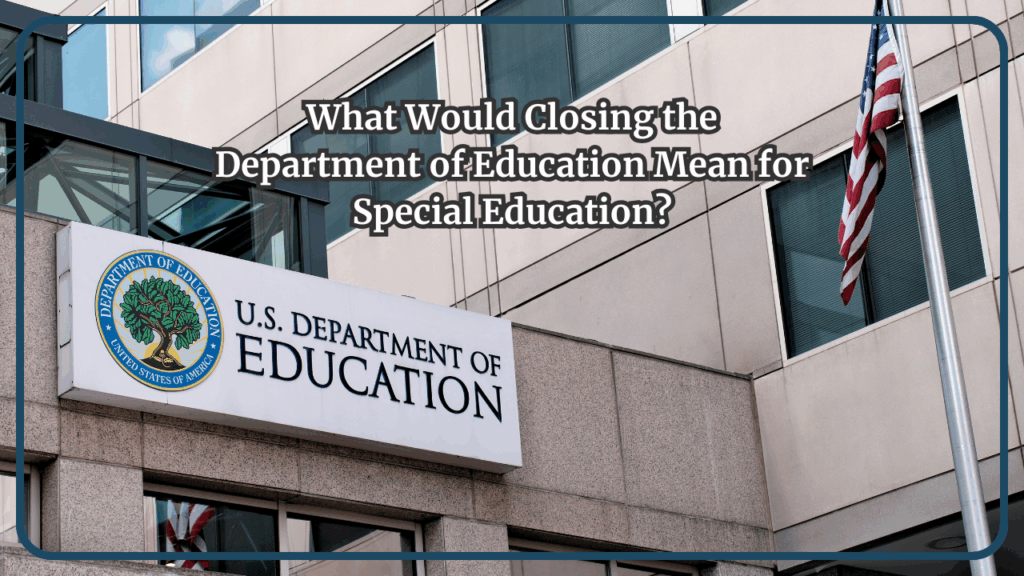
In recent months, discussions about closing the Department of Education have gained new attention under the current administration. For schools, districts, and especially special education teams, this raises important questions. What would it actually mean for students and educators on the ground?
At its core, closing the Department of Education would not erase federal education laws. Instead, it would mean shifting the Department’s current responsibilities to other federal agencies or directly to states. Functions such as distributing federal education funds, monitoring compliance with the Individuals with Disabilities Education Act (IDEA), and enforcing civil rights protections would have to be absorbed by new systems. In practice, this could reshape how special education services are overseen and supported.
This piece looks at the facts we know now, the proposals that have been raised, and the potential implications for special education if such a shift were to happen. The goal is to give school leaders, special education directors, and families a clear, balanced picture of what changes might look like.
Understanding education policy changes can feel overwhelming, especially when the conversation is framed in broad national terms. By examining how closing the Department of Education could affect special education, we can focus on what really matters: ensuring students with disabilities continue to receive the services and protections guaranteed to them under law.
How the Department of Education Supports Special Education Now
Before thinking about what might change, it is important to understand what the Department of Education (DOE) currently does to support special education. The Department’s role is not about setting curriculum or running schools directly. Instead, it provides oversight, funding, and protections that shape how services for students with disabilities are delivered across the country.
Role of the DOE in Special Education
The DOE is responsible for overseeing the implementation of the Individuals with Disabilities Education Act (IDEA), the federal law that guarantees students with disabilities access to a free appropriate public education (FAPE). Through this oversight, the Department ensures that states and districts meet the requirements laid out in IDEA, from evaluations and Individualized Education Programs (IEPs) to due process protections for families.
A major responsibility is the management and distribution of federal funds. For example, in recent years Congress has appropriated more than $14 billion annually in IDEA Part B Grants to States. These funds help cover the additional costs of providing special education and related services for children ages 3 through 21. Without this federal pipeline, many schools would struggle to meet the legal and practical requirements of serving students with disabilities.
The DOE also monitors compliance with both IDEA and Section 504 of the Rehabilitation Act. While IDEA focuses on individualized services in schools, Section 504 protects students with disabilities from discrimination in educational settings. Each year, the Department issues state performance determinations that rate whether states are meeting their IDEA obligations. This process, backed by audits and data reviews, holds states accountable and ensures families have a pathway to address concerns if services fall short.
Office of Special Education Programs (OSEP)
Within the Department, the Office of Special Education Programs (OSEP) plays a central role in supporting schools and districts. OSEP provides technical assistance, resources, and research to help states improve how they serve students with disabilities. For example, it funds the IDEA Data Center, which helps states improve the accuracy of the information they collect and report on student outcomes. Reliable data is essential for identifying gaps and ensuring accountability.
OSEP also supports national centers like the Early Childhood Technical Assistance Center and the National Center on Intensive Intervention, which provide training, guidance, and research-based strategies for educators and administrators. These resources help school teams improve instruction and interventions for students who need the most intensive supports.
In addition, OSEP administers discretionary grants to encourage innovation. These have included projects to improve outcomes for students with significant cognitive disabilities and programs that help older students transition successfully from high school into employment or higher education. In this way, OSEP acts as both a watchdog and a partner, ensuring compliance with IDEA while also fostering new approaches to better serve students.
What We Know About Special Education Laws
When conversations about closing the Department of Education surface, one of the biggest concerns is whether students with disabilities would lose their rights to services. It helps to remember that special education laws exist independently of the Department itself. The foundation of these protections is the Individuals with Disabilities Education Act (IDEA), which was passed by Congress and signed into law. Because IDEA is federal law, it cannot simply disappear if the Department were to close.
At the heart of IDEA is the guarantee of a Free Appropriate Public Education (FAPE) for every eligible child with a disability. This right applies across the country and ensures that students receive individualized supports and services at no cost to families. FAPE is not tied to the Department of Education as an institution, but to the law itself. Whether oversight sits with the DOE, another agency, or the courts, the obligation for schools to provide FAPE does not change.
In fact, courts have long played a role in enforcing IDEA compliance. Families who believe their child’s rights are being denied can pursue due process hearings and, when necessary, bring cases into federal court. Judges have the authority to uphold IDEA’s requirements, order corrective actions, and ensure schools meet their obligations. This judicial backstop exists regardless of which federal agency carries the responsibility for oversight.
Knowing this helps reassure families and school leaders: even if the Department of Education were to close, student rights under IDEA and FAPE would remain intact. The mechanisms for accountability might shift, but the legal protections for students with disabilities would not disappear.
What We Know About Proposals to Close the Department of Education
Conversations about closing the Department of Education have moved from abstract debate to concrete proposals, including draft executive orders. In recent months, federal leaders have put forward proposals and draft executive orders suggesting the Department could be downsized or dissolved. For educators and families, it is important to separate speculation from what these proposals actually say.
Recent Policy Discussions
Several proposals and executive actions have suggested that the Department of Education’s responsibilities could be shifted to other agencies or returned to states. In some drafts, oversight of civil rights protections would move to the Department of Justice (DOJ), while administration of special education funding and health-related services could shift to the Department of Health and Human Services (HHS). These ideas are framed as ways to streamline government, reduce bureaucracy, or give states more direct control.
It is important to note that none of these proposals eliminate existing federal education laws. Instead, they focus on where responsibilities for compliance and enforcement would live. For schools and districts, that means the day-to-day impact would come less from the laws themselves and more from changes in how those laws are monitored and supported.
What Closure Would Likely Involve
If the Department were to close, it would not directly change classroom lesson plans or state standards, since those decisions are made at the state and local level. However, federal funding programs often come with reporting requirements and accountability measures that influence state policy. Changes in federal oversight could therefore indirectly shape how states approach standards, assessments, and program design.
If the Department were to close, it would mean those responsibilities would have to be absorbed somewhere else. For example, IDEA funds might be distributed through block grants managed by HHS or the Treasury Department. Oversight of compliance could be reassigned to other agencies, such as the Department of Justice. While this is one scenario under discussion, the exact structure has not been determined. Depending on how responsibilities are reassigned, families might see changes in how complaints are handled. Some proposals envision DOJ taking on a larger role, which could result in a more formal and legalistic process compared to the current administrative complaint pathways offered by the Department of Education’s Office for Civil Rights.
Importantly, closing the Department would not end laws like IDEA or Title I. These laws were passed by Congress and remain binding on states and districts. What would change is the structure of federal oversight and the level of consistency across states. Schools and families could see more variation in how services are supported and monitored, depending on how responsibilities are reassigned.
Current Status
At this point, no law has been passed to dissolve the Department of Education. Proposals have been circulated and executive orders have been drafted, but any actual closure would require congressional approval. That process would involve extensive debate, legal challenges, and a transition plan to determine which agencies or state systems would take on the Department’s current responsibilities.
For now, the Department of Education continues to operate as usual. Federal funds are being distributed, oversight activities are ongoing, and programs like the Office of Special Education Programs (OSEP) remain active. While discussions about closure are politically significant, they do not change the legal obligations that schools have under IDEA today.
What We Don’t Know Yet
While there is growing discussion about closing the Department of Education, many details remain unclear. For school leaders, special education directors, and families, these unknowns are often the most concerning because they affect how services would actually reach students.
One key question is how Congress would redirect IDEA and Title I funds. These federal dollars are critical for supporting students with disabilities and schools serving low-income populations. If the Department were dissolved, lawmakers would need to determine which agency would manage and distribute these funds. Would they continue as dedicated IDEA and Title I grants, or would they shift to block grants with fewer strings attached? The outcome could significantly shape how consistently services are delivered across the country.
Another uncertainty is whether state systems could absorb oversight roles quickly. Currently, the Department of Education provides monitoring, technical assistance, and enforcement tools that many states rely on. If those responsibilities were suddenly shifted, states would need the staff, infrastructure, and expertise to take them on. States vary widely in their current capacity to monitor compliance and provide technical assistance. Some may adapt relatively smoothly, while others could struggle with staffing, infrastructure, or expertise. This raises the possibility of uneven protections for students with disabilities depending on where they live, at least during a transition period.
Finally, we do not yet know what new enforcement mechanisms would look like. The Department of Education’s Office for Civil Rights and Office of Special Education Programs currently offer families pathways to file complaints and resolve disputes without going to court. If those offices were dissolved or moved, the pathways for resolving disputes could change. Families might see greater reliance on state-level systems or federal courts, but it is too early to know whether administrative complaint processes will remain in their current form. Until a clear plan is laid out, the accessibility and efficiency of enforcement for parents and students remain uncertain.
In short, while the legal rights of students with disabilities remain intact under IDEA, the practical systems of funding, oversight, and enforcement are full of unknowns. These unanswered questions highlight why it is important for school leaders and families to stay informed as policy discussions unfold.
Potential Benefits of Closing the Department of Education
State and Local Flexibility
One of the most frequently discussed arguments for closing the Department of Education is the possibility of increased state and local flexibility. Without federal oversight concentrated in one agency, states could have more room to design and implement programs that reflect their unique needs and priorities. For example, rural districts might allocate resources differently than large urban systems, tailoring decisions to the realities of their communities. Proponents of this idea argue that shifting authority away from Washington could reduce one-size-fits-all policies and allow for more innovation at the state and local levels.
Reduced Administrative Burden
Another potential benefit often cited is the reduction of administrative requirements tied to federal funding. Currently, districts spend significant time and resources preparing reports, meeting compliance deadlines, and navigating complex federal regulations. Closing or downsizing the Department of Education could, in theory, ease this workload by eliminating or streamlining some of these processes. With fewer federal reporting mandates, districts might be able to redirect staff time toward instructional support and direct student services. For special education in particular, less paperwork could mean more capacity for teachers and administrators to focus on student needs rather than documentation.
Potential Risks of Closing the Department of Education
Uneven Services Across States
One of the main concerns about closing the Department of Education is the risk of creating uneven services across the country. Federal oversight has historically set a baseline for education equity, particularly in programs serving students with disabilities and those in low-income districts. Without a centralized agency, states could vary widely in how they distribute funds or enforce requirements, potentially leading to greater disparities. Some states might maintain strong systems, while others could struggle to provide consistent supports. For special education in particular, the absence of federal monitoring could make compliance harder to track, raising concerns about whether all students would continue to receive equal access to services.
Uncertainty in Funding and Oversight
Federal education funding, especially under laws like IDEA, is tied to specific compliance obligations. If the Department of Education were closed, these funds could be redirected as block grants to states. While this might increase flexibility, it could also reduce accountability for how money is spent. Families who rely on IDEA funding to secure services for their children might face more uncertainty about how those services are guaranteed. Without a clear oversight structure, enforcing compliance could become slower or more complicated, potentially placing additional burdens on parents and advocates.
Civil Rights Enforcement
The Department of Education’s Office for Civil Rights (OCR) plays a central role in investigating complaints and enforcing student protections in schools. If the agency were dissolved, responsibility for these cases might shift to the Department of Justice. That change could make the process more formal and reliant on litigation, which can be lengthy and costly. Responsibility for these cases could shift to the Department of Justice. That change might make the process more formal and reliant on litigation, which can be lengthy and costly. Families and students who currently have a direct administrative path for resolving discrimination complaints could face new hurdles, depending on how the system is redesigned. This raises questions about whether civil rights protections for students could be upheld as effectively without a dedicated education-focused office.
Key Considerations for District Leaders and SPED Teams
For school and district leaders, uncertainty around federal education policy underscores the importance of planning ahead. Even though no law has been passed to close the Department of Education, proactive steps can help safeguard service delivery if changes occur in the future.
Staying updated on legislative changes is essential. It’s important to understand that policy proposals often move quickly, and early awareness allows leaders to anticipate potential adjustments to funding or compliance requirements. Subscribing to and staying abreast of state education department updates, federal notices, and professional association briefings can help administrators stay informed.
Strengthening relationships at the state level is another key strategy. If oversight responsibilities shift from federal to state agencies, having clear communication channels in place will be critical for resolving questions and securing timely guidance. Districts that already maintain strong partnerships may be better positioned to adapt.
Transparent communication with families should also remain a priority. Parents and caregivers will naturally have concerns about how their children’s services might be affected by any policy change. Offering regular updates and providing space for questions builds trust and reinforces a district’s commitment to student success.
Finally, districts should continue to maintain robust compliance systems regardless of where oversight resides. Accurate documentation, consistent monitoring of IEP implementation, and clear accountability practices are vital safeguards. These measures not only ensure that districts remain compliant with federal law, but also protect the rights of students with disabilities.
Final Thoughts
The debate over whether to close the Department of Education raises both possibilities and risks. On one hand, greater state flexibility and reduced administrative requirements could ease the burden on districts. On the other, the loss of a centralized agency raises concerns about equity, oversight, and the protection of student rights.
Through it all, one fact remains constant: students with disabilities are legally entitled to services under IDEA, and that right cannot be dissolved simply by restructuring a federal agency. Regardless of how oversight might shift in the future, the responsibility to provide a Free Appropriate Public Education remains firmly in place.
In this environment of uncertainty, schools and families benefit from reliable partners who understand both the legal requirements and the practical realities of service delivery. Lighthouse Therapy positions itself as exactly that kind of partner: steady, supportive, and focused on continuity. Whether policies shift toward greater state control or remain under federal oversight, Lighthouse continues to prioritize high-quality special education services, ensuring that students receive the support they deserve.
| Section | Key Points | Implications for Special Education |
| DOE’s Current Role | • Oversees IDEA implementation (FAPE, IEPs, due process)
• Distributes $14B+ in IDEA Part B funds annually • Monitors compliance with IDEA & Section 504 • Rates states via annual performance determinations |
• Federal funds support services and technology for students with disabilities
• Families have accountability pathways if schools fall short |
| Office of Special Education Programs (OSEP) | • Provides technical assistance and resources
• Funds IDEA Data Center and national centers (e.g., Early Childhood TA Center) • Administers discretionary grants for innovation and transition programs |
• Improves data accuracy and outcomes tracking
• Supports educators with training and guidance • Encourages innovative practices for students with significant needs |
| Special Ed Laws (IDEA & FAPE) | • IDEA is federal law, independent of DOE
• Guarantees FAPE to eligible children with disabilities • Enforced by courts and due process hearings |
• Rights to services remain intact even if DOE closes
• Oversight may shift, but obligations for schools do not disappear |
| Proposals to Close DOE | • Draft executive orders and proposals circulate
• Responsibilities could shift to DOJ (civil rights) or HHS (funding/health-related services) • Aim: streamline government, give states more control |
• Laws like IDEA and Title I would remain
• Changes would affect how oversight, compliance, and funding are managed |
| What Closure Would Involve | • DOE does not set curricula but influences policy via funding requirements
• Funds could become block grants via HHS or Treasury • Complaint systems could move to DOJ or states |
• Families might face more formal/legalistic complaint processes
• States may vary in how consistently they support services |
| Current Status | • DOE remains fully operational
• Proposals exist but no law has dissolved DOE • Closure would require Congressional approval |
• For now, funding, oversight, and OSEP programs continue as usual |
| Unknowns | • How Congress would reassign IDEA/Title I funds
• Whether states can absorb oversight roles quickly • What new enforcement mechanisms will look like |
• Risk of uneven protections during transition
• Families could face delays or barriers to resolving disputes |
| Potential Benefits | • More state/local flexibility to design programs
• Possible reduction in administrative burden for districts |
• Districts might redirect resources from paperwork to instruction
• States could innovate with tailored approaches |
| Potential Risks | • Uneven services across states without federal baseline
• Uncertainty in funding/oversight with block grants • Civil rights enforcement could shift to DOJ, making it more legalistic |
• Risk of greater disparities in student services
• Families may face longer, costlier processes to secure rights |
Note: This article was written in September 2025 and reflects information available at that time. Education policy continues to evolve, and new developments may emerge. We encourage readers to check back for future updates on this topic.