Will AI Replace Teachers? Myths vs Reality
In recent years, the question “will AI replace teachers?” has been asked in schools, staff rooms, and even around kitchen tables. With the rise of tools like ChatGPT and other AI-driven platforms, fears about machines taking over classrooms have only grown louder. Some worry that technology could replace human educators altogether, leaving students without the personal connection and guidance they need.
But these concerns often come from myths rather than reality. While AI in education is advancing quickly, its role looks very different from replacing teachers. Instead, it opens new opportunities to support teaching, streamline administrative work, and personalize learning in ways that save time for what matters most: the human connection between teacher and student.
In this blog, we will explore the myths and realities behind AI in education. We’ll look at what AI can and cannot do, why human expertise still leads the way, and what the future might hold for schools that choose to use AI responsibly.
Why People Ask if AI Will Replace Teachers
The idea of technology replacing teachers is not new. For decades, each wave of innovation in education has raised questions about whether human educators would still be necessary. From the first computers in classrooms to online learning platforms, every advance has carried both excitement and concern. Artificial intelligence is simply the latest chapter in that story.
Much of today’s worry comes from how AI is portrayed in the media. Headlines often frame new tools as if they can “teach” independently, sparking fears of an AI teacher replacement myth. Stories about chatbots writing essays, grading assignments, or delivering personalized lessons make it sound as if human teachers could one day be unnecessary. These narratives mirror larger workforce anxieties across industries, where automation is seen as a threat to jobs.
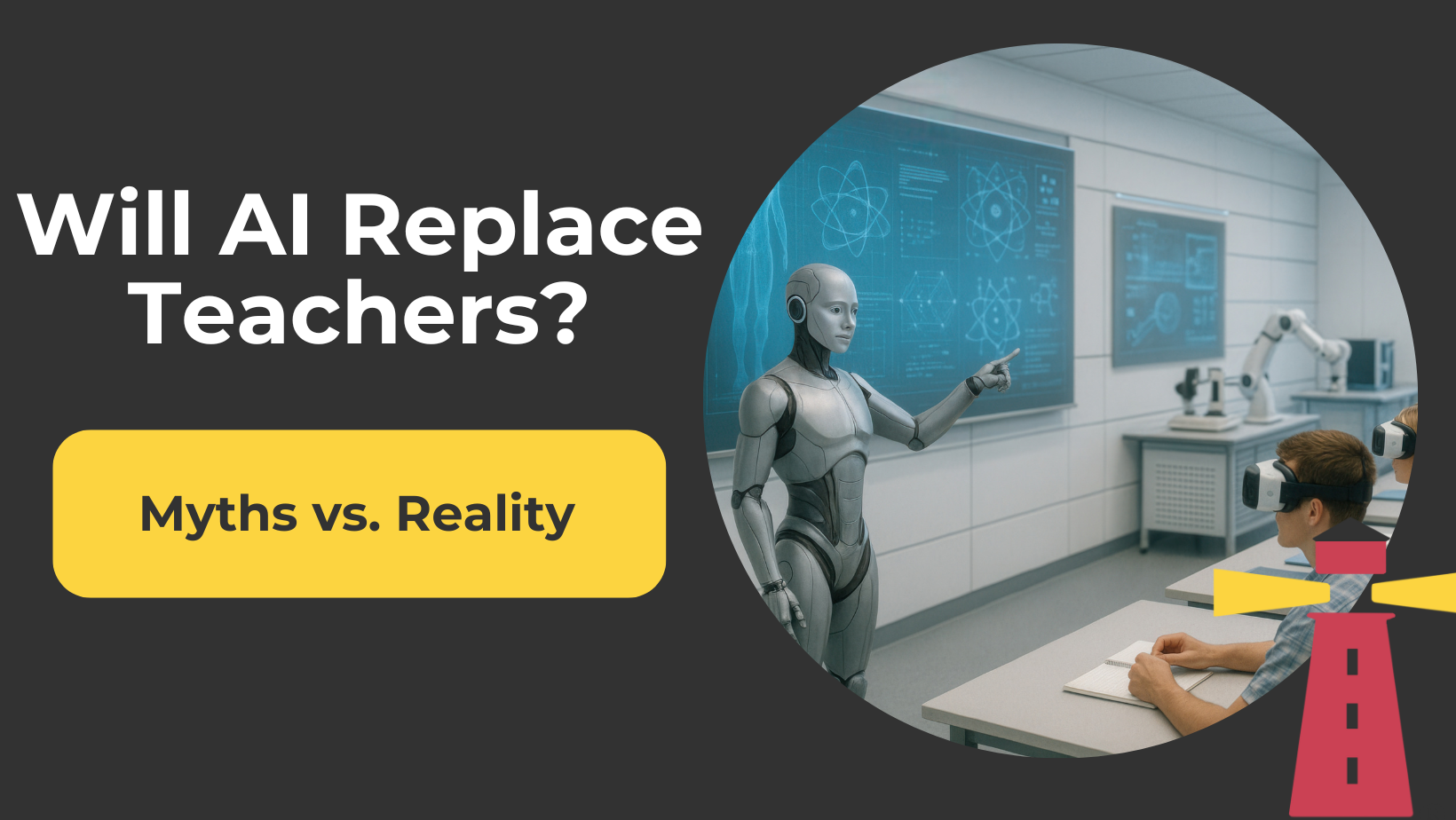
But education is not like manufacturing or data entry. Teaching requires empathy, judgment, and real-time decision making that no AI system can replicate. While AI vs teachers makes for a striking headline, the reality is that the two play very different roles. AI can support the learning environment, but it cannot replace the human expertise, encouragement, and connection that students need to thrive.
Myth 1: AI Will Replace Teachers Entirely
One of the most common fears is that AI will completely take over the classroom, leaving no role for human teachers. With stories about chatbots generating lesson plans or tutoring students online, it can feel like a future where schools no longer need educators is just around the corner.
Reality: Teachers Are Irreplaceable for Human Connection
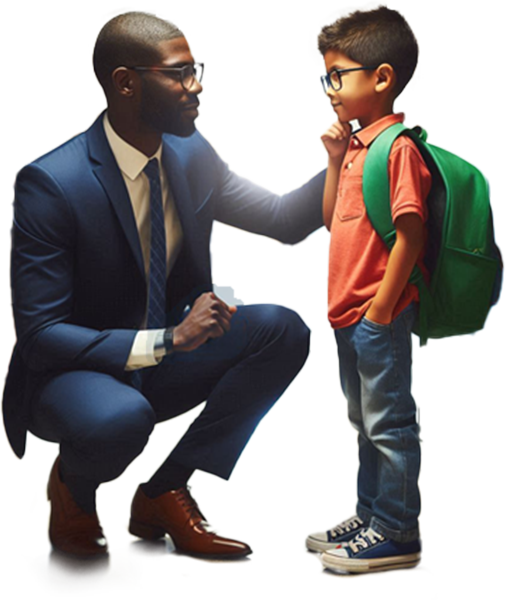
The truth is that while AI can process data, generate text, and even simulate conversation, it cannot replace the human touch in teaching. Education is not merely delivering information. It is also building trust, fostering curiosity, and guiding students through the challenges of learning and growing. Teachers use emotional intelligence every day to notice when a student is struggling, adjust their approach on the spot, or provide encouragement that keeps a child motivated.
AI lacks this depth of empathy and adaptability. A program can suggest feedback, but it cannot truly understand the look on a child’s face when frustration sets in, or the pride when a breakthrough happens. These moments matter. They shape how students see themselves as learners and build confidence that extends far beyond the classroom.
So, will AI replace teachers? No. It may become a helpful tool, but it cannot replicate mentorship, compassion, or the human connection that defines effective teaching. Emotional intelligence in education is not optional—it is essential, and only teachers can provide it.
Myth 2: AI Makes Teachers Less Relevant
Another myth suggests that as AI tools become more advanced, teachers will fade into the background. The idea is that if machines can grade papers, track progress, and even generate lesson materials, the teacher’s role must be shrinking. This perception often creates anxiety among educators who already feel stretched thin by constant change in schools.
Reality: AI Frees Teachers for High-Value Work
In reality, AI can enhance teaching rather than diminish it. Many of the tasks that consume a teacher’s day are not the heart of education but the paperwork and planning that come with it. Automated grading for quizzes, lesson-planning suggestions, or data analysis of student progress are examples of how AI tools for teachers can lighten the load. By handling these repetitive tasks, AI can reduce teacher workload and give educators back one of their most valuable resources: time.
That time can then be redirected toward what truly matters: building strong student relationships, mentoring, and providing one-on-one support. These are the high-value aspects of teaching that no algorithm can replace. Far from making teachers less relevant, AI in the classroom highlights just how important teachers are. The more technology handles the background work, the more space there is for human educators to focus on creativity, connection, and individualized instruction.
AI can enhance teaching, but it does not replace the wisdom and care that teachers bring. Instead, it can make their contributions more visible and impactful by clearing away the clutter that often gets in the way.
Myth 3: AI Creates Impersonal Learning
A common concern is that AI could make classrooms feel cold and robotic. If students spend more time on devices, parents and educators worry that learning will become detached, standardized, and disconnected from the warmth of human teaching. The myth assumes that AI in classrooms can only deliver cookie-cutter lessons, stripping away the personal touch that makes education meaningful.
Reality: AI Supports Personalization at Scale
In practice, AI educational tools can actually help create more personalized learning experiences. Adaptive systems adjust the difficulty and type of practice based on each student’s responses, ensuring that learners are challenged at the right level without being overwhelmed. For example, a student who struggles with reading comprehension might receive extra practice passages, while a peer ready for more advanced work can move ahead. This kind of personalization, which once required significant teacher time, can now happen more efficiently at scale.
Still, AI does not interpret learning in the way a teacher can. A dashboard can flag that a student is missing questions, but only a teacher can decide whether that’s due to a lack of understanding, a bad day, or something more complex happening in the child’s life. Teachers remain essential in guiding students through these moments, offering encouragement, context, and the human insight that data alone cannot provide.
Far from making learning impersonal, AI in classrooms can strengthen personalization when paired with teacher expertise. The technology helps organize information, but it is teachers who use that information to inspire, connect, and create meaningful growth for their students.
Myth 4: AI Is Too Complex for Everyday Teachers
Some teachers worry that AI will be too complicated to use in day-to-day practice. With all the technical language around algorithms, data sets, and machine learning, it can seem like these tools are built for programmers, not classroom educators. This myth often leads to hesitation: if technology feels intimidating or requires advanced expertise, how could it ever help teachers already managing full workloads?
Reality: Many AI Tools Are User-Friendly
The reality is that today’s AI teacher assistant tools are being designed with educators in mind. Many platforms resemble the apps and software teachers already use, with simple dashboards, clear instructions, and ready-to-go templates. Instead of replacing teachers, these programs aim to support them by saving time on routine tasks, offering lesson ideas, or providing quick feedback on student work.
At the same time, schools and districts are beginning to expand professional development around AI for educators. Training opportunities are growing, from online tutorials to in-person workshops that show teachers how to integrate AI in ways that are practical and effective. These efforts emphasize human (AI collaboration), where teachers stay in control of the learning process while AI provides extra support.
The myth that AI is too complex overlooks how quickly the tools are becoming approachable. Just as educators learned to integrate laptops, interactive whiteboards, or learning management systems, they can also adapt to AI with the right resources. Simplicity, accessibility, and training are making it possible for teachers to use AI without needing a degree in computer science.
Myth 5: AI Is Always Right and Bias-Free
Because AI tools can generate quick, detailed responses, some assume they must always be correct. In education, that might mean trusting AI-generated lesson plans, assessments, or explanations without double-checking. Another misconception is that algorithms are neutral, free from the biases that can affect human judgment. These beliefs create the dangerous myth that AI in classrooms can operate flawlessly without oversight.
Reality: Human Oversight Is Essential
In reality, AI systems are only as good as the data and instructions behind them. They can make mistakes, provide incomplete answers, or reinforce bias if their training data reflects inequities. For example, an AI tool might favor certain cultural references, overlook accessibility needs, or misinterpret student responses. Left unchecked, these errors could harm learning and widen gaps rather than close them.
This is why teachers remain essential. Human oversight ensures accuracy, fairness, and appropriateness in how AI educational tools are applied. A teacher can catch when a generated quiz question doesn’t align with curriculum goals, or when feedback might confuse rather than clarify. Teachers also bring ethical judgment to decisions, weighing student context and needs in ways AI cannot.
Bias in AI is a real risk, but with careful human guidance, it can be managed. AI vs teachers is not a competition. It is, however, a reminder that technology works best when paired with professional expertise. Teachers safeguard the integrity of education, ensuring that new tools serve students equitably and effectively.
What AI Can and Cannot Do in Education
The myths illustrate that much of the debate comes down to understanding where AI truly fits in classrooms. To make sense of it, it helps to separate what AI can do well from what remains uniquely human.
On the positive side, AI excels at automation and analysis. It can grade multiple-choice quizzes in seconds, generate lesson-plan suggestions, or highlight patterns in student performance data that might take hours for a teacher to spot. Adaptive practice systems can also give students tailored exercises, adjusting difficulty to match their progress. These tools can make everyday teaching more efficient and give educators valuable insights into learning trends.
But there are clear limits. What AI can’t do in education is provide the heart of the classroom: the social-emotional learning, ethical judgment, and deep context that only humans can bring. Teachers read subtle cues (a student’s tone of voice, their body language, the emotions behind their words) and respond with empathy. They know when to push a student forward, when to pause for encouragement, and when outside factors are shaping performance. These are moments that no algorithm can truly interpret.
In short, AI can take on the background tasks and offer tools for personalization, but humans remain essential for shaping meaning, nurturing growth, and ensuring fairness. Education depends on both efficiency and empathy, and only teachers can bridge the two.
Teacher Perspectives and Real-World Use Cases
Discussions about AI in classrooms often focus on the technology itself, but teacher perceptions of AI provide the most valuable insight into how it works in practice. Educators are not passive observers. They are the ones testing these tools, weighing their usefulness, and deciding where they fit into daily instruction.
In many schools, AI is already supporting learning in practical ways. Some districts use adaptive reading programs that adjust texts to each student’s skill level, giving struggling readers more practice while allowing advanced learners to move ahead. Others rely on AI-driven language platforms that provide instant feedback on grammar and pronunciation, freeing teachers to focus on deeper communication skills. Even simple tools like automated grading systems or lesson-plan generators are easing workloads and saving time for relationship-building with students. These examples show that AI in classrooms can be a powerful assistant when guided by thoughtful educators.
Survey data reinforces this mixed but cautiously optimistic view. Many teachers see potential for AI to reduce administrative burden and improve personalized learning, but they also emphasize the importance of oversight. A recent national survey found that while a majority of educators are open to trying AI educational tools, most believe human judgment should remain central. Teachers want reassurance that technology will serve students rather than replace the relationships and expertise that define effective teaching.
These real-world perspectives highlight the balance schools are aiming for: use AI where it adds value, but keep teachers at the heart of the process. AI is not the story of machines overtaking classrooms. It is the story of educators choosing how technology can best support learning.
Looking Ahead: Teachers and AI as Partners
The conversation about the future of AI in schools should focus less on replacement and more on partnership. Teachers and technology can complement each other when the boundaries are clear: AI handles tasks at scale, while teachers bring the human connection that defines real learning.
Best Practices for Schools
To use AI responsibly, schools should prioritize training teachers in how to integrate these tools effectively. Professional development can help educators feel confident, avoid misuse, and understand both the strengths and the limits of AI educational trends. Without this training, technology risks being underused or misunderstood.
Schools also need to balance innovation with compliance and ethics. Responsible use means protecting student data, following privacy laws, and making sure AI aligns with curriculum goals. By approaching AI as teacher augmentation rather than replacement, districts can create environments where technology enhances education while keeping trust and safety at the center.
The future of AI in schools depends on thoughtful choices. When educators are supported, AI becomes less about disruption and more about opportunity.
Final Thoughts
The myths about AI in education often paint a picture of machines taking over classrooms. The reality is much different. AI is a tool which is powerful in some areas and limited in others, but it cannot replace the wisdom, empathy, and creativity of teachers.
The future of education will be shaped by collaboration between teachers and technology. AI can streamline administrative work, highlight patterns in student data, and offer adaptive practice. Teachers, meanwhile, provide the guidance, mentorship, and human judgment that make learning meaningful. Together, they can create classrooms that are more efficient, more personalized, and more supportive of student growth.
Frequently Asked Questions
Q: Will AI replace teachers in the future?
A: No. While AI can automate certain tasks, it cannot replace the human touch in teaching. Teachers remain central for mentorship, emotional support, and ethical decision-making.
Q: Can AI teach better than humans?
A: AI can deliver practice exercises or generate explanations, but it lacks empathy and adaptability. Humans interpret student needs in context and inspire growth in ways technology cannot.
Q: How does AI support teachers in classrooms?
A: AI can assist with grading, generate lesson ideas, track progress data, and provide adaptive learning opportunities. These tools save time, allowing teachers to focus more on relationships and individualized instruction.
Q: What can’t AI do in education?
A: AI can’t provide emotional intelligence, build trust, or make ethical judgments. It also cannot replace the mentorship and encouragement students need from human educators.