

Episode Description
When districts stop viewing each other as competitors and start pooling resources through an Educational Service Center, transformation happens—especially for students who’ve fallen through the cracks. Nancy Santilli and Kelly Moran from the Educational Service Center of the Western Reserve share how Gateway High School emerged from collaborative problem-solving, pairing rigorous academics with equine therapy, art, and music interventions to reach struggling high school students in ways traditional settings cannot.
Headshot Quote Candidates
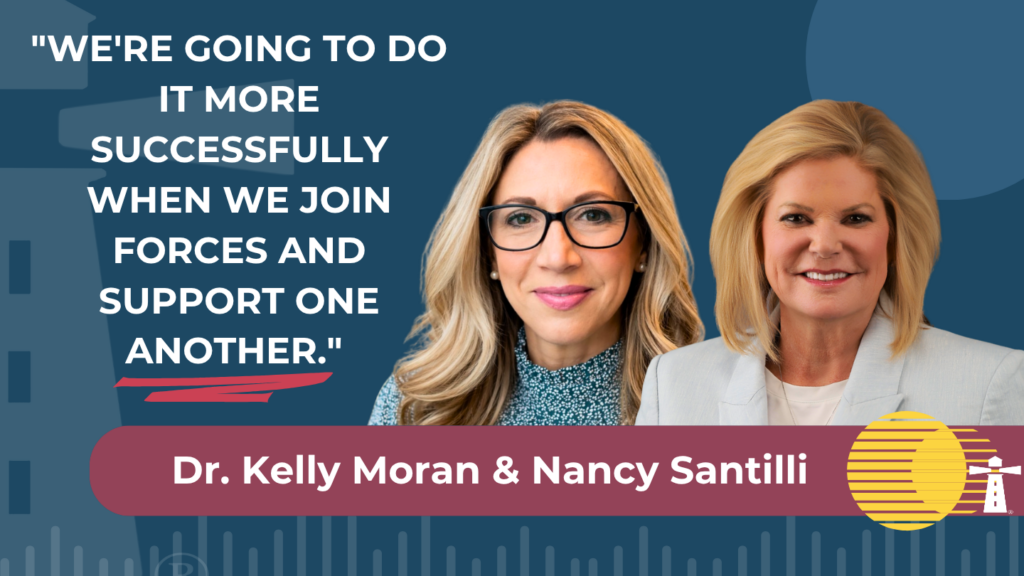
“We’re going to do it more successfully when we join forces and support one another.” [00:07:32]
“When you bring different minds together, that can open your eyes to different avenues of how we can best educate all students.” [00:16:13]
“Everything that they do, they are with the students all day long.” [00:20:52]
“I feel the energy of students who hold their chin up high and take pride in the work they do with the horses.” [00:26:55]
“We really want to continue with your education and work with you in such a way to meet your needs.” [00:16:50]
Full Podcast Transcript
Lighthouse Therapy (00:01.66)
Hello everyone and welcome to the brighter together podcast. My name is Janet Courtney and my special guests today are Kelly Moran and Nancy Santilli. Kelly is the director of instructional programs and Nancy is the superintendent support services and gateway administrator at educational service center of the Western reserve, which is in Concord township, Ohio. Nancy and Kelly, welcome to the show.
Nancy Santilli (00:31.586)
Thank you.
Kelly Moran (00:31.779)
Thanks for having us. It’s great to be here with you today, Janet.
Lighthouse Therapy (00:35.046)
Thanks. So tell us a little bit if you guys want to take it, take turns a little bit about yourselves and how you got to the positions that you’re in. And then a little bit about the Western reserve ESC. That’d be great.
Kelly Moran (00:48.739)
Sure, absolutely. I’m happy to jump in first. So it’s a pleasure to be here. I serve as our director of instructional programs. I oversee a curriculum team of content area experts. And what we do is a lot of customized, personalized, and tailored professional development and curriculum supports for our regional schools, school districts, both private and public, as well as other community agencies. I represent a curriculum team. However,
educational service center does so much more than just curriculum and instructional supports. And that’s why I invited my friend, Nancy Santilli here to talk about just one of the many things that we do well as a service center. Nancy, you want to introduce yourself?
Nancy Santilli (01:33.144)
Great, certainly. I’m so happy to be here. So I appreciate the invite and thank you very much, Dr. Moran, for including me as well. So we’re very proud to be part of the Educational Service Center of the Western Reserve. And I have been a superintendent for many years, but most recently I did join the Educational Service Center. And then I became part of one of their programs, which is Gateway High School.
which is an alternative school for our high school students, which serves grades eight through 12. And so I oversee that program and just I’m very excited to be here. And I have been at that program for over a year now and can talk a little bit about that a little bit later in this.
Lighthouse Therapy (02:24.316)
Awesome. Awesome. So tell us a little bit about why is it called the Western Reserve?
Kelly Moran (02:32.227)
So that was historical. you know a little bit about the geographical history of Ohio, the Western Reserve area of Ohio was the area where pioneers had migrated to start new communities. And so this area in which we reside and work in was named that. The interesting history about our educational service center is that we merged two different educational service centers.
There was one in Lake County and then there was a separate one in Geauga County. Our superintendent, Jennifer Felker, was wise and innovative and really saw the opportunity that had existed 10 years ago to bring both of those agencies together, merge, and be a stronger infrastructure for all the educators around. Nancy, anything I’m forgetting about why Western Reserve?
Nancy Santilli (03:27.214)
No, the only the only thing is is that. The nice thing about that is we service many different entities, so it’s not only just that like yoga now it’s like jogga portage and so it’s all of those counties and any school districts. And so our Superintendent of Fulker will tell you it’s and beyond, right? So you we service so many of those school districts and and different educational entities that.
Lighthouse Therapy (03:50.418)
Mm-hmm. Yeah.
Nancy Santilli (03:57.07)
We’re just proud to represent so many. And so the Western Reserve encompasses a lot.
Lighthouse Therapy (04:03.922)
It sounds like it. sounds like it. That’s fantastic, though, that you that you’ve got that leadership that you’ve done that that there’s so many schools that are benefiting from that. And can you give our listeners just a little bit? What is why an ESC? Why does why do schools need an ESC?
Kelly Moran (04:24.473)
So I think that we’re seeing now more than ever before a lot of constraints, financial restraints, districts and schools, educators are seeing needs and have growing problems and there’s barriers and obstacles. And it’s hard to navigate those tough challenges on your own. And so school leaders, educators, superintendents, they need to turn to some
Lighthouse Therapy (04:44.422)
night.
Kelly Moran (04:52.089)
place else to help them solve these challenging things. And that’s a beautiful aspect of a service center. We can reinvent and reimagine and be innovative in what we’re offering and providing to those around us based on what they need. Nancy?
Nancy Santilli (05:09.722)
Yeah, and I can speak to that having been a superintendent actually in this area for a long time. If I can do it in my school district, right, then I would do it. But there were many times that I wasn’t able to do that. And so I did need to reach out to the Educational Service Center for something that I wasn’t able to do on my own. And so that’s why it was there. And whether that was staffing, whether that was a professional development.
Lighthouse Therapy (05:21.798)
Right.
Nancy Santilli (05:39.406)
I utilized the Educational Service Center for that. And so that was the great part of it was for me that I was able to have it as a cost effective means, as a program means where it was a resource for me if there was something I couldn’t do within my own district.
Lighthouse Therapy (05:58.098)
Mm-hmm.
Lighthouse Therapy (06:01.98)
Right, and if you need a PT for two students, you’re not gonna go out and hire a full-time PT for two students, and it’s hard to source out a PT for just two students, right? So that’s a little bit, that’s just my, that’s my knowledge from my area. I know it’s way more than that, but that’s just an example that I know from my own personal experience, so yeah. Yes.
Nancy Santilli (06:06.753)
Exactly.
Nancy Santilli (06:14.379)
Exactly.
Nancy Santilli (06:23.478)
So many, know, time saving, cost savings, staffing, all of it. I mean, it’s just anything. And then it’s also a sense of connectedness and just community. And I know we spend a lot of time just with that relationship building and networking. And I think that’s what we work really hard on is making sure that we’re bringing all of our school districts and people together so that we do have that commonality and that network.
Lighthouse Therapy (06:34.994)
Mm-hmm.
Nancy Santilli (06:53.544)
And I think that’s one of the benefits of our ESC as well.
Lighthouse Therapy (06:57.158)
Yeah, I didn’t tell you this before the show, but a part of my career was my husband. did tell you my husband was born and raised in Ohio, but we had one child in Cincinnati and our other two children were in Dayton, Ohio, where they were born. And at a part of that time, I was working as an SLP for Green County ESC. know, because as an SLP, they provided and I hopped at.
to a couple of different school districts because they needed the services, but they didn’t need me full time. So it’s, yeah.
Kelly Moran (07:32.388)
Yeah, I just think too, if we’re all in the business of educating children and helping them succeed and thrive in life, we’re going to do it more successfully when we join forces and support one another as opposed to having a competitive mindset. And so that’s one of the many things I love about being employed at an educational service center is that we’re all in this together. We’re, joining one another to help solve problems and provide the best instruction and environment we
Lighthouse Therapy (07:43.506)
Mm.
Lighthouse Therapy (07:47.665)
Right.
Kelly Moran (08:02.351)
can for kids to thrive.
Lighthouse Therapy (08:04.26)
And we’ve always seen that two minds are better than one. You’re always gonna have, they’re gonna have a different idea, better way to do it, a suggestion, things you just, and sometimes you just get this way and you don’t mean to like get this tunnel vision. I’m, for those that are listening, instead of seeing me with my hands on both sides of my head, you just kind of like, this is the way I need to do it. And when you can bounce ideas, and this is,
One of the things I absolutely love about educators is that they want to share. They want to help each other. it is. so having that collaborative and cooperative ability. Here’s my voice. It’s amazing that you that you have that ability and it’s it’s just beautiful. So kids win. Right. So tell us a little bit about Gateway. I want to hear. I know you guys are excited about it. I would love to hear about it.
Kelly Moran (08:51.673)
Mm-hmm.
Lighthouse Therapy (08:58.876)
How did it come about and what exactly is happening there?
Nancy Santilli (09:03.29)
So I’d love to share. So I’m very excited and passionate about Gateway. Even though I haven’t been here that long, Gateway has been in existence now for 20 years. And it is in collaboration and partnership with a farm called Fieldstone Farm. And it is a therapeutic writing center that is that joint collaboration. And we’re really here. It is a
a program of our Educational Service Center and it’s one of our keystone programs. I’d like to think about it that way. But they’re committed, we’re really committed to helping students achieve their potential. So academically, socially, emotionally, and we really partner with our school districts to make sure that our students can be successful. So our school districts will send a child here
But maybe they weren’t doing well in their traditional high school setting. And so they pay the tuition and they send the student to Gateway High School and they come here and we work with the school district to.
create their academic schedule and we do that in partnership with the school district for what their needs are. And they spend their days here and it’s pretty traditional in that sense that we follow the Ohio standards, the same curriculum. But the beauty of it is that we are partnered with Fieldstone Farm where they do equine therapy. And so they have horses here that are
out in a beautiful 46 acre setting. There’s trails and a pond and all kinds of things. It’s the setting nature. And so the students are able to go out and experience nature and go and work with field stone staff. We do equine therapy as part of kind of their overall health and wellness. And we see that their theme is, you know, horse can change a life.
Lighthouse Therapy (11:14.034)
night.
Nancy Santilli (11:17.798)
and we see that that’s really the case. So our schedule, we’re really committed to the wellness for the students. And so we’ve actually built in a wellness period where we bring in art therapy, music therapy, a physical education, and then again, that equine therapy component. And then part of the students days too, when they’re juniors and seniors is they
Lighthouse Therapy (11:21.884)
Very cool.
Nancy Santilli (11:46.114)
have a workforce development component through. And we do that in conjunction with the Educational Service Center. And we work to take our students in community where they can then have their job and workforce development career focused through. So it’s all encompassing. And the hope is, is that these students who may not have been successful in their high school setting, we bridge that gap.
and help them become more successful so that they can either work to go back into their high schools, but most of them do stay with us and then we do have them graduate from high school here and then their homeschools. Obviously they’re still connected to their homeschools and get their high school diploma from the homeschool.
Lighthouse Therapy (12:37.168)
So how did this come about, Nancy?
Nancy Santilli (12:40.11)
Oh, I believe it was a collaboration from a guidance counselor who was in partnership with the ESC at, you know, 20 years ago, they’re like one of those meet the need. And it was, you know, let’s talk about this and what works for what works for children. Right. And it was we can do this. And then again, how do we build a program that our schools need?
And it was one of those programs that was built from the ground up, like many of our programs, as Kelly had suggested, we reach out to our districts with what are your needs? And we listened to our districts. so then we built the partnership with Fieldstone to say, Hey, can we put a program in your space? And the rest is history. And it’s been thriving ever since. And now is one of their cornerstone programs. And
Lighthouse Therapy (13:15.218)
Mm-hmm.
Lighthouse Therapy (13:32.594)
Wow.
Nancy Santilli (13:39.15)
I don’t know that they would ever want to do without it. And it’s Millstone themselves. They do run other programs outside of the high school. So they do bring in, you know, other groups, community groups, things like that, that are separate from us. But our high school is here. It’s the physical space is ours. It is a fully operating, you know.
Lighthouse Therapy (13:42.864)
Right. Yeah.
Lighthouse Therapy (13:55.246)
Mm-hmm. Right.
Nancy Santilli (14:08.013)
run high school and you know our students are here every day. The schools transport them and we just
Lighthouse Therapy (14:08.146)
Mm-hmm.
Lighthouse Therapy (14:16.432)
Wow. So about how many students do you have?
Nancy Santilli (14:19.928)
So we cap, it’s very small, so it’s very personalized and we cap our enrollment at 24. And we run like around 20 students and with room for students to kind of come in and out if need be, but it is very personalized instruction. And so our teachers do work one-on-one. They really customize the curriculum based on a student’s IEP needs and what they need to have.
Lighthouse Therapy (14:22.322)
OK? Right.
Nancy Santilli (14:47.864)
We do have a licensed social worker guidance counselor, and they work with the students, but she works with the students every day based on what their IEP goals are. And we really pay attention and personalize, again, whatever the child might need. We also have a strategic advisory time and a data block time built into their schedule where where.
their case manager would work with the students to review wherever they are with their goals on their IEPs to see where they’re making progress, where they might not be, just kind of review with the students, you know, are you on target? Where do you want to be in your life, in your career, those kind of things, just so that we can always keep a pulse on that and continue to keep their homeschools updated as well.
Lighthouse Therapy (15:35.9)
Mm-hmm.
Kelly Moran (15:43.118)
I think one of the powerful things to note here about the origination story of Gateway is that creative thinking and problem solving in a group as opposed to individually can be very, very powerful. All of our students are unique. We know that. But when you bring different minds together to think outside of the box, take that time for ideation and creation, creative thinking with others outside of your brick and mortar school wall.
Lighthouse Therapy (15:57.777)
Yes.
Kelly Moran (16:13.131)
or your district walls that can open your eyes and perspective to different avenues of how we can best educate all students.
Nancy Santilli (16:22.478)
And my philosophy here, having been in various schools, right, and having been at a high achieving school district and having been a superintendent who sent students here prior, right, I focus on making sure that our students are meeting academic standards that are there. I’m really focused on pushing them academically.
Lighthouse Therapy (16:22.492)
Mm-hmm.
Nancy Santilli (16:50.47)
And so I like to think of this as a premier school district where for the students sake, that they’re really believing in their education, that they recognize that these school districts that are sending them here, that they’re not throwaway kids where somebody’s going, okay, you know, couldn’t, you couldn’t make it in the traditional high school. That somebody’s cared enough to say, you know what, we really.
want to continue with your education and we want to work with you in such a way to meet your needs and so we’re going to provide you with the tools, with the things that are necessary to help you succeed a little bit more and really meet the needs that you have and take the time to listen. I said earlier about building relationships, get to know them, build the relationship and help them be a little bit more successful.
Lighthouse Therapy (17:47.6)
Mm-hmm.
Nancy Santilli (17:48.248)
They just need that little bit of push. I’ve watched them go into the barn, which is actually a barn. mean, there’s stables, beautiful horses that are well cared for. are therapeutic horses. I’ve watched the students go over into the barn. And when they say, one horse can change a life, these students do.
Lighthouse Therapy (17:50.46)
Yeah.
Kelly Moran (17:59.29)
stables, or still.
Lighthouse Therapy (18:00.487)
You’re talking about horses. Yeah, it’s not gonna be, yeah, it’s a farm.
Nancy Santilli (18:17.484)
really regulate themselves with the horse. It is that equine therapy piece where it is reaching a social and emotional need for the students. And I just think that’s something that makes us unique that you can’t provide in a traditional high school setting. And so it’s paying attention to the needs of the child as well. And so I commend our districts that are committed to saying
Lighthouse Therapy (18:36.708)
No, you couldn’t, yeah.
Nancy Santilli (18:47.394)
How do we help this child a little bit more? so kudos to those school boards, to those superintendents, kudos to the ESC where they say, what can we provide for even that few to really change that trajectory of what that child needs?
Lighthouse Therapy (19:04.088)
Mm-hmm. So how do, I’m sorry, go ahead, Kelly.
Kelly Moran (19:06.393)
I was gonna say what’s neat is.
not only to be able to see an impact, but to feel an impact. And so each year I make it a point to take a visit and go to Gateway a couple times a year. And what always impresses me isn’t so much what I’m seeing, it’s what I’m feeling. I feel the energy of students who traditionally might not have been successful in their homeschool. And now they’re in a learning environment where they hold their chin up high, they greet visitors by name,
They take pride in the work and the chores that they do in the stables and with the horses. They can articulate to a visitor what they’re working on because as Nancy commented, it’s so personalized. So these are students who are highly engaged because their teachers have have uniquely crafted lessons, curriculum.
learning experiences that are specific to each child. And that’s just a feeling in an environment that again has been cultivated by the leadership, Nancy and her teachers and her staff, as well as the Fieldstone staff to make an effect that you can feel more so than see.
Lighthouse Therapy (20:22.671)
Mm-hmm. Right.
Nancy Santilli (20:23.022)
Thank you, Kelly. I think that does sum it up. And I attribute that to everybody’s team approach. And also the commitment for people to come and see it and to really care about it, because it does take a team. The staff here, they are so committed to the students. When you look at our schedule, it’s not a traditional schedule.
Lighthouse Therapy (20:41.692)
Mm-hmm.
Nancy Santilli (20:52.718)
The staff members, they don’t have time in between classes. They don’t have a lunch time where, you know, there’s somebody else watching over the students or whatever. They are with the students all day. So they’re very committed to being with the students. So the teachers eat lunch with the students. The teachers are in the wellness periods with the students. There is no planning time for the teachers. Everything that they do, they are with the students.
Lighthouse Therapy (21:07.922)
Mmm.
Lighthouse Therapy (21:16.828)
Gotcha.
Nancy Santilli (21:22.478)
all day long. So they’re very committed to their success. And I just think that’s a tribute to the wonderful educators that we have here. And we just had a visit from the ESC staff that came through today. And I think that’s also a tribute from our superintendent who said, I need the support team from the ESC to also see the program, the people that are supporting behind the scenes so that they understand what
Lighthouse Therapy (21:23.41)
Wow.
Lighthouse Therapy (21:51.068)
Mm.
Nancy Santilli (21:51.726)
programs look like and what they’re supporting so that they know, you know, if they’re at the Educational Service Center office, what their work means and how they can support the, you know, the programs elsewhere. Because we are about a half hour away, 25 minutes away from the main office of the Educational Service Center.
Lighthouse Therapy (22:06.492)
Right.
Lighthouse Therapy (22:13.52)
Okay, gotcha.
Kelly Moran (22:15.555)
But.
Janet, that’s a message all of your listeners can take from this podcast, right? This idea of taking time to take your folks throughout the different facets of your organization. How often as educators do we only know the classroom, the content area, or the grade level that we’ve been hired for? And so when you find opportunities to take people on your team throughout the different facets, programs, hallways, buildings,
Lighthouse Therapy (22:26.854)
Mm-hmm.
Kelly Moran (22:46.327)
You are giving people a gift that adds to that idea of collective belonging, which we know has such a high effect size, right? It’s a unifier. So I think that’s a powerful message your listeners can take from this.
Lighthouse Therapy (22:55.384)
Mm-hmm. Yeah.
Yeah, and I’ve heard from several districts to the senior or seasoned teachers, know, mentoring and taking under their wing the newer teachers and helping them, you know, and being a part of the collection so that, you know, that, because it’s hard when you first start as a teacher, it’s a hard job anyway. And it’s probably, just does seem, it seems like it’s just not getting easier.
And so having people that have been there done that and to be able to give that back is such a gift. And that’s what you’re doing. You’re giving that piece to all of those people, which is so good, so great. So how does a student become, cause I want to go, I’m sitting here going, I would love, my husband grew up with horses. His parents had horses. He showed horses through 4-H. I never did.
didn’t have any of that. was, I’m, I’m from Nebraska, but I was a city girl. You know, I grew up and, and no, my parents had a farm, but I didn’t milk cows. didn’t do any of that stuff. So how does this, how does this student, I went, wow, I went off on that one, didn’t I? But anyway, to bring it back, the question is, how do you, how do you decide who qualifies for this program? And, and, you know, so that’s.
Nancy Santilli (24:21.292)
So it really is a district referral, right? So again, I said these are students that really may not be doing well in a traditional high school setting. So, you know, they may have had a whole series of circumstances where they may not have been functioning well in that high school setting.
Lighthouse Therapy (24:24.654)
Okay.
Nancy Santilli (24:45.036)
You know, you talked about being an SLP, so you know that they’ve gone through the whole gamut of we’ve tried everything and things weren’t working. And so now it’s a team decision. It’s a parental decision. And where can we place that student? And so the student does end up here. And ultimately, it is the district’s commitment to say. We think this is going to be a good placement. They call us and we work together to review.
Lighthouse Therapy (24:51.068)
Right? Right?
Nancy Santilli (25:14.904)
the students file and say, here’s what we can do. Our program is more on the social emotional, not as much of a behavioral, although behavioral does enter into it. And as you know, right, it has to because they are married. That’s it exactly. So we do, it’s a team decision. So.
Lighthouse Therapy (25:32.976)
Well, yeah, they’re married. don’t. You can’t have one without the other for sure. Yeah.
Nancy Santilli (25:42.862)
You have to look at different factors. And as I’ve told Dr. Moran this before too, I kind of have three audiences when I am looking at accepting a student. One is I have the school district. They have to be willing to place the student here. I also have a parent who has to be willing to place their child here. And that’s a big, scary piece too. You’re now saying, okay, I’m giving you.
my child to go to this alternative setting, right? And then we have, you know, this whole team decision of does the child even want to come here? So there’s a lot of times I’ll give a tour and the child’s coming here going, horses are big, scary animals, right? Do I really want to be on a farm? And we have some students that go, I’m never going in that barn. I don’t know if I want to be near that animal. And eventually they do. Eventually they end up
Lighthouse Therapy (26:21.554)
Mm.
Lighthouse Therapy (26:27.612)
Yeah.
Nancy Santilli (26:39.468)
you know, kind of loving the horses. But those three components sometimes are, you know, they have to come together sometimes. So it’s sometimes a challenge to say, are we going to hit all those targets? So, just interesting. But you’re welcome to come anytime, Janet, you know, come and see it and come and ride the horses.
Lighthouse Therapy (26:47.952)
Mm-hmm.
Lighthouse Therapy (26:53.072)
Yeah, yeah.
Kelly Moran (26:55.031)
And
Lighthouse Therapy (26:57.934)
Love to see it. Yeah, that would be great. Yeah.
Kelly Moran (27:00.897)
And again, it was such a great question about the mechanics of like, how does this work? Right? How does from school A get to Gateway High School? And what I would say to people out there listening who think, wow, this sounds really great. I would say start by identifying in your area, where are those educational service centers or ITCs or whatever service agencies you call them in your respective states and find out what they offer or even better, pick up the phone and call them or show up at their
Lighthouse Therapy (27:06.022)
Mm-hmm.
Kelly Moran (27:30.861)
office and see what exists because if something doesn’t exist already for a student that you’re looking for, I would really believe that that educational service center would love to hear from you and have that conversation about what’s missing and what could we create or provide.
Lighthouse Therapy (27:46.162)
Mm-hmm.
Lighthouse Therapy (27:50.514)
All right, absolutely. Well, ladies, I said 20 minutes, it’s been 27. We’ve been talking, it’s beautiful, I love it. So tell our audience where they can go to find out a little bit more information about your educational service center. Where do they start? know, Kelly, you we talked about having them come, where do they go? Where do they go?
Kelly Moran (28:13.001)
Absolutely. Absolutely. So the first thing I would say is find us at our website www.escwr.org. We also are on X, LinkedIn, and Instagram and Facebook. So all of your social media channels. I would encourage anybody who’s listening, who is excited about what they heard today to reach out via email to me. We can give your listeners my email as well as
Lighthouse Therapy (28:31.492)
Nice.
Kelly Moran (28:42.655)
Nancy Santilli’s email as well. We would love to connect with you, talk more with you, host you at one of our events, get you out to Gateway, and make that connection as educators.
Lighthouse Therapy (28:53.296)
And I’m sure they can find your information on the website, right? You’re connected on the website. So Santilli, I’m going to do Santilli. It’s S-A-N-T-I-L-L-I, Nancy and Moran, M-O-R-A-N, Kelly. So there you go. Ladies. Wow. So good. So, so good. Thank you so much for taking the time to be on brighter together and for your passion for the children, because obviously you guys have some amazing passion and, and the kids win.
Nancy Santilli (28:53.57)
Absolutely.
us.
Lighthouse Therapy (29:23.206)
Right? The kids win. So thank you so much.
Nancy Santilli (29:26.914)
Thank you.
Kelly Moran (29:27.78)
Thank you.
Lighthouse Therapy (29:30.065)
Alrighty.