

Episode Description
Are we inadvertently crippling our students by shielding them from failure? In this powerful conversation, we challenge conventional wisdom about student support and explore what’s really holding our learners back—and it might not be what you think. Dr. Robert Langman, Superintendent of Darien School District 61, shares groundbreaking insights about the social-emotional crisis affecting student learning and reveals how his district turned a post-pandemic V-shaped academic dip into unprecedented success.
About Our Guest
Dr. Robert Langman is the Superintendent of Darien School District 61, where he has been instrumental in reimagining how schools support student growth. Under his leadership, the district has not only recovered from pandemic learning loss but has surpassed pre-pandemic academic performance in both math and ELA—achievements he credits to intentional, evidence-based practices centered on student well-being and resilience.
What You’ll Learn
This episode tackles the uncomfortable truth that our students are struggling—not because they lack ability, but because they lack emotional regulation, civil discourse skills, and the safety to take intellectual risks. You’ll discover:
– Why social-emotional barriers are the *real* obstacle to academic achievement
– How to create classroom environments where students feel secure enough to fail productively
– Practical strategies for rebuilding the lost art of respectful disagreement
– Why teachers need support in roles they weren’t trained for—and what districts can do about it
– The actionable practices that helped one district achieve remarkable post-pandemic recovery
Key Takeaways
**Student safety isn’t just physical—it’s emotional.** When students feel secure taking intellectual risks without fear of ridicule or failure, learning accelerates.
**Respectful disagreement is a dying skill.** The inability to disagree while maintaining respect and dignity is crippling students academically and socially.
**Teachers need more than classroom management training.** Educators are managing what amounts to psychological and social work—without the formal training. Districts must provide support and resources.
**Recovery is possible with intentional practice.** Darien’s turnaround proves that focusing on social-emotional foundations creates the conditions for academic excellence.
**Listen more than you convince.** Leaders and educators who approach others with curiosity rather than certainty model the discourse our students desperately need to learn.
Notable Quotes
*”The greatest kind of skill that’s lacking is that conversation and the ability to disagree with somebody while respecting their opinion and still treating them the same.”*
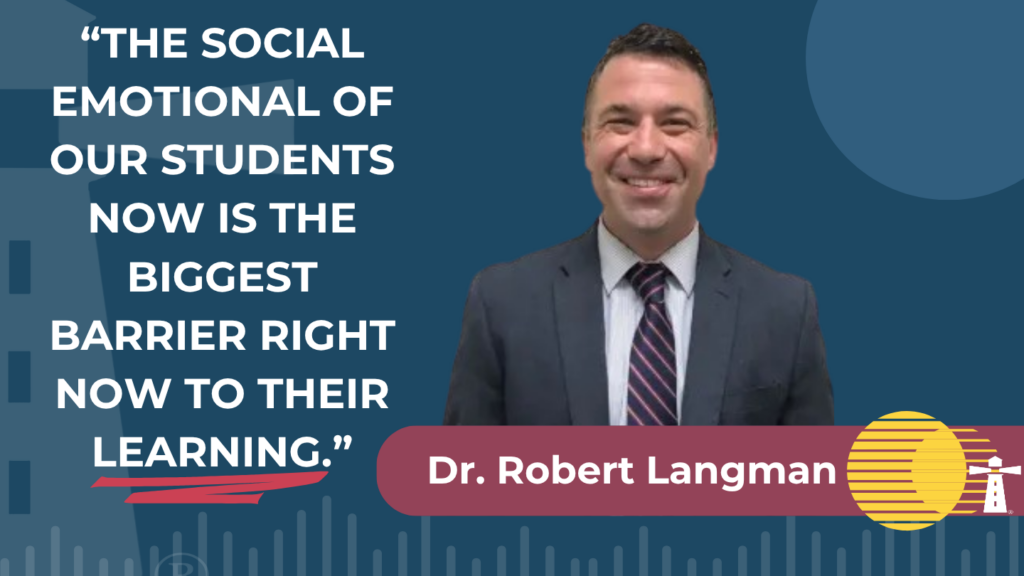
*”The social emotional of our students now is the biggest barrier right now to their learning.”*
*”When students feel safe and secure to take risks with their learning without fear of ridicule or failure then they can…they also have to feel safe and secure about themselves.”*
*”And I can hear you out, maybe I’ll learn from something. I’m not here to convince you, but maybe you’re going to teach me something I didn’t know.”*
—
**Ready to transform how your district supports student growth?** Listen to this essential episode and discover how creating emotional safety and fostering civil discourse can unlock academic potential you didn’t know was possible. **Subscribe now** to ensure you don’t miss crucial conversations that are reshaping K-12 education leadership.
FULL PODCAST Transcript
Lighthouse Therapy (00:00.871)
Hello everyone and welcome to the Brighter Together podcast. My name is Janet Courtney and my special guest today is Dr. Robert Langman. He is the superintendent at Darien School District 61, which is in Darien, Illinois, which he let me know there’s a Darien, Connecticut, but this is Darien, Illinois, which is kind of a suburb of Chicago. So Robert, nice to have you here.
Robert Langman (00:18.606)
Yes.
Robert Langman (00:25.534)
Yes. Nice to have you. Thank you for having me. I appreciate it. It’s a pleasure.
Lighthouse Therapy (00:29.667)
Absolutely. Tell us Darian or listen to me. my goodness. Okay. We’re going to just cut that out right now. Okay. So tell us Robert about a little bit about your journey and a little bit about Darian.
Robert Langman (00:44.334)
Okay, about my journey. Well, this is my, I if it’s like 20, 25, 26 years now in education. I started off as an elementary school teacher, taught fourth and fifth grade. That was in a school district called Glen Ellyn District 89 in Illinois here. Then from there, I became assistant principal for two years at an elementary school. And then I was principal in Addison, Illinois at Wesley Elementary School for nine years.
At the same time there, my last three years, I was also the director of instructional technology for the district. So I held two roles there, which was busy, you know, but yeah, but it gave me good experience too. Then after that, I was actually blessed to go back to the district I taught in in 89 for four years as assistant superintendent for curriculum instruction. And then I’ve been blessed to be here since this is my sixth year now in Darien as superintendent. Started right in the fun.
Lighthouse Therapy (01:19.047)
Wow, yeah, that’s busy, yeah.
Robert Langman (01:42.314)
of COVID with rates, but I’m still here and lucky to be in this position and work with this great community.
Lighthouse Therapy (01:43.509)
yeah.
Lighthouse Therapy (01:52.903)
So tell us a little bit about Darien.
Robert Langman (01:55.982)
Yeah, Daring is great. It really is a nice area. Actually, their slogan is, it’s a nice place to live. It really is.
Lighthouse Therapy (02:01.249)
nice.
Robert Langman (02:03.326)
But our district is a small district. We’re approximately about 1300 students preschool through 8th grade. We have three schools. Mark Delay School, which is a preschool through second grade school. We have Lace Elementary School, which is 3 through 5, and then we have Eisenhower Junior High, which is grade 6 through 8. And it’s a you know we serve portions of Darien of a town downers Grove Willowbrook Westmont. So we serve a number of.
towns in our area too.
Lighthouse Therapy (02:33.991)
So where do they go after for high school then when they leave you, where do they go?
Robert Langman (02:36.802)
So for high school then actually we’re kind of we’re split so half of our students about half of our students go to Hinsdale School District Hinsdale 86 they go to Hinsdale South High School and then the other half of our students they go to Downers Grove South High School so two different high school districts. Illinois is kind of goofy we have a lot of districts and so we have two high school districts Hinsdale and Downers Grove and because of that half of our students go to each.
Lighthouse Therapy (02:46.823)
Mm-hmm.
Lighthouse Therapy (02:50.609)
Wow.
Lighthouse Therapy (03:02.541)
Interesting. Interesting is that do they do they have a choice? I mean, can they like they don’t know.
Robert Langman (03:07.31)
No, they don’t have a choice. depends on where they live. That’s basically all what it is. And so one person across the street can go to Hainesdale, across the street go to that. It’s pretty interesting how sometimes that can work out.
Lighthouse Therapy (03:11.878)
Mm-hmm.
Lighthouse Therapy (03:18.511)
Wow, yeah.
Yeah, yeah. We lived in Michigan when our kids were going to school and we had school of choice, which was kind of a nice thing. Illinois doesn’t have school of choice at all, huh? No? Interesting, interesting.
Robert Langman (03:31.776)
No, we do not. There’s no school. There used to be back in the day with NCLB when it was first going through, but that was only within your district that you can do. So schools in the district, depending on how they performed. So when I was principal in Addison, there were, I think, five or six elementary schools. And then my school was a school choice school. So if you chose to go there, then students from within the district, they got to apply and then they got to, you
go over too. So like one year we had an increase of like 60 students in a year because of that too. But you know, but that’s the only level of school choice there has been. since NCLB has been kind of you know out for a while, that’s that hasn’t been the case anymore. I’m sorry. The no child left behind.
Lighthouse Therapy (04:08.474)
Mm-hmm.
Lighthouse Therapy (04:17.509)
And what does NCLB stand for? No, it’s all right.
okay. Gotcha.
Robert Langman (04:23.886)
Which is basically just the name they gave with the renew of the Elementary and Secondary School Education Act, ESSEA. They just keep removing it. So that was back in the early 2000s, kind of the race to the top. know, when President Barack Obama was there, they kind of changed it to that, and they offered some things, know, transition, and then they changed it again. So it’s all, all those different revisions of the same act. Yeah.
Lighthouse Therapy (04:31.548)
Mm-hmm.
Lighthouse Therapy (04:39.579)
Okay.
Lighthouse Therapy (04:46.279)
Yeah, yeah, yeah, it’s crazy. Yeah, it just, you just go, gosh, every administration has their own pet projects and yeah. And education gets just plopped in the middle of it, plopped in the middle. And that’s part of the reason why Brighter Together is here because it’s, know, all you hear is, all I ever hear is the negative. And there are so many great things with that transition. Tell us about the amazing things that are happening at Dairy and you guys have some good wins.
Robert Langman (04:56.674)
Yeah,
Robert Langman (05:14.414)
You know, we really do. There’s a lot of good wins to say. mean, honestly, the first is, like I said, I’m very blessed because we, really do. have amazing staff, families, and students and supportive community that I get to work with and support. You know, we’re not the, you know, our district, have very limited resource. We have limited resources. We’re in good, decent financial shape, but in Illinois, all of our resources come from a majority, should I say 80 % or more,
come from our local taxes, from our real estate taxes. So we have to be very mindful and responsible with how we spend our money. so we’ve been doing, well, we don’t have too much. We do quite a bit with that. we’re very proud of that. Our staff, actually recently, what I’m very proud of too is that recovery from the pandemic.
Lighthouse Therapy (05:47.313)
Yeah.
Robert Langman (06:08.248)
we really had a good recovery from that. still have a room to grow. Don’t kid yourself. We had a very good recovery. There’s a couple of recoveries you look at. They say there’s like a U-shaped recovery where if you start before the pandemic of 2019 and everybody dipped down, you know, and then slowly you can kind of come up and just, you know, kind of a slow curve like that. Or they have the V shape where you dipped and you come straight back up and then you have, or, you know, you have a negative which you don’t want to see either. So I’m very proud that we actually
Lighthouse Therapy (06:11.793)
Mm-hmm. Mm-hmm.
Lighthouse Therapy (06:23.367)
Mm-hmm.
Lighthouse Therapy (06:32.401)
Yeah.
Lighthouse Therapy (06:35.975)
Yeah.
Robert Langman (06:38.282)
had like kind of a V for both math and ELA and we’re now performing better than we were before the pandemic with all our academics too which is a huge win. That’s due to the hard work and dedication and intentional practices of our staff and our leaders here in the district.
Lighthouse Therapy (06:45.678)
nice.
Lighthouse Therapy (06:50.949)
Mm-hmm.
Lighthouse Therapy (06:54.791)
And that’s exactly it. I always tell people when we have this conversation, it’s like kids didn’t stop learning. They just didn’t learn what we needed them to learn to be able to learn the math and the English and all of that. They’re still learning, but it was, what did they learn? They just didn’t learn the things that they would have been learning if they had been in school. So I love that you have that big bounce back. That’s great. That’s really great.
Robert Langman (07:00.43)
Hmm
Robert Langman (07:10.754)
Mm-hmm.
Robert Langman (07:21.71)
Yeah, it is great. I’m very proud of that. And like I said, that’s because because of the efforts, you know, and intentionality. it was not easy during that time. You know, in the beginning, it first started, it was it was not. But since then, we’ve worked really hard to, you know, to hope close those, hopefully close those gaps as much as we can.
Lighthouse Therapy (07:26.609)
Mm-hmm.
Lighthouse Therapy (07:42.151)
Yeah, there’s still issues with social emotional stuff though, know, I know that’s something that you’ve mentioned in our pre-interview about stuff that you’re dealing. So touch on that for us if you would.
Robert Langman (07:53.478)
Yeah, sure. You know, I think when you talk to school districts and you talk to even my colleagues across the, you know, where I talk to our superintendents, actually my wife is also in education. She’s an instructional coach and it’s it really is the social emotional of our students now is the biggest barrier right now to their learning. As you know, it’s kind of like, you know, the higher grade needs.
Lighthouse Therapy (08:19.239)
Mm-hmm.
Robert Langman (08:19.372)
if you’re familiar with any type of a teacher evaluation, you know, we use Charlotte Danielson’s evaluation piece and they always say, what’s the most important? I always say it’s the learning environment that’s most important. you know, when students feel safe and secure to take risks, you know, with their learning without fear of ridicule or failure than they can. However,
Lighthouse Therapy (08:34.332)
Yeah.
Robert Langman (08:38.83)
They also have to feel safe and secure about themselves and be able to express and be regulated and everything too. And right now, unfortunately, a lot of our students, our younger ones especially, are really lacking in a lot of…
skills for whatever reason it is. And so until they’re ready at that way, they really can’t learn too much and we’re struggling sometimes to really meet their needs in the best way. Because it’s hard when you have a classroom of, you know, 20 something other students, you want to help a student, but when that student is unable to regulate or is, you know, disrupting everything, you’re trying your best to do that. But then you have the other students too, you have to be considered about and they’re learning and it’s sometimes a tough balance.
There really is. And the teachers, mean, teaching is not the same. Everything is thrown on their plate. Everything. And to do that too, and they’re not trained social workers, they’re not trained psychologists, so they have some tools, but how do they know to respond? So trying to help them as well and navigate some of those things can be challenging, and it’s challenging for everybody.
Lighthouse Therapy (09:38.791)
Mm-hmm.
Lighthouse Therapy (09:46.555)
Yeah.
Robert Langman (09:47.23)
So we have to try and get better plans in place. Yeah, so we’ve been working. There’s quite a bit been working on so. A major you know over the past few years, some of the initiatives we’re working on is having some responsive classroom training for our teachers. Whatever it was because you know we did that my previous district and not you know that everything but really it’s just a matter of the approach of.
Lighthouse Therapy (09:50.343)
So what kinds of things are you doing right now? What kinds of things have you worked on so far?
Robert Langman (10:16.77)
looking at classroom management as like the plate of everything. So your actual foundation of how you’re planning and your approach to class to teaching and learning in general. If you’re from that lens of clear expectations, you know.
Lighthouse Therapy (10:28.775)
Mm-hmm.
Robert Langman (10:34.614)
communication with the students, making sure that they understand clearly and know what’s expected of them and how to achieve that. If you start from there and you build that, then you’re able to have the students learn. After the pandemic, we knew that this was going to be a big need for our students. after we came back to school and after the pandemic, we have now taken the first about
two weeks, about 11, 12 days. So we start school about mid-August.
Lighthouse Therapy (11:06.481)
Mm-hmm.
Robert Langman (11:07.054)
And then we go then up till Labor Day. just focus on SEL. We just focus all on, you know, culture, routines, learning environments. The school does that. The teachers do that in their classrooms just to set the ground, just to set everything there. Get all those expectations known. Everybody’s clear. So everybody’s working in the same way and doing that. And so that way then, and I said, listen, yes, you’re going to teach, but this
Lighthouse Therapy (11:23.483)
Right. Yeah.
Robert Langman (11:37.0)
is your focus. If you don’t get to math lesson two, whoopity-doo, take this time and do it. And so then all the schools have times they focus on that together. Grade level teams focus on that together and the classroom teachers do as well. And it’s really shown to be positive because then after that point students know a little bit more. You know, they know better and know what to expect and can go through that too. They model expectations, they model all that and that’s really helped. Now they need reminders of course.
Lighthouse Therapy (11:38.129)
Right. Yeah.
Right.
Yeah.
Lighthouse Therapy (11:58.824)
Right?
Robert Langman (12:06.864)
because you know they’re they’re kids. It’s like, I taught you don’t you know it why don’t you know it yet? You know have you looked at yourself too? I mean I do the same thing but you don’t do that so but you have to teach them because they’re kids and but it’s it really helps.
Lighthouse Therapy (12:07.322)
of course they’re kids. They’re kids, right?
Haha, yeah.
Lighthouse Therapy (12:17.415)
Yep.
You’re laying the groundwork. Yeah. Giving them a foundation on which to build from. You can’t build the second floor and the third floor without building the first floor. Sometimes it takes the basement. Sometimes you got to start in the basement sub levels, right? Yeah.
Robert Langman (12:37.035)
Exactly.
Yeah, exactly. exactly. But that was shown to be very positive, so we’ve just kept with it. We just keep going.
Lighthouse Therapy (12:46.885)
Yeah, good. Well, obviously, if your scores are back up, I mean, you guys are doing something right, right? I mean, you’re getting there. I love that for you guys. And I love that for your kids because, you know, we want you want the kids to be successful. And, you know, there’s so many different approaches I’ve talked to. I think your number like 202 or something of podcasts I’ve done. And this is a theme. You know, this is a definite theme that goes through so many
Robert Langman (12:54.414)
Yeah, we’re getting there.
Robert Langman (12:58.626)
Thank
Robert Langman (13:09.582)
Yeah.
Lighthouse Therapy (13:16.167)
And it doesn’t matter big school, little school, rural school, know, big urban school doesn’t matter. There is always that that piece of it. I, you know, I’m really prayerful that as society grows and technology and all of that, because I think there’s a definite tie to screens and technology and how much time we’re allowing.
Robert Langman (13:21.165)
BOOM
Robert Langman (13:35.854)
I would agree 100 % but I think it’s not just the children screen time, it’s the adults screen time.
Lighthouse Therapy (13:44.932)
yeah. yeah. Yeah. When I say that it’s absolutely, you know, it’s like, yeah, I find myself, it’s hard to put it down sometimes. And I’m, my kids are grown. One thing we do, and I’ve always done is no phones at the table. If we’re having a dinner or out to eat out to eat the other day we were at, we went, we have a Friday morning dinner or breakfast with our, team, which is mostly Courtney’s cause we’re a family business, but, we go and
Robert Langman (13:59.662)
Yeah.
Lighthouse Therapy (14:14.767)
No phones, no phones during you know, because that’s it’s it’s team building. It’s time to have conversation and yeah.
Robert Langman (14:19.318)
And that really, I think that is really the, if you were to ask me like, what is the…
the greatest kind of skill that’s lacking is that conversation and the ability to disagree with somebody while respecting their opinion and still treating them as the same. OK, fine, I don’t agree with you, but that’s OK. We can agree to disagree. It doesn’t mean you disrespect me or I disrespect you. just agree to disagree and move on together.
Lighthouse Therapy (14:32.517)
Mm-hmm.
Lighthouse Therapy (14:39.62)
yeah.
Lighthouse Therapy (14:52.955)
move on and work on something else,
Robert Langman (14:54.126)
And I can hear you out, I hear out, maybe I’ll learn from something. I’m not here to convince you, but maybe you’re going to teach me something I didn’t know I’d consider next time. That, especially for our children, can be very, very tough. if adults don’t know how to do that, then they’re not taught how to do that. And so teaching with that, too. And then everybody’s just so quick to judge. everything is just, it’s it’s hard. It’s hard because everything’s instant right now. so navigating that is tough.
Lighthouse Therapy (15:02.321)
Mm-hmm.
Lighthouse Therapy (15:15.323)
yeah.
Mm-hmm.
Yeah, it’s a societal problem. is definitely, it’s definitely not. And kids don’t want to be bad. Kids don’t, kids react and learn and behave the way that they are taught. And when the teaching at home is not there or lacking or, mean, it’s just, it’s systemic. it’s just every, you see right now all the stuff that’s going on in Minnesota and people are seeing that. I just, don’t, I,
I don’t care what side of the aisle you’re on. It doesn’t matter. You know, to me, it’s like, I’ve got my opinions and, I loved what you said about, just, let’s agree to disagree and move on instead of being so volatile. It’s just, it gets so tiresome. It gets so tired. And I know people have such high passions about what they do and I get that, but so do people on the other side. So, you know, it’s like, let’s not kill each other for goodness sake. Right. So yeah.
Robert Langman (15:54.594)
Thank
Robert Langman (16:15.694)
Exactly. And it’s hard because again, you know, in school too, but I think one of the tough parts, and this is just me because I’m old now. Back in mother’s day, uphill both ways, but we also don’t allow kids to be kids.
Lighthouse Therapy (16:23.847)
Me too
Lighthouse Therapy (16:33.317)
Mm-hmm.
Robert Langman (16:33.55)
And so, you know, you, I when I think back to when I was a kid, I’m surprised I’m still alive and, you know, doing things. But honestly, but like you learn through your failures, learn to do stuff, you know, there’s, and that’s what I think, you know, we’re talking about, I’m actually just talking about my staff this other day. So one of the elements of responsive classroom that I do like is that it talks about the whole aspect of natural consequences for your behaviors. And so that we don’t, that is, that sometimes
Lighthouse Therapy (16:43.089)
Yeah. Yeah.
Lighthouse Therapy (16:57.575)
Mm-hmm.
Robert Langman (17:03.504)
can be controversial for, know, for some adults to understand, but I’m like, but wait a minute. if, you know, we allow kids to be kids because they’re going to say mean things, they’re going to do these things. But the consequences then is that people are going to avoid them or maybe they’re going to into trouble. So we provide opportunities for that to happen, but also then to work with them to learn about, well, what is it that you did? How did this impact the other? And what do we do next time? And you’re going back and forth and you’re so quick to judge and so
Lighthouse Therapy (17:13.191)
Mm-hmm.
Lighthouse Therapy (17:16.859)
Yeah.
Lighthouse Therapy (17:25.799)
Alright.
Lighthouse Therapy (17:29.959)
Mm-hmm.
Robert Langman (17:33.444)
quick to know blame others or do things you don’t allow that to happen. So that’s what we’re really trying to work through with that piece because I think a lot of people feel that punishment or consequence always means punishment. No, there’s good and bad consequences and it’s just a matter of we have that’s part of learning and growing in life.
Lighthouse Therapy (17:37.617)
Yeah. Yeah.
Lighthouse Therapy (17:48.689)
Yeah, yeah, for sure.
Lighthouse Therapy (17:54.034)
Taking responsibility for your own actions. my goodness, what a concept, right? I mean, it’s just like, hello. You know, it’s like, I remember when you were talking about surviving your childhood, we had, do you know the little white landscape rocks? They’re crystalline, really sharp rocks. We used to have rock fights, because they were in the backyard, in the back. We had an alley and they would lay those down.
Robert Langman (18:12.48)
yeah.
Lighthouse Therapy (18:22.181)
and I’m limestar, I don’t know what they were made of, but dang, they were sharp. I got one, I have scars still right between the eyes and you know, head wounds bleed and I was a little kid and my brother threw it, got me right between the eyes and cut. I mean, the cuts like maybe a quarter of an inch or maybe an eighth of an inch, but boy, it bled and I screaming and crying and running to the house and my mother was an RN. So there wasn’t too much that would phase her.
Robert Langman (18:22.466)
Yep.
Lighthouse Therapy (18:49.265)
But my mom didn’t even hear me. The neighbor next door heard me screaming because I couldn’t get the door open because I was trying to hold them. That was crazy. Yeah, there you go. See, and you get hit one time. I’m telling you, I never had, I never did that rock fight again. That was the last one for me, you know, and you have the scars from those, but there are consequences for the choices and for my brother had a better aim than I did. He was set five years older than me.
Robert Langman (18:53.548)
you
Yeah, I I have BB gun fights.
Robert Langman (19:18.454)
No, that’s true, but you
Lighthouse Therapy (19:19.525)
You know, but so many times now parents today, you know, you talk about helicopter parents and it’s like, we don’t want them to have to experience that. But sometimes, you know, parents listen to this. They need to, they need to, I don’t want your child to be harmed. don’t, I get that you have to try to create a safe environment, but a completely perfectly safe environment is not going to teach a child that.
If you run your bike along an edge that there’s gravity and if you do it wrong, you’re going to fall. You got to let them fall sometimes. You got to let them. You just do.
Robert Langman (19:53.806)
You always get the more you fail. That’s when you learn. That’s how you succeed. I have that Michael Jordan. I’ve had it in my classroom and I have it up in my office to the where he talks about his failure. You know, he’s failed time and time again and that’s you know, that’s why it succeeds. You know, I think you know, going to the parents piece too, you know, and that’s and that’s hard and whenever I talk with parents, I always try and also have the perspective because you know, parents are coming with the best that they have and all the parents are trying to do the best for their children.
Lighthouse Therapy (19:56.838)
Yeah.
Lighthouse Therapy (20:03.771)
Mm-hmm.
Lighthouse Therapy (20:23.609)
Absolutely.
Robert Langman (20:25.02)
never apologize for being an advocate for your child. But just let’s talk about this and we have to come to an agreement though and have an understanding because you know obviously some things maybe are not working. So how do we work that through?
Lighthouse Therapy (20:27.729)
Mm-hmm.
Lighthouse Therapy (20:36.259)
Mm-hmm. Yeah, if you’re talking to me, there’s a problem, right? Yeah.
Robert Langman (20:39.438)
Correct. Yeah, and it’s, know, and I’m not trying to, so that I always try to have that lens because, you know, parents are, you know, are doing the best that they can. They really are. And if they’re, you know, that’s the best they’re coming with. Okay, well, let’s try and meet them and work with them too, because the ultimate goal is to help their child be successful. Let them feel that they’re a partner with us, not, you know.
Lighthouse Therapy (20:48.337)
Mm-hmm, I agree.
Lighthouse Therapy (20:58.471)
Mm-hmm.
Robert Langman (21:03.532)
not this, you know, not going against each other. And that can be a difficult road to navigate sometimes because, you know, they’re not able to maybe do that. So we just have, we have to work with the parents and sometimes the staff and the students to make sure we get that through because it’s just, it’s hard. It’s a lot. It really is. And school is a microcosm of society and society is, and it’s not easy to navigate. It really isn’t sometimes.
Lighthouse Therapy (21:26.278)
It is, yeah.
Lighthouse Therapy (21:31.474)
But you’re doing it, you’re doing it and your kids are being successful and that’s what matters is, yeah, and that’s the thing that I love about educators is that it doesn’t matter what you throw in front of us, we’re gonna figure it out. We’re gonna do the best that we can with the amount of money you give, which is never enough, with the number of kids that you give, which is overwhelming and not enough staff. And yet every single person that I talk to says, we’re figuring it out, we’re doing what we can.
Robert Langman (21:33.472)
and our best.
Lighthouse Therapy (22:01.125)
But we need also part of the reason that this show exists is they need to know. You guys don’t have the money to run a podcast and to talk about the frustrations and the struggles that you’re having. So I’m, that’s why I do this. I mean, it’s like, it would be easy not to do this, but we do it because it’s the right thing to do. And you do need to talk about the hard stuff and you do need to talk about the fact that, yeah.
Robert Langman (22:23.032)
We do because…
just because that’s part of the, it’s just part of the gig. It’s part of what we’re dealing with now, you know, and that’s that’s I’m very proud of because that’s, like I say, I’m very blessed because the staff that I have on my leadership team, everybody from our, you know, custodians, bus drivers, secretaries, know, food service, teachers, aides, administration, like they, they do such an amazing job of every day they come here and they do, they want to do what’s best for the students. And they have been really,
Lighthouse Therapy (22:27.941)
Yeah. Mm-hmm.
Lighthouse Therapy (22:52.156)
Mm-hmm.
Robert Langman (22:55.312)
You know, we’ve done a we’ve done a lot of changes the past few years. We we started off we implemented a new math program right away in 2020 So then this is our third year of a new ELA curriculum. We shifted to a Block schedule for our elementary buildings, which has really been beneficial now So it’s similar to the schools and we’ve that’s really helped us get our ELA and math time sacred. So every student Receives the core and they’re not being pulled out as much so we have dedicated time
Lighthouse Therapy (23:12.099)
nice.
Robert Langman (23:25.232)
for that too. We implemented what we call late starts. Our community has been awesome too because this is now the second year of our late start Wednesdays so every Wednesday school each of the schools is delayed about 35-40 minutes start so it gives the teacher teams an hour of professional learning time.
Lighthouse Therapy (23:40.071)
Mm-hmm.
Robert Langman (23:45.538)
teachers now are taking that time to plan out lessons to talk about students talk about groups, know, talk about interventions and use that to really be intentional to meet the students needs and the community has been super supportive of that. was a little tricky at first, but it’s been beneficial and now the staff are doing a great job with, know, making sure that’s being used wisely and the way it’s supposed to. So I’m just like I said, I just I they may they all make me look good, you know, and then the students.
Lighthouse Therapy (24:06.599)
Yeah.
Lighthouse Therapy (24:12.293)
Yeah, absolutely, absolutely.
Robert Langman (24:15.502)
The students are great too, because they want to work hard and they show up every day and they really amaze me every day of what they’re able to do.
Lighthouse Therapy (24:25.659)
Yeah, kids don’t kids don’t intentionally decide to be bad for the most part. They don’t, you know, and I love that. I love that for you guys, because it is it is it is just a testament to even though we have the issues that we have in our society, even though even though we have these social emotional issues with kids and parents and whatever, we’re still doing it. You’re still getting up every single day. You’re still going in. You’re still doing the work because this is our this is our future. These kids are our future.
Robert Langman (24:55.446)
It is. Yeah. And you know what? And I think if we’re all just willing to listen to each other, you know, and then try and work together to figure it out, then, you know, we can do anything together. And that’s that’s really what it’s been like from our from my amazing board members to the staff to the students. mean, everybody is really trying to work together. Yeah, they always say it’s over there. Everybody gets tired of my image. I have that all the arrows are aligned.
Lighthouse Therapy (25:01.223)
Mm-hmm.
Lighthouse Therapy (25:13.761)
in the same direction, right?
Lighthouse Therapy (25:19.941)
Yeah.
Robert Langman (25:20.18)
know, we’re a huge plan so we don’t have all these random tangents. But we’re all working towards that and it’s, you know, to inspire and empower our students, you know, to be the best they can. And I really feel everybody does that. And like I said, they make me look good and I’m proud of the
Lighthouse Therapy (25:24.017)
Mm-hmm.
Lighthouse Therapy (25:35.717)
Awesome. So where do people go, Robert, if they want to learn a little bit more about Darien school district, number 61.
Robert Langman (25:42.798)
Absolutely. So you can go to our website, is www.darian61.org. D-A-R-I-E-N, yes. So www.d-a-r-i-e-n 61.org.
Lighthouse Therapy (25:52.227)
And Darien is D-A-R-I-E-N.
Lighthouse Therapy (26:00.679)
Great. Perfect. Perfect. So thank you so much. Thank you for your time. I, it has been an, no, it’s beautiful. You, you are amazing. I love the conversation and just thank you for, for your passion, you know, and what you’re doing. And you know, as, as a podcast is called, we are brighter together because of what you guys are doing. So thank you.
Robert Langman (26:07.63)
I hope that was enough, I, you know, hope that was enough, I, you
Robert Langman (26:14.464)
Two.
Robert Langman (26:24.682)
I appreciate you too. So thank you so much for this opportunity. I wish you the best. Thanks. Okay. Nice to
Lighthouse Therapy (26:28.678)
Thanks.