

The Classroom Visit That Changed How I Lead: Leonard’s 10-Year Wake-Up Call
When was the last time you taught a full lesson to a room of 25 students? If you’re an administrator, that honest answer might be uncomfortable—and that discomfort is exactly why you need to hear this episode. Leonard Martinez’s transformative classroom visit didn’t just remind him what teaching feels like; it fundamentally rewired how he leads.
About Our Guests
Allison Smith and Leonard Martinez are seasoned educational leaders who’ve spent years navigating the complex intersection of special education, parent advocacy, and school leadership. As co-hosts of the Mosaic Days Educational Leadership Podcast and independent consultants, Allison and Leonard bring real-world experience and hard-won wisdom to the challenges that keep administrators up at night. Allison specializes in collaborative partnerships and learning through her independent practice, while Leonard brings transformational insight through Grouchy Owl Consulting.
What You’ll Learn
In this candid conversation, we explore three critical blind spots that undermine school leadership:
- Why administrators lose touch with classroom reality—and how that disconnection erodes your credibility with teachers
- How to empower parents as confident advocates rather than forcing them toward legal confrontation and external advocates
- The art of depersonalizing conflict so that frustrated parents and staff feel heard rather than judged
- Practical strategies for restorative conversations when relationships have been damaged
- The urgent case for getting back in the classroom—not as an evaluator, but as a learner
Key Takeaways
✓ Administrators who haven’t taught in 10, 15, or 20 years forget how genuinely difficult classroom management and differentiation really are. One afternoon co-teaching shifts perspective instantly.
✓ Parent frustration with special education processes stems from lack of knowledge and confidence, not defiance. When we educate parents about IEP/504 meetings, we build collaborative partnerships instead of adversarial ones.
✓ Frustrated staff and parents often aren’t angry at you—they’re angry at the system. Separating personal defensiveness from systemic empathy is transformational.
✓ Restorative approaches work. Acknowledging disagreements, validating concerns, and clearly communicating next steps rebuild trust faster than defensiveness ever could.
✓ Soft skills and conflict resolution aren’t “soft”—they’re the foundation of effective leadership. Without them, even the best policies fail.
Notable Quotes
“We forget how difficult teaching really is if we’re so far removed from the classroom. I would definitely encourage all administrators out there to get back in the classroom and see how difficult that was.” — Leonard Martinez
“Get back in there. Get your hands dirty with a lesson. Get to see what it’s like to experience those teacher frustrations with classroom management or realizing this kid’s being left behind while you’ve got to move forward for everyone else.” — Leonard Martinez
“How do we empower parents to have the knowledge of an IEP process so they can successfully and in a collaborative, positive manner advocate for their child?” — Allison Smith
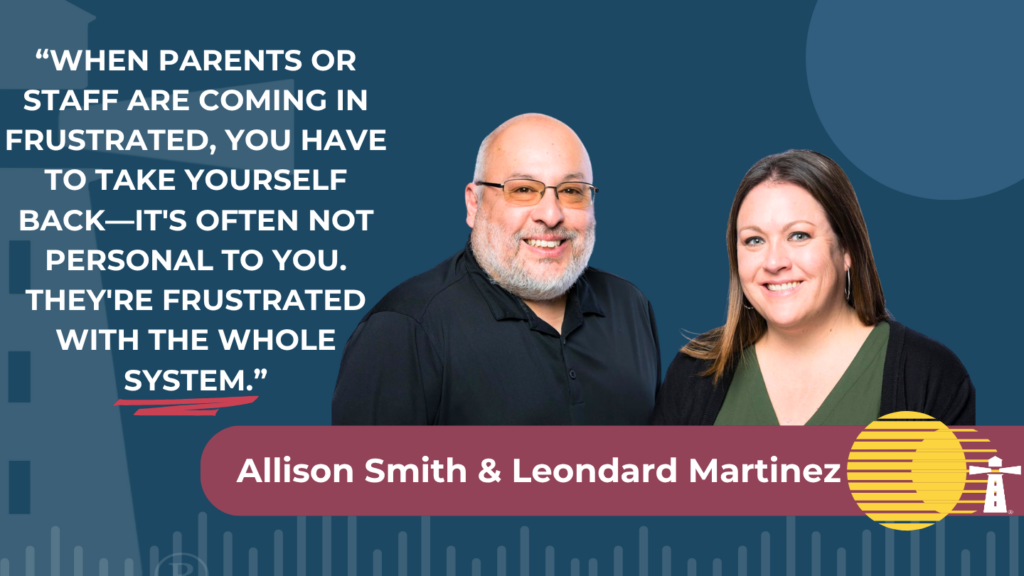
“When parents or staff are coming in frustrated, you have to take yourself back—it’s often not personal to you. They’re frustrated with the whole system.” — Leonard Martinez
Ready to reconnect with your why? Listen now to hear how one classroom visit became Leonard’s wake-up call—and how you can lead with renewed empathy and authenticity. Whether you’re struggling with parent relationships, staff morale, or your own disconnection from school life, this episode offers honest reflection and actionable strategies.
Subscribe to the Mosaic Days Educational Leadership Podcast and never miss insights that matter to school leaders who care.
FULL PODCAST Transcript
Lighthouse Therapy (00:01.016)
Hello everyone and welcome to the brighter together podcast. And I am so excited today guys. I met these two lovely people when I was in California at a conference and I’m so excited to have them on the show. So we have with us today, Allison Smith and Leonard Martinez and they are the co-hosts of their own podcast. It’s called Mosaic Days Educational Leadership Podcast.
and they are in the Los Angeles, California area. So, Allison and Leonard, thank you so much for being willing to come on my show. I appreciate it.
Allison Smith/Leonard Martinez (00:37.786)
Yes, thank you for having us on. We’re excited. Let’s talk about education. All things education. And we have our representation of California up here. We are in the northern Bay Area right now at a conference doing an educational leadership conference and presenting today on just some difficult things with special education students.
Lighthouse Therapy (00:42.782)
Absolutely. All things edu-
Lighthouse Therapy (00:51.448)
Awesome.
Lighthouse Therapy (00:58.19)
Mm-hmm and for those of you there listen Oh, I just bit my tongue for those of you that are listening She pointed to they have a picture behind them of the Golden Gate Bridge So it’s a beautiful photo, too So and I just say that because not everybody’s gonna be seeing watching us, but we do have listeners as well So, so tell us tell us what’s going on. Tell us what’s happening in your world You guys are have such a wealth of knowledge when it comes to education. Give us a little little synopsis
briefly if you don’t mind of each one of yours history like your what your career history and So they kind of know who I’m talking to because you guys have an impressive background both of you. So
Allison Smith/Leonard Martinez (01:31.271)
yeah. Yeah.
Allison Smith/Leonard Martinez (01:37.106)
Thank you. Go for Go for it, SAllison. Thank you. So I started actually out in general education. So was a general education elementary teacher. And over the years just fell in love with working with our students that needed a little bit of extra support. So I ended up going back to school, getting my special education credential. I have worked elementary, secondary.
at the district level as an administrator, at the county office as an administrator, at the SELPA as an administrator in California. Those are our special education local plan agency area. And so, you know, just a lot of support around compliance, around all aspects of special education and how to incorporate best practices for our students with special needs.
Lighthouse Therapy (02:28.237)
Awesome.
Allison Smith/Leonard Martinez (02:29.06)
Yeah, I’ve been doing this for over 20 years. As a special ed teacher, I started out working in a mild, moderate setting and then a mild, severe setting. Really enjoyed working with children with autism in a self-contained setting at one point. I was doing full inclusion, was doing behavior. You know, really was fortunate enough to work with all aspects of special education.
Then went to district office and did a lot of work with compliance, a lot of work with training on behavior and autism spectrum disorders. Then became an administrator and really taking a look at, know, the goal right now is to develop leaders. I feel like we need to do a more hands-on approach with supporting our administrators with special education. It’s not an easy thing to do.
Lighthouse Therapy (03:17.068)
Right.
Allison Smith/Leonard Martinez (03:22.394)
And so we really have to take a hands-on approach with training our administrators. We’re big on compliance. We’re big on instruction. We’re big on behavior. you know, we really, fortunately, I think between the combined experience with us, we really have been able to work with all aspects of special education. And so I’ve known Allison now for probably eight years, I think. And we’ve decided that we needed to share some of this knowledge that we’ve gained.
so that people could avoid the things that we got. We got into trouble when we were younger and we needed support. And so the idea of doing the podcast was really talking about, again, the same to all things education, professional development. We want to train our teachers, our administrators, our parents. We really even want to train our students on self-advocacy. So really we take a look at all topics in not only in California, but what are some of the issues nationwide?
Lighthouse Therapy (03:54.581)
Right. Yeah.
Lighthouse Therapy (04:12.942)
Mm-hmm.
Allison Smith/Leonard Martinez (04:19.889)
that are impacting us as educators and with a little bit of a focus on special ed, but we know like say math achievement across the country is really, really having some struggles right now. That’s not a special education issue. That’s an all student issue and that’s an all teacher issue. How are we approaching this challenge and what are we doing to develop some interventions that are really gonna be, have a positive impact on our students? And so that’s where we started coming up with ideas for the podcasts.
Lighthouse Therapy (04:31.81)
Right. Mm-hmm. Mm-hmm.
Lighthouse Therapy (04:49.24)
So how long have you guys been doing? I’m sorry, I didn’t mean to interrupt you, Allison. Go ahead.
Allison Smith/Leonard Martinez (04:49.414)
So, yeah.
No, I mean, we can just, was just going to speak to that. It was fairly recent, August, August of this year. So I think we just hit 25 episodes. We do about one episode a week. Sometimes it is, you know, specific to subject matter. So we did a three part series that was around leadership and guiding school site staff through the IEP process. So what to do to prepare for the IEP during the IEP and after for administrators, but then a hot topic will come up. So
Lighthouse Therapy (05:07.0)
Awesome.
Allison Smith/Leonard Martinez (05:23.708)
You know, just a couple of weeks ago, like Leonard had mentioned, we did that focus on math achievement and some of those areas. And I think, you know, the really, powerful thing for us is as leaders, we’re able to take the time also to reflect on our previous experience and look at how much we’ve grown and how much more growth there still needs to happen because leadership is ever changing. And so, you know, we want to make sure that we’re also sharing that process with other leaders so that they themselves can reflect.
Lighthouse Therapy (05:29.912)
Mm-hmm.
Lighthouse Therapy (05:45.218)
Mm-hmm.
Allison Smith/Leonard Martinez (05:52.806)
you know, and take hopefully some nuggets of advice or some guidance on what maybe we did wrong and how we kind of approach things now moving forward. So it’s a very short time.
Lighthouse Therapy (05:59.767)
Yes.
Lighthouse Therapy (06:04.386)
Yeah, but you guys are delving deep. You guys go deeper than probably what I have time to do on my show because you know, we’re, we’ve got 30 minutes. That’s what I got. I got 30 minutes with you. That’s what I got. and then it’s onto the next person. Cause my focus for brighter together is getting the stories out there. You know, you guys are, are really consultants and training and helping in education, helping those people that are, that are
fighting this fight and doing this work every single day, which is awesome. I’m just trying to say, stop beating up on our teachers, stop beating up on our schools. Let’s talk about the good things that are happening in education. Yes, there’s challenges and we need to talk about the challenges too, but it’s really, it never ceases to infuriate me more than when I hear somebody say, this teacher and they apply it to every single school and every single teacher that ever took a breath in this country. And it’s like,
Will you stop? Yeah. So I love that. I love that you guys have that and that it’s a resource for people that I can go to your podcast and I can learn and know something that I didn’t know before and go, wow, I didn’t even think about that maybe.
Allison Smith/Leonard Martinez (07:18.202)
Yeah, we’re really a hands-on approach to a lot of these issues. These are issues that we’re dealing with on a daily basis. And a lot of times, administrators do not receive training through their educational programs on how to deal with something like conflict with staff or conflict with parents. And so if we’re not guiding our young administrators through this, they’re left to their own devices. And we’ve seen at times where administrators don’t handle these interactions appropriately.
and it results in some litigation. So we’re really trying to give some sound advice based on our own experiences, but really trying to create cohorts of learners so that they can approach like conflict, for example, through a prescriptive lens and realizing that there is a process, realizing that, you know, we’ve all been yelled at by people in our professions and sometimes we get yelled at by parents. And we internalize that.
And we think that it’s accusatory and we think that we need to defend whether through the lens that we often talk about is this parent is advocating for their child and that’s going to bring some emotions and sometimes the expression of those emotions are not appropriate. And so we not have to, we have to make sure that we can remain objective, remain in control of our emotions, not really trying to go back and forth and becoming a power struggle with the parent because that’s going to damage a relationship.
Lighthouse Therapy (08:16.302)
Mm-hmm.
Lighthouse Therapy (08:26.158)
Yeah.
Allison Smith/Leonard Martinez (08:46.082)
And we’re talking about a K-6 school that happens in the first grade. We have five years that we have to make this relationship work. So it’s really looking at being empathetic. It’s really looking at if a relationship has been damaged, restorative, and making sure that we can come back to the same place. We do have a disagreement, and we want to hear your concerns. This is the process that we need to follow. And so we have to be able to remove ourselves from some of those emotions.
Lighthouse Therapy (08:46.382)
Mm-hmm.
Lighthouse Therapy (08:52.077)
Yes.
Allison Smith/Leonard Martinez (09:14.438)
because then we get escalated and in turn it can turn into the struggle that we don’t wanna see our administrators go through. We don’t want our parents to feel that they’re not being heard or they’re being dismissed. So it’s really walking administrators and teachers and paraeducators through that process to get support. Cause you know, we don’t get that training in our admin programs. I wish we needed to develop that university course where we’d look at the soft skills.
Lighthouse Therapy (09:35.04)
Right. Yeah.
Allison Smith/Leonard Martinez (09:39.546)
and we take a look at conflict resolution and restorative practices with our community members. Yeah, and I think, you know, we like to focus on the mental health and the well-being also of our administrators and our teachers. So we did do one episode around ensuring that you yourself, you’re taking care of yourself because if you’re not good, you’re not able to be able to support your families or your students because the teachers are at the heart of everything that we do. And if we don’t support them and we don’t help them to
Lighthouse Therapy (09:51.554)
Mm-hmm.
Allison Smith/Leonard Martinez (10:09.5)
to have the tools and the resources that are needed. Ultimately, the students are the ones that are impacted, the families are impacted. So we wanna ensure that we start with our teachers first. So a lot of this is just even having conversations with administrators, how are you best supporting your teachers through this process? How are you best supporting your teachers through a difficult IEP so that teachers are not stuck there with this, my gosh, everyone’s attacking me, but rather the administrator is coming in and helping to guide that conversation into a positive manner.
Lighthouse Therapy (10:36.494)
Mm-hmm. And how many times have you guys had a teacher go, I didn’t even realize, I didn’t even realize that I was internalizing that or that I wasn’t practicing good self care. know, because I think that sometimes we’re so close to it. We’re just so close to what’s happening that taking a step back and looking at the big picture is it’s a skill that you have to learn, right?
Allison Smith/Leonard Martinez (11:00.432)
Yeah. And we’ve talked often about how the frustration that occurs is not usually about the teacher. And it’s not usually, it’s about the situation. And when parents or staff are coming in, even just really frustrated, you have to kind of take yourself back, even as an administrator, sometimes it’s not even personal to you. They’re frustrated with the whole system as a whole. We don’t have the funding for resources. We don’t have the right level of adult support. don’t have whatever it is that they’re frustrated about.
Lighthouse Therapy (11:09.806)
All right.
Mm-hmm.
Lighthouse Therapy (11:30.541)
Mm-hmm.
Allison Smith/Leonard Martinez (11:30.766)
And when you take it so personally, they’re saying I’m horrible as a leader. They’re saying I’m a horrible teacher. Oftentimes it’s not even about you, it’s about the overall situation.
Lighthouse Therapy (11:41.25)
Right, right. And helping them to see that, that’s so critical. Yeah, absolutely. So yeah, go ahead. Yeah.
Allison Smith/Leonard Martinez (11:47.178)
Yeah. It’s a stressful job, right? I mean, you’re in charge of, if you’re a general education teacher and you’re teaching high school, for example, you’re in charge of teaching math to 150 to 200 students a day. I mean, think about the pressure of that. And when you start seeing test scores and when you start seeing progress reports and your parents are coming with concerns and administrators are coming with concerns, I mean, it is a high stress environment. And so we want to make sure that we’re supporting our staff.
Lighthouse Therapy (11:59.618)
Mmm.
Allison Smith/Leonard Martinez (12:15.41)
supporting our teachers so that we can walk them through some of this process, maybe taking a look at instruction, maybe taking a look at classroom management, and being very thoughtful and hands-on on how teachers can improve their practices. No one’s going to be a high-level teacher for long. We’re constantly changing our practices. We’re constantly raising the bar. So that’s part of that whole lifelong learner. We’re learning how to be experts at our craft.
Lighthouse Therapy (12:38.167)
Mm-hmm.
Lighthouse Therapy (12:41.966)
All right.
Allison Smith/Leonard Martinez (12:44.612)
And like what we do in our daily lives, mean, we’re always learning something else. If I was an expert last year, I can’t be an expert at the same time the following year. You’re constantly updating your knowledge. You’re constantly updating your practices. You’re constantly updating your approaches. And so we have to foster that community of learners within a campus, within a district, within the state. We have to have those conversations to calibrate our approaches to students, because the students have changed.
Lighthouse Therapy (12:55.278)
Mm-hmm.
Allison Smith/Leonard Martinez (13:13.66)
That’s the thing that we hear from decade to decade. The students have changed. It wasn’t like it was 20 years ago. How are we adapting as professionals to meet the needs of those students in the classrooms today?
Lighthouse Therapy (13:16.642)
you
Lighthouse Therapy (13:24.588)
And if there’s a time where it’s changing faster than other other 2026, it’s February 25th, 2026 right now guys. And it is incredibly fast how quickly things are changing and you know, it’s almost like you start out and you’re already behind the eight ball.
Allison Smith/Leonard Martinez (13:44.306)
Well, don’t get us started with the AI that’s going on right now and the technology because, mean, we cannot stay ahead of that fast enough. And so how are we addressing that in the classroom? How are we promoting responsible use of it? You know, I have my very opinionated ideas about that. Opinionated? Nah, he’s not opinionated. You know, my fear always is, you know, again, I appreciate that we are free thinkers.
Lighthouse Therapy (13:54.551)
No, you can’t.
Lighthouse Therapy (14:05.686)
Hahaha!
Allison Smith/Leonard Martinez (14:14.222)
And so whenever that’s short-cutted, we have to be very cautious. And I think that’s probably all I’ll say about AI use in the classroom right now. But even utilizing it, we see at today’s conference, there’s a lot of just good use for our special education populations around AI. And how do you successfully teach students, especially older students, how to utilize that to create scaffolds for themselves and graphic organizers?
Lighthouse Therapy (14:14.318)
Mm-hmm.
Lighthouse Therapy (14:21.122)
Yeah.
Lighthouse Therapy (14:31.16)
Mm-hmm.
Allison Smith/Leonard Martinez (14:42.258)
the tools that they need to structure writing and things like that. And so I do think that there’s a lot of benefit in that. All of the conferences that we do attend, there’s often talk about how we’re utilizing AI to be beneficial to students and to hopefully reduce workload for teachers and looking at how we can expand that for them, especially in special education. I know there’s a lot of tools around development of IEPs, but.
Lighthouse Therapy (14:56.462)
Mm-hmm.
Yes.
Allison Smith/Leonard Martinez (15:10.052)
still needing to ensure it’s individualized for students being the important thing. So, you know, there are some benefits to it as well.
Lighthouse Therapy (15:13.282)
Right.
Lighthouse Therapy (15:17.9)
Yeah, and there’s there’s always got to be a human. There’s always got to be a human behind all of that. And that’s the part that because certainly, even with Lighthouse, know, that AI is is a piece that, know, everything we do and everything you guys do, it has to be HIPAA and FERPA compliant. I mean, you can’t just start throwing student data out there and on to chat GPT and just expect it to be OK. It’s not so.
Allison Smith/Leonard Martinez (15:20.678)
Yes.
Lighthouse Therapy (15:45.026)
there’s that piece too. So, you know, even with what we’re doing and work, you know, it’s just, you have to be so careful and, but, but there’s power, there’s definitely power there. And I was, I was encouraged to hear, we just had the president’s speech last night and I don’t want to go political and I’m not trying to, but I was encouraged to hear that he’s taking a stand with this AI that they have to pay for the electricity. They have to make sure that they’re not going to cause
this incredibly increase on the grid. And then you and I as citizens have to pay for that. was really, that was encouraging for me to hear that. But you know, it’s not going away. We know it’s not going away. We just, it’s just, it’s just constant movement. And I think that you’re absolutely right, Leonard. It’s like, are, we are still students. Yeah. Yeah. So what are some of, tell us a little bit. I know you guys each have your own consulting.
Allison Smith/Leonard Martinez (16:31.044)
Yeah.
Lighthouse Therapy (16:39.502)
Firms, tell us a little bit about that. I would love to hear a little bit more about that. Yeah, you guys have too many hats. I can’t wear all the hats you guys wear.
Allison Smith/Leonard Martinez (16:42.698)
Our mini hats, our mini hats.
Allison Smith/Leonard Martinez (16:49.106)
So I started at Collaborative Partnerships and Learning and my company is really focused on bridging that gap between parents and school site staff so that it’s not, you know, two sides being an opposition. How do we teach and educate our parents so that they can walk into any IEP meeting or 504 meeting and feel successful and confident in the approach that they have? So they don’t automatically have to link up with
advocates who sometimes come in very adversarial and aggressive or you know go immediately the legal route, you know, how do we empower parents to have the knowledge of of an IEP process and to feel like they can successfully and in a collaborative positive manner advocate for their child and then how do we as school site staff foster that relationship and build that partnership?
Lighthouse Therapy (17:21.356)
Mm, yeah.
Lighthouse Therapy (17:45.04)
And that’s huge.
Allison Smith/Leonard Martinez (17:45.234)
That’s really the work I’m doing. I mean, really parent education, empowering families to advocate for their kids appropriately. It really is something that is needed. And I don’t care what state you’re in and what city you’re in, really trying to get parents to understand their child’s disability, which we’ve seen oftentimes, you know, kids are in high school and the parent doesn’t know what autism means or
Lighthouse Therapy (18:05.806)
Mm-hmm.
Allison Smith/Leonard Martinez (18:13.958)
what a specific learning disability means and how that impacts their child. And more importantly, how can they learn to successfully work with their child? And so think we see early on school districts, parents rely on school districts to support that child. Really, that’s a partnership. When I was in the classroom many years ago, I would encourage my parents come into the classroom, see how we work with your kid, and let us
Lighthouse Therapy (18:32.493)
Yes.
Allison Smith/Leonard Martinez (18:42.906)
let us give you the support so that you can do what we do at the home. And that strengthens that student’s ability to learn and that strengthens that student’s ability to form relationships. So the work that Allison is doing is so crucial. Parents need the support. They need someone who’s gonna be knowledgeable, which she is gonna be supportive and really be able to feel confident that I can communicate what my student’s strengths are.
because that’s first and foremost, right? I wanna know, I wanna be able to communicate about what my kid does really well, some challenges that we might have and where we see that child is gonna be in a year or five years or 10 years. So it really is making sure that parents see where that kid’s at now, but also taking a look at where that kid’s gonna be in the future and how can we help shape that path with a student. And I think that’s a critical component that…
Lighthouse Therapy (19:11.726)
Mm-hmm, yes, yes, absolutely.
Allison Smith/Leonard Martinez (19:38.662)
that you provide for parents. He’s my spokesperson. That sounded great. Yeah. I’m a little bit different. My company is called Grouchy Owl because that’s pretty much me, right? That’s everyone knows me. I’m grouchy and I’m old and I have some wisdom. So Grouchy Owl was basically a form because I love knowledge.
Lighthouse Therapy (19:41.634)
There you go, yeah, absolutely. Yeah.
Allison Smith/Leonard Martinez (20:08.818)
I love reading. I love being expert at what I do. I take pride in that. And so people are coming to me saying, hey, we need support. need to have, tell me about this. Tell me about this. And either I knew the answer or I would research it thoroughly to come up with an answer. so. And like that’s, that’s what drives me, right? I have that.
Lighthouse Therapy (20:15.138)
Mm-hmm.
Lighthouse Therapy (20:27.308)
I can see that Leonard. can totally see that. What? I don’t know something. I got to find it. Yeah.
Allison Smith/Leonard Martinez (20:38.416)
that quest to know what the answer is and being able to now support districts in creating consistency. This is the work that we’ve done throughout our careers, creating consistency, creating processes and procedures to streamline so that everyone is in a school or a district, for example, is applying the same thing with uniformity.
Lighthouse Therapy (20:41.742)
Mm-hmm.
Allison Smith/Leonard Martinez (21:07.45)
And so that’s really what it’s about. It really isn’t about pockets of this school’s doing this and this school’s doing this. It really is at either a county office or a school district level for them to create practices and procedures and train their staff for implementation. And so that’s kind of my thing. I want to build consistency. I would like to do it in a prescriptive manner so that we’re all saying, we all should be able to know you need to do this, you need to do this.
Lighthouse Therapy (21:07.598)
Mm.
Lighthouse Therapy (21:25.564)
Mm, very good.
Allison Smith/Leonard Martinez (21:37.266)
We were talking about manifestation determinations before we started and it’s a difficult process It’s a process that a lot of districts get wrong And so what I’ve done over the years is taking a look at how to take the guesswork out of it How do we take a look at data? How do we make informed decisions? Because at times our emotions interfere with that ability to make decisions and so that’s something I I think I do well and it’s not it really isn’t about
Lighthouse Therapy (21:40.984)
Mm-hmm.
Allison Smith/Leonard Martinez (22:06.054)
this is what to do. It’s really about developing capacity too and developing confidence in staff members so that they can trust themselves to make an appropriate decision or to implement a practice. And at times I feel, you know, we really don’t, I think do that at the university level. And if you don’t have a strong support system at a district office to bring along those staff members for their journey and support them through their journey as educational leaders, whether they’re teachers,
Lighthouse Therapy (22:25.176)
Uh-huh.
Allison Smith/Leonard Martinez (22:35.75)
or administrators, there are going to be some bumps in the road. And so I think having that ability to have a mentor to guide you through that process, to help you create and collaborate processes and procedures is something that to me is exciting. Yeah.
Lighthouse Therapy (22:39.022)
Mm-hmm.
Lighthouse Therapy (22:51.852)
Yeah. And it’s so critical. It’s so critical. Even at Lighthouse, every single, I don’t care how long you’ve been a therapist, you come to Lighthouse, you have a mentor because we do things a certain way. And the schools, we partner with schools and we want to make sure that when we bring our therapists to a school, that isn’t a contracted therapist that you’ve hired to just make sure that you can check off a box. We want them to be a part of your team.
So we want to make sure that whatever that school needs, that needs to be communicated so that they can be a part of that team. It’s really important because it isn’t just like, it isn’t just us going, okay, here, here you go. You know, I’ve seen so many contract companies like you need a speech therapist. Okay, I’m done. You got one. No, you need somebody that’s going to help you to help that therapist to be productive and to be doing things exactly the way that you want them done. Right. And if we don’t know that and the therapist doesn’t know that
That’s when communication breaks down and then we’re not, your therapist is crappy. They don’t do their job or whatever, know, whatever it is. So we try to support them so that, and support you so that they come together. And I always tell people, it’s like, I have two customers. I have the therapist that I hire, but I also have the schools, but neither one of those is the reason I do what I do. They both come together for those kids.
That is the reason that we’re here. And that gives me chills because that’s exactly what you and I and all of the people that really care about education, we’re doing all of this for the kids. It’s not something that is just, I gotta go to work, right?
Allison Smith/Leonard Martinez (24:13.937)
Yeah.
Allison Smith/Leonard Martinez (24:34.162)
Well, and I think sometimes we have to, in our busy lives, bring it back to that and just remind everybody that that’s why we’re here. Because I think, you know, especially at our level, when we’re dealing with a state and we’re dealing with compliance and we’re dealing with this, you know, it’s because we’re having an answer to the higher ups that are saying, well, if you don’t do this, then you’re going to get in trouble. You know, but we bring it back to the kids. It becomes a whole different perspective shift on why you’re doing what you’re doing. You know, it’s not just about compliance, but it’s ensuring the most appropriate.
Lighthouse Therapy (24:38.926)
Yeah.
Allison Smith/Leonard Martinez (25:02.939)
supports and services for kids. And when you bring it back to that and you look at the data, I mean, that’s really where most of our work should lie.
Lighthouse Therapy (25:10.284)
Yeah, yeah. And as we move into AI and as we move into this new technological advances that we’re seeing, think that used properly, I think that it can make the workload, the workload. Because there’s that one of the things you hear all the time, how many guys have you heard? Another thing that I have to fill out? Are you kidding me? You know?
Allison Smith/Leonard Martinez (25:33.212)
Yeah. Yeah.
Lighthouse Therapy (25:34.734)
I think that that workload can, with the right software, again, it’s gotta be the right software, but it can lift that up a little bit. Let’s get them back more in the classroom. Yes, you want that data? Okay, we’ll get you that data, but let’s get you mostly working with the kids and understanding what you need to do with the kids so that you can get, dear administrator, you can get your numbers, but you’re not putting all of that burden on your teachers.
Allison Smith/Leonard Martinez (26:00.824)
Yeah, I think that’s something we’ve talked about. We have to stop. We have to stop. We have to move away from, we got to deal with this situation or put out this fire and create and put systems in place that are going to support kids because that’s what we’re really here for, right? We talk about compliance and we’re to have IEPs on time and we have to give so many reports to the state to monitor us. We can’t lose sight of what we’re here for.
Lighthouse Therapy (26:15.918)
Mm-hmm.
Allison Smith/Leonard Martinez (26:26.49)
And what we’re here for is to provide a quality education for our students. And so sometimes we do lose sight. And I think it’s important that we do bring it back to this is what we’re doing. I think as administrators at times we lose sight of that because we’re not in the classroom anymore, right? Now, one thing I do think that I encourage administrators to go into those classrooms and not just do an observation because we all know how to check the boxes off for evaluations on the observations.
Lighthouse Therapy (26:41.986)
Right, right.
Allison Smith/Leonard Martinez (26:55.026)
Work with a couple of kids, get a small group and what do you get? There is nothing more. And I was telling, I taught an algebra lesson a couple of weeks ago and putting myself back in that teacher role, it was very humbling. It made me realize that it’s easy for me to tell teachers go and teach standards, go and increase test scores, but until you put yourself back into that role of teacher,
Lighthouse Therapy (26:56.982)
Yeah, get on the floor.
Allison Smith/Leonard Martinez (27:22.916)
And I was thinking to myself, we had a lesson plan and I, I missed that. I missed that. my gosh. That was so, there’s so many things going on at once. We forget how difficult teaching really is if we’re so far removed from the classroom. So I would definitely encourage all administrators out there to get back in the classroom, work with the group of kids and see how difficult that was because in our heads, they were, you know, some of us are 10, 15, 20 years removed from the classroom setting.
Lighthouse Therapy (27:34.062)
Mm-hmm.
Lighthouse Therapy (27:49.934)
Okay.
Allison Smith/Leonard Martinez (27:50.566)
Get back in there. Get your hands dirty with a lesson. Get to see what it’s like to experience those teacher frustrations with classroom management or this kid’s being left behind. What can I do because this other kid over here, these kids got it and this group of kids didn’t, but I got to do the next lesson. And so I really would, we’re really would challenge all of our administrators to, to put on that teacher hat again, because you’re going to have that experience of frustration and a sense of urgency like never before.
Lighthouse Therapy (28:19.5)
Yeah, yeah, for sure. I even myself, you know, as an SLP, I haven’t been a speech therapist in a session for three years. And it’s like, whew, it’s easy. It’s really easy to like, And one of the things that we have, that I’ve always said is, I’ll always be a therapist first.
But it’s easy to forget, just exactly like what you were talking about. So all of my coordinators, all of my clinical coordinators, my middle management people, they’re amazing, but I won’t allow them to stop seeing kids. You’re 50 % clinical coordinator, but you’re 50 % therapist treating, because I don’t want them, I know how easy it is to lose it. And I’ve seen it in other organizations where, and even in myself, I mean, we’re all guilty of it. It’s just, it’s…
It’s just a part of you have to make sure that you’re doing something to help you to remember and not just get focused on. But that’s part, I mean, that’s just what I’ve done to try to combat that because, but I can, it’s not the same for a school because you guys have to have administrators. It’s not like you can go, okay, well now I’m just gonna be a teacher all day and I’m not doing any administration. It’s not that easy. But I love the fact that you’re pointing that out because it’s just so important. And it’s something that I…
I even struggle with myself, you know, so for sure.
Allison Smith/Leonard Martinez (29:44.124)
Well, and it puts you back into the joy of why we’re all in the profession. You know, when you get those kids and you’re working with those kids, I mean, I just even when I sit and I oversee 504 meetings and just having that ability to connect with a student and a family is so powerful. And it makes me love the work that I do because it reminds me of why I’m there and why my long hours and my extra work like where that goes to it’s really for this kid.
Lighthouse Therapy (29:47.026)
yeah. yeah.
Lighthouse Therapy (29:58.286)
Mm-hmm.
Yeah.
Lighthouse Therapy (30:05.87)
Mm-hmm.
Lighthouse Therapy (30:10.904)
Right? Yeah. Yeah. Cause that’s the ultimate. That’s the reason we do what we do every single day. I remember going back those three years as, and that’s probably more like four or five now that I’m sitting here thinking about it. Anyway, but once, know, I was our first Lighthouse Therapy’s first SLP. You know, I started this company. I’m an SLP. You you spend all the plates as an owner and an entrepreneur. you know, you can call me all of those things, which I am fine.
Allison Smith/Leonard Martinez (30:32.818)
Yeah.
Lighthouse Therapy (30:40.856)
but I’m a speech therapist first. I will always be a speech therapist first. And I remember we had a shortage. We couldn’t hire enough speech therapists for this particular school. So I was like, okay, just give me the kids. I’ll keep them for the 13 weeks or whatever it’s going to take until the other SLP can get her license and get going. And we were small enough at that time than I could do that. I wasn’t a good therapist and I wasn’t a good CEO. I couldn’t do. And it was, I remember the day I’ll never forget. It’s probably going to make me cry.
Allison Smith/Leonard Martinez (30:42.652)
Yeah. Yeah.
Lighthouse Therapy (31:09.998)
because it was hard, it was hard to set, to give that up to say, but, but what, and I’m a Christian, you guys know this about me. God says, you can serve 55 kids as a speech therapist. We have 3,500 kids now in Lighthouse. And you go, I go, he’s like, you can’t do 3,500 by yourself. You can’t do 25,000 by yourself. You can do that as a CEO. You can get to the place where you can serve that kind of, those kind of numbers, but not.
Allison Smith/Leonard Martinez (31:16.786)
Thank you.
Allison Smith/Leonard Martinez (31:24.389)
Wow.
Lighthouse Therapy (31:39.296)
not you have to let go of that piece. And it was, well, I don’t want to, you know, it just, it was a hard part. So, you know, so it’s something that’s, that’s near and dear to my heart because it’s so hard. It’s so hard to, to know that what you’re doing is critical. Please don’t hear that. We don’t think that you’re not important to either side of that equation because both are necessary. but it’s hard. It’s a hard, it was, it was really hard for me for sure. So.
Allison Smith/Leonard Martinez (31:44.335)
Yeah.
Allison Smith/Leonard Martinez (32:06.066)
Yeah, and I think that’s part of the role of leadership that we take on, right? We can work with the caseload in your case or classroom in our case, and we’re impacting 15, 30 kids a day. But when you take a look at moving up to leadership and administration, you’re impacting more kids. And so that’s the responsibility that we take on that we, you’re not having that direct one-on-one interaction with students anymore or a classroom full of students.
Lighthouse Therapy (32:10.111)
Mm-hm, yeah.
Lighthouse Therapy (32:15.15)
Mm-hmm.
Lighthouse Therapy (32:25.198)
Mm-hmm.
Allison Smith/Leonard Martinez (32:34.684)
but you’re creating systems and you’re creating processes that benefit many more students. And so that’s the trade-off and you’re right. It’s a tough trade-off because, we signed up for this to work with students and to see that, and as you and Allison are saying, that joy of students getting a concept, the joy of students struggling and potentially failing, but then…
Lighthouse Therapy (32:51.395)
Mm-hmm.
Lighthouse Therapy (32:56.75)
Mm-hmm.
Allison Smith/Leonard Martinez (33:03.174)
getting right back up and solving that problem and making that connection and being successful. That’s really what we signed up for. And so although we don’t necessarily get to see that on a regular basis anymore, the decisions that we’re making, the processes and the procedures that go back that we’re creating will have a positive impact on students. so it changes a little bit, but this is what we’ve decided to do. We decided to make systemic changes that are gonna have
Lighthouse Therapy (33:07.022)
Alright.
Allison Smith/Leonard Martinez (33:31.846)
positive outcomes for students and we have to take pride and we have to take joy. And you know, one of the things when the three of us met, clearly there was a passion for providing appropriate services for students so that they can achieve. And that’s really what we’re here for.
Lighthouse Therapy (33:46.456)
Right.
Yeah, 1000%. So we’re 33 minutes in. We need to wrap this up. It’s been so much fun. I wish we had another hour, but where, Part two, yeah, absolutely. I would love to have you guys back. Absolutely. Let’s talk about that. So, but where do people go? First of all, to find the podcast, Mosaic Days Educational Leadership Podcast. Where do they go to find that? And then where do people go if they want to learn more about Allison?
Allison Smith/Leonard Martinez (33:56.69)
How’s that? Part two. Part two.
Lighthouse Therapy (34:17.909)
Smith and Leonard Martinez.
Allison Smith/Leonard Martinez (34:20.71)
Well, the podcast is so we have a YouTube channel. You can look at Mosaic Days for our YouTube channel. podcast, Spotify, wherever you get, whether you want to listen to us or whether you want to see us and listen to us. We’re everywhere and our contact information is available through that avenue as well.
Lighthouse Therapy (34:29.24)
Apple podcast. Okay.
Lighthouse Therapy (34:35.382)
Mm-hmm.
Lighthouse Therapy (34:41.75)
Awesome. And mosaic for those of you that don’t spell well because I don’t always spell well is M-O-S-A-I-C, mosaic. Yeah.
Allison Smith/Leonard Martinez (34:48.498)
That’s correct. I misspell it at times,
Lighthouse Therapy (34:51.214)
Well, and I only do that because the, you know, the, the, need, we need people to be able to find you. We want them to find you for sure. So, and you guys, where do we find you guys?
Allison Smith/Leonard Martinez (35:03.026)
So I am at www.collabinlearning.com. So that’s Collaborative Partnerships in Learning. That is my official website. And then you, Mr. Grouchy Owl. I don’t know. Google Grouchy Owl and my picture will probably come up looking angrily. And we’re both on LinkedIn as well. So you can always look us up on LinkedIn. yeah. We are on LinkedIn.
Lighthouse Therapy (35:15.575)
Haha.
Lighthouse Therapy (35:19.758)
Probably.
Lighthouse Therapy (35:25.378)
good. Okay. All right.
Lighthouse Therapy (35:32.142)
All right. Well, thank you. Enjoy the rest of your conference. But thank you so much for being on brighter together. I you know, I’m it has been an absolute and I knew it would be an absolute pleasure to have you guys on the show.
Allison Smith/Leonard Martinez (35:44.722)
Come on, thank you Janet. Thank Thank you so much for having us.
Lighthouse Therapy (35:48.622)
Absolutely. All right.