

Episode Description
Many special education students graduate without a post-secondary career plan, leaving them unprepared for independence and employment. John Ischy, an intervention specialist at Switzerland of Ohio Local School District, shares how intentional transition planning, hands-on career exploration through the PAYS Lab, and virtual reality job simulation transform student outcomes—moving from “no plan” to meaningful, sustainable employment. Discover why career-focused transition planning starting in middle school matters more than traditional academic metrics for older students.
Notable Quote
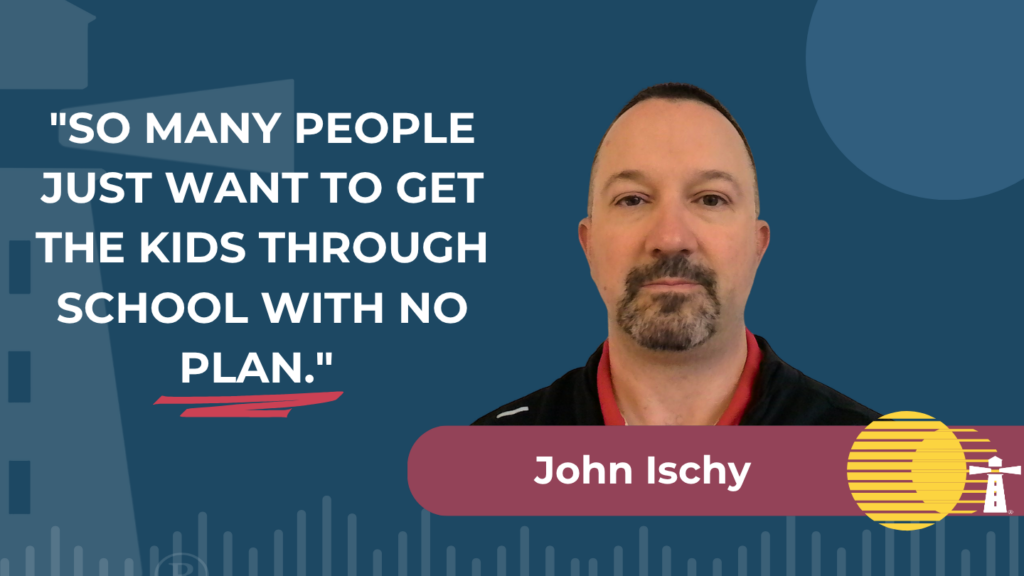
- “So many people just want to get the kids through school with no plan.” [00:03:45]
- “That’s the most important piece because by the time you get to the kids at seven through 12, the amount of growth you can make on reading and math is going to be minimal.” [00:18:16]
- “We can have those success stories and not just with our special ed population.” [00:19:15]
- “My door is always open so if anybody wants to see it, they can stop by.” [00:22:03]
- “If they are willing to work, we can get them a job.” [00:24:46]
Full Podcast Transcript
Lighthouse Therapy (00:01.548)
Hello everyone and welcome to the brighter together podcast. My name is Janet Courtney and my special guest today is John Ishii. John, am gonna get it out, I swear. He is an intervention specialist at Switzerland of Ohio local school districts and he’s gonna explain that to us. And he is in Woodsfield, Ohio. John, welcome to the show. After that crazy introduction, right?
John Ischy (00:25.08)
Thanks for having me.
Lighthouse Therapy (00:29.708)
So tell us John a little bit about how you became an intervention specialist. Tell some people what that is because they may not know and tell us a little bit. go ahead. Good. No, no, you’re fine.
John Ischy (00:38.146)
So intervention, I apologize. So intervention specialist is basically the name we use in Ohio for a special education teacher. You know, I’ve done everything from self-contained classrooms to inclusion classrooms. I actually have a pretty neat classroom now that I’m sure I’ll be talking to you about here shortly.
Lighthouse Therapy (00:47.499)
Okay.
John Ischy (01:00.014)
you know, as far as becoming an intervention specialist, I originally went to school right after high school and I got to be in one semester away from graduation and had a job opportunity not in the field that I was studying in education and it was going to be a good paying job and you know, I was burnt out on school and I left.
college early and went and did this job and I was actually in retail, which is what it was until I was 32 years old and I finished up as a manager for a large national chain and I was just coming home miserable every day bringing work home with me, you know, and just not a good person to be around and my wife just finally told me she’s like
Lighthouse Therapy (01:31.542)
Okay.
Lighthouse Therapy (01:47.201)
Yeah.
John Ischy (01:49.614)
you’ve got to make a change and you’ve got to make a change for you and you got to make a change for our family. And she fortunately had a nice job and that allowed me to go back to school and finish up. So I went back and finished my bachelor’s degree and I finished that up in a little under a year. And I just decided to go right into my master’s degree in special education and did that. And I want to say it was like 18 months, finished that up and then
Lighthouse Therapy (02:16.96)
Yeah, it’s amazing when you’re motivated, right?
John Ischy (02:20.167)
It’s amazing when you’re motivated and you want to do something different and you’re paying for it all yourself. And I was fortunate enough that because of our location, which I’ll talk about that here shortly, we couldn’t find a position for an intervention specialist. And so I was able to do my student teaching as a long-term sub, which my university allowed me to do.
Lighthouse Therapy (02:24.926)
Mm-hmm, mm-hmm, yeah, for sure.
Lighthouse Therapy (02:45.975)
nice.
John Ischy (02:46.049)
So I got right in there, at least got some pay and stuff like that. I look back at it now, that was my first year, probably my worst and toughest year as far as experience goes, but the year I learned the most from. I’m not going to tell you every day is rainbows and sunshine and all that kind of stuff, because it’s not. And I’d be lying if I said it was.
Lighthouse Therapy (02:58.28)
Mm-hmm. Of course, right? Yeah.
John Ischy (03:15.245)
But having been in other jobs, I can tell you I really enjoy what I do. I’m really fortunate to be in the placement that I’m in right now because I have a passion for it. I ended up picking up an endorsement for a transition to work in Ohio. And basically that’s like an expert on transitions, transitioning students from middle school and high school into the workforce. And that’s really what I’m passionate about.
Lighthouse Therapy (03:36.534)
Mm-hmm.
John Ischy (03:45.036)
You know, so many people previously, and I’m still fighting the battle now, just want to get the kids that we teach through school with no plan. And that’s not what’s best for them. That’s not what’s best for society. You know, so trying to find them. Yeah, trying to find some level of independence for them, but also being productive. You know, there’s ways to be productive besides being a factory worker or besides, you know.
Lighthouse Therapy (03:53.662)
Mm-hmm. Yeah.
Lighthouse Therapy (03:58.945)
Yeah, graduating them to the couch, right?
Lighthouse Therapy (04:11.51)
Right?
John Ischy (04:13.025)
being some kind of manufacturer. There’s other ways to be productive and that’s what I like to do with them and I’m fortunate in the position that I’m at now, which if it’s okay with you, I’m just gonna kinda talk about it little bit while we’re right here. I do a little bit, I multitask during the day. I do inclusion work in math and science here at the junior high.
Lighthouse Therapy (04:14.22)
Grocery bagger. Mm-hmm.
Lighthouse Therapy (04:26.463)
absolutely. Absolutely. Tell us about it.
John Ischy (04:42.093)
And then I do intervention for K-4 in the morning at the elementary school and I do 5-6 in the afternoon. And then I also have two periods which is what I like. It’s kind of the placement that I’m in right now. It’s called the PAYS Lab and what that stands for is Practical Assessment Evaluation System. And basically what we do is career exploration and career training before the vocational level.
Lighthouse Therapy (04:51.66)
Wow.
John Ischy (05:12.045)
And we have, we’ve really expanded this, but year one, we have all these prefabricated jobs. There’s like almost 400 in the classroom and everything’s lined out from the instructions to the materials they need. And they’re designed to simulate different jobs in, you know, that you might find in any environment, whether it’s here locally or whether it would be, you know, if they moved somewhere.
Through that, we’re able to document what their strengths and what their opportunities are, what accommodations they may need. Like they may be successful at something that somebody might not expect, but they need a certain accommodation for that, you know. So we’re able to document all of that. And then we’re able to kind of drive their transition planning through that process. you know, in the past, in our district, was almost always get them to…
Lighthouse Therapy (05:51.712)
Right? Mm-hmm.
John Ischy (06:09.781)
11th grade, get them to vocational school, get them their high school diploma, and then they got to figure out the rest of their world. Now, it’s not so much that way. We can kind of plan for them and help drive what they want to do because they can test a bunch of different career opportunities to see what they like and what they’d be interested in. And also, things they thought they wanted to do, now they can test that out and go, you know what? I don’t really like that.
Lighthouse Therapy (06:27.399)
Mm-hmm. Nice.
John Ischy (06:38.925)
you know, that’s got a lot of math involved and I’m not really good at math. So maybe I need to look at something else. So that when we send them the vocational school or I’ll talk about the other part of that in a second. If we send them the vocational school, we can, you know, help drive what would be the best fit for them as far as the program’s offered. And we’re one of the few districts that have our own vocational school. Yeah. So that helps.
Lighthouse Therapy (06:42.304)
Mm-hmm.
Lighthouse Therapy (07:01.034)
nice.
John Ischy (07:03.393)
And then I can give to those teachers, you know, what those students are going to need to be successful in their classroom, you know, or to pass their certification test. The other side of that is, and I’ve had a lot of success with this, students that maybe weren’t going to, you for whatever reason, didn’t want to go to vocational school or weren’t vocational bound, we have been able to partner with local businesses and do some job placement and I’ll go with them and…
you know, help them train on different jobs and learn and most of them have been paid, like almost like internship. And so they’ve got a taste on that. You know, I had success with a student, it’s been a few years now, but we placed them at the local cabinetry shop and they couldn’t run the machinery because they were under 18 yet, you know, from their labor, but they were able to do everything else, including helping to load the materials and stuff. And this
Lighthouse Therapy (07:37.319)
nice. All right.
John Ischy (08:00.769)
you know, this was a student that nobody thought was ever going to be able to be independent. He ended up through his work decided he wanted to go into our maritime academy at the Swiss, or at the vocational school. And he graduated with his certification in maritime and he now full time employed on a river boat out on the high river.
Lighthouse Therapy (08:22.592)
Wow, good for him. That is amazing. Yeah, yeah. And those are the ones that just grab you and you just go, this is why I do what I do, right? This is the reason those kids and we don’t get the wins like that all the time, but boy, when you have them, it makes all of the other days just 100 % worth it. yeah.
John Ischy (08:25.165)
That’s a success story right there.
John Ischy (08:43.807)
Absolutely. Absolutely.
Lighthouse Therapy (08:47.466)
good for and the kids are better off because you’re there and you’re cheering them on and you’re helping them and you’re working with them and and had they been somewhere else, they wouldn’t have had that opportunity.
John Ischy (08:58.347)
No, this was something new that we started. I believe it was 2018. It was right before COVID. And it was really taken off and then COVID kind of knocked down the work placement part for a couple of years, know what I mean? It’s the liability and all that kind of stuff. But we’re working back in that direction now, but we’ve been able to expand it. was able, fortunately, I threw in my district.
Lighthouse Therapy (09:03.723)
Mm-hmm.
Lighthouse Therapy (09:11.956)
Yeah. Mm-hmm. Yeah.
John Ischy (09:25.089)
They purchased a, I did all the research and everything that I could, a VR system for me. And it’s called Transfer VR. Yeah, it’s called Transfer VR. And I had researched several different ones that were out there and this just seemed like the best fit. And it has been everything we wanted more. Matter of fact, everybody that comes and observes my classroom, when they see the kid, cause I can cast it up on the white.
Lighthouse Therapy (09:31.454)
Uh-huh. Virtual reality.
Lighthouse Therapy (09:50.236)
okay, so you can see what they’re seeing, yeah.
John Ischy (09:52.428)
doing and you can see exactly what doing. It’s quite amazing. I not just the fact that it looks kind of real, but just, I never would have thought they could have done that. And here they’re proving right there. And it gathers all the data for me, lets me know exactly how they’re doing, their proficiency, where they’re struggling, all that kind of stuff. So it’s been a really nice system to have.
Lighthouse Therapy (10:02.667)
Right.
Lighthouse Therapy (10:16.508)
Awesome. So tell us why Switzerland of Ohio local school districts. How come you have a name like that?
John Ischy (10:23.767)
So we are the largest geographic school district in the state of Ohio. We encompass all of Monroe County, part of Belmont County, part of Washington County, part of Noble County, and just a little sliver of Guernsey County. So that, guess that’s, plus when you look around, we’re really hilly and rural and stuff like that, so kinda.
Lighthouse Therapy (10:29.598)
Okay.
Lighthouse Therapy (10:33.931)
Okay.
Lighthouse Therapy (10:39.852)
Wow.
Okay.
Lighthouse Therapy (10:50.06)
Mm.
John Ischy (10:51.117)
Remind you, guess, of Switzerland, you know, as far as that goes without the snow on the the mountaintops. But and there’s a lot of German heritage in this area, That would be another another reason reason as far as that goes. But, you know, that we have currently two high schools. I’m trying to remember, I think five, six elementaries in our district were about 2000 students.
Lighthouse Therapy (10:55.892)
on the peaks. Yeah.
Lighthouse Therapy (11:17.568)
Mmm.
John Ischy (11:20.353)
which isn’t a huge number, but that’s just because we’re all so spread out. So, I’m fortunate I teach on the Woodsville campus, which has our Woodsville Elementary and Munner Central High School. I grew up in this area. In previous work experience, I lived in DC area.
Lighthouse Therapy (11:20.565)
Okay.
Yeah, yeah.
Lighthouse Therapy (11:38.956)
Mm.
John Ischy (11:44.938)
I lived in West Virginia and I just wanted to get back home once I got married and started having kids and decided to go back to school. this is where I want to be because I want to impact the kids from where I used to grow up. And the thing about it is industry and stuff has really declined from when I was a child. So job opportunities here aren’t as prolific as what they used to be at this time. So these kids that want some kind of
Lighthouse Therapy (11:51.628)
Mm-hmm.
Right.
Lighthouse Therapy (11:58.722)
Right?
John Ischy (12:13.623)
positive transition, I’m probably going to have to move. So we got to make sure they have the skills to be able to do that.
Lighthouse Therapy (12:18.38)
Yeah, yeah. that’s the part of part of getting out of high school is doing all of those things and figuring out where you want to go. And I don’t know. I took me a while.
John Ischy (12:29.761)
Hey, listen, you heard my story. So I’ve been around too, but you know, I’ve got a son that wants to go to vocational school. He’s a freshman in high school and he wants to go into heavy equipment and welding, you know, and I’m supporting that. We’re going to need that. But you know, even him, he’s probably going to have to travel at least an hour away for work, you know, once he gets certifications. So I’m supporting him and trying to make sure he does that. But then my daughter who’s in junior high.
Lighthouse Therapy (12:33.183)
I know.
Yeah.
Lighthouse Therapy (12:43.052)
Mm-hmm.
Lighthouse Therapy (12:50.56)
Wow.
John Ischy (12:57.685)
She wants to be, at least at this time, she wants to be in some kind of animal health field, whether it be a full-fledged vet or not. So she needs a different kind of skill set. Need to make sure she has those skills too.
Lighthouse Therapy (13:02.304)
Mm-hmm.
Lighthouse Therapy (13:08.48)
Right.
And I love that because that’s something that I’ve been seeing a lot and it’s been a repeating theme is individualized education plans aren’t just for special needs kids anymore. You know, really need to look at each child and where their interests are and what are they going to do with their high school diploma and where are they going after and you know, and some kids are coming out with their associate’s degrees and all kinds of different things. And I’ve talked to so many
John Ischy (13:36.418)
Yeah.
Lighthouse Therapy (13:40.621)
career and technical education people who really just have a passion for where do you want to go? What can we and how can we help you to get there? You know, and it’s really amazing because, you these kids aren’t just graduating from high school and then going and working and there’s nothing wrong with working in a factory. Please don’t hear that from me. But you know, not everybody wants to do that and not everybody needs to do that. And so it’s really good to have other
John Ischy (13:58.605)
right.
Lighthouse Therapy (14:07.916)
And not everybody needs a four year degree or a master’s like you and I, we had to go get our master’s to do what we do, but not everybody needs that. And it’s funny you said you went back, because my husband did the same thing. He went to school, got one semester away from getting his degree, got a job and then didn’t finish. He got his associates, but didn’t get his bachelor’s. And then he at 40 lost his job during the recession and went back full time. And that’s why I was like, when you’re motivated, it’s the same thing.
taken anywhere from 16 to 24 credits a semester and he graduated with honors, but boy, when you are motivated and paying for it, it’s a whole different ball game. Yeah.
John Ischy (14:45.197)
Absolutely, absolutely. And that’s the thing for the kids. I’m not thinking that they’ll stay 40 years in one specific job. I mean, I think those days have gone the wayside. But they need to have the skills to be able to do whatever kind of field they want to do. that’s the thing. We have to think outside of the box with that. There is no cookie cutter plan anymore going through the school system.
Lighthouse Therapy (14:55.786)
No, no.
Yeah.
Lighthouse Therapy (15:04.438)
Mm-hmm.
Lighthouse Therapy (15:10.316)
Mm-mm. Yeah.
John Ischy (15:13.963)
I think we’re getting better. I don’t think we’re fully fledged. I mean, I think to me already starting junior high level, you’ve got to be thinking career planning with those kids because they’re not thinking about it yet. They’re thinking, still got four or five, six years of school. Yeah, that’s going to go by fast. So what do we want to do so that we know that you take the things you need to in order to be best prepared?
Lighthouse Therapy (15:25.631)
No, course not, yeah.
Lighthouse Therapy (15:30.548)
Mm-hmm.
Lighthouse Therapy (15:36.221)
Mm-hmm, yep, and if it changes, that’s okay, you can change your mind. It’s okay to change your mind, it really is. Don’t do something you hate and be miserable just because it’s a good paycheck. When you can do what you love and make money at it and get up and love that every day, you never work another day in your life. It is the best place to be. That’s where I’m at right now. I love what I am doing. I love doing these podcasts.
John Ischy (15:40.065)
Yeah. That’s awesome. Yep.
Absolutely.
John Ischy (15:57.32)
That’s very true.
Lighthouse Therapy (16:05.964)
You know, I start you didn’t want to talk about a career change, you know, it was and it wasn’t you know, but 2018 is when we established lighthouse therapy I never I never meant to be a business owner and an entrepreneur and all of those things that they say I am now I don’t know who they are but you know, but you just
John Ischy (16:24.173)
you
Lighthouse Therapy (16:27.082)
life takes you on a path and you know, I was very much led by the Lord and I grabbed onto it and I had not looked back and it’s been such an incredible blessing because I really do love what I do and I get to do it every day. So it’s pretty cool, pretty cool. So, all right. So I have one other question for you, John. So if you could, and you can’t say money because money, we all need money. Everybody needs more money. Every school that I know of,
out there that I’ve talked to needs more money. Somebody needs to listen and start giving our educators more money. But if you could take one thing from your world that is a difficulty or a struggle or whatever, just one thing and make it so you never had to worry about that one thing again, know, miraculously gone, never have to deal with it again. What would that one thing be?
John Ischy (16:57.453)
Yeah.
John Ischy (17:01.591)
You
John Ischy (17:21.357)
You know that it sounds like a tough question because like what would you you know? What’s that one thing? But it’s more tough because there’s a few things I can think of but I guess I guess the main thing is there’s still that the old mindset of You know, why why are we changing? Why are we doing this? You know, like as far as my program goes now I can I can You we still have some that say no I can transition plan by giving them surveys or whatever
Lighthouse Therapy (17:30.75)
Of course, right?
John Ischy (17:50.914)
when I have hardcore data, you know what I mean? That shows them exactly how this kid is performing for transition plans. I guess the one thing that I would say, and I should be careful saying this because I don’t want to create more work for myself, but I’m the only one in our district that’s got the transition to work endorsement. And I teach in a class that’s focused on transition.
Lighthouse Therapy (17:53.238)
Mm-hmm.
Lighthouse Therapy (18:06.355)
You
Lighthouse Therapy (18:10.55)
Huh.
John Ischy (18:16.469)
I probably, if there’s one thing I could do is I would write all the transition plans for all our IEPs because I just feel like we don’t put enough stock in that. That’s a compliance piece. We want to check that box. You know what I mean? And to me, I guess I view it differently. Maybe it’s because of what I do, I don’t know. But I look at it, that’s the most important piece because by the time you get to the kids…
Lighthouse Therapy (18:22.87)
Mm-hmm.
Lighthouse Therapy (18:27.276)
Hmm.
Right, yeah, we’ve gotta have that. Yeah, you gotta check that box. Yeah, exactly, I get it.
Lighthouse Therapy (18:39.734)
Yeah, sure.
Mm-hmm.
John Ischy (18:45.773)
at the age levels that I’m teaching now, primarily, you seven through 12, the amount of growth you can make on the reading and math is going to be minimal, you know, and it’s going to be how to overcome what obstacles they have. Like, I don’t allow any of my kids, know, in seventh grade or beyond to do any math without a calculator. I mean, they’re never going to do it in life without a calculator. So, and I probably don’t want them to do it without a calculator. So teach them how to use a calculator properly or different, you know, different…
Lighthouse Therapy (18:57.344)
Mm-hmm.
Lighthouse Therapy (19:00.982)
Right.
Lighthouse Therapy (19:08.129)
night.
Lighthouse Therapy (19:12.748)
All
John Ischy (19:15.117)
kind of computing systems, you know, because that’s what they’re going to do. And that’s just kind of the way I look at it is, is I just wish we would all buy in, you know, the ones that have bought into it, they see the value now. It’s getting everybody on board is, is the struggle. And it’s just like, you know, we have those success stories, like the one I told earlier, and there’s others, you know, we can have more of that and not just with our special ed population. We can have that with all our students.
Lighthouse Therapy (19:29.62)
Yeah.
John Ischy (19:45.277)
if we’re willing to invest the time.
Lighthouse Therapy (19:48.096)
Yeah, yeah, time and money, right? Time and money. Yeah, always. There never seems to be enough of time. There never seems to be enough money. It is the truth.
John Ischy (19:50.668)
That’s it.
John Ischy (19:57.42)
And it always seems like it’s the same people that are always doing everything because nobody else wants to do it.
Lighthouse Therapy (20:02.38)
Mm hmm. Mm hmm. Mm hmm. Yeah, I think that in just about in every industry, there’s like even at churches, you know, you volunteer. There’s those people that volunteer at church and they’re the people that are always there and always doing it. And then there’s the other people that aren’t, you know, just it’s just the reality of it sometimes. And more people, some people are called to do certain things and others, other others are doing other things. And, know.
John Ischy (20:18.451)
That’s it. Yeah.
Lighthouse Therapy (20:28.31)
That’s not my place to judge, but it’d be nice if we had more help, wouldn’t it be, John?
John Ischy (20:29.709)
Me neither. Yep. Yep. And you know, I’m going to keep advocating. You know, like I said, you know, when I first started, I don’t know that there was hardly any that were on board. And I would say now, you know, it’s probably about a 50-50 split. So we’ll eventually get there. It’s just frustrating when you don’t get there when you want to.
Lighthouse Therapy (20:35.829)
Yeah?
Lighthouse Therapy (20:46.026)
You’re getting there, yeah.
Right, yeah, well you just keep stepping into it, keep stepping into it, good for you. So where do people go, John, if they wanna learn a little bit more about what you’re doing or maybe they have a question about this VR or something like that, how do they find you?
John Ischy (21:03.489)
So there’s a couple websites. There’s actually, can, I believe it’s payslab.com. Let me double check here.
Lighthouse Therapy (21:12.437)
Mm-hmm.
John Ischy (21:17.453)
want to make sure I you the right place. Yeah, so they’ve changed companies, but it’s called worklifeready.com and you can go backslash and type in P-A-E-S and kind of learn about it. That would give you the overview of it.
Lighthouse Therapy (21:19.894)
Sure, we can.
John Ischy (21:35.372)
And then for the VR, it’s transfer VR and you can just Google that and can find their website really easy. you can get, every place you go on there, they even have a catalog of all the different jobs. You can see everything that they offer through their VR system. And then they have ways that you can contact them to find out more information. But that would be the quickest and easiest way.
In my area and I’ve always said this my door is always open so if anybody is ever down around this area and wants to see it you know they can always stop by and and I mean like I said you know you know. What’s that? Yes, it’s through our district. It’s swissohio.k12.oh.us and then you can find our schools there and click on that. But I.
Lighthouse Therapy (22:10.412)
Does the school have a website? Does the school have a website?
John Ischy (22:30.781)
My room’s always open. I know our educational service center. I’ve done presentations for them. They’re out of Cambridge, Ohio. And they brought people to see what we do, to try to incorporate it into what they’re trying to do with transition.
I tell people all time, I’m fortunate enough I’ve got a good principal and a good assistant principal and I tell them the same thing when it’s evaluation time that I tell them somebody wants to come and see.
I don’t really need to schedule it. Come and see me because I do the same thing every day. You know what mean? So I don’t even care about a heads up or anything. You can just come check in, you know, because we’re doing what we’re supposed to be doing and working towards the greater good. And I think it’s easy when you believe in what you’re doing to do that.
Lighthouse Therapy (23:06.622)
Every day you’re doing it. You just keep doing it, right?
Lighthouse Therapy (23:19.518)
Absolutely.
John Ischy (23:21.525)
So that would be probably the easiest way. But like I said, those would give you big overviews. People can always contact me too via phone or email and I’ll give them as much information as I can. Cuz I really believe in what we’re doing and I know that there’s districts out there, cuz we used to be that way. We’re a little bit more of a fortunate district right now because of gas and oil money.
But we’ve been poor, you know what mean? We’ve been where we didn’t have resources and you’re thinking outside of the box and I still have to do that. mean, even though we’re a little more fortunate now, you we know what the educational atmosphere is, you know, you never know what your funding is going to be. So, you know, I try to self-fund and fundraise and do everything I can.
Lighthouse Therapy (23:44.458)
Yeah.
John Ischy (24:08.885)
for my classroom without that assistance, you know, and I wouldn’t have been able to do the VR without the district assistant, but luckily they were, they saw the value in what we were doing. And I think my room being open and people coming in and seeing what we’re doing, we have a new superintendent this year and he came and saw and he’s like, we need to roll this out to more students, you know, than what we’re doing.
Lighthouse Therapy (24:31.788)
Mm-hmm.
John Ischy (24:33.525)
I think that helps promote the assistance because they go, this guy’s at least using what we give him instead of just let it sit on a shelf. that would be the biggest advice that I’d give to anybody. And don’t be afraid to show your students your passion behind it. I tell them all the time, if they are willing to work, we can get them a job.
Lighthouse Therapy (24:35.884)
Yeah.
Lighthouse Therapy (24:46.316)
Yeah.
Lighthouse Therapy (25:01.376)
Yeah, yeah, yeah, for sure. That’s awesome. All right, well, John, it has been an absolute pleasure. Thank you so much for your time today. And for the kids that you are touching their lives, I know that they are getting the impact that they need. So keep up the good work.
John Ischy (25:19.214)
and thank you very much for having me.
Lighthouse Therapy (25:20.915)
Absolutely.