

Episode Description
What does it actually take to stop staffing turnover at a struggling district where educators want to stay—and students can thrive?
In this episode of Brighter Together, Superintendent Erika Bare shares how her district moved from nearly 25 percent staff turnover to building a stable, high-performing culture in just a few years.
But this isn’t a story about quick fixes.
It’s about intentional systems.
From rethinking hiring practices to redesigning onboarding, coaching, and staff support, Erika reveals how focusing on people—not just programs—created measurable change in both staff retention and student outcomes.
And at the center of it all is one overlooked leadership skill: communication.
Because the way adults talk—to students, to families, and to each other—shapes everything from behavior to burnout.
If you’re navigating staffing challenges, culture shifts, or trying to build a system that actually supports your people, this conversation offers a clear, practical path forward.
Summary
Erika Bare, superintendent of South Umpqua School District, shares her 25+ year journey in education, highlighting her transition from special education teacher to district leadership and her focus on building systems that support both students and staff. She discusses how intentional strategies around literacy, attendance, and staff recruitment/retention have led to measurable improvements in student outcomes and school culture. Erika also introduces her books, which focus on using effective communication to transform student behavior and navigate difficult conversations among educators and families.
Topics to Stop Staffing Turnover
- Career pathway from special education teacher to superintendent
- Role of a TOSA (Teacher on Special Assignment)
- Leadership in rural school districts
- Strategic planning and measurable school improvement
- Early literacy initiatives and student achievement growth
- Attendance improvement strategies
- Teacher recruitment and retention challenges and solutions
- Building positive school culture and staff support systems
- Instructional coaching and mentorship programs
- Importance of communication in education
- Book: Connecting Through Conversation (student behavior & relationships)
- Book: A School Leader’s Playbook for Tough Conversations
- Navigating difficult conversations with staff and families
- Special education communication and IEP dynamics
- Collective efficacy and team-based approaches in schools
Full Podcast Transcript
Lighthouse Therapy (00:01)
Hello everyone and welcome to the brighter together podcast. My name is Jana Courtney and my special guest today is Erica Bear. Erica is the superintendent at South Amqua School District 19 in Myrtle Creek, Oregon. Erica, welcome to the show.
Erika Bare (00:18)
Thank you so much for having me. Thrilled to be here.
Lighthouse Therapy (00:21)
Awesome. So Erica, tell us a little bit about ⁓ your journey in education and South Umpqua because I also know that you’re an author and I want to give you an opportunity to talk about your books as well.
Erika Bare (00:34)
Well, thank you. I started out in education. I was actually just doing this math. I’m going to say a little over 25 years ago and I was a special education teacher and so had the amazing opportunity to serve middle school students in special education for many years up in the Portland area and then relocated and transitioned to more of a district office TOSA role where I was supporting students.
from pre-K through transition age, which was incredible. And then high school administrator, elementary administrator, student services director, assistant superintendent, and now ⁓ superintendent in this beautiful little district here in Southern Oregon. So that’s kind of been my professional journey and trajectory. And then thank you for mentioning the books a couple of years ago with a co-author. ⁓
Tiffany Burns and I wrote the book Connecting Through Conversation, a playbook for talking with students, which is all about how to transform student behavior through how the adults approach and interact with students and really build that culture of connection. And then in the next couple of weeks, our second book is coming out, A School Leader’s Playbook for Tough Conversations. So that’s all about me.
Lighthouse Therapy (01:57)
Very nice Awesome.
So where would they go if they want to buy these books? Are they Amazon or online? Where do they go?
Erika Bare (02:05)
Yeah, absolutely available on Amazon. That’s the easiest way. You can also learn a bunch more and see some free resources on our website, connectingthroughconversation.com.
Lighthouse Therapy (02:18)
beautiful. Okay. And Erica Bear is B-A-R-E for those of you that are looking for her. Erica, you said you were a TOSA. You were, what is TOSA? don’t know that one. Right? Absolutely.
Erika Bare (02:27)
up.
I know alphabet soup in education. Teacher
on special assignment. So ⁓ in Oregon, that’s kind of code for we’re going to ask you to do a lot of administrative work, ⁓ but you’re not actually an administrator. had the opportunity to, it was a phenomenal role. learned so much, had the opportunity to really coach new special education teachers, really guide some of the policies and practices that we were using in that district.
Lighthouse Therapy (02:43)
Hacha, okay.
Erika Bare (02:59)
and then had the opportunity to do a lot of support with families and students who were requiring a little bit of extra in terms of making sure that we had IEP teams that were functioning really well and getting the right supports for kids where we needed them. it was, yeah.
Lighthouse Therapy (03:18)
Awesome. So how did you end up in South Amqua?
Erika Bare (03:23)
So this is such an amazing and sweet district. It is in this beautiful part of the country. I’m surrounded by mountains and lakes on all sides and about 90 minutes from the coast. What really drew me to the district was a couple of different things. One,
Lighthouse Therapy (03:35)
Nice.
Erika Bare (03:46)
The people here are incredible. It was a community that was really welcoming, supportive of the kids and the educators and really wanting what’s best for our students in this area. And…
a group of educators who were really passionate about doing what we can to make sure that we’re getting outcomes for kids. And a lot of problems that so many districts are facing that were really juicy problems that I wanted to dig my teeth into. So how are we going to really accelerate student achievement as we’re coming out of this?
period of interrupted learning and how are we going to ensure that
We had a lot of students here that I think is true everywhere that were coming in with lot of lagging skills around socialization, behavior, social skills, all of those pieces. We were seeing a lot of holes, a lot of lagging skills. So how can we really support through systems ⁓ and through techniques so that we can help support students to reach ⁓
their unlimited potential, was honestly as I was kind of doing my initial research on the district, the mission statement here is unlocking the unlimited potential in every student. And my personal educational mission statement is to ensure that every student has the proper supports to reach their unlimited potential. And so it was just the perfect marriage of… ⁓
Lighthouse Therapy (05:24)
beautiful. Yeah.
Mm-hmm.
Erika Bare (05:29)
a vision in education and where we wanted to go. So it’s been a great fit for me here. ⁓ It’s going incredibly well. This is a
Lighthouse Therapy (05:34)
So how is it going?
Erika Bare (05:39)
like I said, a really special community, but we are seeing such growth in every area that we’re looking to see growth. So when I came in, we really started with a clear focus on early literacy and literacy in general and ensuring that every single student is a reader and is making progress in literacy. And so that has been our focus and we’ve seen our scores in that area.
in the last three years, like trying to do the math triple. So we’ve increased.
Lighthouse Therapy (06:14)
Wow.
Erika Bare (06:15)
significantly in that area ⁓ and still have a ways to go to reach that to reach that gold standard of every student reaching benchmark, but we are on our way. And so I feel really good about that trajectory. We’ve also been putting a big focus on attendance and making sure that our students are here and available to learn. And so really making sure that our schools are places where kids want to be and feel comfortable showing up every day and
ensuring that families and caregivers really understand the importance of making sure that our kids are here every day.
and so that we can work together in partnership to help reach those outcomes. that is also going really well. Our attendance rates are up. Kids are coming to school more often and more available to learn and the learning is improving. And so that’s been really exciting. ⁓ This is year one of, and I kind of geek out on this stuff, so apologies in advance, but we are,
Lighthouse Therapy (07:15)
No, it’s okay.
Erika Bare (07:20)
coming to the end of our first year of our strategic plan and having these really clear targets and really clear markers that we as a community, a group of educators, as community members really saw as these are the priorities and being able to really see the progress we’re making towards those goals has been phenomenal. ⁓
As an example, one of the pillars in our strategic plan is ⁓ empowered and valued staff and a really clear statement around. ⁓
Lighthouse Therapy (07:56)
Mm.
Erika Bare (07:59)
recruitment and retention and making sure that we’re attracting the best quality educators and once they’re here that they stay, right? We’re in rural Oregon. It’s not a place people think, you know where I want to go move is to this community because they just haven’t heard of it. And we don’t have a teacher preparation program in this community. So it really takes a concerted effort. And we were in a position where
Lighthouse Therapy (08:08)
Mm-hmm.
Erika Bare (08:29)
we’re turning over almost a quarter of our staff every year for the last couple of years. And that is incredibly challenging to build any kind of momentum, any kind of progress when you’re trying to catch up that many teachers. And they tend to, they,
Lighthouse Therapy (08:33)
wow.
Yeah.
yeah.
Erika Bare (08:52)
We were hiring teachers who were brand new to the profession or still in program. I think something so many folks have faced in the last couple of years. This year we are down to like 2 % turnover. So far I’m gonna knock on something.
Lighthouse Therapy (08:54)
Yeah.
Mm-hmm.
⁓ wow.
Yeah,
I know. I hear you. hear you.
Erika Bare (09:12)
Yeah, but
you’re in such a better position than we have been in a very long time and it really is such a testament to the work that ⁓ our building leaders and teachers are doing to make sure that we’re building ⁓ a culture and climate of connection where people want to be and want to stay so.
Lighthouse Therapy (09:32)
Can you give us a snapshot of some of the things, like just an overview, because I know that there’s so many people out there that are in the same boat as you, just because obviously you’ve done something and it’s working and I’d love for our listeners to hear a little bit about what that looks like.
Erika Bare (09:49)
Yeah. So in terms of recruitment and retention, a big thing that we did, and I know this is hard in today’s climate, but we made sure that we were paying people competitively. So we had to make sure that compensation was competitive. We really focus on
Lighthouse Therapy (10:04)
Mm-hmm.
Erika Bare (10:09)
some grow your own programs. So looking at taking some of our educational assistants, some of our folks who may not yet have ⁓ teaching degrees, but really show that promise and that desire, really supporting them through those programs. And it’s really been about creating an experience as they come. So we’ve done a lot of work around our orientation, around how we greet folks, how we make sure that they have
the support they need when we get here. We instituted an instructional coaching program that’s been really powerful in supporting our new teachers alongside kind of your traditional mentor and that kind of work as well which is also critically important. And then I
Lighthouse Therapy (10:54)
Mm-hmm.
Erika Bare (10:57)
Last year, ⁓ and I really used this information, sat down ⁓ after every new teacher had been here and every new classified for 60 days and sat down with them and just found out how’s it going, how’s it going, what did we do well in bringing you on, what didn’t go well, what can we do better, and what supports do you need, and then really use that information. And now that’s a practice that our principals have that they will be meeting.
meeting with any new staff member at 30 days, at 60 days, at 90 days, and just checking in on how things are going. ⁓ And this might sound a little bit counter, counterintuitive, but we also really increased the rigor of our hiring process. And what I mean by that is I think there was a little bit of a culture of we just want somebody, you know, anybody. Exactly.
Lighthouse Therapy (11:32)
Mm-hmm.
The mirror test if you’re breathing, right?
⁓
Erika Bare (11:58)
Exactly. And
we know that excellence starts with us. Excellence starts with the grownups. And there’s no one more powerful and important than the teacher in front of the room or the specialist working with a group of kids to really make that difference. And so we’re only going to hire the very best. And so really making sure that we’re communicating that through our process, because then when folks are
chosen, they’re also choosing us and they know that they’ve chosen a place that they’re going to be supported, that excellence is the expectation and that they’re going to have all of the support they need to live into that vision and it builds a community and what we’re finding the best.
Lighthouse Therapy (12:47)
Mm-hmm.
Erika Bare (12:50)
kind of measure for me that this is working is that the folks that we are hiring now, many of them were recruited by the folks that we hired last year. They’re reaching out to their like, this is a place you wanna be, this is a place that you wanna work. And so we’re really excited because it allows us to, like I said, build that momentum, build that collective efficacy.
Lighthouse Therapy (13:00)
⁓ nice, yeah. Mm-hmm.
Erika Bare (13:17)
in a way that is really hard to do when you’re working with such small group, you know, with such a large group of folks who are new to a system every year.
Lighthouse Therapy (13:23)
Mm-hmm.
Right, right, that changeover is, and it kills morale too, because it just is like, ⁓ who’s next, who’s next, who’s next, right? Yeah, yeah, we’ve done similar here at Lighthouse. just really, we mentor all of our therapists and check in with them frequently when they get started. And I always have an open door policy because I want them, it’s like.
Erika Bare (13:31)
Yeah. Yeah.
Yep. Yep. Yeah.
Lighthouse Therapy (13:49)
I had someone tell me once that I needed to like, no, you’re a CEO. You need to be at 10,000 feet and let the people below you. And I was like, ⁓ you don’t know me at all. That is definitely not how Janet Courtney is gonna run her business. it matters. Our mission is to be a therapy company run by therapists, because I’m an SLP for therapists for the betterment of students.
Erika Bare (13:59)
Yeah, yeah.
Right. It does.
Lighthouse Therapy (14:13)
So, you know, taking care of the people that are doing that work, which is exactly what you guys are doing. Take care of the teachers that are up there in front of those kids. Let them know that they matter, their pay matters, their problems matter. You know, having somebody to go to that and not even realize, sometimes you don’t even realize that you’ve got a problem until someone asks you like, how’s it going? And then you really reflect on it say, ⁓ yeah, I could use some help in XYZ or whatever.
Erika Bare (14:41)
Yep.
Yep.
Lighthouse Therapy (14:42)
giving
them that opportunity to really reflect on it instead of just reacting to the situation is critical. So kudos to you, kudos to you guys. So I wanna shift a little bit because I wanna talk about your books. ⁓ So tell me how that initially started and can you give us like an overview of the book that’s coming out and then maybe just a brief overview of the one that’s already out there, that’d be great.
Erika Bare (14:49)
Yeah, absolutely. Yeah.
Okay.
Yeah, so ⁓ I’ll start if it’s okay with the one that’s already out there because it is, that has kind of been the genesis of all of the work. when we were, so Tiffany Burns is my co-author and we had the great fortune of going through our administrative program together and then we were both first year administrators in the same district.
Lighthouse Therapy (15:13)
sure, can, absolutely, absolutely.
Okay, well that makes sense then.
Hmm.
Erika Bare (15:34)
at the same time and we were the only two. So we really became this little support group for each other, I guess you would say. And what we found as we were going through is we spent a lot of our time talking through and problem solving through coaching educators. And we believe that anyone who speaks to kids at school is an educator.
Lighthouse Therapy (15:42)
Mm-hmm. Yeah.
Is an educator, yeah.
Erika Bare (15:59)
teachers, bus drivers, everybody. And we were coaching folks on how to have conversations in a way that we’re gonna build connection, respond to behaviors in a way that was going to build connection, do a reteach and move things forward in a positive direction, how to avoid those ⁓ power struggles, all of those pieces and.
We found ourselves doing it so often that we were like, you know what, we just started jotting some things down. And then Tiffany actually was asked by a staff member. She’s like, Hey, can you just take us quickly through some of those tips and tricks that you do all the time when you’re talking with students? And so she threw together this quick staff meeting and ⁓ it was just thrown together. She’s like, it was not my best work at all, but people were writing every single thing down.
Lighthouse Therapy (16:33)
Mm.
Erika Bare (16:57)
And we debriefed after and she’s like, you know, this is really the book that we need. And at that time I was the assistant superintendent and she was the principal. So it was my job to, to help. And so I’m like, okay, I go back to my office and I’m like looking for this book, how to talk with kids. Cause that’s what she said she needed. So I’m like, how to talk with kids. And I’m looking all over and I text her and I’m like, Tiffany, who’s, who’s the author? I like, can’t find it. And she’s like, no, we are, this is the book that we need. And so that is really what started it.
Lighthouse Therapy (17:21)
We are heavy on…
Erika Bare (17:27)
and it has been such a joy because what we’ve found is
and you all know this, like you work in education and it’s hard. This is hard work and there’s so many different, you know, statistics around burnout and things that make it hard and what we have really found and what we found through this work because it really balances that what does research say and then what is that like practical, here’s how you actually do it step by step and
As we were doing that work, found that what reduces burnout, what helps people do their job well, isn’t…
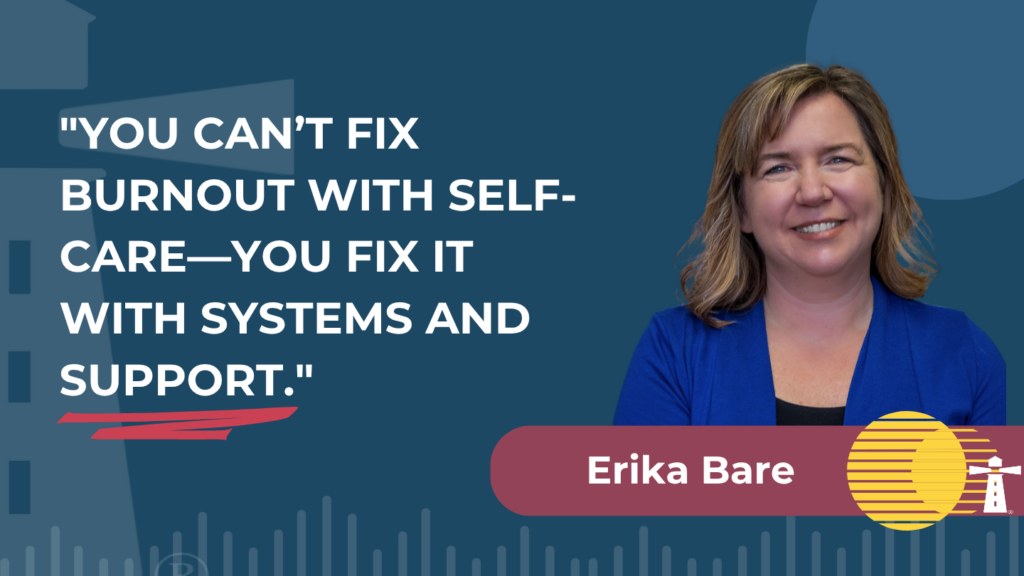
you know, go get a massage. It’s not self care, right? Because what you do to take care of yourself on Sunday is not going to help you when a kid is throwing a chair at you on Tuesday. Like it just isn’t. And the solution is having that collective efficacy, knowing what to do, knowing how to respond and knowing that everyone on your team has a similar set of skills, strategies, sentence stems, so that you’re all working together to really make a difference.
Lighthouse Therapy (18:16)
Mm-hmm.
Right, yeah, yeah.
Erika Bare (18:43)
and move the needle on student behavior. And so that’s what this book does. It really is just a step by step. Here are the things that you can do. Read it today. Do it tomorrow. And it is written like a playbook. It’s written for really busy people. So it’s an easy like, I just want to read about the power struggle things right now. And so you can flip to that really quickly. ⁓ And it
it has been really successful. We’ve seen some significant shifts in buildings where it’s being implemented and districts where it’s being implemented and we’ve had the chance to go all around the country all you know doing this work.
Lighthouse Therapy (19:23)
Presenting, yeah.
Erika Bare (19:25)
Every place that we go, there’s a leader in the room who will come up to us and say, this is so helpful. I want everyone on my team to have this. And can you help me with the grownups? that is really like, how can I shift this work? And so that really became the genesis of the second book, which is a school leaders playbook for tough conversations. And this…
Lighthouse Therapy (19:41)
Right?
Erika Bare (19:51)
book is really about, again, how do we use these techniques to really build connection in what can oftentimes be really divisive and difficult conversations. And this is something that we do not spend enough time preparing folks for. And I’m actually doing a lot of work right now specifically because special education is my background with special education providers, because those conversations with caregivers can be so challenging.
Lighthouse Therapy (20:16)
Right.
Erika Bare (20:21)
and sometimes just having a few different techniques, some sentence stems and approach.
a way of listening, a way of responding that can really just bring the temperature down and some of those conversations can be transformative. So that is that second book and we’re really excited about it. It comes out towards the end of April and it we already have some early editions out there and we’ve done some training on it and again folks are just what we’re hearing back is it
Lighthouse Therapy (20:38)
yeah.
Erika Bare (20:58)
it moves the needle because we all got into this work for kids. Every single one of us got into it for kids and
Lighthouse Therapy (21:04)
Right.
Erika Bare (21:07)
for school leaders, for folks who are leading teams, for folks who are consulting and working with broader teams around a kid, the avenue towards that success for kids is often through the grownups. So how can we make sure that those conversations are getting us moving in the direction we want to go? So we’re really passionate about the work and are so grateful that it’s resonating for people.
Lighthouse Therapy (21:34)
Yeah, it’s interesting that you said special education, because that’s immediately where my brain went, because I’m an edge. I’m a speech therapist. So talking to parents and helping them to understand and listening to the parents and making sure that ⁓ the way that I’m presenting it to them makes sense to them and, you know, giving them an opportunity to ask questions and just being able because there’s it’s overwhelming, especially in that initial
Erika Bare (21:42)
Yes.
my God.
Lighthouse Therapy (22:04)
IEP meeting, you know, when you’re trying to they’ve had all of these different tests and they’ve been through all these tests with their kids or they’ve seen their child go through all these tests. And then and then you’re defensive. You know, they get defensive because they don’t want to hear that Johnny’s got a problem. Right. And so I think that is that’s incredible. It’s it really sounds like a fabulous book. And today is March 31st, 2026. By the time this comes out, this book should be.
Erika Bare (22:06)
out.
Yep.
Yeah.
Right.
Yeah.
Yes.
Yes.
Lighthouse Therapy (22:32)
Published because it takes
about four to six weeks. I think is what we’re doing right now So by the by the middle of May we should be good. Yeah, so by the time you guys are hearing this go look for it It should be there. So, ⁓ that’s fantastic. ⁓ okay So if one other question for you, sometimes I am skit. Sometimes I don’t i’m gonna ask you ⁓ so if you could and we all know money is an issue in every district So you can’t tell me you need more money because everybody needs more money. ⁓ but if you could fix just one thing
Erika Bare (22:43)
⁓ No.
You
Lighthouse Therapy (23:01)
in your sphere of influence as the superintendent of South Umpqua School District 19 and never have to worry about it again. Just one thing. What would that one thing be?
Erika Bare (23:13)
Mmm.
That’s such a good question. I think…
Cracking that nut of how do we ensure that everyone sees the role that they play in creating an environment?
with the right tools and the right supports to ensure that every student is going to be successful. This work is never done in isolation. It takes every single team member, every single community member, every single kiddo in the classroom to really build that culture of connection and that culture where every student and educator can thrive. And so I think it’s about helping everybody see their
and then also through that lightening the load for everyone because I think, you know, there’s so much, there can be so much overwhelm in this work and, you know, many hands makes light work. And so if we can really figure out how to…
Lighthouse Therapy (24:14)
Mm, true.
Mm-hmm.
Night.
Erika Bare (24:30)
engender that sense of team and that’s really the work that we’re trying to do here and are doing and are making progress on. You just want to hit fast forward and get there, right? But that ability to work together towards the betterment for our students.
can make a significant difference not only for our kids, but for our own job satisfaction, our own longevity in the profession, and all of those things. So I think it’s about how do we build team.
Lighthouse Therapy (25:01)
Yeah, that’s great. Great answer. Okay, so where do people go if they want to learn a little bit more or get in touch with you or have a question about how you do things at South Umpqua?
Erika Bare (25:11)
Yeah, so for South Umpqua, email is great. ⁓
you know, erica.bear at South, ⁓ I’m sure you can put it in the show notes, but you can find me through email on our website, South Umpqua School District’s website, absolutely. I’m on all of the socials, LinkedIn is great, and it is ericabear. You can find me that way, and you can also find me, sometimes it’s even easier to find me through my connecting through conversation work, and so through that website, you can get me email, all the socials, all of those things, and would
Lighthouse Therapy (25:44)
Awesome.
Erika Bare (25:48)
to chat with folks. Yes.
Lighthouse Therapy (25:50)
Awesome. And it’s Erica with a K just so you know,
and it’s bare B-A-R-E. I think I said that before, but just so we’re clear. ⁓ Well, Erica, it has been an absolute pleasure ⁓ to have this conversation with you and thank you so much for coming on brighter together because exactly what you said, you know, we are so much brighter when we bring all of these people together for the kids, for sure.
Erika Bare (25:55)
Yes.
Thank you so much, this was super fun. Great to chat with you.
Lighthouse Therapy (26:18)
Mm-hmm.
All right.