

Episode Description
Dr. Eugene Blalock Jr., superintendent of North College Hill City School District in Cincinnati, Ohio, implemented Ohio’s first four-day blended learning week not to save money, but to address catastrophic teacher burnout and absenteeism that had reached 32-33% monthly—dropping to just 8-9% within three years. Discover how giving teachers a dedicated Monday for planning, preparation, and data-driven instruction transformed educator morale, student discipline, and career exploration while challenging the false narrative that one standardized test score defines school success.
Noteable Quotes
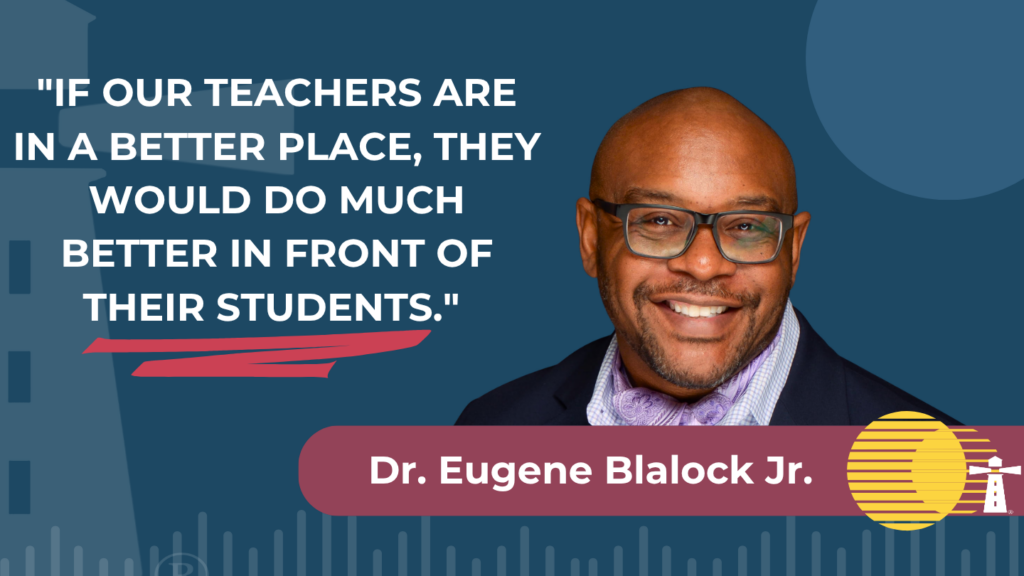
- “if our teachers are in a better place, they would do much better in front of their students.” [00:08:21]
- “a couple teachers that’s been teaching over 20 years said that this basically changed their life.” [00:09:23]
- “individuals, you can see it in their eyes, you’re looking at them and they’re there but they’re not there.” [00:11:08]
- “we didn’t do it to save money we did it to save teachers and save the profession.” [00:09:52]
- “I’m not in a good place right now. And it saddens me.” [00:23:39]
Full Podcast Transcript
Janet Courtney [00:00:00]
couple times. Hello everybody and welcome to the brighter together podcast. My name is Janet Courtney and my special guest today is Dr. Eugene Blalock Jr. He is the superintendent at North College Hill City School District in Cincinnati, Ohio. Eugene, thank you for coming on the show today.
Dr. Eugene Blalock Jr. [00:00:20]
Thank you for inviting me on the show. I’m excited to speak with you and just talk education. Like you said, my name is Dr. Eugene Blalock Jr. I am the superintendent of North College Hill City School District. I’ve been a superintendent now for 30, I’m sorry, I’ve been a superintendent for 11 years, but I’ve been in education for 31 years. So I’m just excited to say 31, because I get to retire at 32.
Janet Courtney [00:00:40]
years from.
Janet Courtney [00:00:47]
There you go. Where’s my retirement? I’m missing it somewhere.
Dr. Eugene Blalock Jr. [00:00:49]
So anyway, I’ve been…
So one more year to go and I’m excited about finishing strong. But North College Hill is a small suburban urban school and we’re in like I said Cincinnati, Ohio. We’re about 1400 students. We have four school buildings. We have an elementary middle school, high school, and we also have alternative learning center. Trojan Way Learning Center. I’m really excited about.
Janet Courtney [00:01:00]
Yeah.
Janet Courtney [00:01:09]
Mm-hmm.
Dr. Eugene Blalock Jr. [00:01:20]
And our students, we’re 100 % economically disadvantaged. We have 20 % special needs. Our students are considered special needs as far as IEPs and whatnot. As far as the population, we’re probably 78 % African-American. And then we have mixed race. We have other white, and then we have other, but predominantly African-American.
Janet Courtney [00:01:25]
Mmm.
Janet Courtney [00:01:32]
Yeah.
Janet Courtney [00:01:49]
That’s amazing. So, so how long has North College Hill been there?
Dr. Eugene Blalock Jr. [00:01:54]
We’ve been here forever. So the building I’m sitting in right now, which is my board office, it was here in 1923. So it’s 100 years where I sit right now in my office. So I think it was, I don’t want to throw out the wrong date, but we’ve been here for quite some time.
Janet Courtney [00:01:56]
No good.
Janet Courtney [00:02:03]
wow.
Janet Courtney [00:02:12]
Wow. Wow. So, so what would you say are some of your biggest challenges and some of your biggest wins right now? I know it’s a, it’s a tough time right now.
Dr. Eugene Blalock Jr. [00:02:22]
It’s a very tough time, so gonna say some wins. So like I said, I’ve been the superintendent for 11 years, so this is my finishing my 11th year and I have a couple things I’m extremely proud of that we were able to accomplish as a team as a district. And one of the things was what I said that alternative learning center we created Trojan Way Learning Center right after where we actually created it during the pandemic right before the pandemic happened. So the virtual school was supposed to have a virtual school. We’re going to be all.
Janet Courtney [00:02:24]
Sure, absolutely.
Janet Courtney [00:02:40]
Mm.
Dr. Eugene Blalock Jr. [00:02:52]
alternative to suspension and expulsion. We’re going to be a transition for those students who might have had some tough times and have been incarcerated per se and would be able to come back into the district. And we also created small resource rooms for those students who might not be able to make it in the traditional school setting. we would normally in the past, we used to send those students out to different schools, I should say outside placements.
Janet Courtney [00:03:02]
Yeah.
Dr. Eugene Blalock Jr. [00:03:22]
And we decided to create our own school within a school and keep those students here. So I’m extremely excited or happy about what’s happened with that. The interesting thing with it, I said it happened during the pandemic. When we started this, we had five virtual students. And then a pandemic hit and we had 500 virtual students. which we weren’t prepared for, we, know, education, we pivoted and we were ready.
Janet Courtney [00:03:40]
Okay.
Yes you did! Yes you did!
Dr. Eugene Blalock Jr. [00:03:51]
we did a awesome job with handling that during that time. And now we’re probably about 100, 100 students in our virtual program. And that’s K through 12. And I’m really excited about that. And another thing that we have, we’re the first school district in Ohio, the first school district in Ohio to go to a four day blended work week. So, and that actually happened, a lot of stuff I’m saying happened because of the pandemic.
Janet Courtney [00:03:51]
Yeah.
Janet Courtney [00:04:00]
Mm.
Janet Courtney [00:04:14]
Okay.
Janet Courtney [00:04:19]
Mm-hmm, yeah.
Dr. Eugene Blalock Jr. [00:04:19]
We had a situation where we had, well, as you know, it’s a teacher shortage. So North College Hill is a small suburb school and we was tough first getting subs in and teachers, everybody thought after the pandemic things were gonna change, things were gonna get better and teachers were gonna come back and they were excited. That didn’t happen for North College Hills. Our teachers came back and something changed in them.
Janet Courtney [00:04:26]
Now, of course.
Dr. Eugene Blalock Jr. [00:04:44]
and a lot of teachers struggled coming back into the classroom. And we found out that teachers were taking a lot of time, personal time, to themselves just to be mentally prepared to come back into the classroom. And we had a situation where on any given day, one out of three staff members were absent. Our absenteeism basically was around 32 % and 33 % a month.
And I was struggling. Definitely. So was just for me struggling to get subs. We knew it was a bad situation. The board knew it was a bad situation. My team knew it was a bad situation. Because believe it or not, all of us were over at the buildings covering classes and doing supervision. Yes, ma’am. So that’s a.
Janet Courtney [00:05:13]
my goodness, that’s hard to function. Yeah. wow.
Janet Courtney [00:05:32]
Yeah, right. Instead of instead of the other jobs that needed to be done, right? Yeah.
Dr. Eugene Blalock Jr. [00:05:41]
So that was something that drove us to go to a four day. And it’s interesting being African-American male, I actually was going to school. I was in school at that time to get my doctorate. And my goal was to figure out basically how could I recruit and retain African-American males, K-12, because I’ve been in the game, like I said, over 30 years. And I could not find African-American males teachers. And so that’s what I wanted to kind of study.
Janet Courtney [00:06:08]
Right.
Dr. Eugene Blalock Jr. [00:06:10]
After the pandemic, I realized that I couldn’t find a teacher, not male, not female, not black, white, Asian. It was just a situation where they didn’t exist and we had to do something. And I was reading an article and the article said could a four day school district save the teaching profession? And I kind of.
Janet Courtney [00:06:15]
Hmm.
Right.
Janet Courtney [00:06:30]
Mm-hmm.
Dr. Eugene Blalock Jr. [00:06:31]
Delved into it and three years later, this is our third year as a four day blended learning school district and it’s working out extremely well. Just kind of explain that our teachers, everybody works five days a week. So let me say that. But our students come to school four days a week. They come Tuesday through Friday. And Mondays are used. We use Mondays. Our teachers use Mondays.
Janet Courtney [00:06:37]
Okay.
Janet Courtney [00:06:51]
Okay, yeah.
Janet Courtney [00:06:57]
Okay.
Dr. Eugene Blalock Jr. [00:07:01]
use Mondays for planning, preparing for our students. So we use that time to use data to drive instruction, basically looking at what the students and their individual needs. And this worked out extremely well. We’ve seen some growth. Our students continue to grow. We may not make what they would say proficient on the state report card, but that’s because a number of our students, they come in and they’re below grade level. So we have data that we can share that show the students are making at least a year’s growth.
Janet Courtney [00:07:12]
Mm-hmm.
Dr. Eugene Blalock Jr. [00:07:31]
sometimes more than the years growth. And although we’re happy and we’re excited and their parents are happy and family’s excited about it because they’re growing. know, when you share that information in the public eye, all they see is they didn’t make proficient. They don’t see the work that went behind and what they have been doing and what they’ve achieved.
Janet Courtney [00:07:46]
Right.
Janet Courtney [00:07:50]
And that’s what brighter against all about is, is taking, trying to take some of that stigma and the schools are all failing and giving you guys an opportunity to say, look, here’s a number, but here’s what we’re doing. And, and, and we’re winning. We’re making, we may not be winning in your eyes, but in the eyes of our parents, in the eyes of our students and the eyes of God, in my opinion, we are.
winning. are moving forward. are doing positive things and God bless you for that because that matters. that just gives me chills. I just love that so much. yeah.
Dr. Eugene Blalock Jr. [00:08:21]
You
It’s been exciting. We’ve been able, when you talk about it matters so that that Monday, number one, I want to say it was about mental health and it’s about our teachers. So I started with the kind of hypothesis that if our teachers are in a better place, they would much, they would do much better in front of their students. So given the teachers the time and opportunity to plan and prepare for their students has been a, what they say to me has been a godsend.
the time has been everything and to hear some of the things that they had to say in their surveys was amazing about how this allowing them this time and you know, you know, but most individuals who are not in education, they don’t understand how much time teachers really put in, you know, to be able to they work a full day. Sometimes they go without a plan bill, which means they’re not getting time to work or prepare for their students. So they’re doing that after school. They don’t have time to grade paper.
Janet Courtney [00:09:09]
Mmm. Mm-hmm.
Mm.
Dr. Eugene Blalock Jr. [00:09:23]
and run all copies, that’s after school or on the weekend. So, you know, it’s one of those situations where as I look at it and we talk to them, they’ve been extremely happy with the time that they’ve been given. And a couple teachers that’s been teaching over 20 years said that this basically changed their life, that they were, it gave them kind of a new leap on life or changed the pace because they were really getting burnt out. So I think this is something that if more districts
Janet Courtney [00:09:23]
after school, on the weekends, in the evenings, yeah. Yeah, mm-hmm.
Janet Courtney [00:09:47]
Right? Yeah.
Dr. Eugene Blalock Jr. [00:09:52]
will go to it would help with teacher burnout and now with everything going on with school funding I’m getting calls because you know some schools go to a four-day to save money because it’s a lot of things that you can do. For North College Hill we didn’t do it to save money we did it to save teachers and save the profession.
Janet Courtney [00:10:10]
Teachers. Yeah. Yeah. And that’s, that’s beautiful because I was wondering about that and you’ve kind of already answered all of those, all of my questions. Cause I was like, okay, so how do you, how do you defend it? You’ve already defended it. How do you, how did the teachers, what caused the decrease in absenteeism? And it just sounds like they’ve got time outside of work. That’s not specific. And I don’t want to put words in your mouth, but like you’ve seen a significant drop. said you were at 33%, right?
Dr. Eugene Blalock Jr. [00:10:38]
We all look.
Let me just say, remember when I said that our absenteeism was at 32, 33, 32 % monthly. That was the monthly average, one out of three. My absenteeism is about 8 to 9 % now. the idea that we’re over in the building covering classes, teachers are here, teachers are happy. know, back when we, before we went to the four-day, as I walked through the building, was just, morale was just down.
Janet Courtney [00:10:40]
Yeah.
Mm-hmm.
Janet Courtney [00:10:47]
Right.
Janet Courtney [00:11:07]
And you can feel it and the kids feel that, yeah.
Dr. Eugene Blalock Jr. [00:11:08]
individuals, you can see it in their eyes, you you’re looking at them and they’re there but they’re not there. I think in their heart they wanted to give 100%, they even might have thought they were giving 100%, but it just wasn’t there. It was definitely a profantery effort on all parts. But now they are working together, they’re collaborating, they’re using that time, that data to drive instruction.
I ask questions about, you know, how has it changed their life? And they talk about the work-life balance. They’re even able to spend more time, family time, and be present with their significant other, their partners. Because now, when they’re home, they can pay attention to what’s going on and not worry about preparing for lessons and things of that nature. So that’s been just amazing to hear them talk about it. And to hear them encourage other people to come to North College Hill. When I first started this,
Janet Courtney [00:11:44]
Mm-hmm.
Janet Courtney [00:11:53]
at home.
Dr. Eugene Blalock Jr. [00:12:05]
In North College Hill, we’re a small school district, like I said, and when I would go to job fairs, I couldn’t get people to come to North College Hill. The last job fair I went to, I had the longest line, and they basically had to put me out of Miami University because I had so many students inquiring about North College Hill and about what we were doing with.
Janet Courtney [00:12:12]
Mmm.
Dr. Eugene Blalock Jr. [00:12:26]
day and I want to hit some real quick if I can. So for our four day we you know it was some barriers that went in and some of the things that they talked about. What works in North College Hill when I talk about it may not work in other school districts because we’re a small school district. One we don’t have busing so we’re two miles radius walking school district. So on Monday all of our students are allowed to come up to get a meal and then we decided with our
Janet Courtney [00:12:29]
Sure. No, no, you’re fine, please. Yeah.
Janet Courtney [00:12:49]
okay.
Janet Courtney [00:12:54]
Okay.
Dr. Eugene Blalock Jr. [00:12:56]
through eight because remember I said everyone’s working although the teachers may be planning all of our support staff educational aides they’re here at school and so we offer K through eight families the opportunity to come into the school we call it family support but we also you know use that time for intervention instruction small group instruction and next year we’re really going to start inviting those using data and inviting those individuals up who
Janet Courtney [00:13:17]
Okay.
Dr. Eugene Blalock Jr. [00:13:26]
might be below grade level to try to come up and really encourage the parents, please send them, because we can use that time in a small group environment and do some targeted instruction. So I really see us next year doing some wonderful things with that. And like I said, we’ve seen growth, but I think if we just move just a nudge and try to get those individuals in, that that’ll go up. And one of the things that’s been amazing is our 9th and 12th grade.
Janet Courtney [00:13:36]
rhyme.
Dr. Eugene Blalock Jr. [00:13:56]
We use that time and we encourage those students to seek jobs, to do career explorations, to do college visits. We have programs on campus now where, or I say, we have programs on campus, but we also have partnerships with individuals that’s doing construction, nurses aid, STEM, drones. So we’ve been able to connect those students with opportunities to help them after
Janet Courtney [00:14:02]
Right?
Janet Courtney [00:14:15]
Right, nice.
Dr. Eugene Blalock Jr. [00:14:26]
High school, so if they want to go to college you know what we have a track for you We can get you there if you want to go to the military you know what Mondays is a perfect opportunity for you to meet with our United States military or participate in any type of drilling or ROTC Programs that they may have and then other piece is that career exploration and it’s been huge. I have more companies coming to me Asking me what we’re doing and seeing if they can get first dibs at this new workforce that I have available
Janet Courtney [00:14:41]
Right?
Janet Courtney [00:14:55]
How nice.
Dr. Eugene Blalock Jr. [00:14:56]
for them than I’ve had my entire life. So it’s been wonderful.
Janet Courtney [00:15:00]
That’s fantastic. are you obviously you’ve seen an increase in your there, your assisted to me. I’m therapy company. So therapist, your teachers to be present. But what have you, I’m sure I know it’s spilled over your, your, you’re just saying it, but I would love to hear like, what have you seen with the children with their, discipline? And I I’m sure it’s probably made a big impact there as well.
Dr. Eugene Blalock Jr. [00:15:23]
You know what it has and that’s interesting as you ask that and I don’t think people understand.
the stress that the students are going through. Now, I mean, you understand, but that’s huge when you talk about mental health for even the students. The students, when we ask them, especially more, we usually do it with our middle school, high schoolers, but they welcome, you know, they like the opportunity. They’re not at school and they need that break and it allows them to do other things. So I think it’s been a positive. As far as our school discipline, our school discipline definitely has went down. Our bullying reports have went down.
Janet Courtney [00:15:30]
Yeah. Yeah.
Dr. Eugene Blalock Jr. [00:15:59]
that we’ve seen and we’ve been able to do also is that we’ve been able to offer counseling on those days and therapy on those days so those students don’t miss out on the academic piece of class. you know in school you come to school and then the therapists come they pull you out of math. Teachers are mad, you’re mad. So now we have opportunity for actually to have some of those therapeutic sessions that happen at the school but does not interfere with
Janet Courtney [00:16:17]
Right, mm-hmm. Yeah.
Dr. Eugene Blalock Jr. [00:16:28]
with the academic classroom and that’s been helpful also. So there’s so many positives that I’ve seen with the four day school week and I’m really excited about continuing to kind of, I guess, be the flag bearer for this because with everything going on with school funding and I’ll just kind of get, it’s a sore spot for me so I’ll talk about it though. But in Ohio right now, we have a situation where a lot of schools are
Janet Courtney [00:16:51]
Of course, right? Yep.
Dr. Eugene Blalock Jr. [00:16:58]
going out for levies. it’s basically because I’ll just say North College Hill. So North College Hill last year or last March.
in March, probably what a month ago, I had to look 20 some people in the eyes and say that they wouldn’t have jobs next year because of the defunding of public education. So it’s nothing that we did. We haven’t had a school levy in over 20 years, but because the legislators in Columbus have decided to do, we had something called a fair funding plan and that was agreed to in 2021. And then
And in 2023, that money was pulled out of there, which meant that North College Hill next year was supposed to $8.1 million. Again, we were supposed to receive $8.1. We will only receive $1.7 million. So when you look at a school economically disadvantaged where 72 % of our funding come from the state, that’s going to hurt us. And then they’re saying, hey, we don’t have the money.
Janet Courtney [00:18:03]
yeah.
Dr. Eugene Blalock Jr. [00:18:09]
$1 billion in vouchers to private schools. And I tell people, don’t have a problem with choice, but I do have a problem when you use public funding, which is supposed to go to public schools, which is a common good that the state is supposed to support. And you take that money from my families and then you give that money to individuals who probably would, I can tell you, most of them would never be, they would have never went to North College.
Janet Courtney [00:18:17]
Right.
Janet Courtney [00:18:24]
Mm-hmm.
Dr. Eugene Blalock Jr. [00:18:37]
They had planned on going to private schools because that’s their preference. And if that’s their preference, I support that, but I don’t think our students should have to pay for that. And that’s what’s going on. So, you know, I’ll just say we have a levy up, so we’re fighting the good fight to try to get that passed. But if that doesn’t pass, we’re looking at making some deeper cuts, and that’s going to hurt our students and the progress that we’ve made.
Janet Courtney [00:18:41]
Mm-hmm.
Janet Courtney [00:19:01]
Yeah, that’s heartbreaking. That’s absolutely heartbreaking. Yeah, I don’t, it’s such a broken, broken system. How funding and education and even the, and I’ve said this a million times on the show, but the funding and education is broken and is upside down and backwards. And how we, you touched on it early on, how we judge how a school is doing by a test score.
for a child one moment in time and that’s supposed to regulate and tell you how that child has done for the entire year. It doesn’t address the fact that mom and dad were fighting if dad was even there, right? It doesn’t affect the fact that even though you guys are doing the best that you can, maybe they didn’t even make it to breakfast that day so they didn’t have breakfast that day so they’re hungry.
Dr. Eugene Blalock Jr. [00:19:33]
Thank you.
Dr. Eugene Blalock Jr. [00:19:44]
Yes.
Janet Courtney [00:19:53]
you know, and, the emotional trauma that they’re dealing with and all of those things that you need, you and I both need, you have to have all of these things to even be able to learn. And none of that is being taken into consideration. And we wonder why education quote is failing in the United States when you don’t even have a system that is, that is fair at all to judge how kids are doing. And so it just makes me crazy. It really does really makes me crazy.
Dr. Eugene Blalock Jr. [00:20:10]
Yes.
Dr. Eugene Blalock Jr. [00:20:18]
I’m glad you said that. It’s one of those things as far as fair. People talk about fair and when you try to explain it to people, when you talk to them and you give them the facts, most of them get it. At first, I think you have a community that all they see is this report card. But the interesting thing is if you go into the school building and talk to the parents, they love the school. Most parents love the school, love the teachers, love everything that’s going on. It’s the individuals who…
Janet Courtney [00:20:40]
Mm-hmm.
Dr. Eugene Blalock Jr. [00:20:48]
excuse me, who does, they do not have kids in the building and they don’t see the good things, the wonderful things, the hard work of the teachers, administrators, support staff, secretaries, custodians. They don’t see all the hard work that’s going into creating a safe environment for these students, a nurturing environment, environment where they can really exceed the expectations or at least meet their expectation. Only thing they see is, that once you said it, it was beautifully.
Janet Courtney [00:21:13]
Mm-hmm.
Dr. Eugene Blalock Jr. [00:21:18]
One moment in time, a one day, a one shot, not taken into, you know, this year I literally had a situation where it was a huge disturbance in the neighborhood and everybody was affected by it. But guess what? The next day we had testing and I couldn’t say, you know what, we’re not going to test today. We had to, you know, have a talk and continue like nothing, nothing happened. Understanding that, you know, some of our students had some tremendous loss.
Janet Courtney [00:21:34]
state testing.
Dr. Eugene Blalock Jr. [00:21:48]
And even if it wasn’t a direct loss, they knew the individual who was affected by it. And going in, you still have to deal with that. And I said this, and I’ve been saying it, and it’s sad, but this is where I’m at in my career.
I said that I’ve been doing this 31 years. I have always, always been a cheerleader for teachers and educators. I have two daughters and I encourage them to get into education. One did, one didn’t. So, you know, I’m at 50 % even in my house. But I say all that to say that I told, I spoke to some university individuals who I work with and they asked me, hey, would you mind coming out and speaking to our students? And I told them, I’m just not at a good place right now.
Janet Courtney [00:22:15]
Yep.
Dr. Eugene Blalock Jr. [00:22:33]
I don’t feel comfortable telling a young person because of everything going on. I’m talking from the top. I’m talking from the national, from what’s going on with the president, to what’s going on with the governor’s office, what’s going on with the Department of Education, which is…
Janet Courtney [00:22:33]
Mm-hmm.
Janet Courtney [00:22:42]
Yeah, yeah, yeah.
Dr. Eugene Blalock Jr. [00:22:52]
pretty much gone now and then trickle that down to trying to defund public education at the state level. And then you look in Ohio and every day you hear another district laying off 50 people, 100 people. I just don’t feel comfortable going to a young person saying, you know what, education is a good place to be. And it’s sad, but until things change,
My, my, who I am, my spirit won’t allow me to do that to a young person. And it’s really a shame when you talk about 30 some years in education where I’ve been one of the biggest cheerleaders and love it, encouraged everybody to go to education. Even some of my students, had some of the…
Janet Courtney [00:23:22]
Mm-hmm.
Right.
Dr. Eugene Blalock Jr. [00:23:39]
So major issues. I said, you would be a good teacher. You are the one who should go in education. And now all I can say is we need individuals to be friends of education at this time until the profession changes. But I’m not in a good place right now. And it saddens me.
Janet Courtney [00:23:43]
Yeah.
Janet Courtney [00:23:51]
Mm.
Janet Courtney [00:23:57]
Yeah, that’s heartbreaking. Yeah, it’s heartbreaking to hear, but it’s understandable, know, and it really is understandable. You’ve been with all the things and that’s the piece that’s so hard is that people just don’t see that. You know, they’ll see one news snippet and they apply something that happened at one crazy school or with one crazy person and they apply it to the entire industry. And it’s like,
You can’t do that. And yet I see it over and over and over again. And these are people that don’t even have kids in public education. You know, it’s like, if they have kids, they’re probably private schools, you know, or they’re, they never had kids or it just drives me crazy. I just am like, you cannot, you can’t even, even begin to know what’s happening. And that’s just, it’s just sad. It’s just really sad.
Dr. Eugene Blalock Jr. [00:24:30]
Right, you’re right. Yes.
Uh-huh.
Janet Courtney [00:24:50]
And I am prayerful that we will see change because we’ve got to take care of our kids. We’ve got to take care of this next generation. And it doesn’t matter where you were born. It doesn’t matter what school district you were born into. Every single child deserves the opportunity to have a free, appropriate public education, right? Yes. Yes. Yes. my goodness.
Dr. Eugene Blalock Jr. [00:24:56]
Yes.
Dr. Eugene Blalock Jr. [00:25:12]
Thank you. Say that. Yes, a free and appropriate education. Thank you. Yes.
Janet Courtney [00:25:18]
So one other question I had for you not to not to like take us back, but I want to make sure I ask it because I know there’s people that are looking into the four day a week. How do you how do you handle instruction days or instruction? I don’t know if it’s days or hours in every state is different, but how do you handle that when you go to when you’re going to a four day a week for the students? How do you manage that?
Dr. Eugene Blalock Jr. [00:25:22]
Yes.
Dr. Eugene Blalock Jr. [00:25:32]
Yeah.
Dr. Eugene Blalock Jr. [00:25:38]
Yes, ma’am. So in Ohio, it’s based off of hours.
Janet Courtney [00:25:41]
It is ours,
Dr. Eugene Blalock Jr. [00:25:41]
So we had, it’s based off of hours. So we have to get 910 hours of seat time, or our students have to have 910 hours of seat time. So what I did with ours, and like I said, when I did this, I did it because I wanted to create a better situation for our teachers. So I based mine off of just, you know what, saying on this one day, the students won’t come. We’ll basically subtract the day. It’s a non-academic day. So by being a non-academic
academic day, the students, don’t have to do attendance or things of that nature. But I’ll tell you where it hurts us at.
I live in Ohio. So even this year, it got a the storm, we had a couple of storms, but you have days where you have calamity days and most schools may have 15, sometimes 20 calamity days. North College Hill, because we’re on a four day, I only have about four to five days. So therefore, if we miss a day, I have to then add a day on. So some school districts, they’ve extended
Janet Courtney [00:26:20]
Hmm
Janet Courtney [00:26:26]
okay.
Dr. Eugene Blalock Jr. [00:26:49]
school year to do a four-day, some school districts extended to school day. So either you extend the school day or you extend the school year. What we decided to do at North College Hill is say you know what we’re going to give this day off for the students, we’re going to put all of our money on our teachers being able to use their time wisely to plan, and we’re going to have the teachers be able to provide more to our students because they’ll be able to meet their needs. But
Janet Courtney [00:26:54]
I wonder, yeah, longer day.
Dr. Eugene Blalock Jr. [00:27:15]
Because of that, if we miss a day, then I have to add on a day.
But the beauty to that is, this week was a makeup day. Instead of when I do makeup days, I just tell the students, you have to come in on Mondays. The teachers and staff, they’re already here. So the only thing it’s doing is saying, you know what, because of the weather, because of calamity, because of some situation, we need to add a day on. But the day that we’re going to add on is a day that you’re supposed to be at work anyway. teachers have been grateful for that, because we’re not
Janet Courtney [00:27:31]
Right.
Janet Courtney [00:27:48]
Yeah, doesn’t add an extra day. Yeah, yeah, gotcha. That makes sense. That makes sense. Well, thank you for that. That’s super helpful. And it and yeah, I bet I bet because you know, it is one of those things where it’s like, where do you where do you take it from? You know, it’s kind of like when you’re when you’re trying to figure out the budgets to it. It’s not just the money. It’s the time and it’s the kids and it’s the teachers and who? Yeah, tough job. Tough job. So
Dr. Eugene Blalock Jr. [00:27:50]
Yes, ma’am.
Dr. Eugene Blalock Jr. [00:27:55]
yeah, that’s one of questions I get asked a lot.
Dr. Eugene Blalock Jr. [00:28:14]
.
Janet Courtney [00:28:15]
But beautiful. Have you been the 11 years that you’ve been a superintendent? Have they all been at North College?
Dr. Eugene Blalock Jr. [00:28:21]
No, I actually did 20 years in the neighboring district, which was Mount Healthy City Schools. And then from there, I came over to North College Hill. Now, the beautiful thing about this, I live in North College Hill. Both my daughters graduated from North College Hill, so I’m extremely vested in the school district. And when I say the neighboring school district, is really one block, two blocks up from where I’m at now, where I live. I have a lot of community ties and relationships
Janet Courtney [00:28:26]
Okay.
Janet Courtney [00:28:37]
Yeah.
Janet Courtney [00:28:46]
Mom.
Janet Courtney [00:28:50]
Yeah, you’re right there in the midst of all of it. Yeah.
Dr. Eugene Blalock Jr. [00:28:51]
that I’ve been able to build. And a lot of times, and I was just saying our district, it’s a transient district. So the same kids and families I had in Mount Healthy are some of the same kids and families I have right here in North College Hill. So when they come down, we see each other and we hug it out and say, I remember when I had this person or that person here. I’ve been seeing a lot of my students. Now I guess I’m showing my age, but I even have students’ kids now.
That’s actually in North College Hill and that’s been a blessing to see them see how the parents are doing and then see them raising kids. So that’s been good to see come full circle.
Janet Courtney [00:29:31]
Yeah, yeah, I didn’t tell you, I didn’t tell you when I don’t think I did anyway, usually, usually I tell people 32 years I’ve been on an SLP as speech therapist for 32 years. So you and I are really close to the same amount of time in our careers. So yeah, I’m just aging well. We look good, don’t we?
Dr. Eugene Blalock Jr. [00:29:41]
wow. Yeah. Yes, ma’am. Yeah. It’s been fun. Hey, you and me both. You and me both. look good. I thought you were one of those young whippersnappers just coming out of college. I figured you just finished up your doctorate or your master’s after going straight through eight years, four years on this. Yeah, I figured you just, you know, jump right out.
Janet Courtney [00:30:01]
Nope.
Nope, 58, I’m 58 years old, there you go. Thank you, my hairdresser, she keeps the gray at bay.
Dr. Eugene Blalock Jr. [00:30:15]
I got a good one too. No gray anywhere. Yes. I shaved it, yeah. I shaved it. It’s a little gray, yeah, yeah, yeah.
Janet Courtney [00:30:17]
Yeah, for those of you that are listening, Eugene is completely bald. Do you shave it? Do you shave it? Or is it just you shave it? Yeah, yeah, so nice beard though. He’s got a nice nice nice beard going on. Yeah, there you go. Okay, well on that silly note, let’s talk about where people can go if they want to learn a little bit more about North College Hill and Dr. Blalock.
Dr. Eugene Blalock Jr. [00:30:41]
Excuse me. Well, for me, I can be emailed. So my email is blalock.org. And that’s an open invitation to anybody who would like to learn more about North College Hill or the four day. I’ve already, I’ve spoken to a number of school districts. two weeks ago, we had a school district come down from up north.
and come speak to us because they’re going to a four day and just wanted to get a feel of what we were doing and how we were doing it. So that is my email address and then if they want to just go to our website it’s at nchcityschools.org and they can look us up and find out all the wonderful things we’re doing here and follow us on Facebook at North College Hill School District.
Janet Courtney [00:31:34]
Awesome. Well, Eugene, it has been an absolute pleasure to have you on the show. Thank you for your time and thank you for sharing your passion and taking care of those teachers and those kids. You take care of the teachers so they can take care of the kids. And I love that so much. So thank you.
Dr. Eugene Blalock Jr. [00:31:51]
Well, I appreciate you for having me. And I appreciate everything you’re doing to kind of uplift the industry, as some people would say, but just what we’re doing in education. So keep doing what you’re doing. And with Lighthouse Therapy, keep helping them kids. We appreciate you.
Janet Courtney [00:32:04]
Thanks.
Yep, appreciate it. Thank you so much.