

You think you know who your struggling readers are—but what if your best readers are hiding the biggest gaps?
In this episode, we uncover a counterintuitive challenge that affects far too many classrooms: how exceptionally strong readers can inadvertently mask critical comprehension gaps, while other students find alternative pathways to success that schools rarely recognize or cultivate.
Richard Modery, Superintendent and Curriculum Leader at Glenburn School Department in Glenburn, Maine, joins us to discuss how we can shift our lens from viewing academic ability through a single metric to recognizing the multifaceted strengths every student brings to school. Drawing from his extensive experience in both healthcare and education leadership, Richard reveals how fixed mindsets about reading ability damage student confidence and engagement—and what educators can do to foster genuine, sustainable growth.
What You’ll Learn
This episode tackles the hidden dynamics of student self-perception and academic identity, exploring how traditional metrics of reading excellence can actually work against deeper learning. You’ll discover practical approaches to helping students recognize their strengths in unexpected places—from technology to the arts—and how reframing success creates more resilient, engaged learners.
Beyond individual student growth, we also address the systemic pressures facing small school districts, including enrollment challenges and the spread of misinformation that threatens community trust and recruitment efforts.
Key Takeaways
- The “Best Reader Trap”: Exceptionally strong readers may hide comprehension gaps because they’ve learned to perform proficiency rather than develop deeper understanding
- Alternative Pathways Matter: When students struggle with traditional academics, they often excel in technology, arts, and creative fields—and these strengths deserve recognition and cultivation
- Fixed Mindsets Start Early: Students develop limiting beliefs about their reading abilities at critical points in their academic journey, leading to disengagement and reduced confidence
- Redefine Excellence: Being the strongest reader in school isn’t the ultimate measure of a student’s potential or worth—diverse strengths lead to more well-rounded, resilient learners
- Lead with Authenticity: Education leaders who communicate genuine impact and shared purpose build community trust in an age of rapid misinformation
Notable Quotes
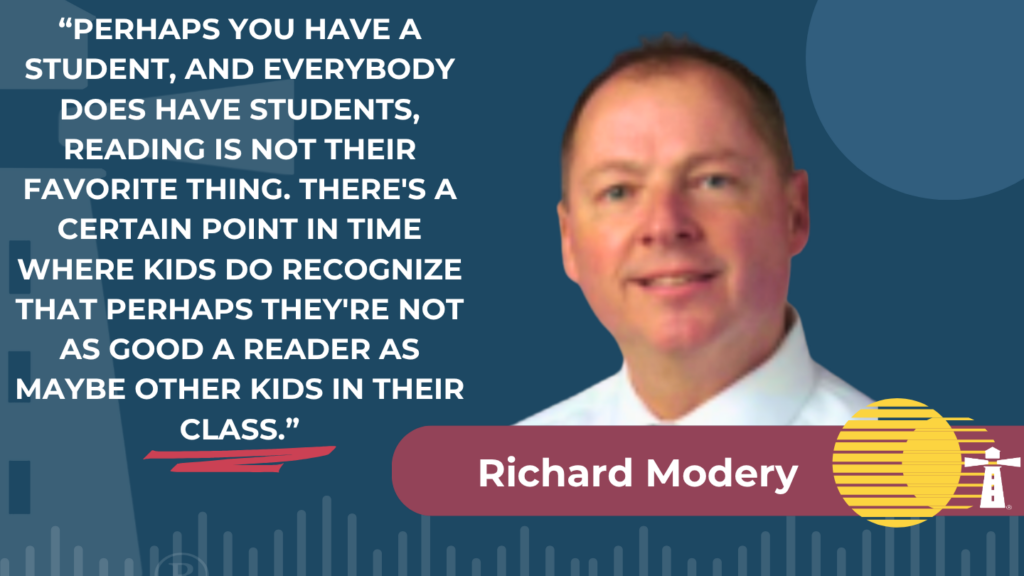
“Perhaps you have a student, and everybody does have students, reading is not their favorite thing. There’s a certain point in time where kids do recognize that perhaps they’re not as good a reader as maybe other kids in their class.”
“And one of the ways they can do that is sort of shining in this technology field or in an art field where they can create something that perhaps that really strong reader is just not quite as good at.”
“Being the best reader in the school is not all it’s about.”
“I can’t think of a way where I can get up every day, come to work, have a genuine impact, hopefully a positive one, on a lot of kids and a lot of adults. I just think that’s pretty hard to find that in other places.”
Listen Now
If you lead a school or district, teach in the classroom, or care about how we identify and nurture student potential, this conversation will reshape how you think about academic strengths and student identity. Subscribe now and discover how to help all your students—including your strongest readers—reach their genuine potential.
FULL PODCAST Transcript
Lighthouse Therapy (00:01.033)
Hello everyone and welcome to the brighter together podcast. My name is Janet Courtney and my special guest today is Richard Modery. Richard is the superintendent at Glenburn school department in Glenburn, Maine. Richard, welcome to the show.
Richard Modery (00:15.822)
Hey, thanks for having me and appreciate being invited and sharing some good things that are going on in the small community of Glenburn, which is just outside of the Bangor area in Maine, a place not many people would have heard of.
Lighthouse Therapy (00:27.809)
And it’s beautiful. is just, Maine is beautiful. I just love it. I’ve been there a few times and there is, other than the colds, you I’m not a fan of the cold. It is a beautiful state. So, well, thank you for being here. Tell us Richard a little bit about your journey to being a superintendent. And then I’d love, you told me ahead of time because I was like.
department? Why is it a department? Glenburg School Department? So if you could tell us a little bit about that, why it’s a department and then about the school, that’d be great.
Richard Modery (00:59.862)
Yeah, sure thing. So I’m really fortunate to serve as the superintendent and actually I’m the curriculum leader here in the Glenburn School Department as well. The Glenburn School Department is a single municipality department. We have a single kindergarten, pre-kindergarten through eighth grade school here on our campus and we tuition our high school students to a variety of high schools that are situated in and around the Bangor area. So we have
We have students, secondary students, high school students in eight or nine different high schools in our region. And so in Maine, if you are a single municipality that makes up a school unit, you are a school department. If you are a member of a school unit that is made up of a number of different municipalities, you are likely known as a school district.
So the Glenburn School Department is one very cozy pre-K through eighth grade school with about 280 kids in it. I’m sorry, 380 kids in it. And we also transport about 200 high school students to a variety of area high schools. So real fortunate to be here. I started my career in education as a teacher, like most folks in the town of Bangalore right next door. I was fortunate enough to…
Lighthouse Therapy (01:57.385)
Interesting.
Lighthouse Therapy (02:02.823)
Nice. 380, okay.
Richard Modery (02:23.136)
start off as an athletic administrator and that’s what got me interested in sort of the administrative realm of things. Grew up as an athlete, enjoyed athletics, that athletic administrator work kept me close to those kind of experiences. So got my masters at the University of Maine in a town right, if anybody’s, hey, go Maine Black Bears, and Hockey East, so let’s go. But.
Lighthouse Therapy (02:27.537)
Mistreated, yeah.
Richard Modery (02:48.084)
You know, finished my master’s degree there, became a school principal, served as a school principal, also very fortunate to work in that small community about 30 miles to our east and was there for 12 or 13 years as a school principal. And then actually I wound up in Glenburn. This is the town I grew up in. So very fortunate to be here. Yeah.
Lighthouse Therapy (03:06.791)
Wow, very cool. So you’ve stayed in a relatively small geographical area your entire career. Nice.
Richard Modery (03:16.556)
Yeah, yeah, haven’t traveled more than 30, 35 miles in any one direction my entire career. So as a teacher and then as an administrator and now landing back here where I don’t actually live in Glenburn, but I grew up here in Glenburn, attended the school that we’re sitting across the parking lot from.
Lighthouse Therapy (03:36.361)
Wow, wow, that’s amazing. Yeah, yeah, I can’t say that. I moved, I moved, I was born and raised in Grand Island, Nebraska, and I moved away when I was 19 and I haven’t lived there since. So I’ve lived a lot of places, but I haven’t been, mean, Nebraska’s got its own beauty. Every state has a beauty of its own, but.
Richard Modery (03:47.758)
Yeah.
Lighthouse Therapy (03:56.009)
But I just never had enough. I never I never did move back I just my parents live there for my my sister actually was a 911 operator for Hall County until she retired so yeah, so now that now everybody kind of just we all kind of migrated to Texas as my parents did the snowbird thing they were back and forth between Texas and Nebraska and then eventually Said as they got older settled in South, Texas and then as time went by All of us just kind of like traveled down this way. So
Richard Modery (04:06.859)
wow.
Richard Modery (04:14.772)
Okay.
Lighthouse Therapy (04:26.409)
Here we are, I’m in Corpus Christi, so there you go. I like the weather, I like the extra sunshine. We were talking a little bit about the light, because that really is an issue, right? You can have light deprivation if you live too far north. You gotta pay attention to that, so yeah.
Richard Modery (04:43.918)
It just can become a little bit, you know, when you get up in the morning and you’re going to work and it’s dark out, you drive to work, in the dark, you arrive at your office in the dark, and then by the time you leave, it’s dark. And so, you know, we have a few months of that, and yeah, it is something you gotta pay attention to, not only just as an adult, but you gotta pay attention for your kids that you’re servicing and identify that…
Lighthouse Therapy (04:55.675)
It’s dark again. Yeah.
Lighthouse Therapy (05:04.937)
For the kids, yeah.
Richard Modery (05:09.804)
you know, though it’s cold here sometimes in the wintertime and we get stuck with inside recess, teachers dread the idea of hearing the word inside recess because of the cold. But boy, if we can get the kids outdoors during the daytime, it’s really, really important because that might be their chance to soak up a little vitamin D and feel that sun on their skin. Yep.
Lighthouse Therapy (05:14.036)
Yeah.
I bet.
Lighthouse Therapy (05:20.531)
Get that light. Yeah.
Lighthouse Therapy (05:26.953)
Mm-hmm.
Yeah, absolutely. Absolutely. We were not meant to live in caves all of our lives, were we? So let’s talk about Glenburn. I know you guys, you’ve got some good programs and some good stuff going on there. So I’d love for you to tell us about your wins. I love hearing about wins.
Richard Modery (05:35.586)
Yeah.
Richard Modery (05:49.068)
Yeah, so again, we’re a really small knit community here. Again, we have 380 ish kids pre-K through grade eight. And we’re excited next year. Maine, a little bit different than some other places. Local school units are going to be taking on the free and appropriate public education. So the FAPE responsibility for three and four year old children starting.
Lighthouse Therapy (06:14.622)
Okay.
Richard Modery (06:16.738)
the year after next, so Glenn Byrne is gonna do a member of a cohort three pilot where we’re gonna be providing, we already provide regular education pre-K for four year olds, but up until now, a different quasi governmental organization called Child Development Services has been, who’s been responsible to provide any special education programming for children birth to age five. And so, yeah.
Lighthouse Therapy (06:43.548)
it’s a five, okay.
Richard Modery (06:45.292)
So starting next year, the Glenburn School Department will be providing those special education services to children who are above the age of four. And then the following year, we’ll be doing that for children above the age of three and four. And so we believe pretty firmly that we’ll be able to do this. We’ll be able to do this really well. The school is the center of the community in Glenburn. And though…
Lighthouse Therapy (06:57.833)
Hmm.
Richard Modery (07:09.229)
You know, some kids might be missed by a larger governmental organization like Child Development Services, not of their own doing, just because, you know,
And so trying to identify students and get them the services, whether that’s speech and language services or occupational therapy services, physical therapy, maybe even some direct instruction that they may need as a youngster with some challenge, whatever that might be. So we’re pretty excited to be bringing that on board. We’ve got a large group of regional partners that are coming here to Glenburn on the 13th of March. And the Department of Education here in the state of Maine is going to be sending some experts. And we’ll be doing some professional
development with our pre-k staff preparing them to hey what’s this going to look like how’s this going to work what types of things we need to be thinking about are there furnishings equipment materials what do we need to make sure we’re prepared to not just take this responsibility on but take this responsibility on really well prepared and ready to do it well
Lighthouse Therapy (08:01.363)
Mm-hmm. Mm-hmm.
Lighthouse Therapy (08:11.048)
Right.
Richard Modery (08:11.31)
And we’re pretty confident we can do that. that’s pretty exciting. So I’d say that’s bit of a challenge and something that we’re excited about. And I think it’s the right thing to do. So yeah, I can go on and on about the excitement in Glenburn. We certainly have our challenges too. Very fortunate to have a tech integrator that works with all of our kids in the building. So we have a steam lab here that has everything from laser cutters to 3D printers.
Lighthouse Therapy (08:19.945)
Mm-hmm.
Richard Modery (08:40.267)
robotics equipment, coding machine, all kinds of different settings where kids really get an opportunity to do some hands-on things.
The idea with our tech integrator is that he will really work with the kids and the adults so that hopefully we can drive some of that technology learning, not just when they’re in the STEAM lab, but drive that all the way back to their classroom so their teacher becomes more comfortable with those types of things. so pretty proud of our STEAM lab. A lot of work has gone and finance has gone into that. We’ve been fortunate to have some different donors provide some support financially. And so we’re excited about that as well.
Lighthouse Therapy (09:19.387)
So what does STEAM, I’m assuming it’s an acronym for something, tell me what that means actually, like if you don’t mind. Yeah.
Richard Modery (09:25.484)
Yeah, good question. Science, technology, engineering, art, and math. Yep. Yeah.
Lighthouse Therapy (09:31.441)
Okay, woo, okay. I’m proud of you. Good for you. I knew it was science and technology, but I’m like, I don’t know what the EAM is and I need to… Usually I prep people for that and I apologize I didn’t because we love our acronyms in education. We really do. And most of the time, if I put that in people’s working memory, like, if there’s an acronym and you don’t tell me what it is and I don’t know what it is, I’m gonna ask you. Because if I don’t know, my listeners might not, right?
Richard Modery (09:55.037)
You can ask me if I don’t know, I’ll just go ahead and say, jeez, you you can stump me on that one, and that’s okay.
Lighthouse Therapy (10:02.107)
Yeah, well, it’s okay. I’ve it’s happened to me too. But you know, it’s but you did and thank you for telling me. I mean, I again, I based on the conversation and what you were talking about, you know, I can I can guess and I know our listeners can guess and they probably all went to it. That’s a stupid question. But I don’t know. The only stupid question is when you don’t ask. So I asked the question.
Richard Modery (10:05.038)
Yeah.
Richard Modery (10:22.394)
That’s right, and you said something earlier that we have lot of acronyms in education, and I think every industry does, and I think every industry thinks that everybody else knows what their acronyms mean, but the reality is if you were to go to an architecture firm, and they would have some of the exact same acronyms in terms of letters, but they have entirely different meanings than what we have, and so I think it is important for folks to identify that.
Lighthouse Therapy (10:28.551)
Mm-hmm. Mm-hmm.
Lighthouse Therapy (10:32.51)
Right?
Lighthouse Therapy (10:42.855)
Two different meaning. Yeah. Yeah.
Richard Modery (10:48.462)
everyone listening might not be in this field and seem to them might mean an entirely different thing. so, yeah, yeah.
Lighthouse Therapy (10:49.225)
Yeah. Yeah.
Lighthouse Therapy (10:54.685)
Right, well thank you, yeah. So that’s awesome. So do you have someone outside of education that runs that department? did you hire somebody? How does that project and that cohort or whatever it is work for you guys?
Richard Modery (11:11.214)
We actually do have, so we have a full-time technology director who really is kind of the big thinker person, makes sure our infrastructure works, does all of the things, know, all of the things that like, I don’t know how they work. Like, I don’t know how the email works. Yeah, so I mean, he kind of makes all that work. And then we have this technology integration person who’s essentially people would think of him as like a teacher. He is a teacher.
Lighthouse Therapy (11:15.869)
A director, okay.
Lighthouse Therapy (11:24.071)
Yeah, I get it. get AI. Get me started in AI.
Lighthouse Therapy (11:34.173)
Mm-hmm.
Richard Modery (11:36.056)
but he’s based out of the steam lab, is where all this equipment is. And I’ll say, you know, and I’m talking about technology, like I’m a technology expert. I am not a technology expert at all. Like when our tech director told me that we were getting a laser cutter, I thought he was kidding. Like I didn’t know that was a thing. And so.
Lighthouse Therapy (11:40.009)
Mm-hmm.
Lighthouse Therapy (11:53.663)
gotcha. Yeah.
Richard Modery (11:56.334)
So now we have two of those. So our tech director does a great job connecting with an organization called the Perloff Foundation. It’s a family in the Northeast that loves to support public education and get largely technology into schools. And so they’ve done a lot of things. I think we have somewhere in the vicinity of 20 or 25 3D printers.
Lighthouse Therapy (12:11.014)
Nice.
Mm-hmm.
Richard Modery (12:21.026)
We have two laser cutters. so kids can be working either in their classroom with their teacher or with the technology integration person or in a collaborative with the teacher and the tech integrator, developing and building things. As an example, let’s just say in language arts class, they perhaps did some kind of a book project and they read a book, a variety of different things that I’ve seen them do. So they might pick a few objects.
Lighthouse Therapy (12:21.448)
Thanks.
Richard Modery (12:50.798)
that set a scene in a book and then they design those on a computer and then print them in real life so that they have the object that they read about. On the printers is an example. And another thing they did in art class was that they took a scene out of a book they might have read and made some art that they believe depicts that particular scene.
Lighthouse Therapy (12:57.991)
Yeah.
Lighthouse Therapy (13:03.623)
Yeah.
Richard Modery (13:18.08)
and then burned that art into wood using the laser cutters. And so they’ve done a variety of different things like that. I think it’s just amazing. I love to see kids have opportunities to take things that they’ve had to do. Perhaps you have a student, and everybody does have students, reading is not their favorite thing. They don’t feel particularly good at it. There’s a certain point in time where kids do recognize that perhaps they’re not as good a reader as maybe other kids in their class.
Lighthouse Therapy (13:22.536)
Mmm.
Lighthouse Therapy (13:28.679)
Yeah.
Lighthouse Therapy (13:39.165)
Mm-hmm.
Richard Modery (13:46.83)
And so trying to get them to identify that though they may not be as fast a reader or they may not see themselves as a good of a reader, they can take as much value out of a reading experience as that kid that they think is the best reader in the school or whatever. And one of the ways they can do that is sort of shining in this technology field or in an art field where they can create something that perhaps that really strong reader is just not quite as good at.
Lighthouse Therapy (14:00.804)
Yeah, very good.
Lighthouse Therapy (14:13.554)
Yeah.
Richard Modery (14:14.062)
So finding a lot of different ways to overcome some of those barriers and sometimes even self, know, kids decide, you know, what their strengths and weaknesses are based on experiences and sadly sometimes what people say to them and things of that nature. And so if any way that we can overcome those things for those kids and get them to recognize that, you know, being the best reader in the school is not all it’s about.
Lighthouse Therapy (14:40.7)
Yeah, it’s not the only thing that you can do and it doesn’t, yeah. It’s so funny that you said, yeah, absolutely, yeah. Yeah, but it’s like anything else, know, it’s like you need good readers, but you also need good technical people. It’s funny that you were talking about a 3D printer and about burning into a design because.
Richard Modery (14:43.884)
Right, right. Great for that kid who was the best reader, the way. Awesome for that kid, you know, too. I mean, that’s great. But anyway.
Lighthouse Therapy (15:05.25)
The room next door, you know, we’re a family company. My husband’s my CTO. He is very much he reads. Well, don’t get me wrong, but he’s got a project going right now. He’s and the 3D printer is going right now in the other room. And then my son, when he was a senior in high school, which was about the year, year and a half before we started Lighthouse, he was in an art class. And so he took and I’m holding up a wood picture of our logo that he actually put burned into wood.
And then he’s got NC, Nathaniel Courtney right there. He put his initials on it and it sits on my desk. And this is from 20, 2019 maybe, you know, and it’s just, it’s, it’s a part of he recognized how important that logo to me, because it was the beginning of, mean, we were a baby company back then.
And it’s just, know, and he was a part of it. He was a part of it. He was doing my my my son was doing cold calls for me at 16 because he had this big deep man voice, you know, got our second contract for us. So he was so excited. He’s like, I told him, I said, you get a contract to get a bonus, you know, and he when he got that bonus check, he was like, wow. And I was like, do it again.
Richard Modery (16:15.906)
Yeah, mean, you know, in education, it really does, you know, so much of our experiences and what it’s about developing relationships and building experiences for kids that have meaning to them. And that meaning can be a lot of different things. And so whether that’s.
Lighthouse Therapy (16:29.478)
Yeah. yeah.
Lighthouse Therapy (16:34.781)
Mm-hmm.
Lighthouse Therapy (16:39.09)
Mm-hmm.
Richard Modery (16:42.062)
you know, a student really excels on the soccer team or on the basketball team or whatever it is, that’s great. And that’s a way for them to identify, excel in some area that maybe in other areas in school is not really their strength. But the same is true for kids with technology or with, you know, we have a large chess team and chess club here that travels around and plays other schools. And so it’s really just trying to say, to be open to this idea that
Trying to provide opportunities for kids that they can connect with, that have meaning for them, that give them opportunities to grow and develop as young human beings. And if we can do that, think the math and the reading and the science and the social studies will come along.
Lighthouse Therapy (17:19.612)
Mm-hmm.
Lighthouse Therapy (17:24.84)
Mm-hmm.
Lighthouse Therapy (17:32.602)
It comes along. Yeah, I’ve I’ve noticed as I’ve been doing these, I was telling you when we started, you’re like number 213. I’ve done 213 shows, which I’m proud of that. But with the as you as you see and talk to people in all different areas of education, because it’s been public school, virtual schools, charter schools, private schools. I’ve talked to them all. You know, I don’t we don’t discriminate. I want I want all education, all educators to have a voice.
And one of the things that I’ve really noticed and I’ve mentioned it before on the show is education is really becoming. Center to what that child’s interests are, especially as they get up into the middle school and high school level, because it’s like, and giving them an opportunity to find where their passion is. So when they’re ready to graduate and they go out into the world, some of them are coming away with major certificates and associates degrees and all these different things. And it’s just.
It’s amazing and it’s exciting because we are creating and educating the next generation, which is so critical to our future.
Richard Modery (18:41.462)
Yeah, it’s what makes me excited to come up and go to work every day. You know, is that literally education is a great opportunity. You know, we were talking before the show started about, you know, so much of the narrative about education is kind of negative. And so that can also be about the field of working in education. People feel like, you know, I don’t really want to, you know, there’s no money, you know, all these types of things. But I got to say the reality of
of being an educator, at least for me, like I can’t think of a way where I can get up every day, come to work, have a genuine impact, hopefully, positive one I hope, on a lot of kids and a lot of adults. And I just think that’s pretty hard to find that in other places. Certainly you can, but.
The other benefit, I don’t think it’s a hidden benefit, but the thing that we don’t talk about in education so much is, man, what a great opportunity to have a career, but also if you want to have a family. The schedule working as an educator is really, really kind. I worked in medicine before.
Lighthouse Therapy (19:50.376)
Yeah.
Nice,
Richard Modery (19:57.486)
transitioning to public education. And so, you know, I worked in a hospital. the hospital’s open 24 hours a day, seven days a week. And so, you know, that was just, that was my life for a while as a young adult. so, and I love that experience too, by the way. You know, I wouldn’t trade that time in for anything, but boy, you really can’t trade in not having to worry about whether you’re going to be on call on a holiday or.
Lighthouse Therapy (20:07.282)
Seven days a week, yeah.
Lighthouse Therapy (20:16.242)
Mm-hmm.
Richard Modery (20:25.794)
You know, got weekends off if that’s what you choose to do. And you know, have every school vacation. You know, don’t have to find childcare for your family. So I wouldn’t want people to go into education simply because they think it’s a sweet schedule. But I also wouldn’t want people who might be somewhat interested in education being worried about the money side of things and not recognizing that this whole adult thing, it’s not all about the money.
Lighthouse Therapy (20:40.423)
Yeah.
Lighthouse Therapy (20:49.862)
Yeah, yeah, for sure. For sure.
Richard Modery (20:51.724)
It’s about the bigger experience. And if you can find something that really you’re passionate about, you can make enough money to survive and also have this other benefit of time. In another field, you just don’t have it. In Maine, as an example, we have 10 weeks in the summer, typically 10-ish weeks in the summer.
Lighthouse Therapy (21:11.368)
Mm-hmm.
Richard Modery (21:12.076)
where staff and students are not, I work all summer, but the staff and students are not at school. Again, we have a long winter, not a lot of sunlight. So when summer comes along, summer vacation is a really healthy part of this Northeast region, at least in Maine. Families spend time together, lots of people have camps and go to the lake and go fishing and do a variety of different things. so,
Lighthouse Therapy (21:28.872)
Bye.
Mm-hmm.
Richard Modery (21:40.652)
I guess I’d say to any budding educators out there, man, you’re not gonna find a better way to spend your time as an adult. Obviously you have to like kids and you have to want to be around kids and there is a daily grind to this thing, 175 or 80 days with a little family of kids. That’s an experience that you have to be prepared for, but don’t shy away from coming into education. It’s a great field. I wouldn’t choose anything else.
Lighthouse Therapy (21:51.1)
Right.
Lighthouse Therapy (21:55.314)
Mm-hmm.
Lighthouse Therapy (22:03.869)
Yeah.
Lighthouse Therapy (22:09.362)
Well, and you know, it’s one of those things where it’s like, you don’t even always know the entire impact that you’re having on those kids. And when you have, there’s aha moments and those are great to see. They are so fun when you get an aha moment. Kids, you’re working on something and you’re working on something. As a therapist, know, for me, that’s like, that’s, that’s like golden, but also there’s a, there’s this thing that happens at the longer you’re in education.
where all of the sudden you’ve got kids that you you influenced and didn’t even really know how much you influenced when they were little. Now they’re 18, 19, 20, 25 years old and coming back and they’re like, you were my favorite. were my, know, and, and you had no idea, you know, you’re doing your job and you’re enjoying it you’re having fun and whatever. But boy, that, that piece that you’re paying forward is there’s, you cannot put a price tag on that. You just cannot. So.
Richard Modery (23:06.412)
Yeah, you said that well, and so I’ve been doing this for a while, longer than I want to admit, but the…
Lighthouse Therapy (23:12.4)
Me too.
Richard Modery (23:15.148)
What you just said is absolutely correct and one of the things I try to remind teachers and particularly young teachers, you can become frustrated because you’re working with kids and you’re working with kids and you don’t feel like they’re making progress, you don’t feel like they’re making progress. And sometimes I think when you’re a teacher and you’re in a classroom and you’re close to it, I mean you’re right nose to nose with it. And you can become a little discouraged that you don’t feel like you’re making any kind.
Lighthouse Therapy (23:32.296)
Yeah.
Richard Modery (23:40.244)
of a difference or a large enough impact or what have you. But the thing that I, like those kids aren’t the snapshot that you see. That’s not what they are. Like you’re going to see them 10 years from now and they’re not going to be having the same challenges. They might have new challenges, but you know, whatever. Yeah. I mean, they’re going to be, they’re going to be.
Lighthouse Therapy (23:48.104)
Mm-hmm. No.
Lighthouse Therapy (23:58.685)
Well, don’t we all, right? Yeah.
Richard Modery (24:02.946)
They’re going to have grown up and they’re going to have learned things. sometimes when you’re trying to work with a child, and sometimes it’s a behavioral challenge or whatever, some kids seem to be able to manage that really well pretty easily. Somebody gives them some kind of direction. They’re like, OK, I’m supposed to do that. They do that, And other times, individual might have to hear a message a million times.
Lighthouse Therapy (24:19.186)
Mm-hmm.
Lighthouse Therapy (24:30.568)
Bye.
Richard Modery (24:31.502)
But who knows which of those millionth times we made it, you know what I mean? And so trying to convince people that, know, you were one of the people in the group of million messages that child got along the way. don’t feel like you’re making, they hear what you’re saying, you know? But if you are always thinking that every kid’s gonna appreciate everything you’ve done.
Lighthouse Therapy (24:34.108)
He’s gonna get in there, right? Yeah.
Lighthouse Therapy (24:44.196)
Mm-hmm. Yep.
Yeah. Yeah.
Richard Modery (24:55.886)
and be excited about every single moment all the time along the journey, then you’re going to be a little disappointed because that’s not going to be the reality. But they really are paying attention and they really are appreciating what’s happening. But it’s unlikely. Yes. Yeah. Yep. Sure.
Lighthouse Therapy (25:03.494)
Yeah. Yeah.
They are.
and they are worth it. They are so worth it. They are so worth it. Wow, yeah. Okay, one last question for you, Richard, because wow, we got 25 minutes already in and it goes so fast and I promised I would be, I always try to be very respectful of people’s time. So if you could, if you could, now we can’t, we don’t say money. We didn’t really touch on money, but we all know schools are underfunded. They always are. But if you could fix one thing,
Richard Modery (25:27.854)
I appreciate that.
Lighthouse Therapy (25:39.46)
in your world just one thing as a superintendent of Glenburn School Department and never have to worry about it again. What would that one thing be?
Richard Modery (25:51.074)
Huh. That’s an interesting thing. Unfortunately, in my world, you know, I’m right now, and maybe it’s my world right now, this time of the year, we’re working on budget. We’re trying to develop a budget that to pass on to our taxpayer and that kind of thing. And so I don’t want to focus on money, but I would say one of the challenges that we’re experiencing, and I think it’s being experienced all over the country, is we have fewer kids.
Lighthouse Therapy (26:01.234)
Mm-hmm.
Lighthouse Therapy (26:19.656)
Hmm.
Richard Modery (26:19.79)
We have a enrollment in our school, in our state. Most states, I think, are experiencing something similar. And the way education is funded, at least in Maine, I think it’s pretty, it’s different everywhere. But in Maine, largely it’s funded, your subsidy is funded from the state based on your student population. So if your student population is declining, then your funding declines.
Lighthouse Therapy (26:41.203)
Numbers, yeah, numbers.
Richard Modery (26:48.622)
And so again, I know you don’t want to, I don’t want to talk about money either. It is what it is. we’re, you know, we’re going to develop a budget and we’ll work with the town and we’ll, we’ll Glenburn school will be providing services to kids next year. And we’re going to do the very best we can. I would say the thing though, if I could fix it. And I think I’ve kind of talked about it already in, in that is overcome.
Lighthouse Therapy (26:57.341)
Right.
Lighthouse Therapy (27:02.93)
Right.
Richard Modery (27:18.346)
this negative narrative about public education, perhaps it’s about education and you know overall.
Lighthouse Therapy (27:28.658)
Public education gets more of a more of, they get a bigger swing. think, you know, when they’re swinging the bat, they’re swinging it more at public education than anywhere else. I agree with you there.
Richard Modery (27:38.24)
Yeah, so I mean, I think, you know, all of the negativity and the hype that you hear out of national media, politicians, things of that nature, much of that is perhaps maybe an isolated thing that happened in one school in one town. And now suddenly there’s this fear that this type of thing is happening.
Lighthouse Therapy (27:58.95)
Mm-hmm.
Richard Modery (28:07.616)
in all schools all over the country. And I’ll give you an example. This was several years ago. The pandemic certainly really kind of galvanized people in one way or another on this type of thing. But again, we’re a small pre-K through eighth grade school. Here we send kids to a variety of high schools. And so I had a gentleman call me up, doesn’t have any kids in Glenburn.
But he was at work. He worked at a local garage. And he was in an argument with his coworker. His coworker was trying to convince him that one of our surrounding high schools had litter boxes in their school for students whom were identifying as cats. And so he was saying that this is ridiculous. There’s no way that’s true.
Lighthouse Therapy (29:04.232)
Mm-hmm.
Richard Modery (29:06.894)
He said, don’t know the person in your town, I’m gonna call the superintendent, I live in Glenburn, I’m gonna call the superintendent in Glenburn and find out if there’s anything true about this. And so he called, which I appreciate. I wish everyone could do that. so, correct, because I think there was something that went out on the internet around that time about, this is all a bit of a political thing around, you know,
Lighthouse Therapy (29:11.752)
Mm-hmm.
Lighthouse Therapy (29:20.625)
Yeah, yeah, instead of just assuming, making assumptions, yeah, yeah.
Richard Modery (29:34.262)
gender identity and that kind of thing and then it caught in as you know it
Lighthouse Therapy (29:34.846)
yeah, identity. Yeah, yeah, D, I and all that. Yeah.
Richard Modery (29:38.582)
Yeah, kids kids were saying that well, I don’t identify as a male or female I’d identify as a cat or whatever I think there was some pushback around all of that and that’s where this sort of caught wind and so there was literally nearly a physical altercation at a local garage between two workers because one man was trying to convince another man that an area high school had litter boxes in its school and You know, there’s something so far-fetched from the truth. I guess if I can fix
Lighthouse Therapy (30:06.502)
Right? Right.
Richard Modery (30:08.416)
one thing it would be if we could if we could overcome this negative narrative that’s out there and and folks so quickly being willing to latch on to something they saw on some social media post or you know or that kind of thing and if they see something that they think is a little outlandish just call the local school stop by the local school for a visit you know i’ve encouraged people in glenburn like like
Lighthouse Therapy (30:20.872)
Mm-hmm.
Lighthouse Therapy (30:29.597)
Mm-hmm.
Richard Modery (30:34.476)
when these, we haven’t had a lot of, not quite that much, not quite to that degree of what I would consider a little bizarre. But I’ve just said to folks, there’s a narrative, like the school is like this, like you tell me, I’ll give you a tour of the school, any day, any time that you want. You pick it that way, you don’t think that I’m trying to bring you at the right time of day or to the right role. Like you tell me and you come.
Lighthouse Therapy (30:41.128)
Yeah.
Lighthouse Therapy (30:52.925)
Yeah.
Yeah, right. Let’s clean it up before they get here, right? It’s ridiculous. Right.
Richard Modery (31:04.074)
like the things that you think are somehow happening. So I guess if I could fix one thing and it’s more not just about like education, but it’s kind of like healing communities. And if we could get to a place where.
Lighthouse Therapy (31:15.496)
Mm-hmm.
Richard Modery (31:19.648)
we could just communicate with each other rather than lashing out on some social media post or whatever it might be or hearing something. Again, these colleagues in this garage, Like the man called me, I’m glad. The man tried to get the other guy to get on the phone with me, but the guy, wouldn’t get on the phone with me. So, you know, it’s just weird, funny things like that. Well, not really funny, but unfortunate things like that where it’s like literally an adult man convinced that this was happening.
Lighthouse Therapy (31:31.144)
Yeah.
Lighthouse Therapy (31:48.882)
Night.
Richard Modery (31:49.678)
So I guess I don’t know if that’s a real great answer to that question.
Lighthouse Therapy (31:53.319)
No, I think it’s a great answer, you know, and it is a problem that, you know, brighter together is a part of that. I mean, that’s part of why we’re trying to get stories out there and trying to help for people to have this kind of conversation to go, you know, that crazy is not the reality of everyday schools and educators and what they’re doing. Yes, there’s crazy out there. There’s crazy. Pick a field.
There’s crazy and every there’s crazies everywhere. You you pick a field, there’s going to be somebody that’s going to have some crazy thing that they’re doing. And but we work really hard and and teachers and superintendents and special education directors and all of the janitors and the bus drivers and the meal people. And I’m you know, all of those all of these people that are that are there every day and endow educating our kids.
and giving them an opportunity to have a conversation and say, no, that’s not reality. That’s not what is happening in education. You are taking one tiny bizarre story that probably isn’t even has been twisted by the media for the most hype that they can get out of it. And then it just like catches fire because it’s sensationalism, you know, and that just is like, that’s not the reality of the world. And so that’s why I do what I do.
Richard Modery (33:14.828)
Right. Well.
Lighthouse Therapy (33:15.837)
You know, that’s why brighter together is here for that very reason. So thank you, Richard. It’s a great answer. And I appreciate your heart and I appreciate what you’re doing and just keep up the good work. Where do people go if they wanna ask a crazy question like that? How do they do that? How do they find you and Glenburn?
Richard Modery (33:33.326)
Yeah.
Yeah, hey, we’re right out there on the World Wide Web and I can take emails and phone calls and I would so much rather have people reach out and just ask questions. And again, obviously folks from Texas aren’t gonna be coming to Glenburn to visit to see what it looks like here. But I would say to folks out there, if you have questions or you’re concerned about something in your school, the best resource you have is to talk to the folks at your school. And I would say if you have a question or a concern about something that’s happening
Lighthouse Therapy (33:51.016)
It’s okay.
Lighthouse Therapy (34:00.402)
Yeah, yeah.
Richard Modery (34:05.008)
in your child’s classroom, talk to the child’s teacher first and give them a chance to provide you a response. And if that doesn’t work, there’s likely a school principal there. And so, you know, give that school principal a call and say, geez, I’m really just worried about this. And if you’re not getting there, there’s a superintendent somewhere along the line too. And in my experience, at least in the folks that I work with here in the Penquist region in Maine, that’s what everybody wants. Just reach out, let’s have a dialogue, let’s have a conversation.
Lighthouse Therapy (34:22.216)
Mm-hmm.
Richard Modery (34:34.572)
You know, I’ve found in the last, say, 10 years or so, people are interesting. Like, they would much rather text or email these days rather than have a two-way dialogue, you know, verbal, or certainly an in-person meeting. I’m sort of little bit of an old-school guy. I’d so much rather if someone’s upset just to sit across the table from me and let’s have a conversation about this person. But, you know, a phone call or an email or a text, I’m good with those things too.
Lighthouse Therapy (34:48.828)
Mm-hmm.
Lighthouse Therapy (34:57.243)
Yeah. Yep.
Lighthouse Therapy (35:03.429)
Yeah. It’s generational Richard. are, we are, we are Jen. What are we? Jen Z’s and the, the Gen X, Jen, I don’t know. Jen Ackers, whatever we’re, we’re the, we’re the seventies and eighties kids and they’re, and, I mean, my kids are my kids. don’t, they don’t, they don’t even, I’m like, how do you not pick up the phone and make a phone call? Well, I can text them or I can email them. And I’m like, I don’t want to, I don’t want to talk to them on the phone.
Richard Modery (35:04.078)
I just, I just, I just.
you
Richard Modery (35:18.017)
Yes.
Richard Modery (35:27.886)
Yeah.
Yeah, it is.
Lighthouse Therapy (35:33.605)
You know, I got that all wrong. I know I did. So people, I’m sorry, I don’t have my generations correct in my head. But you know, the point is, that we are, people don’t, you’re right. People don’t make phone calls. They don’t. And if they’re gonna talk to you, they’re gonna like, let’s do a Zoom meeting or something like that, you know? Not even that. They don’t even want that half the time. So.
Richard Modery (35:51.243)
you
But basically, I guess my thought on that is that I guess for me, and I think probably most people that do the type of work that I do, I’m pretty open to communicate with people in any way that they feel the most comfortable with. I’m the most comfortable with talking to somebody face to face because I feel like so much can be lost in text or in an email type of format. People can misperceive things really easily and in a two-way kind of conversation, usually you can overcome those because you can read.
Lighthouse Therapy (36:03.899)
Yeah, absolutely, absolutely.
Lighthouse Therapy (36:22.193)
Well, cause there’s so many nuances to now we’re getting into my SLP area, right? Speech therapy. was talking to somebody about this at the last show and that’s the problem with social media and with the way that we communicate. I think that’s a huge piece of it is so much of the message is completely lost because we, know, I mean, here I am, I’m using my hands. Even the people that are listening, aren’t going to see
Richard Modery (36:24.974)
Right. Yes.
Lighthouse Therapy (36:47.375)
the expression on my face and the hand movements and whatever and how I’m leaning in or leaning back or whatever. You miss some of that when you only hear the audio or when you only read the text, the black and white text. you know, communication itself is so nuanced. Just try to teach a child that struggles with pragmatics.
the rules of communication and you will understand the complexity of communication because it’s so much more than just the words that we say. and then, and the tone that we use, there’s just so much more to it. So, anyway, well, thank you, Richard. Thank you for being here. Thank you for, your passion and what you’re doing with your students. And I just, I wish you the best for this year and the years to come.
Richard Modery (37:37.25)
Hey, thank you so much for having me. Take care now.