


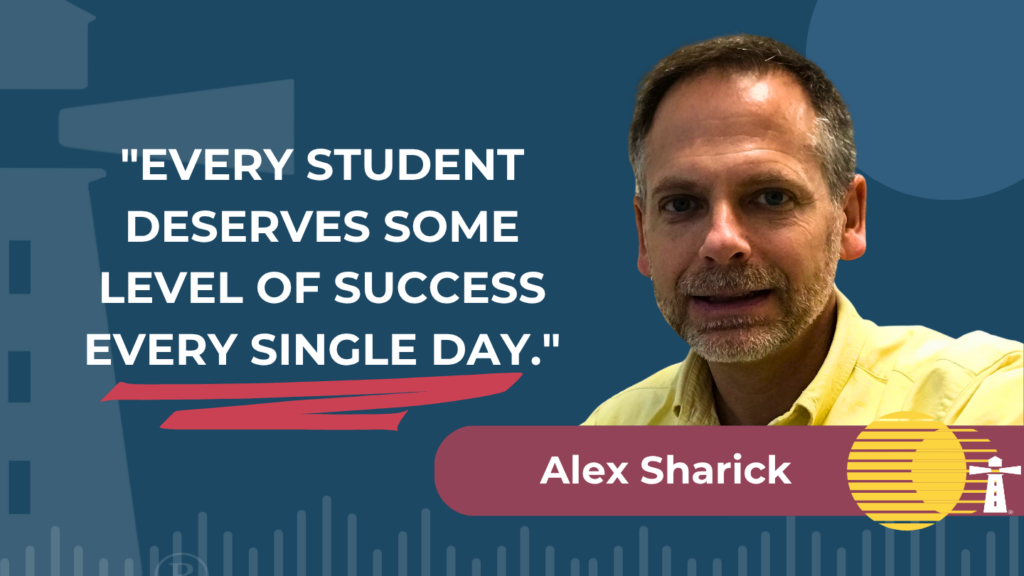
Episode Description
What if the most powerful strategy in education isn’t a program, but a mindset?
In this episode of Brighter Together, Alex Sharick, Director of Special Education at Plymouth Shiloh Local School District, shares what 30 years in education has taught him about leadership, relationships, and building systems that actually work for students.
From the life-changing impact of mentorship to the evolution of MTSS and behavior supports, Alex challenges a common assumption: that better outcomes come from doing more. Instead, he reveals how clarity, collaboration, and understanding the why behind student needs can transform an entire district.
In a time when educators are overwhelmed by initiatives, Alex brings the focus back to what matters most: every student experiencing success—every single day.
If you’re leading teams, supporting diverse learners, or trying to build a culture that sustains both students and staff, this conversation will meet you where you are—and challenge where you’re going.
Summary
Alex Sharick, Director of Special Education at Plymouth Shiloh Local School District, shares his 30-year journey in education, emphasizing how mentorship and relationships shaped his career path. He discusses the importance of relationship-building, collaborative leadership, and leveraging team strengths to effectively support students, especially in special education. Alex also highlights evolving practices like MTSS and behavior-focused supports, stressing the need to understand root causes and create systems that ensure every student experiences success daily.
Topics Explored for Mentorship Mindset
- Career journey and transition into special education leadership
- The impact of mentorship in education careers
- Importance of relationships in schools and leadership
- Structure of a small rural school district
- Roles and challenges of a special education director
- Collaboration and team-based service delivery
- Professional development and cross-department coordination
- Multi-Tiered System of Supports (MTSS)
- Behavioral supports and the role of BCBAs
- Inclusion, least restrictive environment (LRE), and service models
- Evolution of special education practices over time
- Family engagement and community support systems
Full Podcast Transcript
Lighthouse Therapy (00:01)
Hello everyone and welcome to the brighter together podcast. My name is Janet Courtney and my special guest today is Alex Sharick. Alex is the director of special education at Plymouth Shiloh local school district and that is in Plymouth, Ohio. Alex, welcome to the show.
Alex Sharick (00:19)
thank you for having me, Janet. Thank you.
Lighthouse Therapy (00:22)
So
Alex, tell us a little bit about how you became a director of special education and a little bit about Plymouth Shiloh.
Alex Sharick (00:30)
All right, sure. So this is my 30th year in education. So kind of going way back in the catacombs there ⁓ would be really, I had a mentor by the name of Jerry Dunlap, who ⁓ was my high school guidance counselor actually. And he was really instrumental in kind of the trajectory of my life. And so… ⁓
Lighthouse Therapy (00:36)
Yeah.
Alex Sharick (00:56)
Got went off to college when I got to college. It was kind of torn between actually English education or elementary Ed and professor again, you know, said, hey, you know, Alex, I think you can do this English stuff. And I which was shocking to me because I always thought I was a poor, you know, writer, poor, you know, speaker and all that kind of stuff. And then all of a sudden, you know, I’ve had these people that really spoke into my life. And so, like I said, it changed my trajectory. Went into education.
You know did the what typically you know instructors do they they teach they coach? And through you know the various experiences that they’re exposed to they start to find their niche So I’ve gotten into guidance for a couple years I actually put more like seven years, but nonetheless was in guidance Enjoyed that had an opportunity to be an assistant principal then a principal of an intermediate school and then had an opportunity and ⁓
Lighthouse Therapy (01:32)
Mm-hmm.
Mm-hmm.
Alex Sharick (01:56)
five years ago, a former colleague of mine who works in the district as a high school principal said, hey, we have this opening in special education. I know, you you got this guidance background, you know, this might be something you’re interested in. And, you know, I really gave me a chance to kind of reflect a little bit and think, you know, what are the tenants that I always kind of hang my hat on? You know, and it’s always been a quote that I actually remember a long time ago. was destiny is not a matter of
Lighthouse Therapy (02:18)
Mm-hmm.
Alex Sharick (02:26)
but a matter of choice and opportunity. And so I thought, hey, this is this opportunity, we’re gonna take it and go from there. Who knows what’s gonna come of it, but nonetheless, ⁓ and again, that relationship. So just in the course of my career, I think that’s been really the ⁓ mantra is the relationships matter, they really do.
Lighthouse Therapy (02:28)
100%, yeah.
Mm-hmm. Yeah.
Alex Sharick (02:50)
And
then you go into my role as sped-ed, I can speak to that as well. Plymouth Shiloh, Plymouth is a small rural ⁓ district. We have ⁓ all our elementary, our middle, and our high school all on one campus. So again, ⁓ having come from…
a small city district into back at rule. Again, what was a common theme that relationships in these small districts are able to do that. And even the, you know.
Lighthouse Therapy (03:19)
Yeah. Yeah.
Alex Sharick (03:23)
two years before that when I was not two years, two school districts before that, I was in a rural district. So that’s where I started. And so it was kind of a coming home for me. I enjoyed that because you really do have a chance to get to know the kids, the families that you serve, that you work with. And I knew I was at the right place when the superintendent, a shout out to Mr. Churston, love the guy. His ⁓ mantra for our school district is every student, some success every day. And I mean,
Lighthouse Therapy (03:53)
Mm.
Alex Sharick (03:53)
believes that and I do as well that you know some of the simplest things that’s all we need and you give that kid that little ⁓ encouragement you’ll never know what can you know be brightened as you know so that’s that’s a little bit of what I got.
Lighthouse Therapy (04:00)
Right.
Mm-hmm.
Wow,
that’s incredible though. You’ve had some people in your life, which I think we all are. I think we are those people now. We are those people that you’ve, we’ve made that influence on people that we don’t even know. I know that I know what I know, but there’s so many things that we just don’t know. And yet we do it every single day and a child, say something encouraging to them and they needed it at that moment.
Alex Sharick (04:19)
Alright.
first one.
Mm-hmm. Certainly.
Lighthouse Therapy (04:39)
that was what they needed and that’s what we do. And it’s
so amazing to be that person, right? So.
Alex Sharick (04:46)
Right.
You know, and that’s when it almost hits you because, you know, I remember, you know, a new rookie teacher coming out, you know, and seeing all these veteran teachers and, and, know, thinking I’m never going to get there. Right. You know, and then you, one day you look in the mirror and you’re like, I’m that, I’m that teacher now 30 years in, you know, what, what, you know, what is in store for me next. But the common thing I think in my, ⁓ you know, my life is always the building of the relationships and, and, you know, fostering, encouraging those. ⁓
Lighthouse Therapy (04:59)
yeah.
I’m that person, yeah.
Alex Sharick (05:16)
and feeding into them because at the end of the day, that’s really what matters.
Lighthouse Therapy (05:21)
Mm So how many how how big is Plymouth Shiloh? I you said it was small, but like what does your special education department look like?
Alex Sharick (05:28)
⁓ sure.
So special education department, am the sped ed director. I’m my own secretary, you know, as well. I have 10 intervention specialists ⁓ that I work with. ⁓ We have basically a combination of one for almost all of the middle school. So that would be. ⁓
Lighthouse Therapy (05:36)
Okay.
Alex Sharick (05:56)
So we serve in our middle school five through eight. So we have three there. Then we have two that serve our high school. Many of our kids go off to a career center.
Lighthouse Therapy (06:00)
Okay.
Alex Sharick (06:10)
So the population that stays back at the schools is rather small. And then in our ⁓ elementary, we have ⁓ again, three to four, two MC units, multi-categorical units ⁓ that ⁓ serve our most need students. So that’s kind of the makeup of the SpedEd department. Roughly, I think at one time I saw. ⁓
Lighthouse Therapy (06:11)
Nice.
Alex Sharick (06:37)
Was it like 800? I mean, that’s on the maximum end of even in the district. So, a really small school district, but proud of our big red country.
Lighthouse Therapy (06:43)
Mm-hmm.
Yeah, absolutely, absolutely. So 800, when you say 800, do you mean 800 total students or 800 in special education?
Alex Sharick (06:58)
800 total students.
Lighthouse Therapy (06:59)
Total students, yeah, okay, yeah,
awesome, awesome. And so what that was, I mean, I know you said you did counseling, but that was a little bit of a leap for you, or am I wrong? Was it not a leap for you to become a director of special education? mean.
Alex Sharick (07:14)
⁓ Well, so
right after guidance, went really into assistant principal. I did that for a year and then, you know, decided to take my show on the road, as they say, and ⁓ was an intermediate principal for six years. So at that, you know, obviously the principal role, director type role. And so then that’s where it was kind of more of a natural transition into, you know, the role that I’m in now.
Lighthouse Therapy (07:36)
Mm-hmm.
Yeah, yeah, but you have to deal with IDA and you have to, I mean, you’re still dealing with people. I get that, but it’s a little bit. I mean, there’s, always, I tell people, I’m like, you guys have the hardest job in the world. As far as I’m concerned, I don’t think you could pay me to do your job because it’s a hard job. There’s so regulations and people and emotions and you know, and we’re, we’re there for the kids and you know, keeping the kids in the center, but it’s not easy. It’s not easy.
Alex Sharick (07:46)
Mm-hmm.
Mm-hmm.
No, it’s not easy, but I would say that’s where you kind fall back on one of my greatest resources are my personnel. Making certain that I’m putting in front of them as I direct, I really I take that particular word as kind of importance is my role as a director, like a musical director. services, I need to be able to… ⁓
Lighthouse Therapy (08:19)
Mm-hmm. Yeah.
Alex Sharick (08:37)
One, know where we can go to get certain services, but also ⁓ bring out the talents of the different intervention specialists to have a particular skill. I can think of ⁓ different individual intervention specialists who… ⁓
are really good at ⁓ maybe MTSS. So they’re really good at the data collection. Maybe some others are a little bit more ⁓ on the behavioral and the intervention supports there. So yes, it’s a challenge, but like anything, ⁓ you kind of just lean into it.
Lighthouse Therapy (09:01)
Mm-hmm.
Mm-hmm.
Mm-hmm.
Alex Sharick (09:19)
lean into
that challenge, talk to the people you need to talk to. Again, going back to my theme here is the relationship. So if I don’t know, the nice thing is that there are other special ed directors in my region I can call. And so that’s always a plus. I think going to, ⁓ taking the time, and we all know that, hey, I gotta go to a PD, and that can be begrudging, I gotta go. But you find helpful information there, you get to change.
network. So that’s how you kind of combat some of those difficulties. ⁓ Use your resources, know who to talk to, and then yourself be involved in direct the services, direct the daily events, schedules, so forth for kids, families, so that it runs smoothly.
Lighthouse Therapy (09:55)
Yeah.
Right, yeah.
Yeah, so PD, professional development, do you, it’s okay, you’re all right. ⁓ Do you, as the director, also have some influence on the professional development for the gen ed staff as well?
Alex Sharick (10:13)
Yes.
Yes, you know
kind of in a broad sense so I work closely with our curriculum director, you know in the district so any in-house, know professional development that we have You know, she’ll always ask hey, you know, is there anything that you specifically are seeing a need and so most recently with the you know, the spectrum of autism You know, that was my
Lighthouse Therapy (10:31)
Okay.
Alex Sharick (10:47)
know, dialogue with her that, this is something that I’m seeing. You know, I know even in our intervention specialist world, you know, we’re trying to traverse that. I can only imagine what that looks like for a classroom instructor. And so, you we were working together instrumental in bringing some speakers in. Then they were able to do some really ⁓ hands-on type work with our elementary ⁓ staff. So that has been.
a way that we can address some of those needs, just working together.
Lighthouse Therapy (11:22)
Mm-hmm.
Yeah. Yeah. So what would you say has been some of the biggest, ⁓ I don’t want to say breakthroughs, like education is always like changing. There’s always, you know, there’s always buzzwords in education. There’s always things that we’re latching on and you’ve got 30 years in, I’ve got 32 years in and the way that we’re doing things today versus how we were doing them 30 years ago have definitely changed.
Alex Sharick (11:48)
Right.
Mm-hmm.
Lighthouse Therapy (11:51)
So
what would you say in your career as you’ve seen things, and it doesn’t have to be special education, just things, initiatives that you’ve seen or things that have come through or bubbled to the surface that have become really important to how you do your job or how we educate kids.
Alex Sharick (12:08)
Right, you know, I can think a bunch, but I mean, really the one that pops in my mind the most is really that MTSS. So the multi-tiered system of supports. I mean, I really, you know, what I have seen, you know. ⁓
when I was a classroom teacher, I remember having conversations with parents, and parents getting emotional about thinking that their child had a disability or some specific challenge to speed ahead to where I have people coming to me who have their diagnoses, and I always say, diagnosis doesn’t mean a disability. And so we, ⁓ and I hear you, and I want to get to know,
⁓ know what it is that you ⁓ are presenting to me. But I also want to make certain that we take a good look at what we’re dealing with so that we can really target what it is that the student needs, the child needs. And I think that that’s where… ⁓
when you have a good MTSS system, you’re really able to filter those kinds of, the needs of that child out. And so whether it’s behavior, ⁓ which I would say that’s kind of the other thing that I have seen. Now I would have never thought that I would be talking about needing a board certified behavior analyst. And we do, we have one in our small district, but I will tell you ⁓ we are fortunate because she does a wonderful job
Lighthouse Therapy (13:33)
Mm-hmm.
Yeah. Yep.
Alex Sharick (13:42)
job,
our kids are able to transition back, you know, when sometimes when they need to go to a private separate facility because that seems to be, you know, their least restrictive environment, their LRE, ⁓ you know. So those are the two things that really just kind of popped to mind right off the bat.
Lighthouse Therapy (14:03)
Yeah, yeah, I have a friend who’s a BCBA and we hire, we serve schools and BCBAs are actually a part of what we do as well. ⁓ And it’s just to get the BCBA to help you to understand what’s causing the behavior, know, before we were reacting to the behaviors, right? And now it’s like, let’s look at the underlying cause of the behavior.
Alex Sharick (14:20)
yeah.
Certainly, sure.
Lighthouse Therapy (14:30)
And then we can cut it off at the pass, right? When you start seeing them escalate, you can go, okay. And helping them to recognize, especially if they, know, cause some of these kids are so incredibly smart and helping them to understand why they escalate and what triggers it and what upsets them is the, you know, knowledge, that knowledge and understanding is such a huge piece of, ⁓ I get it now. So maybe I…
Alex Sharick (14:32)
Right.
Mm-hmm.
Lighthouse Therapy (14:56)
Maybe not every time. Sometimes I just need to freak out. I get that. I have my own freak outs. think we all do, but, but not so bad that I’m throwing the chair at the teacher, right?
Alex Sharick (15:01)
Sure.
Right, right, right. You know, and
I think, you sometimes there aren’t healthy ⁓ models of what, you know, how to address, you know, if it’s behavior. you know, they see, ⁓
it displayed, you know, I get frustrated or whatever and I, yeah, I throw something or I say something and then later regret it. You so I think that, you know, that modeling has a lot to do with that as well. And so like you said, once the child, and then even when you kind of partner with the families and talk about, here, you know, here may be some other ways to go about this type of situation. Because again, that comes into those, you know, conversations that I’ll, you know, sometimes be brought into where we’re trying to not only
advocate for the student and his or her needs, but also we see it as a much larger issue. And so how do you rally around and bring the other supporting players? Again, that’s that directing role that I see that I enjoy so much. How do I bring that in to give this single mom with three some help or a family who both parents are working and there’s sometimes no time for the kids? And you know what I mean by that? And that’s disheartening.
But it’s real, so how do we address it? We can continue to look at all the barriers, but let’s look ahead. When I was coaching track, I always remember a track coach that I coached with, he always said, when you’re teaching them hurdles, Alex, you don’t have them looking at the hurdle. You’re always looking at the end. You’re looking at the finish line. And the hurdle just happens to be a temporary obstacle, and you’re running over that. And I try to-
Like you’ve mentioned, with behavior as one example, there’s always a reason why, right? We do what we do, and so you just have to kind of break it down. But sometimes people are too busy, right? They just don’t want to do that. And so that’s where we come in to help facilitate some of that.
Lighthouse Therapy (17:03)
Yeah, 1000%. Yeah, yeah. And that’s what makes, that’s what makes, I think, special education so incredible is that we can do that. We can take those barriers that they have and remove them, or at least break them down or show them a way to get over that barrier so that they can be successful. And it’s, there’s nothing like that aha moment is there. There’s nothing like it. There is nothing like it. Yeah, yeah, yeah. It’s…
Alex Sharick (17:27)
You’re right, yeah. You can literally
see the light bulb glow above the head.
Lighthouse Therapy (17:33)
Mm-hmm. Yep. And
when it goes off, it’s like the most beautiful thing in the world for that child and not and for you because again, you talked about relationships and facilitating that and that’s a big piece of of how you facilitate it. So how do you how do you have your special education students? Are they are they in classroom? Are they pulled? Are they mainstreamed? How are you guys handling all of that? You know, the are they are they in the class? Are they on their own special classes? What are you guys doing?
Alex Sharick (18:03)
So they are in our general education population. ⁓ Even in our, again, the MC multi-categorical room, ⁓ we try to, we not try, we do, we get our kids out for specials. We get them out for… ⁓
Lighthouse Therapy (18:07)
Mm-hmm.
Alex Sharick (18:20)
the recess, the lunches, the connect that way. One of the things that we began to find is that because we have all our kids out is really kind of an interesting thing that going, speaking of kind of the career path, right? We used to have the resource room where the kiddo was plucked out of the regular classroom, put into a room, and then they were there all the time. Well, we have begun in actually our elementary principle and with the approval of our superintendent.
Lighthouse Therapy (18:36)
Mm-hmm.
Mm-hmm.
Alex Sharick (18:50)
that we’re gonna go back to really kind of talking about a four tier system of supports. So we have, you the first tier is general education. But what we were finding is that we had students who struggle, whether it was behavior or academically, just needed that a little bit extra, right? A little bit extra time or let’s do a reteach. ⁓
Lighthouse Therapy (19:11)
Right?
Alex Sharick (19:15)
And so what would happen sometimes is, well, where do they go? Where do they go during the day? And so what was happening is sometimes we would ⁓ call on. ⁓
you know, an MC classroom instructor to say, hey, can you help us out? We see this need, you know, when they already have their caseload, right, you know, all the needs that are going on in their classroom. So there’s like, have to begin to think there’s got to be another, in a better second tier. And so what we, you know, are going to bring actually back for the 26, 27 school year is an idea of the resource room where a kiddo may be struggling, let’s say in English. And so a fourth grade student who’s struggling,
Lighthouse Therapy (19:36)
All right.
Right.
Alex Sharick (19:58)
in
English when the fourth grade is having their ELA, that same kiddo is going to have an opportunity to go to a smaller environment to work with our intervention specialists as well as we’ll probably have an RBT in there, but be able to work at those 45 minutes on that language arts, but then be able to go back because perhaps they don’t need it for math. They don’t need that quiet separate space for the math. And so we’re going to have that. That teacher’s going to have a 730 to, know,
Lighthouse Therapy (20:22)
Right? Yeah.
Alex Sharick (20:28)
30 to 330 schedule that will be servicing kids that will be from your.
kindergarten all the way to the fourth grade in that particular room. Then we get into our third, you know, tier of service and that is our MC, where kiddo has, you know, perhaps the academic, maybe the physical needs that only can be addressed in that, you know, multi-categorical room. And then our final is really when, you know, when we’re looking at some behaviors that are beyond, you know, our scope and sequence, even with the help of our BCA, BCBA, ⁓
Lighthouse Therapy (20:51)
Mm-hmm.
Alex Sharick (21:03)
or some of the kiddos that we’re seeing with autism, non-verbal. ⁓ That’s been something also I think it’s been important is knowing what your limits are. Sometimes we try to fix everything, but we’re not good at everything. And so I think that’s a good litmus test for us always to be able to say, at the end of the day, some student every day should have some success. And if that kiddo really isn’t,
Lighthouse Therapy (21:16)
Hmm.
Mm-hmm.
Alex Sharick (21:33)
⁓
we perhaps need to see is there something better out there? And that’s where the fourth tier comes in. we have, we partner with some surrounding programs that help the student in that fourth. Now, at the end of the day, they are always a Plymouth Big Red student. And they’re always, we’re always looking to bring them back. And so I always say it’s not a sentence to have this challenge that you’re faced with.
Lighthouse Therapy (21:37)
Right.
Right, right.
Alex Sharick (22:03)
you know, provide you with those skills so that we can, you know, incorporate you into the, you know, the general education setting you find into success. That is your least restrictive environment. But sometimes we have to really, you know, drill down and like you said, even with behavior, drill down to what is the root cause so that we can serve it so that, you know, we can best meet your needs, the students need.
Lighthouse Therapy (22:22)
Yeah.
Yeah, yeah,
yeah, because every child is different, right? Every single child is different, for sure, for sure. So ⁓ Alex, where would people go if they wanted to learn more about Plymouth Shiloh and maybe ask you a question?
Alex Sharick (22:32)
Mm-hmm, certainly. Yeah.
Sure, so they could just go to our website, Plymouth, Shiloh. I don’t go there that often.
Lighthouse Therapy (22:53)
That’s okay,
that’s okay. I’m gonna note the time and then I’m gonna ask you the question again once you have it, okay?
Alex Sharick (22:59)
Okay, yep, let me take, oh yeah, pramichowSD.org, Yep, pramichowSD.org, there you go.
Lighthouse Therapy (23:07)
Okay. All
right. So Alex, where should people go if they want to learn a little bit more about a Plemish Shiloh or about you?
Alex Sharick (23:15)
Certainly, PlymouthShilohSD.org. That is our school website. ⁓ And they’ll find, you know, under staff links, they’ll find, you my name there. Shoot off an email. And I like to always, again, kind of old school. So hey, if you say you’re gonna, you need me to call back within 24 hours, I will call back within 24 hours. That drives me nuts now, but, you know.
Lighthouse Therapy (23:37)
Yeah, yeah, that’s it. I think that’s a generational thing too,
you know, because we’re the same way. If you reach out to someone here at Lighthouse, my policy has always been within one business day, you will hear for hear back from us because there is nothing worse out there than to send an email and not know if they got it and not know if you know, it’s like.
Alex Sharick (23:45)
Mm-hmm.
Sure. Certainly.
Lighthouse Therapy (24:00)
Don’t wait a week to get back to me. need to know that I heard, I mean, I sent you an email because I had a question. I needed something, right? So yeah, yeah. So that’s definitely customer service. That’s just all about taking care of people. Relationships again, right? Did you hear me? Even my husband, when I text him, even though he doesn’t, he’s not a text, or at least I get, okay. If we get something, it’s kind of a running joke. If we get something, my daughter and I are chatty.
Alex Sharick (24:03)
right.
Right. Sure.
Certainly. ⁓
Sure, sure.
Lighthouse Therapy (24:28)
⁓ And if we get something other than okay from my husband on a text, it’s like, wow. What happened? Yeah, really. I love my husband. He’s a great guy, but he just isn’t a texter and that’s okay. It’s really okay. anyway, okay. Yeah, exactly. Exactly. And he tells me all the time. was like, he’s like, you’re.
Alex Sharick (24:34)
Whoa, right, what happened? There you go. Right, right. Sir? Sir? Sir. And you know that, and you know how to communicate with him, There you go.
Lighthouse Therapy (24:53)
You’re wired to do this. You’re wired to be a podcast. You’re wired to be a speech therapist. said, yeah, I like people. I like talking to people. He’s like, well, I don’t. And I was like, I know. said, but you like talking to me. And he’s like, sometimes he’s a jokester. He’s a jokester. Yeah. Okay. Well, thank you so much for your time, Alex. It has been an absolute pleasure to have you on the show. Enjoy the rest.
Alex Sharick (25:02)
Sure. ⁓
yeah. All right. There you go. huh. Sure.
Certainly. Well, thank you. Thank you. Appreciate the opportunity.
Lighthouse Therapy (25:22)
Yeah,
enjoy the rest of your semester. It’s March 31st. when this comes out, it’ll be about six weeks. So we’ll be heading to the end of the semester. We’re on the downwards track. Yeah. Yeah. All right. Well, take care.
Alex Sharick (25:27)
That’s all I know.
Certainly, yep, we’re there, Linda. All right,
yes, thank you.





First Quarter Report Card Comments: 300+ Ready-to-Use Examples for Teachers