

Public education is under scrutiny like never before—and if you’re not actively sharing your district’s story, someone else is writing it for you. In this eye-opening episode, we sit down with Dr. Kathleen Truitt, Superintendent of Lee County School District in Georgia, to explore how leaders can reclaim the narrative around their schools and tackle the critical challenges that keep them up at night.
Guest Introduction
Dr. Kathleen Truitt brings over a decade of classroom experience and unwavering passion to her role as Superintendent of Lee County School District in Leesburg, Georgia. Despite her leadership position, she remains a teacher at heart—and that perspective shapes every decision she makes for her community’s students and educators.
Episode Overview
Discover what’s really happening in Lee County schools and what Dr. Truitt is doing to bridge critical literacy gaps, support teacher compensation in a fiscally constrained environment, and protect student well-being in an age of technology and social media. This conversation reveals the honest challenges facing modern public education and the strategic, community-focused approaches that are creating real change.
What You’ll Learn
- Why storytelling matters: How proactive communication shapes community perception and protects your district’s reputation
- The literacy imperative: Strategic approaches to closing grade-level reading gaps without compromising overall academic performance
- The compensation conundrum: How to attract and retain excellent teachers while maintaining fiscal responsibility
- Social-emotional priorities: Navigating technology’s impact on student mental health and interpersonal skills in the digital age
- Leading with heart: How classroom experience informs superintendent-level decision-making
Key Takeaways
✓ “A school system should be a reflection of the hopes and dreams of a community.” Leadership is about understanding and serving your community’s deepest values.
✓ “If we’re not telling them, somebody is.” In today’s environment, silence isn’t neutral—it’s a lost opportunity to shape your district’s narrative.
✓ “We are never going to sleep until we have as many students reading on grade level as we humanly can.” Excellence requires relentless commitment to foundational skills, even when other metrics look strong.
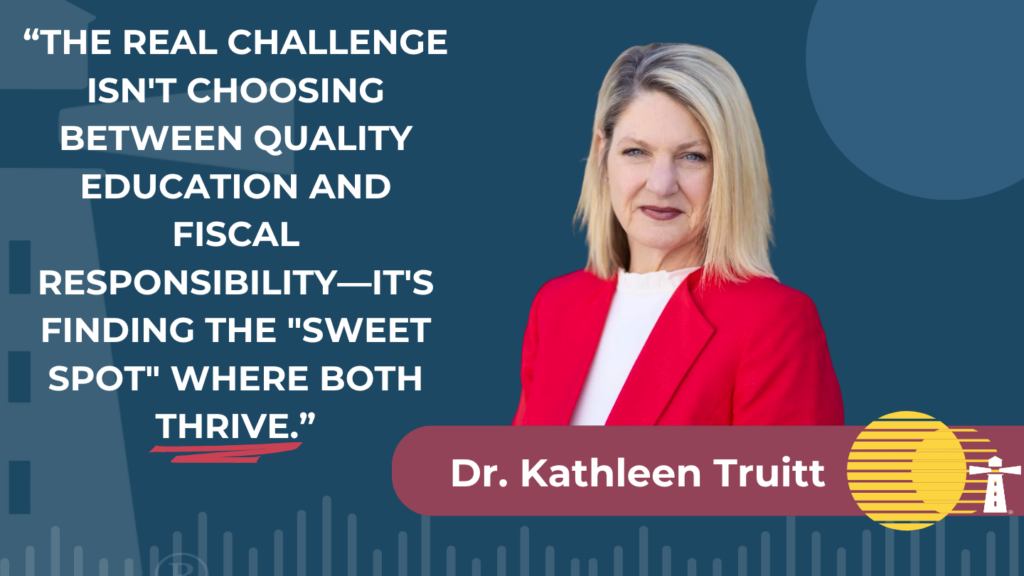
✓ The real challenge isn’t choosing between quality education and fiscal responsibility—it’s finding the “sweet spot” where both thrive.
✓ A teacher’s heart in a superintendent’s role creates decisions rooted in classroom reality, not bureaucracy.
Ready to hear how one superintendent is leading with authenticity and purpose? Listen now to discover the strategies and mindset shifts that are transforming Lee County schools—and could transform yours.
Don’t miss this conversation. Subscribe to stay updated on future episodes featuring education leaders who are making a real difference.
FULL PODCAST Transcript
Lighthouse Therapy (00:00.91)
Hello everyone and welcome to the brighter together podcast. My name is Janet Courtney and my special guest today is Dr. Kathleen Truitt. Kathleen is the superintendent at Lee County School District and that’s in Leesburg, Georgia. Kathleen, welcome to the show.
Kathleen Truitt (00:17.206)
Thank you, thank you for having me. It’s great to be here.
Lighthouse Therapy (00:20.328)
Awesome. So Kathleen, tell our visitors a little bit about you and your journey to be a superintendent and then give us a little bit about Lee County.
Kathleen Truitt (00:30.732)
Well, first of all, I think at my heart of hearts, I’m a teacher. I spent 13 years in the classroom and so I have never not
considered myself a teacher. From teacher, I moved on and took a leadership role as an assistant principal, opened a new school. That is clearly a once-in-a-lifetime opportunity and it will happen once in my lifetime because that’s the biggest thing I might have ever done. And from there became an elementary principal, a middle school principal, and then district leadership in the area of teaching and learning. And then my journey took me to superintendency and I am finishing my third
Lighthouse Therapy (00:52.685)
Yeah.
Kathleen Truitt (01:08.938)
year here in Lee County, Georgia and it was one of those things that I think you get put in the right place at the right time and through mutual acquaintances someone said, have you thought about Lee County? And my first reaction was, no not really and they’re like, I think it would be a good fit and indeed it has been and it’s been a great journey here for the last three years.
Lighthouse Therapy (01:32.884)
Awesome. That’s fantastic. I love the nothing against male superintendents, but it is a male dominated industry. So I’m always excited when I see, cause the industry itself, teachers in general was a female dominated industry. But then when you get to that level, it seems to be a male dominated. And, and so I’m always excited when I see females who have, have gotten to that level. So congratulations. That’s awesome. So yeah. So tell me a little bit about Lee County school district.
Kathleen Truitt (01:41.952)
Thanks
Kathleen Truitt (01:57.558)
Thank you.
Kathleen Truitt (02:01.692)
Lee County School District is a rural school district in southwest Georgia. We are right, if you know Georgia at all, we’re right between Albany and Americas. We are a bedroom community to the greater Albany area and so we have a lot of agriculture and then a lot of housing. We are a, I think we’re a little bit of an anomaly in what people kind of consider about rural school districts. We’re actually a pretty high performing school district
in the state of Georgia. We’re usually within that top 15 % of all school systems in terms of overall performance. And so there is a deep and long history of value of education here that you don’t always find everywhere. just one of those special places. When I first got here, I asked the board, said, would you like to be the best kept, would you like to stay the best kept secret in Georgia? Or would you like for people to know that we’re here? And their responses, I think we’re ready for people.
to know that we’re here.
Lighthouse Therapy (03:02.706)
nice, very nice, very, very nice. And so the district itself, what is the population like? And I’m assuming you’re TK to 12. I’m guessing, but pre-K.
Kathleen Truitt (03:13.26)
We’re pre-K, I’m 12, and we have just shy of 6,000 students here.
Lighthouse Therapy (03:19.01)
Big bigger district. Yeah, that’s nice. That’s really nice. So when you say bedroom community, so there’s no major industry there. It’s all agriculture and people commuting to work.
Kathleen Truitt (03:29.481)
That is correct. We are. The school system is the largest employer in the county and so we’re a county school district. There’s no city systems and so yes, at about 1000 employees we are the largest by far employer in the district in the system.
Lighthouse Therapy (03:33.805)
wow. Mm-hmm. Okay.
Lighthouse Therapy (03:45.294)
Wow, wow, that’s crazy. Yeah, I love that. So lot of pride in the community, lot of, yeah, awesome, awesome.
Kathleen Truitt (03:51.743)
Yes. We’re a one high school school system, is, you know, if you the difference between one and multiple. So on any given night, if there’s a school event, we have a we have a lot of community buy in in that event. So.
Lighthouse Therapy (04:08.34)
Mm-hmm, I bet Friday Night Football’s a blast at your school.
Kathleen Truitt (04:12.299)
We might do pretty well in that football arena. We’re pretty good athletic school as well as academics so and fine arts as well. So it’s one of those. We are successful in all areas and and that is a great testament to our teachers and our kids and our families.
Lighthouse Therapy (04:21.25)
Yeah.
Lighthouse Therapy (04:30.072)
Yeah, awesome. So tell us a little bit about your philosophy and how you lead and how that has impacted the school. Because you’ve been there for three years, so you have that tried and true time to know what you’re doing. So that’s awesome. So tell us a little bit more about that.
Kathleen Truitt (04:49.035)
I think my philosophy really centers around what happens between the student and the teacher in the classroom. And then the rest of the work is built around to make that possible. So district leaders are crucial and important because they set the conditions to make sure that that teaching and learning can take place. And then really focusing on valuing exceptional practice in the classroom is a big…
it’s really important to me and when it’s not there, making sure that we develop that. And then relationships with your community, being open, transparent, and making sure that what we’re doing is visible.
because every parent and every community member can’t be in the classroom. So one of my big focuses since I have been in Lee County has been really centered around communication, making sure that we are celebrating the wins, making sure that we’re telling the stories that are there because if we’re not telling them, nobody is in a in an environment right now where public education is a little bit, not just a little bit, but you know.
Lighthouse Therapy (05:36.588)
Right.
Lighthouse Therapy (06:00.0)
I was gonna say not just a little bit. Yeah. For sure.
Kathleen Truitt (06:02.559)
We are under the microscope and if you are not really being active in communicating what you’re doing, how you’re doing it and why you’re doing it, you’re really, someone is gonna tell your story. So it can be you or it can be somebody else, but if you’re not telling it, the story is still being told. And so we’ve really focused on telling our own story and celebrating the incredible work that’s happening in our classrooms.
Lighthouse Therapy (06:18.04)
Mm-hmm.
Lighthouse Therapy (06:26.796)
Yeah. And you told me before we started that you guys actually do your own blog or your own podcast.
Kathleen Truitt (06:32.415)
We do. No, we are not professionals. So we say that. But it was really about having another avenue to highlight the great work that teachers and students are doing. So we’ve featured students on our episode, teachers on our episodes. We’ve done all kinds of community collaborations where we’ve talked about school safety and just it really gives us a really fun avenue to have additional communication that you can’t just you’re not going to just see on social
Lighthouse Therapy (06:43.438)
Mm-hmm.
Kathleen Truitt (07:02.429)
meter you won’t see in something printed.
Lighthouse Therapy (07:05.464)
Yeah, I love the fact that there’s multiple avenues because as you and I both know, not everybody learns exactly the same. I’m much more of an experiential and visual learner than I am. My husband loves to laugh at memes. He’s like, they might as well not even send you the instructions because you’re not going to look at them because I don’t. I just don’t learn that way.
Kathleen Truitt (07:12.884)
No.
Kathleen Truitt (07:25.588)
It’s funny.
It’s funny that you say that the first thing when I got to Lee, I walked in the office, it’s a big office, and I said, where’s the whiteboard? And they’re like, whiteboard? I said, how do you guys solve problems? Like you need a whiteboard. So it was my very first purchase was a whiteboard for the offices and we definitely have put it to good use.
Lighthouse Therapy (07:50.286)
Yeah. And that’s just, that’s your style and it’s how your brain is wired. And we know like, especially my husband, because we, we’re a family business. So he’s my CTO and, we do not think alike at all. And so, so when there’s an issue or something and our daughter, our 28 year old daughter also works for us, she kind of becomes the liaison between the two of us because we’re also married, you know, we’ve been married for 30, almost 30, it’ll be 31 years in April.
Kathleen Truitt (07:59.945)
Yeah. Okay.
Kathleen Truitt (08:13.471)
wow. Yeah.
Kathleen Truitt (08:19.392)
Yeah.
Lighthouse Therapy (08:19.529)
And so there are things that, you know, you pick your battles sometimes when you’re married. And I know that this thing needs to be happening, but I can’t communicate it in a way that he’s going to get from me. And she picked up on that early on. And so it’s like, so she, when, when we’re doing something, you know, and it’s like, okay, so she’ll come to me and she’ll be like, okay, what do we need it to do, mom? What’s it, you know, what’s the, what is this?
Kathleen Truitt (08:23.882)
Yeah.
Lighthouse Therapy (08:45.313)
the thing that whatever it is, cause he’s a programmer and he gets the technological side of it. And I try to tell him and he’s like, but you’re not giving me every step. And I’m like, yes, I am. And so it doesn’t work. So we just go, and so we found a balance. I think sometimes you just have to find a balance. So you talked a little bit about,
Kathleen Truitt (08:50.762)
Yeah.
Kathleen Truitt (09:01.311)
Yeah, nice.
Lighthouse Therapy (09:08.211)
liaisons, partnerships. Can we delve into that a little bit? I’d love to hear the kind of partnerships in your community that you’ve developed for your kids.
Kathleen Truitt (09:16.443)
absolutely I think that’s one of the strengths that we have in our school system. I’ll give you a perfect example. This summer I have a great relationship with my emergency management
person in the district and you know my phone blew up and it’s cold and I’m thinking the weather looks great. I haven’t heard any bad weather. What are we doing? And he said, hey, we need a little bit of help. And I said, OK, what are we talking about? He also is the assistant fire chief. When you’re in a small place, you wear lots of hats.
It’s like we really have a shortage of firefighters. We want to talk and see if there’s a way that we can collaborate on this and make it a win win for your kids and for us. And so we sat down and got all the powers at B around my conference room table. And we walked out of that with an agreement that our local fire department and the fire trainer will come in and teach courses in our high school for seniors. We’ll have 15 seniors that will participate next year.
then upon their 18th birthday, they’ll take their fire exam and they will graduate from high school as fully certified firefighters. Really a really respected career and we are investing in 15. Our local system needs, our local fire department needs six. And so then we’re also then contributing to surrounding, surrounding counties as well. And in the second year, my juniors who start the program will be EMB.
Lighthouse Therapy (10:24.865)
Nice.
Kathleen Truitt (10:46.463)
T firefighters and so they will graduate with highly coveted certifications that lead to career paths that they can do as a stopgap. Hey, I want to be a firefighter while I continue my education or I’m really invested in this as a career as a my all-in career and we’ll then have opportunities that way as well. And so that’s just one example of some of the partnerships that we have formed but a really good one and
I think we are responsive as a school system. I’ve always said that a school system should be a reflection of the hopes and dreams of a community. And so some of the hopes and dreams of our families here are that kids have places to come back to or to stay. And so we want to make sure that we create those as well.
Lighthouse Therapy (11:24.653)
Yeah.
Lighthouse Therapy (11:35.563)
Yeah, that’s fantastic. what do you what do the kids have to do to be because you said you’ve got 6000 kids. How how did they how do you whittle it down to 15?
Kathleen Truitt (11:45.215)
think you look at interest first and anytime something’s new, success breeds success. So when they see their friends become firefighters, we may have a bigger interest, but we’re looking at across between. We already have a career technical pathway for law enforcement. it would be students who have completed those beginning courses in that pathway would be eligible and we’ll do a lottery if we have more than the 15 who are interested.
Lighthouse Therapy (11:47.265)
Mm-hmm.
Lighthouse Therapy (11:51.223)
Mm-hmm.
Lighthouse Therapy (12:02.779)
Okay.
Lighthouse Therapy (12:11.591)
Wow. Okay. Awesome. That’s really, that’s really great. And then, what would you say are some of the biggest challenges and how are you working to overcome those?
Kathleen Truitt (12:21.737)
I think, challenges in general or related. Okay. I think, no.
Lighthouse Therapy (12:25.367)
Just whatever, you know, whatever, whatever you want to talk about. mean, I’m like, I think every district has their challenges. Maybe it’s financial, maybe it’s, it’s, I don’t know. I’m just curious. Yeah.
Kathleen Truitt (12:35.433)
Yeah, okay.
I think right now challenges are some of our bigger ones. We are never going to sleep until we have as many students reading on grade level as we humanly can. were about of my 11th graders. I have about 94 % that are reading on a high school level, not quite on grade level. All of them about 80 % 80 % are on grade level, but we you know we have about another 14 % of that are reading on a high school level, but not quite there.
Lighthouse Therapy (12:47.053)
literacy. Yeah.
Lighthouse Therapy (13:06.007)
Mm-hmm.
Kathleen Truitt (13:06.925)
I think that that is something that we, it’s not just something that we’re trying to do. That is a commitment that we owe children that.
Lighthouse Therapy (13:15.851)
Yeah, yeah.
Kathleen Truitt (13:17.373)
And so that is something that I wouldn’t say it is a roadblock, but it’s something we’re continually to work on. Roadblocks in general will always be making sure that while you’re providing an excellent education, that you’re fiscally responsible to your community. So it’s finding that sweet spot where teachers are compensated well, and they are compensated in a manner that is reflective of the surrounding communities.
Lighthouse Therapy (13:34.113)
Mm-hmm.
Kathleen Truitt (13:47.277)
And then making sure that you’re fiscally efficient so that you’re responsive to your taxpayers. are in Georgia, we are funded through state funds and then property, local property tax. And so a huge responsibility to your community to be spending tax dollars well. And so I think it’s not a roadblock, it’s just an ongoing responsibility. And then to be really transparent about what you’re doing and how you’re doing it.
Lighthouse Therapy (14:12.353)
Yeah, yeah, excellent, excellent. And that’s part of what I think, you know, for me, brighter together is all about is giving, giving schools an opportunity, superintendents and special education directors and people that are in those kinds of leadership roles to talk about the amazing things that you guys are doing. I mean, and one of the, one of the things that, you just, just proved it to me again, and I’ve, I’ve seen it again is education is no longer
sitting in a classroom, making sure you get your credits and graduating. Yeah, it’s really become, go ahead. No, you say it, absolutely.
Kathleen Truitt (14:43.177)
No.
No, it’s really become more than that. And I think we see that through the number of students that are participating in work-based learning. We see that in internships that our students are participating in. We see that in the willingness of our community partners and businesses that within Lee that are stepping up to the table to make and to continue to provide those partnerships. But then we’re also seeing that in, we really believe
opportunities. So I just talked about the ability to be a firefighter, but I’m also looking at consistently year after year, we’re sending our top 10 % to really high quality, top tier universities. And so the goal of the school system is making sure that every child has a spot and a place to be successful in an area in which interests them. And so whether that’s full theater productions every year or whether that’s
band or music or technology, know, wherever that fit is. And that’s, I will say that’s a, that’s a challenge, you know, being something for everybody and having a little bit of everything for everybody is, a tricky business.
Lighthouse Therapy (15:53.837)
Yeah.
Lighthouse Therapy (16:00.999)
Mm-hmm. Mm-hmm. But it seems to be the direction that education is going. And, know, for all of my career, IEPs, individualized education plans for students with special needs, that has always been the pathway for them. Let’s find something and let’s not have them be in their 13th year, be the couch, you know, after they graduate from high school. We don’t want them that we don’t want that for them. And there’s lots of really amazing things that are happening in that. But I’ve seen that
Kathleen Truitt (16:10.825)
Yeah. Yeah.
Kathleen Truitt (16:23.209)
Right. Right.
Lighthouse Therapy (16:30.059)
that shift to into let’s do individualized education, not necessarily in it. There’s lots of different plans. We’re not gonna call it an IEP, but for our Gen Ed students, the Gen Ed students are getting pathways based on where their interest is and based on where they’re gifted and what makes them tick, right? So that they can go on and be productive members of society. And that story’s not being told. And that’s why.
Kathleen Truitt (16:51.712)
Yeah.
Lighthouse Therapy (16:59.681)
That’s why brighter together is here because there are so many things that are happening in education and all you hear in the media and here’s me getting on my soapbox because it aggravates me is the bad is the crazy teacher that did the crazy thing and the media loves to take a blanket and put that over every single teacher in the entire United States, which is so incredibly unfair to do. And most of the times when it’s a crazy teacher,
Kathleen Truitt (17:09.299)
Okay. Yeah.
Lighthouse Therapy (17:26.925)
The school is dealing with that crazy teacher before it even makes the media. know, giving, giving superintendents and giving special education and my heart is special education. It always will be out. You you said you’re a teacher at first always, and I may be an entrepreneur and a CEO and all of those things, but Anna podcast host, but first and foremost, I will always be a speech language pathologist because I have been, Ooh, that makes me teary because I love, I love the kids and I love what I do. And
Kathleen Truitt (17:29.65)
yes. Right.
Kathleen Truitt (17:36.874)
Yeah.
Kathleen Truitt (17:40.807)
always.
Kathleen Truitt (17:51.755)
Thank
Lighthouse Therapy (17:55.755)
those kids have to come first before we do anything else we have to consider and consider where what we’re doing and you guys are, I mean, there’s no doubt in my mind you guys put the key and you said that from the beginning, we put the teachers and the students in their relationship and getting them what they need. It’s beautifully said. So, so very exciting and, and, and so good to see. And I want that for, for you guys as well to be able to tell that story. And you are.
So congratulations, keep it up. I love it. And I will get off of my soap box now.
Kathleen Truitt (18:23.947)
Thank you. No, you’re good. You’re good. I think you mentioned, you know, roadblocks. Another thing that is
I mean, I think this is pervasive across the country is that sweet spot for technology. Where does where is it beneficial and then where does it cross over into detrimental and we’re seeing and right now we’re navigating all kinds of research that’s coming out about what where is technology beneficial and then where does it maybe hinder learning and growth. And so that’s something that along with the challenges that come with
Lighthouse Therapy (18:40.237)
Mmm.
Kathleen Truitt (19:03.885)
with devices and social media and all of the social emotional fallout that happens, you you take adolescence and you throw in…
Lighthouse Therapy (19:11.725)
Mm-hmm.
Kathleen Truitt (19:15.325)
social media and all the feedback, whether it’s desired or undesired, that they get from those experiences. And then we put that into school. that has definitely been some challenges for us as well as everybody else. And then trying to find the space where technology is a win and not a detriment. And so there we are. then AI has entered in full force on the scene. And so.
Lighthouse Therapy (19:30.53)
Mm-hmm.
Lighthouse Therapy (19:36.941)
Yeah.
Lighthouse Therapy (19:43.709)
And it’s not going away. It’s definitely not going away. And it’s just getting stronger. They’re getting, I mean, they’re just, I was listening to the radio this morning. My husband and I both had appointments. And so it was like, one car, let’s just go together and then you can pick me up when I’m done, when you’re done. And it was fully human. mean, like you hear that on the radio, we’re fully human. And it’s like, I didn’t really process that. And today it hit me. was like, they’re saying that they aren’t using AI is what they’re.
Kathleen Truitt (19:45.469)
No!
Kathleen Truitt (20:11.306)
Right.
Lighthouse Therapy (20:11.917)
And it just is, it’s fascinating because it’s getting to the place where AI can do some of that stuff. we’re, we’ve got stuff going on here in Lighthouse with AI and it’s, and it’s exciting and it’s innovative, but it’s also intimidating because I’m like, I want to make sure we do it right. You know, and our whole thing. Yeah. Our whole thing is always, it HIPAA compliant and FERPA compliant? If it’s not, we’re not doing it. You know, it’s gotta be.
Kathleen Truitt (20:36.885)
Right.
Lighthouse Therapy (20:37.569)
Because that’s the bottom line. have to be compliant with what’s happening. But it’s just, and the other thing I was gonna say that before I got off on that tangent was as an SLP and you talked about the way that we’re communicating and the way the kids are doing social media and all that. It’s a breakdown. It is a total breakdown in communication because when you send a text, the only thing you see is the words on the screen. You don’t get the intent.
Kathleen Truitt (21:01.577)
this
Kathleen Truitt (21:06.005)
Right.
Lighthouse Therapy (21:07.201)
You don’t get the tone. You don’t get the body language. You don’t get any of that. So, you know, a text on a, and my husband, he’s so funny. He’s just like, okay, you know, he doesn’t, he doesn’t text. He’s like, and we laugh. It’s like, what did dad say? Okay. If he says something other than, okay, we’re like, wow, wow. Dad said something besides okay. Because he just doesn’t communicate that way. You know, it’s, that’s not, but so the kids, so there’s a true breakdown in communication for these kids and how they develop communication because of.
Kathleen Truitt (21:16.447)
Yeah.
Kathleen Truitt (21:24.586)
Right.
Lighthouse Therapy (21:36.661)
social media and the next like and the next hit and you know, it’s kind of heartbreaking. It really kind of is so.
Kathleen Truitt (21:44.681)
It is and then you know what are we we lean in and what can we do to prepare them to use it in a smart way? How do you get kids to still critically and creatively think and use technology to create rather than just consume? And so we’ll continue to look for that balance and then and I think there’s been some interesting legislation for us in Georgia and some other places limiting device use at least personal devices.
Lighthouse Therapy (21:52.705)
Mm-hmm.
Kathleen Truitt (22:14.143)
We were already there. so I think it’s just, again, it’s not going away. So how do you use this in a positive way rather than, mean, fighting it, think it’s past that point. So fighting it is not productive, but figuring out a way to use things and harness things in the right way, I think that’s the direction that we’re looking at going.
Lighthouse Therapy (22:25.229)
productively.
Mm-hmm. No.
Lighthouse Therapy (22:37.483)
And I love that because schools are, it’s changing so fast. It’s just changing so incredibly fast. And you just have to be, you have to be thinking on your feet and excuse me, and just dealing with it. So anyway, it’s a great, that’s a great conversation, but boy, we could really go down a rabbit hole there, couldn’t we? so tell everybody where Kathleen, do they go to find out more about you and maybe about a little bit more about Lee?
Kathleen Truitt (22:53.257)
Yeah, yeah, absolutely.
Lighthouse Therapy (23:07.521)
Lee County School District.
Kathleen Truitt (23:10.165)
So if you’re interested in Lee County School District, obviously our website, and I can give you that if you wanted to post it. It’s lee.k12.ga.us. I had to think about that, make sure I got it right. And I think that’s a great place to start. then social media. So we are on Instagram. are on, we are still on Facebook because we have a strong following on Facebook.
Lighthouse Therapy (23:17.175)
Sure.
Lighthouse Therapy (23:24.566)
Yeah, it’s all right.
Lighthouse Therapy (23:38.797)
Mmm.
Kathleen Truitt (23:39.743)
think some of your communities where some of your more experienced community members still operate in that Facebook space. And so we definitely have a strong following there. Our podcast is available. It’s Let’s Talk Lee. It’s on Apple and Spotify. So can you find us there? So I think that would give you about probably all you would want or need to know about Lee County, Georgia.
Lighthouse Therapy (24:04.605)
Awesome. Well, Kathleen, it has been an absolute pleasure to have you on brighter together. Thank you so much for your insight, for your passion and love for the kids. It’s very evident that you are an amazing superintendent and it’s been an honor to speak with you today.
Kathleen Truitt (24:19.157)
Well, thank you for hosting and I appreciate your platform and your voice in this community. Thank you.