

With just 105 students and a shoestring budget, Happy Valley Elementary School District consistently ranks in California’s top 1%. So what’s their secret? It’s not about money—it’s about knowing every child so deeply that you recognize their jacket in the lost and found.
About Our Guest
Michelle Stewart is the Superintendent and Principal of Happy Valley Elementary School District, where she leads a small but mighty team dedicated to proving that exceptional results aren’t reserved for well-funded districts. Under her leadership, the school has maintained consistent placement on California’s state honor roll while navigating the unique challenges of operating as a basic aid district with limited per-pupil funding.
What You’ll Learn
In this episode, Michelle pulls back the curtain on how a tiny rural district achieves outsized educational outcomes—and more importantly, how they’ve created a culture where every single student is truly known. You’ll discover practical strategies for building authentic community in schools of any size, navigating complex California funding models without sacrificing quality, and preparing students for the critical transition from small, intimate elementary schools to larger middle school environments. Plus, learn how to address the subtle but damaging peer dynamics—like eye rolls and under-the-breath comments—that undermine school culture.
Key Takeaways
- Small can be mighty: Discover how Happy Valley’s tight-knit community and manageable class sizes (TK with just 11 students) translate directly into top 1% academic performance
- Know your students deeply: When administration recognizes every student’s belongings and knows parent names by heart, culture changes—and results follow
- Make the most of limited resources: Learn how a basic aid district operates strategically within its tax base funding model while maintaining excellence
- Intentional culture beats budget: Addressing subtle peer unkindness and building belonging isn’t expensive—it’s essential
- Prepare for transitions: Strategic planning helps students move successfully from intimate elementary settings to larger middle schools without losing their sense of belonging
Featured Insights
“The kids are seen, they are known.” — Michelle Stewart
“I mean, the other day I was going through the lost and found and I went, this is Henry’s jacket, this is Celeste’s shirt. Like not only do you know the students by name and their parents by name, you know their stuff.” — Michelle Stewart
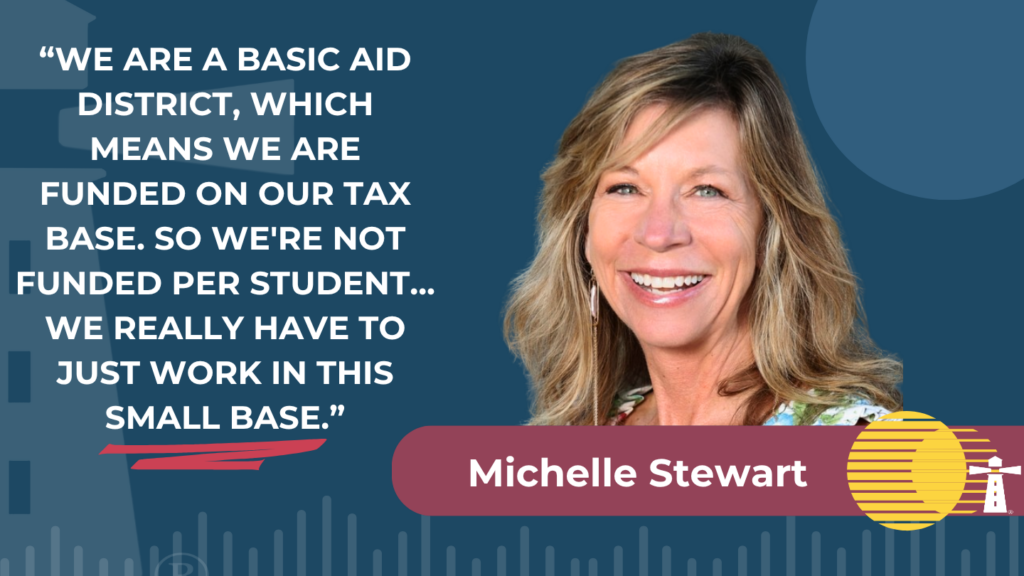
“We are a basic aid district, which means we are funded on our tax base. So we’re not funded per student… we really have to just work in this small base.” — Michelle Stewart
Call to Action
Whether you lead a small district or work in a large one, this episode offers a masterclass in prioritizing what actually moves the needle: seeing, knowing, and caring for every child. Listen now and subscribe to never miss conversations about education leadership that challenges conventional wisdom.
FULL PODCAST Transcript
Lighthouse Therapy (00:01.129)
Hello everyone and welcome to the Brighter Together podcast. My name is Janet Courtney and my special guest today is Michelle Stewart. Michelle is the superintendent and principal at Happy Valley Elementary School District and that is in Santa Cruz, California. Michelle, it’s great to finally have you on the show.
Michelle Stewart (00:22.338)
Thank you, happy to be here. We had a few glitches and so we kept postponing, but today is the perfect day.
Lighthouse Therapy (00:25.342)
Hmm.
Yes, it’s beautiful. actually had a day that the first time was my fault. had I had my eyes dilated and I was like, had no idea what was that was going to be like. So I appreciate your patience with us as we go through this. But tell our listeners a little bit about you and about Happy Valley Elementary. Love that name, by the way. It’s a great name.
Michelle Stewart (00:48.78)
It’s a great name. It’s a great name. My name is Michelle Stewart and I have been in education for 30 years, a long time. I started out as a teacher, taught almost every elementary grade and then was given the opportunity to be a principal when my principal had to leave and I said no. And then she said, just try it. And I said, okay, but I’m not going to leave the classroom. And after I was there for a couple months, I thought, I kind of like this. was in my early forties and I
undergone breast cancer a few years before then and my girls were getting older and I realized how much I liked the connections with the adults both the teachers and the parents and just being able to see all children not just those 29 or 30 in my classroom to be able to see the whole school. So I really did fall in love with administration. After about six years I left that school to go to the district and again I didn’t want to but I was afraid
Lighthouse Therapy (01:39.007)
Right?
Michelle Stewart (01:48.676)
like, okay, if I don’t do it now, what if this opportunity doesn’t present itself again in the future? So I became a director of curriculum and instruction and it came just at the time when California was kind of revamping all the ways that they did funding. And so a bunch, they created this new role in lots of districts called the director of curriculum instruction and assessment. And we looked at how we can kind of unify our schools and
and it went back to more local funding. It’s kind of gone away from that in the last 10 years, but it was super exciting and really fun. And from there, I became the assistant superintendent, so I was in charge of student services. I was in charge of some technology, really had my hands in the budget. So about five years ago, this opportunity opened up for Happy Valley Elementary. And I’d been in a unified TK-12 district before, and this is a, at the time, was a
K6 and there were 130 students and I thought, you know what? I’ve worn every hat. I think I can do this. And so I applied for the job and got it and it was right after COVID. It was in 2021. So my first year, I didn’t even get to see what it was like to be a superintendent principal of a school. got to just give tests and you know, communicate with people about wearing masks and making sure everyone, I mean, we kind of forget all that, right? But just making sure
Lighthouse Therapy (02:57.677)
yeah.
Lighthouse Therapy (03:17.87)
yeah.
Michelle Stewart (03:18.54)
Everyone was separated on the playground only certain classes could use certain equipment and then we’d wipe it down before the next group went out But now this is my it is my fifth year there and we actually are down to about 105 students We are a basic aid district, which means we are funded on our tax base. So we’re not funded per student So even though now we have TK we don’t get extra money for them. We don’t get extra money for lunches
get extra money for all of those things that the state of California gives, we really have to just work in this this small base. A lot of basic aid districts are really wealthy because it means that they make more money than you would if you were funded per student, but we’re really funded on the shallow end. sometimes it would be four or five students would make a difference for us. So that is always a challenge for us. But it’s an amazing little school. We are in the top 10 percent
Lighthouse Therapy (04:11.998)
Hmm.
Michelle Stewart (04:18.096)
of schools in California. We’ve actually been in the top 1 % before. We’ve consistently been on the honor roll, the state honor roll. We have a great endowment fund that helps pay for classroom aids in every classroom. We have art and music every week for every child. In third grade, they start playing the ukulele. We have incredible, incredible test scores, great culture and climate.
Lighthouse Therapy (04:20.989)
Nice.
Lighthouse Therapy (04:42.538)
fine.
Michelle Stewart (04:48.216)
little school with great parent support. We don’t have a whole lot of diversity although two years ago I had two English language learners and this year I have 12 and part of it is because one family with five children moved in and they speak Polish so that’s been fun but it’s you know it’s it’s just because just because you don’t look different doesn’t mean that you don’t still have a lot of internal diversity and things that are challenging.
and opportunities for us.
Lighthouse Therapy (05:20.947)
Yeah. Can I, can we go back just a little bit when you were talking about being funded only by taxes, can you explain that? I, that’s the first time I’ve heard that and I’m, you know, I’m not, I’m not in that, in that, that’s not in my realm. So I’m really curious about how did that happen? Yeah.
Michelle Stewart (05:31.618)
Wow. Sure. Yeah. It’s not real. And I didn’t understand it.
I didn’t understand it until I came here either. So the state of California gives districts money based on students that show up at school. And there’s different funding bases because they’ve thrown so much money into TK. That is one of our, that’s transitional kindergarten. Those are four year olds that, so they have thrown a lot of money. And so they’re the most highly funded students. High school is funded more than
than like fourth through eighth grade so they’re kind of in these four little buckets tk bucket k3 bucket four through eighth nine through 12 and so and so you know back of the napkin math they say okay you get approximately nine thousand dollars per student when you multiply all that if your tax base from your area is higher than that then the state of california goes you don’t need us you just are going to get them
Lighthouse Therapy (06:18.633)
Okay.
Michelle Stewart (06:39.034)
money that you get for your taxes and you can spend it as you want. It’s nice because you get a little more flexibility how you spend your money, but it’s difficult because there’s still mandates. We still have to provide free lunch. We still have to have TK with a one to ten ratio. So you still have to have all that, but we don’t get any of those add-ons. And when you are in a place like we are where four or five students can make a difference, it’s not just, it’s not a straight
Lighthouse Therapy (06:48.799)
Mm-hmm.
Michelle Stewart (07:08.944)
Calculation because you get extra money if your basic aid and you don’t get certain money If you if your basic aid and so it just becomes this very convoluted Decision and some districts decide you know what we’re gonna go ahead and increase our class size and increase our Campus size and get that extra money so we can afford to stay open And then one thing that happened for us a few years ago that I can talk about more later is
Lighthouse Therapy (07:32.607)
gotcha.
Michelle Stewart (07:39.016)
One of the things that I got to deal with was construction. There was construction already in the plans about 10 years ago, long before I got there. And we took down one of our buildings and we’re going to replace it. And once it was down, realized that we’re not funded the same way we were 10 years ago and didn’t have enough money to put that back. And so growing our student body would be difficult. our facilities are pretty
Lighthouse Therapy (08:01.434)
Lighthouse Therapy (08:07.103)
Right.
Michelle Stewart (08:08.73)
small. So, you know, it’s all of those things that affect the next steps for each of the people that are there.
Lighthouse Therapy (08:15.753)
Wow, and you stop at eighth grade, is that right? sixth grade, sixth grade, okay. So pre-K, yeah, TK.
Michelle Stewart (08:18.988)
No, we stop at sixth grade. Sixth grade. Yeah, you can’t be in elementary school district unless you have sixth grade because otherwise you would be absorbed by your local community. You have to have a secondary grade at least one. So we’re TK6. I know.
Lighthouse Therapy (08:28.222)
Okay.
Lighthouse Therapy (08:37.915)
Interesting, interesting. you know, every state has their own nuances and we do a lot of work and serve a lot of kids in California. So I know there’s a lot of nuances with California, but it’s just interesting to hear all of that because it’s not, it’s not something that I deal with every single day, you know, but you obviously, wow, it’s, it’s
Michelle Stewart (08:57.582)
Great. Yeah.
Lighthouse Therapy (09:00.573)
And is it a decision that you as a school and as your board makes or is it something that the state says, no, no, no, no, no, you can’t change that.
Michelle Stewart (09:10.486)
The state says you are basic aid or you are, it’s called ADA funded. Some people say it’s LCFF, which is local control funding formula. ADA is your average daily attendance. Either way, it’s getting money per student or getting money from the taxes. But your local board could decide we no longer want to be basic aid and we would like to start growing and collecting money per student. So first you’d have to get those students and the way you get
Lighthouse Therapy (09:14.185)
Okay.
Lighthouse Therapy (09:23.241)
Okay.
Lighthouse Therapy (09:39.817)
Okay.
Michelle Stewart (09:40.192)
them is by inter-district transfers. you like reach out to other districts and say like we’re gonna take your kids and you know we have an agreement in our county that we will try to do that but you know it’s at the previous district that I was in there’s about I think 20 % 20 to 30 % of their population is from other districts.
Lighthouse Therapy (09:51.441)
Uh-huh.
Lighthouse Therapy (10:06.621)
Yeah, and there’s money that moves around and is sent to this one and sent to, I don’t know how you guys keep all of that straight. I’ll be honest. I’ve heard some of that and I’m like, my goodness. I had no idea. So yeah, yeah.
Michelle Stewart (10:09.268)
It Yup. Yeah. It is. Yeah. It’s crazy. Especially in the small district, it gets a little bit crazier.
Lighthouse Therapy (10:22.183)
Yeah, yeah. So, so tell us a little bit more about like happy value. Like what kinds of things do you do you say make it different from some of the other schools or just make it happy? I love that.
Michelle Stewart (10:35.074)
Well, well.
You know, it is a really happy place. Well for one I only have six classrooms. So I have nine grade levels and six classrooms. So I have to have some combination classrooms, but I have very small class sizes. My largest class size this year is 25 and that’s in a five six combination. I have my TK only has 11 kids. I have a K1 combo that has nine kindergartners and 11 first
So the kindergartners go home after lunch and then those first graders have just 11 kids in their classroom. Because we are so small.
We have to all wear a lot of hats and it’s pretty sweet. The kids are seen, they are known. I mean, the other day I was going through the lost and found and I went, this is Henry’s jacket. this is Celeste’s shirt. Like not only do you know the students by name and their parents by name, you know their stuff.
Lighthouse Therapy (11:23.519)
Yeah. Yeah.
Lighthouse Therapy (11:42.184)
Yeah.
Michelle Stewart (11:43.875)
You know, and then the other cool, cool thing is you can imagine we don’t have a lot of attrition. Our teachers stay. They love to be at the school. And so it’s the same class that moves up, which can cause some problems for our students that, you know, may have some struggles or challenges with other kids. I say it’s sort of like a family in the good ways and the bad ways. But I had a brand new teacher to fourth grade this year. And so she went to the teachers that had all had these kids for four years. Tell me how
Lighthouse Therapy (11:51.871)
Right.
Lighthouse Therapy (12:03.965)
Mm-hmm. Yeah.
Michelle Stewart (12:13.828)
they work together, tell me what they do, they know them so well and even last year I had some students that were giving their teacher a really hard time and I went and got the previous year’s teacher and she went in there and said you know better than this, I kind of you know told them like and then she said you can’t expect that from them, come on you guys you’re better than this, you can do this so it’s that I mean those are some things that like are just amazing, we know the kids, we know the families,
Lighthouse Therapy (12:41.118)
Yeah.
Michelle Stewart (12:43.744)
We know
We know we can give them one-on-one support all the time. We do have some students on 504s, which are a plan for students that need extra support because they may have anxiety or they may have a medical issue. I wouldn’t say that’s really necessary to have those 504s because we are going to provide those accommodations for those students anyway. But I really want to formalize it and still say this is something
Lighthouse Therapy (12:59.655)
Mm-hmm.
Lighthouse Therapy (13:10.194)
Automatically, yeah.
Yeah.
Michelle Stewart (13:15.864)
no matter where you went, you could have this and use it. And it protects the kid, but it also reminds us a little bit, hey, this kid deserves some extra help here.
Lighthouse Therapy (13:22.228)
Yeah.
Yeah, yeah, for sure, for sure. So is there plans in the future to grow or, you know, and how do you how do you maintain like if you’re at 102 and people watch this podcast and you grow? I mean, do you have do you set limits? Okay. Okay.
Michelle Stewart (13:39.459)
Yeah, yeah. We do. We set capacity limits and it’s very important to our board that we keep that small rural feeling. It is just, first of all.
Lighthouse Therapy (13:50.706)
Okay.
Michelle Stewart (13:53.281)
in order to grow we’d have in order to make money because we continue to deficit spend which means that we spend more every year than we make and so we have some reserve but you know it could be scary if that continues to happen but in order for us to actually make money we probably have to grow by a few classrooms well now you’re taking maybe our art music room for a classroom and now we have to hire another teacher and now we have more
Lighthouse Therapy (14:02.387)
Mm-hmm.
Michelle Stewart (14:23.214)
lunch fees and now we have you know all of those things that come which is wonderful to be able to support more students but we want to make sure that we’re first serving our in-district students.
Lighthouse Therapy (14:38.303)
Mm hmm. Yeah, that makes sense. That makes sense. Absolutely. So then where did the kids go after sixth grade?
Michelle Stewart (14:45.414)
that’s a great question. So they go to the nearby middle school Santa Cruz City Schools is kind of are the oversight, you know, the next group that they go to. And what happens a little bit, and it’s happening this year with quite a few. I haven’t had a group like this do this as they’re going to next year. They could they can go to that school in sixth grade if they want to. So usually they they like to stay at Happy Valley because we they get to go to science
Lighthouse Therapy (14:56.307)
Right. Mm hmm.
Michelle Stewart (15:15.248)
We have, you know, special things that only they get to do. They’re on leadership. They, you know, have a graduation. But also, when they get to go to the middle school, they get electives and they get maybe a broader group of friends. You know, when you’ve been with the same group of kids for like some time.
Lighthouse Therapy (15:33.737)
Six years, yeah.
Michelle Stewart (15:35.811)
six to eight years. It’s a long time and if your best friend is there and you are that kid that just is great wherever you are, it might be a perfect thing for you or you know maybe I would have loved for my girls to be there in sixth grade because they were both kind of on the younger emotional side like you know they would they still like to play you know those games and read and all of those things but if you are a kid that wants sports or elected
Lighthouse Therapy (15:56.701)
Hmm.
Michelle Stewart (16:05.744)
or maybe is a little neurodivergent or you know maybe a little eclectic and they just can find their people a little bit more when they go to the middle school.
Lighthouse Therapy (16:17.361)
Mm-hmm, mm-hmm. So how big is the middle school? mean, it, we’re talking, is it culture shock for them sometimes or are they prepared? Yeah.
Michelle Stewart (16:22.83)
It is at the culture center. It is. is. Especially the one that a lot of them go to in sixth grade. I mean, we do have some charter schools that they have access to. And again, the surrounding districts have a pretty robust agreement of taking students. But the one that my students go to is about 50 % English language learners. And the school, gosh, off the top of my
I want to say it’s 700. It’s a big school. So they go from they go from a school of 105 and where we all go to recess at the same time with all the same people. But for some of those, I mean most of kids do really really well and and a lot of them just thrive and so like my group I had a kind of big group of fifth graders this year going into sixth grade and that about half of them are wanting to go there and sometimes it’s like well my best friend is going
Lighthouse Therapy (16:55.967)
much bigger, yeah.
Lighthouse Therapy (17:04.574)
Mm-hmm.
Michelle Stewart (17:22.764)
I want to go but they all kind of going for different reasons, you know I was said it wins where their parents are like time for them to Spread their wings a little bit, you know,
Lighthouse Therapy (17:23.935)
Hmm.
Mm-hmm.
Lighthouse Therapy (17:34.589)
Yeah, yeah, I can see both sides of it. You know, it’s like your top dog at sixth grade, right? You get to be the big kid on campus, right? But then, you know, you’ve got all these new exciting things at the new school that you’ve never seen. And you know, you know, you’re going there. I see both sides of it for sure. So.
Michelle Stewart (17:37.837)
Yeah.
Michelle Stewart (17:50.509)
I started out teaching sixth grade and it was my absolute favorite grade and I taught in elementary school and I said until March, they belong in elementary school and about March 1st, I’m like, go to middle school. You don’t belong here anymore. So, you know, like I know that you’re gonna ask me like if I could change something, I have a different answer, but if I could change the answer in the education system,
Lighthouse Therapy (17:52.959)
Mm.
Lighthouse Therapy (18:04.255)
Mmm.
Lighthouse Therapy (18:17.044)
Yeah.
Michelle Stewart (18:20.472)
I would say you could be in elementary school until January and then you get to go to middle school. That’s probably how people feel about eighth grade too.
Lighthouse Therapy (18:24.241)
and then go to middle school mid-year. It’s interesting. I wrote a blog years ago now, I’ve been, Lighthouse has been since July of 2018. So we’re almost eight years old. I can’t even believe it when I say that. But I remember one Halloween, I was like, I wrote an article and it was a blog on middle schoolers and how you engage middle schoolers and.
Michelle Stewart (18:40.834)
Wow, yum.
Lighthouse Therapy (18:52.415)
the title of the blog, if I’m correct, was something like, help my middle school children or students have turned into monsters, know, kind of going with that Halloween theme. But you know, how you engage them and how you get them excited about therapy and what works and what doesn’t. And I’m blessed to be really good at what I do. But still, you know,
Michelle Stewart (19:03.054)
Yeah. Yeah. Yeah.
Michelle Stewart (19:11.394)
Yeah.
Lighthouse Therapy (19:19.503)
Every single age has its challenge, but those middle schoolers are there there They are a breed all to their all to themselves all to themselves
Michelle Stewart (19:27.34)
They are. My husband used to teach middle school and he said they’re people they’ve never been before and they’ll never be again. But the other thing was when I taught sixth grade, I was young. I was not old enough to be their mother. And I remember I had a parent teacher conference and the little boy that was such a goofball in class crawled on his mom’s lap. And I thought, you’re still a baby. once, you know, now I have grandchildren, but once I have my own children then, and that’s part of the reason why
Lighthouse Therapy (19:33.487)
Mm-hmm, very good, yeah.
Michelle Stewart (19:57.337)
I loved being a principal because I could I could let parents know like I love your your goofy 11 year old kid and I still know that you see them as that little two-year-old toddler, you know that five-year-old kindergarten or like you still you you still see their heart and that they’re still a kid. They’re still a little kid.
Lighthouse Therapy (20:09.599)
Yeah.
Lighthouse Therapy (20:17.011)
Yeah, yeah, and that’s always the thing that, you know, it’s like, I wanna be an adult, but I’m still a little kid, but then I don’t wanna be a little kid, so I act like, I act out, yeah, yeah, it’s such a, and it’s one of those things where it’s like, there’s a lot of firsts and a lot of lasts in that age, you know? The last time they’re gonna sit on your lap, right? The last time they’re gonna run up and hug you in public and.
Michelle Stewart (20:24.184)
Right? Yeah.
Michelle Stewart (20:35.074)
Yeah, you’re right.
Yeah, you are.
Lighthouse Therapy (20:43.005)
all of those things that you don’t even think about. There’s a last to everything, right? But yeah, yeah. And you don’t know when it’s gonna happen. You really don’t. So I always tell, anytime, yeah, treasure it. Exactly, treasure it.
Michelle Stewart (20:54.082)
treasure it. And that’s what I always say at graduation. say, okay, you’re going to seventh grade, don’t blink. Because, know, all of sudden, they’re in college, you know, like, and it really is like, and sometimes I know sometimes parents are like, I’m trying to blink. Come on, keep going.
Lighthouse Therapy (21:04.105)
Yeah.
Mm-hmm. Yeah.
Lighthouse Therapy (21:16.159)
Exactly. Yeah, it doesn’t it until you’ve been through it in it and out of it. We were talking about this in the other day. I don’t even remember what we were who I think was a I don’t know, around around the table maybe. But we were just talking about Oh, I know it was it was at one of our one of our church events we had the anchor fellowship is the 5050 and older and we were and oh and then there was there was a marriage class, you know, we went to a marriage
thing and they were talking about pink brains and blue brains and men, how men think and how women think and all of that. And we were talking about stages and how, you know, there’s different, there’s your, you know, your stage as a child and those stages that you go through. And then, my goodness, then you get to be an adult and then you’re going through the, I’m getting married and having kids and your fertility and your fertility ends at some point. And then,
Your kids are in middle school and high school and then graduation and emptiness. I mean, it just is like, there’s so many so, and each one of them is so unique. You know, I learned at a fairly decent age. I wish I’d have learned a little bit younger, but I started learning to savor it when they were in, when they were in, elementary school and just going, I’m only going to get them for so long. And then they’re going to be gone, you know, and fortunately for me,
Michelle Stewart (22:36.11)
great.
Lighthouse Therapy (22:40.255)
They work for me. So, you know, I get to see them a lot But my youngest is still in Michigan and we’re clear down in South Texas So I don’t get to see him nearly as much so, you know And he’s actually he’s the one that’s going into the Air National Guard and is not gonna stay with the company I got one more month and then the government gets him for a very long time, but he wants to go back to school So he wants to fly wants to fly an airplane. So and and you have to let them live their dreams. Don’t ya? Yeah so awesome, so
Michelle Stewart (22:48.07)
yeah. Yeah.
Michelle Stewart (22:56.014)
Oh my goodness. Good for him. Yeah, good for him. Yeah, good for him. You do. You do. But even, you know, like you were talking about, like that uniqueness, that’s one cool thing about being in an elementary school principal, because you do get to, um…
Lighthouse Therapy (23:16.991)
Mm-hmm.
Michelle Stewart (23:18.978)
just savor each one of those ages and each one of those kind of developmental milestones and who they are.
Lighthouse Therapy (23:21.343)
Yeah.
Lighthouse Therapy (23:27.739)
Yeah, you make such a lasting impact on their lives. And that’s the thing, sometimes even teachers, we don’t always remember or realize the impact that we’re having, because we’re doing it day in and day out and, you know, jogging along trying to make sure we get everything done. But boy, it’s the amount of influence that we have as teachers and the amount of shaping, you know, I think the only person that does more is the parent, right?
So yeah. Okay, so I’m gonna ask you that question. So you’ve got an amazing group, you absolutely do. But if there was one thing and you can’t choose money, you can’t choose money, but if there was one other thing in your sphere of influence and you could change it and never have to think about it again, what would that be?
Michelle Stewart (23:58.115)
I agree with you.
Michelle Stewart (24:18.924)
that kids were kind to each other.
Lighthouse Therapy (24:21.119)
Hmm.
Michelle Stewart (24:21.302)
I’ve just, thought about that a lot. And you know, I have little grandkids, they’re like two and it comes naturally. It starts early. They’re biting and pulling hair and you know, if one of them grabs something, the other one wants it. But I was in a classroom today and just saw it was not overt, but just the eye roll or kind of under their breath. And you know, we don’t realize what we’re doing, of course.
Lighthouse Therapy (24:31.038)
yeah. Yeah.
Michelle Stewart (24:51.216)
to other people, even as a kid, and those things stay on our hearts and our heads forever. And there’s people that are my age that are in therapy because someone was unkind to them. I just, I wish, like I don’t care that everyone’s friends, I don’t care that you know, everyone gets along in every situation, but I just, I wish that they could be kind. If I could just have a magic wand and say,
Lighthouse Therapy (24:53.343)
Mm-hmm.
Lighthouse Therapy (25:20.745)
Yeah.
Michelle Stewart (25:21.136)
And one of the teachers today said, I’m going to tell you who your partner is and don’t forget when I tell you that everyone can see your face. And I thought that was such a great thing to say before she told the partners because you know, they even just the little eye rollers of the like blowing out your breath or being upset. But I do wish and you know, that’s probably a wish for the world. But I do wish that I could find a way to help students at my school.
Lighthouse Therapy (25:33.641)
Yeah.
Lighthouse Therapy (25:38.259)
Lighthouse Therapy (25:46.505)
Sure.
Michelle Stewart (25:51.146)
Be kinder to each other.
Lighthouse Therapy (25:53.118)
Yeah, that’s a great one. It is a great one because it matters. And you know, one of the things that I that I also learned fairly young is is how to forgive, you know, because forgiveness isn’t about isn’t about the person that you’re forgiving. It’s about you releasing that and giving that away and saying because because the the bitterness and the anger and the frustration that you that you carry with you.
That person may never not even remember you, you know, and that’s horrible to say you’re you’ve got all this angst about somebody and they don’t even remember you. It’s not them that is harming you anymore. It’s stuff that you’re doing to yourself by holding on to it, you know, so so learning how to forgive not for anybody else, but just for yourself is such a great tool to to just to just be able to say, you know what I I just
Michelle Stewart (26:26.584)
Okay.
Lighthouse Therapy (26:50.195)
don’t need to carry that anymore. So, yeah.
Michelle Stewart (26:52.526)
That’s a big thing when I’m disciplining even the little ones is you know they get into this I’m sorry it’s okay and and I tell them you don’t have to say it’s okay it’s not okay that they punched you in the stomach or that they called you a name or said that they didn’t like your hair but you can say I forgive you for saying that or thank you for apologizing and then I think then then maybe we don’t carry it the same way like you know it wasn’t okay that he that he said that to me or he did that to me but
Lighthouse Therapy (27:03.081)
Yeah.
Michelle Stewart (27:22.54)
not going to let it define me or how I feel maybe about that person moving forward.
Lighthouse Therapy (27:25.449)
Right.
Yeah. And forgiveness does not mean that you have to stay in that situation. If you’re in an abusive situation, you do not, there is no forgiveness that you have to stay where you have to continue to physically endure abuse or any of those things. But being able to…
Michelle Stewart (27:45.709)
Did you see my face? The problem is when you’re in a small school and you’re in the same class and there’s not another room to go to and there’s not another playground, sometimes that is why people choose to say, I’m gonna send my kid to a different school. Not because everyone’s awful, but just because for their child’s emotional safety, they don’t need to stay with that situation anymore.
Lighthouse Therapy (28:08.179)
Yeah, absolutely, 1000%. And you know, that’s the beauty of education that you can, you know, and as a parent, you can choose. You can choose where you want your kids to go. You know, it doesn’t, don’t have it. And having that flexibility is some, I know there are some states in some places where it, you know, you’re kind of stuck, but there’s lots of choices if you choose, if you can, you know, but it.
Michelle Stewart (28:18.744)
That’s right. That’s right.
Michelle Stewart (28:31.648)
Eric
Lighthouse Therapy (28:34.237)
But ultimately everybody’s, they’re your kids. God gave them to you. They can give them to us, right? So parents out there, you gotta decide what’s best for your children, right? So, all right, well, Michelle, it’s been fantastic. Tell people where they can find Happy Valley Elementary School.
Michelle Stewart (28:39.18)
Right. Yeah. Yeah. And encourage them. Thank you Janet.
Okay.
Happy Valley is in Santa Cruz, California If you’ve ever heard of the mystery spot, which if you come to the Bay Area You probably heard of it. It is it is a unique little weird mystery place and we’re not too far from the mystery spot We’re about five minutes from the beach. You would have to look for us to find us. We’re very rural There’s no stores or gas stations around but we are a sweet school and I’m so thankful that you we do have a website
Lighthouse Therapy (29:17.759)
Do you guys have a website? Do you have a website? Okay, give our listeners your website if you don’t mind.
Michelle Stewart (29:20.528)
It is www.hvest that stands for happy valley elementary school district dot com.
Lighthouse Therapy (29:33.347)
Awesome, awesome. Well, thank you so much for being on brighter together, Michelle. It has been an absolute pleasure.
Michelle Stewart (29:35.384)
Great. Thank you. Thank you for having me.
The feelings are mutual. All right, take care.
Lighthouse Therapy (29:45.36)
Great.