


Episode Description: Why Top Districts Stop ‘Fixing’ Dysregulated Students
What if everything we’ve been taught about supporting struggling students is fundamentally backwards? In this eye-opening episode, education strategist Cheala Herrera challenges traditional approaches to student behavioral intervention, revealing why top-performing districts are reimagining support strategies.
Cheala Herrera, Plans Coordinator at Cap Rock Academy, brings over a decade of experience working with diverse student populations and transforming educational frameworks. Her groundbreaking insights expose the critical gaps between classroom management and genuine student support.
In this powerful conversation, listeners will discover:
• Why “trying” might be the most counterproductive mindset in student intervention
• How systemic approaches can replace reactive behavioral strategies
• The profound impact of holistic family and institutional support
• Practical frameworks for understanding student dysregulation
• Compassionate alternatives to punitive disciplinary models
Provocative Quotes:
“We have to train ourselves to do things. If we say we are trying, trying gives us that little idea in our head that we can’t do something, that we’re failures.” – Cheala Herrera
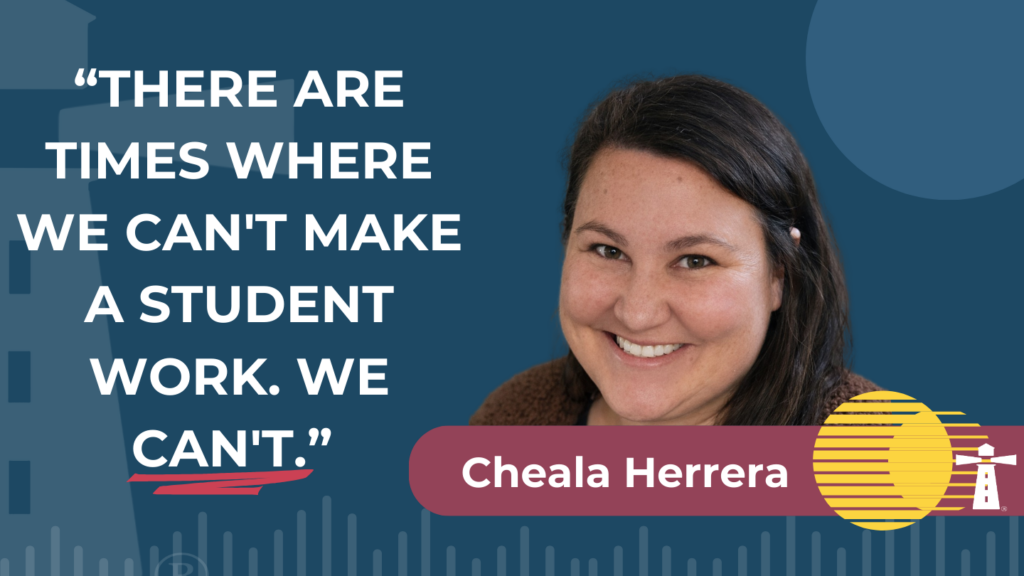
“There are times where we can’t make a student work. We can’t.” – Cheala Herrera
Whether you’re a district administrator, classroom teacher, or educational leader, this episode will challenge your perspectives and provide transformative insights into supporting our most vulnerable students.
Don’t miss this game-changing conversation. Subscribe now and join the movement toward more empathetic, effective student support strategies.
FULL PODCAST Transcript
Lighthouse Therapy (00:01)
Hello everybody and welcome to the brighter together podcast. My name is Janet Courtney and my special guest today is Shayluh Herrera. Shayluh is the plans coordinator at Cap Rock Academy, which is in Grand Junction, Colorado. Boy Shayluh, I had to say that three times before I got it right. Welcome to the podcast.
Cheala (Shayluh) Herrera (00:24)
Thank you so much Janet for having me today. Appreciate it.
Lighthouse Therapy (00:26)
Absolutely,
absolutely. So tell me a little bit and tell our listeners a little bit about you and how you got to the position that you’re in and a little bit about what’s going on at Caprock.
Cheala (Shayluh) Herrera (00:38)
Sounds
great. So I currently live a very blessed life with my husband, our two dogs and our eight chickens. I was born and raised in Southern California and I moved to Colorado back in 2006. So this July will make actually 20 years of me calling Colorado my home. Since moving to Colorado,
Lighthouse Therapy (00:46)
Wow.
Awesome.
Cheala (Shayluh) Herrera (01:04)
I’ve had the opportunity to teach, volunteer, coach, direct, and work with individuals of all ages and abilities. I volunteered with Special Olympics of Colorado as a coach for seven years, served in the youth and children’s ministry for over a decade, and built strong community connections while re recruiting girls to join Girl Scouts of Colorado. The three years here at Caprock,
Lighthouse Therapy (01:17)
Okay.
Cheala (Shayluh) Herrera (01:33)
I’ve been a paraprofessional, middle school, ELA, so language, ⁓ educator for both seventh and eighth graders, as well as my current role is a plans coordinator. So.
The plans coordinator role that I fulfill right now, I service students on IEPs. I service students on 504 plans and I service students on ELL, which is like multi-language learners, learners here at Caprock.
So these are just a few of the things that I do at Caprock is servicing ⁓ multidiverse abilities in different students.
Lighthouse Therapy (02:16)
So you’ve done all of these different things. What I mean, I kind of get, kind of get the progression progression, but what made you go from Girl Scouts into education?
Cheala (Shayluh) Herrera (02:29)
So my heart has always been very well rooted in connecting with my community. ⁓ I have a heart of giving back to the community. I’m very passionate about supporting students with life skills, connecting families with resources, building strong partnerships between families, ⁓ and educators now moving into this home base of Caprock community. pretty much what…
Lighthouse Therapy (02:35)
Okay.
Cheala (Shayluh) Herrera (02:56)
pulled me, what tugged my heart to moving in more of an educator role is really, I could only do so much recruiting girls. I was never a leader of a Girl Scout troop. So I wanted to kind of more so transition into being a leader of.
students where I could be more impactful ⁓ and have that one-on-one or small group or ⁓ meet the individuals in a classroom setting where I can really support them and be more of like a hands-on ⁓ support for those students whether it looks like
⁓ pulling out a book that they’re supposed to be reading, whether it’s helping them scribe to take notes, it could be pulling out a student to support them with their reading fluency. It could also be
giving a student a break. We all need breaks, right? So at times my rule changes from a day-to-day basis. I don’t really have a set routine at Caprock. I kind of fly at the seat of my pants where I transition as I’m needed. But then also I have more of a database role as well where I’m the one developing and ⁓
Lighthouse Therapy (03:59)
Mm-hmm. Mm-hmm.
Cheala (Shayluh) Herrera (04:24)
collecting those observations, the parent input, the teacher input, the student input, the administration input to create, collaborate, connect and communicate with all of these parties and facilitate these 504 and ELL meetings and really just come together as one unit and.
discuss what are the supports, what are the struggles, what can we do better? And what that looks like is sometimes what can we do better is a question I ask the parents. ⁓ Parents support when a kid goes home from school, parents support is such a high
Lighthouse Therapy (04:55)
Mm-hmm.
Yeah.
Cheala (Shayluh) Herrera (05:12)
need that we need to work to be able to work together. That connection with our parent support is so empowering that
In order us to be better equipped and meet these students needs, we have to hold all of ourselves accountable and we also have to do that with love, but also give appropriate consequences. Just because a student may have an impairment, ⁓ which could be ADHD, autism, Asperger’s, dyslexia, dysgraphia, ⁓ maybe it’s their native language isn’t inclusive.
no matter their impairment or their ability, we still have to hold the students accountable. We still have to support them. And one of the things that I learned over time and time again was our students sometimes don’t want to work.
Lighthouse Therapy (06:11)
Mm-hmm, true. Yeah. Yeah. Yeah for sure
Cheala (Shayluh) Herrera (06:12)
And I can relate to that. All of us. There are times
I don’t want to show up to work. I don’t want to walk my dog. I don’t want to go out and ⁓ have to ⁓ respond to a ⁓ code call on campus where I have a dysregulated student throwing, pulling things off the walls or grabbing pencils or ⁓
Lighthouse Therapy (06:17)
Mm-hmm.
Cheala (Shayluh) Herrera (06:39)
going into the opposite sex’s bathroom. There are so many obstacles and issues that we…
go through and support on a daily basis that we all have to collaborate. We all have to work together as one partnership. And so moving forward with ⁓ my role at Caprock, I just want to love these kids. I want to support them the best way I can. But one of the things that it took me about a year and a half to learn is there are times where we can’t make a student work. We can’t.
Lighthouse Therapy (06:56)
Mm-hmm.
Mm-hmm.
Yeah.
Cheala (Shayluh) Herrera (07:17)
⁓ that was such a struggle for me because over and over and over again, it was like, no, but you have this homework. You have this worksheet. We need to finish this classwork. We need to push, push and push. And in all actuality, we, need to meet the student where they’re at. But if they aren’t willing to work, then we need to be quick to supporting the student and say, let’s take a break.
Okay, let’s take a break. Let’s do some breathing exercises. Let’s be mindful because our other friends are trying to learn in the classroom while our instructors are giving ⁓ their teaching support and or an aid is busy with another classroom. We need to be mindful. Sometimes what that could look like is a student stepping out of the classroom with an adult.
Lighthouse Therapy (07:55)
Mm-hmm.
Cheala (Shayluh) Herrera (08:15)
always supervised, always supervised. And walking to the end of a hallway, walking back, getting a drink of water, there were times where sometimes it was like clockwork for me. If a student was dysregulated, I knew like time, time management, I knew it would take 45 minutes for me to help decompress and, and re-regulate
Lighthouse Therapy (08:16)
Right? Yeah.
Cheala (Shayluh) Herrera (08:43)
an individual student to come back to and support them and say, okay, this is where we’re at. This is what you missed and follow through and maybe they’re not ready to go back to class. So maybe the opportunities we have is let’s collect your classwork and let’s go to another safe place, maybe another quieter place. Maybe it’s a dean’s office and we go, we sit together and
we begin working together. ⁓ Sometimes in those scenarios, I’ll set a timer, 10 minutes, give me 10 solid minutes of work, and then we can play ⁓ Hangman on a whiteboard or something like that, where we’re ⁓ focusing on letters and words ⁓ and making it somewhat fun, but also being mindful that whatever a student misses in their class time,
is homework, right? So if they miss that class time, they’re going to struggle to get back and complete their work. So a lot of times I get, I’m known for my patience at Caprock, ⁓ as well as sometimes I do too much and I have a hard time saying no.
But that’s also like one of the gifts I feel like I have is meeting those students where they’re at. ⁓
Lighthouse Therapy (10:10)
Yeah,
yeah, yeah. And I love the fact too that you recognize that there are consequences for their actions, you know, and that there’s it’s not just you have a disability so you get a pass. That’s not the reality of the world that they live in or the world we live in. None of us get a pass. Nobody’s going to. And that’s I think that’s part of what we’ve seen in a shift in society where people think they should get a pass. And it’s like, well,
Cheala (Shayluh) Herrera (10:25)
Absolutely.
Lighthouse Therapy (10:40)
you can take that pass, if you take that pass, understand that X, Y, and Z is going to happen and that’s on you, not on anybody else. And then they’re shocked. It’s like shocking that, wow, you know, so, and that’s an executive function that these kids needs to know and understand, you know, and understand that, you know, yeah, you can have a bad day. Absolutely.
Cheala (Shayluh) Herrera (10:59)
Absolutely.
Lighthouse Therapy (11:04)
Absolutely have a bad day. Everybody has it has bad days. I have bad days. You know, it’s just that’s that’s human. We’re human. But understanding that that homework that that schoolwork, the rest of the people in the classroom are not are not responsible for your bad day or your dysregulation will help you through it. We absolutely will help you through it and we’ll love you through it. But that doesn’t mean that you get to not do anything. It’s just like, hey, you know, yeah.
Cheala (Shayluh) Herrera (11:22)
Right.
Absolutely.
Lighthouse Therapy (11:34)
Yeah, so good.
Cheala (Shayluh) Herrera (11:34)
And that’s kind of a little bit of the push and pull that we get from families. ⁓ I like to say families because sometimes students ⁓ are separated from their families and so it’s not always they have both mom and dad. Sometimes it’s they live with an aunt or maybe they’re a
Lighthouse Therapy (11:51)
Mm-hmm.
Cheala (Shayluh) Herrera (11:57)
a child of the foster care system or maybe they’re adopted and so most of our kids, I mean…
I look at life and I go, if we all had a, we all might have a diagnosis of some kind, some sort, or we all have been exposed to some form of trauma, right? But when it, when it goes to connecting with those families and asking for their support at home, meet us at the same page. We’re disciplining here. And if you, if you at home are just allowing more and more screen time, more and more
Lighthouse Therapy (12:13)
Mm-hmm.
Mm-hmm.
Cheala (Shayluh) Herrera (12:34)
time to play more and more of these other obstacles and missing out on a little bit of homework time, right? Set a timer for an hour. Set a timer for an hour and after that set up the timer for 15 minutes. Give the student a break. Set the timer again for another hour.
Lighthouse Therapy (12:43)
Right.
Yeah.
Yeah.
Cheala (Shayluh) Herrera (12:56)
follow through at home like that, that in itself, if we had every family member support the students that are in education right now, I mean, our, our world could look differently. Really good, really good. And, and
Lighthouse Therapy (13:13)
Yeah, yeah, for sure, yeah.
Cheala (Shayluh) Herrera (13:18)
The best part is when I have those conversations in those in-person meetings and when I have like a high school student, right, just not wanna do the work at home. And so I ask them, what time do you get home from school? Four, okay. What time do you have practice? You know, for two hours, so six o’clock they get home from practice, okay. What time is too late? Too late.
Lighthouse Therapy (13:41)
Mm-hmm.
Cheala (Shayluh) Herrera (13:47)
that you go to bed, 2 a.m. Okay, let’s just say 11. Let’s just say 11 p.m. So from six to 11, you’re eating dinner, and that still leaves you with a few hours, right? A few hours to knock out your homework. So don’t tell me that we don’t have time. It’s about training ourselves to make the time.
Lighthouse Therapy (13:49)
Oof. Yeah. Yeah.
Mm-hmm
Right?
Mm-hmm.
Cheala (Shayluh) Herrera (14:11)
Right?
Like, and that’s one of the things is very interesting. a a few Sundays ago, ⁓ I was listening to a really good message by one of the senior pastors and one of the conversations and that I’ve had following and following and following me, ⁓ from, from that day was basically we have to train ourselves to do things.
If we say we are trying, trying gives us that little idea in our head that we can’t do something, that we’re failures. So if we train ourselves, right, if we train and start new habits, we can be so successful, right? We can learn things. And so ⁓ I just love the fact that like,
Lighthouse Therapy (15:01)
Mm-hmm.
Cheala (Shayluh) Herrera (15:08)
Even though I have conversations internally with staff, sometimes I don’t feel like I’m getting all the answers I need, right? Like on campus with my friend group, but sometimes hearing those messages, those sermons at church feed in and are so relational to where I’m personally at in my life. And I’m able to take that message and translate it into my everyday job.
Lighthouse Therapy (15:34)
Right.
Cheala (Shayluh) Herrera (15:35)
That’s really the power in my eyes of God and how he uses me through these experiences.
Lighthouse Therapy (15:42)
Yeah,
for sure. Absolutely. Absolutely. That’s so great because it just there’s so many things that you can that you can can take from your spiritual experiences into your work experiences and from your work experiences into what you need what you need to help from God with, you know, and where you where God’s going to work in your life. God doesn’t work in just
Cheala (Shayluh) Herrera (16:03)
Absolutely.
Lighthouse Therapy (16:07)
one little section and he and the hard part is he doesn’t work on only the things that you want him to work on either. You know, like, it’s like, no, I don’t want to hear that right now. Lord, I don’t want to work on that right now. But you have to, you know, I mean, because he’s gonna he’s gonna he isn’t gonna just address what you want him to address. He’s going to address all of it and show you where yeah.
Cheala (Shayluh) Herrera (16:14)
Right, right.
Yeah.
a larger picture.
Lighthouse Therapy (16:30)
the spirit is going to guide you and where where you where you need to improve or where you need to listen better or whatever. And you know, not everybody not everybody believes the way you and I believe. But I do think that there is. ⁓
There we are prompted we are all prompted to do things and whether you whether or not you believe that’s the Holy Spirit is up to you But ⁓ but there is that some people call it consciousness someone call it karma call it whatever you want to but but God is so He’s so involved and he’s omniscient and he’s omnipresent. So he knows everything So trying to hide something from him ain’t gonna happen. So, you know
Cheala (Shayluh) Herrera (16:51)
Great.
Right,
Lighthouse Therapy (17:07)
I’ve been there, been there, I think
Cheala (Shayluh) Herrera (17:09)
Yeah.
Lighthouse Therapy (17:10)
I got a medal in that one. So it’s funny because he was really tapping me on the shoulder for two years before I started Lighthouse. I started Lighthouse in 2018 and he was like, I want you to, know, in the last, two years before that, he kept saying, there’s something better for you. And I didn’t want to hear it. I just didn’t want, I’m comfortable. I like right here. I like where I’m at. I like where my kids are at. I like where my life is at.
Cheala (Shayluh) Herrera (17:19)
Really.
Lighthouse Therapy (17:36)
I’m good. I’m really good. And then all of sudden it wasn’t so good anymore. And now I’ve got a problem. And then he comes to me and he says, I want you to do this. And I’m like, that’s hard. I can’t do that. And it’s so funny because I tell people this story. You know, it’s like, Lord, I kept saying, Lord, what do want me to do? What do want me to do? And he tells me literally audibly, I heard, I want you to start your own company. And I went, I don’t know how to do that. I can’t do that. And the only other thing, because this is a relationship I have with God, he says, excuse me.
Like, hello, you’ve been asking, you’ve been asking and asking. And then when I actually audibly tell you, you’re going to give me a hard time. So I was like, OK, OK. And it’s been it’s been a beautiful, hard, not easy ride ever since. But but it’s worth it. It’s absolutely worth it. So I think the things that you’re talking about go right along with that. Right.
Cheala (Shayluh) Herrera (18:14)
Right?
Yeah,
yeah, very, very interesting because it’s like one of the things that I love, I love to do every morning is the minute that I leave my driveway, it’s I’m blaring Christian radio station and I just have to have that time just to get me in a great place to start my morning, right? Because no matter what happened yesterday doesn’t, doesn’t define who these students are, right? Like,
Lighthouse Therapy (18:55)
Mm-hmm.
Cheala (Shayluh) Herrera (18:56)
we need to give students the opportunity to make better decisions, to move forward. sometimes I go back to one of the songs that I listened to, I can’t remember the artist, but talking about…
Lighthouse Therapy (19:01)
Yeah.
Cheala (Shayluh) Herrera (19:14)
that’s when you know God’s not done with you yet, you know, and it’s kind of one of those things. There’s always something more that we can give, that we can offer, and it’s really up to us how far of a distance we’re willing to go. Because a big part of it is, you know, I look at life and I wouldn’t be who I am and what I’m doing without that guidance and without the experience that in my eyes he prepared me for.
Lighthouse Therapy (19:17)
Mm-hmm.
Mm-hmm.
Right?
Yeah, all of the things that you do in your life. That’s like when people say like, would you go back and you change this thing? And I was like, no, because I didn’t. It was a tough road, but I had to go through that road to get to here. Right. And all of the things that we’ve done in our lives are the things that bring us to who we are today. Now, there are people that have had trauma and horrible trauma. And I would never say to that person, you needed to go through that to get to and don’t hear that from me. But
Cheala (Shayluh) Herrera (19:54)
Yeah.
Right.
Lighthouse Therapy (20:10)
But there are so many things in my life that I look back on and they are they there the lessons that God and God was walking through me through my own valleys of this, you know, you know, yeah, though I walk through the valley of the shadow of death. I’m with you, you know, God’s with me through all of it. That’s Psalm 20, part of Psalm 23. For those of that don’t know, but it is but it’s just a it’s just a part of who we are and what makes us better at what we do. And I love that.
Cheala (Shayluh) Herrera (20:20)
Right.
Mm-hmm.
Lighthouse Therapy (20:38)
I love that. I love that we can have this conversation on this show, you know, in education. And, you know, it’s like not everything is always in education, ⁓ black and white. It’s not it’s never going to be just black and white. So having the opportunity to have conversations to say, we love these kids, we want these kids to be successful. We want to help them to be accountable and understanding and giving them the skills, those executive function skills to go.
Cheala (Shayluh) Herrera (20:39)
Yeah. Me too!
Lighthouse Therapy (21:05)
Yeah, I really kind of have to organize my day, my evening, my whatever in order to get to the next thing that I need to do.
Lighthouse Therapy (00:01)
So with all of that said, I’m going to ask you this question. I don’t ask everybody, but I ask it pretty often. So if you could fix just one thing in your world can’t be money because we all know that every school needs more money, right? Money is definitely something that all schools say. Gosh, I wish we had more of if you could just and I say miraculously because I’m a Christian, right? But if you can miraculously stick one thing in your world that that is related to your job, what would that one thing be? You never have to worry about it again.
What would that one thing be?
Cheala (Shayluh) Herrera (00:32)
would really have to say communication.
Lighthouse Therapy (00:36)
⁓ okay.
Cheala (Shayluh) Herrera (00:37)
Communication, I think that’s the key to, and it’s not necessarily like going against what I’m doing or for what I’m doing, it’s communication in general, right? Like if we don’t connect and communicate, we’re never going to get to a place where everybody’s agreeing on something. ⁓
Lighthouse Therapy (00:51)
Mm-hmm.
Yeah. Yeah. And
even if everybody doesn’t agree, at least we heard each other, right? Yeah. Cause I think sometimes that, that lack of, of hearing, always tell people when I, when I do this podcast, well, I’m just the active listener in the room, but it takes work. Active listening takes work. You have to pay attention to what’s being said and to the conversation. Cause if you don’t do that, you lose the thread. That’s a bad thing, especially when you’re doing a podcast. So
Cheala (Shayluh) Herrera (01:07)
Right, right.
Right.
Right, right.
Lighthouse Therapy (01:32)
So I totally agree with you. That’s a great answer. So where, Shayluh, should people go if they want to learn a little bit more about Caprock Academy or maybe even you?
Cheala (Shayluh) Herrera (01:46)
information on Caprock Academy, you can go to www.caprockacademy.org. We are a charter school here in Grand Junction, Colorado.
⁓ You can be in touch with me by calling the school’s phone number and they can transfer you over to me. The school’s phone number is 970.
243-1771 You ⁓ can also find me on Facebook. I believe my username I don’t really check it often but ⁓ in terms of knowing what my profile name is but I believe my profile name is Shayluh Marie and there’s probably a photo of me and my husband back when we first started dating
Lighthouse Therapy (02:31)
⁓ Awesome. Awesome. Well, Shayluh, it has been a pleasure to have you on the brighter together podcast. Keep working with those kids. It’s a beautiful thing what you’re doing. And just thank you for being on brighter together.
Cheala (Shayluh) Herrera (02:46)
Thank you so much for having me, Janet. Have a great day.
Lighthouse Therapy (02:49)
Absolutely, God bless you.





Report Card Comments for Elementary Teachers: 100+ Ready-to-Use Examples