

Episode Description
Precios Armstrong, Director of Special Education for a Michigan school district, unpacks the unprecedented wave of student dysregulation sweeping K-12 schools in her 26-year career—and reveals why most districts are adding new interventions instead of returning to foundational classroom management. Discover how COVID-era isolation disrupted critical developmental skills, why screen time is rewiring young brains, and the partnership model that actually moves the needle on behavior change.
Noteable Quotes
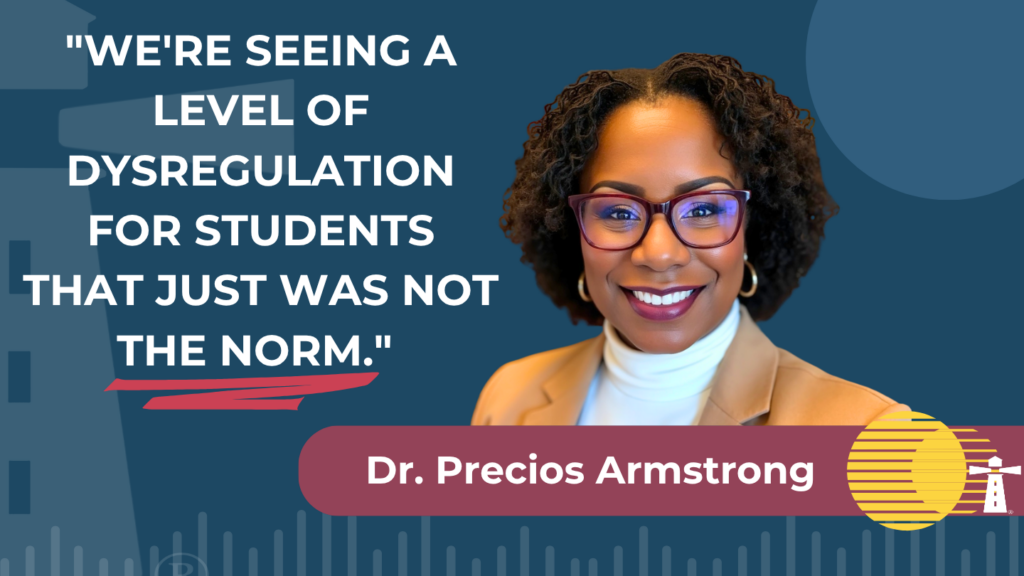
- “We’re seeing a level of student dysregulation that just was not the norm.” [00:07:45]
- “Post-COVID, children were so much more isolated so they didn’t get the same level of exposure.” [00:10:07]
- “We lose out on the opportunity to read someone’s non-verbals as opposed to being a spectator with a device.” [00:12:54]
- “Behavior plans are actually for the adults so that we can change our behavior.” [00:20:17]
- “Everyone needs to assume the positive and come to the table wanting what’s best for the children.” [00:27:21]
Full Podcast Transcript
Janet Courtney [00:00:01]
Hello everyone and welcome to the brighter together podcast. My name is Janet Courtney and my special guest today is precious Armstrong. Precios is a director of special education and we discovered that we both were haunting the areas of Jackson, Michigan. She still works up in Michigan. I have moved to Texas, but we had our paths crossed so many times. It was really a great thing to hear. So precious, welcome to the show. So precious.
Precios Armstrong [00:00:27]
Thank you. I’m excited.
Janet Courtney [00:00:30]
Tell us a little bit about you and your journey to director of special education. And you have some other cool stuff I want to hear about that too.
Precios Armstrong [00:00:37]
So mine is kind of a non-traditional trajectory because honestly, my mom knew I was supposed to be a special ed teacher. Actually, she knew I was supposed to be a teacher from way early in my whole educational timeframe, like university. I, on the other hand, thought I was supposed to go to law school. And so for my first degree, I actually got a bachelor’s in public affairs and policy. And then when I finished, decided I didn’t actually want to go to law school at that point.
Janet Courtney [00:00:51]
Mm-hmm.
Janet Courtney [00:01:02]
Mm-hmm. Yeah.
Precios Armstrong [00:01:03]
And so, you you got to figure out your path. And so the Lord, you got to pray about some things, figure out where you’re going. And so what I ended up doing is I went and worked for the Michigan Department of Civil Rights, working as their bias crime youth coordinator and did that. was like, okay, I love working with kids. I don’t know that I’m loving working in a state department. And so I transitioned to a nonprofit. And again, how your paths line up in spaces and places is important. In that space,
Janet Courtney [00:01:22]
Mm-hmm.
Precios Armstrong [00:01:32]
I was afforded the opportunity to meet some folks who had gone to Notre Dame and had done their program there, which was Alliance for Catholic Education. That program allows you to go and get your masters and get your teacher certification through AmeriCorps. And so I jumped on board, went to Alabama, loved the teaching experience, was not a Southern belt.
Janet Courtney [00:01:56]
I gotcha, okay.
Precios Armstrong [00:01:57]
rubbed back, went right on back to Michigan State knowing that this is what I’m supposed to be doing. I’m supposed to be an educator and then was really blessed to have the opportunity that an assistant principal for a school that I actually went to as a little said to me, okay, so Precios, I’ve got a special ed class for you. I said, I haven’t finished anything and I don’t know anything about special ed, so what are we talking about? And she was like, no, I want you to sub in this class if you try it out for two weeks.
Janet Courtney [00:02:02]
Gotcha.
Janet Courtney [00:02:17]
Wow.
Janet Courtney [00:02:22]
Mm-hmm.
Precios Armstrong [00:02:27]
If you love it, stay. If you don’t love it, no harm done. I fell in love. It was a fourth, split LD categorical class. I had about eight students and I loved everything about it. It touched upon the part of me that really wants to engage with children and make sure children are supported while at the same time touching upon that space in my brain of wanting to problem solve. Like, let’s figure this out.
Janet Courtney [00:02:33]
you
Janet Courtney [00:02:48]
Mm-hmm.
Precios Armstrong [00:02:55]
and we’re going to clear this out together. And so it checked all the boxes for me. And so from there, I said, OK, well, I’m going to need to go back to school. And so I went back, got my special ed, got a second bachelor’s in special ed, got my master’s in special ed, and then took a break after that and just taught. So I taught for a number of years. so just taught everything from at that point, I started off as a CI teacher once I was certified.
Janet Courtney [00:02:55]
Right.
Janet Courtney [00:03:11]
Yeah. She’s an overachiever people.
Janet Courtney [00:03:24]
What’s CI? cognitive impairment, right? Okay, yeah. Yeah, okay, yep.
Precios Armstrong [00:03:25]
So teacher for students with cognitive impairment. So taught in that class for five years, transitioned to being a behavior specialist for that district, went on to be an EI teacher. So working with students with emotional impairments or in some places, emotional behavioral disorders. And so worked there, loved that, transitioned into being a resource teacher. If you notice, I like to figure out how to support kids. And so.
Janet Courtney [00:03:43]
Mm-hmm.
Janet Courtney [00:03:52]
Yep, yep.
Precios Armstrong [00:03:52]
It doesn’t matter what the role I want to be in that space. And so did that. And after a number of years was like, I might want to be able to support more children and support staff as we seek to make sure we’re partnering so that all the babies, because I refer to all the children as babies because they’re somebody’s baby on loan to us. And so I wanted to be able to support them in a greater way. And so then the opportunity came for me to transition into administration.
Janet Courtney [00:03:55]
It’s awesome.
Janet Courtney [00:04:03]
Mm.
Janet Courtney [00:04:11]
Right. Mm-hmm. Yep.
Precios Armstrong [00:04:21]
and I haven’t looked back. And since administration, I have gotten my Ed specialist and my doctorate degrees specifically looking at better ways that I can support children, families, and staff. Because if we’re not all partnering together, what are we doing? Because the babies, they benefit so much better if we are pulling from the same side of the rope and we’re looking at them as a partnership because it’s their journey as opposed to we’re going to hijack it and tell them where to go. No, we’re going to partner with you.
Janet Courtney [00:04:36]
Mm-hmm.
Right.
Janet Courtney [00:04:48]
Mine.
Precios Armstrong [00:04:50]
to see how we can together empower greatness. So that’s, know, kind of a little bit of something.
Janet Courtney [00:04:54]
Awesome. Yeah. And again, more overachieving again. Amazing. She is just absolutely amazing. She is actually Dr. Armstrong. had introduced her as Dr. Armstrong had I known, but good for her. You’re amazing. my gosh. So cool. So, so what, what, what’s happening now? Where, I mean, it’s like, are you settled for a while? Do you think you’re going to stay where you are? I mean, I know you’ve done a lot of amazing things, but what’s, what’s, what’s in, in Precious’s?
Precios Armstrong [00:05:09]
you
Janet Courtney [00:05:24]
career path now.
Precios Armstrong [00:05:25]
I say to folks, I don’t know what I’m going to do when I grow up. That’s what I always say because you never know what path is going to be opened up for you and where you should be guided to. And so at this point, this is where the Lord has placed me for this for this space and this time. And I’ve had the opportunity in this role both in how I’m helping to guide this district as well as looking at the work that I can do nationally. And so one of the things that I’m able to do is I also serve on the International Board.
Janet Courtney [00:05:33]
Mmm.
Janet Courtney [00:05:38]
Mm-hmm. This season, right? Mm-hmm.
Precios Armstrong [00:05:55]
for the Council for Exceptional Children. am one of the member at large. I’m also the immediate past president for the state unit for Council for Exceptional Children for here in Michigan. But I also, because again, I don’t know how to sit still, I’m also an adjunct professor in two special ed programs. I teach, so Central Michigan is one where I teach in the program for individuals that are aspiring special ed teachers. But I also,
Janet Courtney [00:06:13]
neat. Where’s the what school’s data? OK, CMU.
Precios Armstrong [00:06:23]
I’m an adjunct with Grand Valley and I specifically teach individuals who are pursuing their special administration certification and degree. So I look at this space and time of an opportunity to pour into individuals that are doing the work so we can collaboratively move this forward in a global way as well as how we are looking at building up that pipeline of individuals to continue this work because
Janet Courtney [00:06:49]
Mm-hmm.
Precios Armstrong [00:06:50]
I want to see people whose passion and purpose is to support students in special education. And I want to see that we’re pouring in ways that we are seeing ourselves as servant leaders and seeing ourselves as building resources and truly unlocking the key to how to best support students as their whole selves. And so I see for myself, how can I continue?
Janet Courtney [00:07:11]
Mm-hmm.
Precios Armstrong [00:07:14]
to pour into all of those that I have the opportunity to be in contact, be in this sphere with. And so what is next? Only the Lord knows, but I’m enjoying the ride right now.
Janet Courtney [00:07:23]
Yeah, yeah, yeah, that’s amazing. So one of the things that we talked a little bit about is some of the difficulties kids are seeing, that you’re seeing in kids now. Can you give us some insight into what your experience has been and kind of what you guys are doing to help them? Because it’s the littles, right?
Precios Armstrong [00:07:45]
Absolutely. We’re seeing universally in K-12, we’re seeing behaviors that we just didn’t see before. And by that I say we’re seeing a level of dysregulation for students that just was not the norm when I think back over my 26 year career. So we’re seeing this level of dysregulation, this level of inability to communicate their needs. We’re seeing…
Janet Courtney [00:08:00]
Mm-hmm.
Precios Armstrong [00:08:11]
just a difference in how we’re coming to this space academically. But with that behavior, the level of dysregulation, mental health concerns, because we’re seeing so much more mental illness in young people that just wasn’t even a thought before. And I think, and with that, you’re seeing self-harm as well as physically acting out behaviors. And I think when we look at that, one of the things that we’re trying to see
as systems is first, what is happening? How can we describe what is occurring before us? Is it that we’re seeing overstimulation? Is it we’re seeing students inability just kind to integrate into a typical situation and know what’s expected of them with that? Or is it that we’re seeing, hold on, or is it that we’re seeing just an overall
Janet Courtney [00:09:03]
No worries.
Precios Armstrong [00:09:08]
difficulty with knowing who they are as a person. And so with that, we’re just, what we’re seeking to do is build up toolboxes because we know that we have amazing people that are providing these services and supports for these babies, but having the right tools is critical. And so as a solution, we’re seeing increased behavioral management training. So looking at how we can unlock critical tools to support the babies.
Janet Courtney [00:09:27]
Right. Yeah.
Precios Armstrong [00:09:38]
But also going back to the basics, going back to the basics of what are our tier one practices looking like? How are we managing classes? How are we giving targeted praise? How are we giving targeted correction in love and grace? Because, and while offering the opportunity for students to demonstrate that they understand how to move forward. And so I see the solution, I see the issue being an overarching piece. We have children that have varying degrees.
Janet Courtney [00:09:53]
Right.
Precios Armstrong [00:10:07]
of interactions with each other and adults such that before, and I’m really gonna go before COVID, before COVID, it was natural to be able to interact with each other. It was natural for them to have that unstructured place so they could build those critical developmental skills for connecting with each other and adults. Post-COVID, we see these children were so much more isolated so they didn’t get, they often don’t have the same level of exposure.
Janet Courtney [00:10:14]
Right, right. That’s OK.
Precios Armstrong [00:10:37]
So as schools, we gotta relearn some things. Go back to the basics of how are we building our classroom management? Do we have clear and consistent routines to build for babies? Are we reteaching constantly? Because again, we need for those skills for the babies to regulate, we need that to always be at the forefront. So we’re constantly practicing. Otherwise, the generalization of those skills is not gonna occur. So I see the solution being.
Janet Courtney [00:11:03]
Yeah, yeah.
Precios Armstrong [00:11:06]
building up our toolboxes so that we have an arsenal of ways in which we can support students through various different strategies, while at the same time really renewing our commitment to foundational management within classrooms.
Janet Courtney [00:11:23]
How much of this, I know COVID is a big piece of it and the isolation and now they’re coming into school and they don’t have those skills, but are you seeing also the screen time and cell phones and big old tablets? always cringe when I, I know parents are doing the best they can, please parents don’t think I’m judging you, because I absolutely am not, but they’re sitting there with a tablet.
you know, so that they’ll be quiet so mom can do her shopping, you know. So but do you do you see that as part of the cause of some of this?
Precios Armstrong [00:11:58]
I do think the screen time is a contributing factor. Again, I love an iPad and we know that we are all connected to these smartphones. That being said, there’s a lot of reason, I know, right? Cause we don’t really know how to function without them anymore. But that being right, knowing that some of us remember dial-ups. there’s that.
Janet Courtney [00:12:03]
Mm-hmm.
Janet Courtney [00:12:08]
Yeah, gosh, yeah, it’s right there. Yeah. Uh-huh, it’s kind of sad.
Yeah, some of us some of us remember three channels and we were the remote
Precios Armstrong [00:12:25]
This is true. This is very true. But one of the things we know is that the constant stimulation that you get from these phones, from these iPads and computers, it kind of rewires how we look at things. It rewires young brains. And so things that were not even an issue when those of us that are a little more seasoned, they weren’t even a thought for us. But you fast forward that you have
Janet Courtney [00:12:48]
Mm-hmm.
Precios Armstrong [00:12:54]
these babies’ brains that are developing and there is some impact with having so much screen time. We lose out on an opportunity if we have too much screen time. We lose out on the opportunity to have that human connection and to be able to read someone’s, their tales in their face, their non-verbals and their verbals as opposed to being a spectator with a device. And so,
Janet Courtney [00:13:09]
Mm-hmm.
Janet Courtney [00:13:15]
Yeah.
Precios Armstrong [00:13:21]
I think there is research to support it and my own personal theory is if we kind of limit some of that and get outside more, connect with human beings more, that our ability to know who we are in space and time and what our bodies feel like when we’re regulated and dysregulated allows students to have a greater understanding of how they can connect with others and how they can advocate for themselves when they don’t feel all put together.
Janet Courtney [00:13:50]
Yeah.
Precios Armstrong [00:13:50]
as well as when they’re flying high.
Janet Courtney [00:13:53]
Right. Yeah. And and recognizing that’s the first step. You know, the first step to understanding your emotion is just recognizing what they are and how you’re how you’re reacting to them. And little tiny kids don’t think that way. They just are reactive. And that’s part of what you’re seeing, too, is that reaction. And it’s just it’s heartbreaking to see. But, you know, it’s and that’s the society that we live in. You know, it’s like we as educators are figuring it out as best as we possibly can.
Precios Armstrong [00:14:12]
Mm-hmm.
Janet Courtney [00:14:23]
but it’s not going away. It’s really not going away. So you just kind of have to, and I love what you’re doing because you’re getting back to the basics. mean, it’s just like, remember, was, the youngest and I was spoiled rotten. And my parents will tell you, they would have told you they don’t know they’re not alive anymore. They’re in heaven with Jesus. But I remember very clearly as I think it was one of my earliest memories, three, four, four years old, maybe I was a brat. I was a major brat.
Precios Armstrong [00:14:25]
No. Mm-mm.
Janet Courtney [00:14:52]
My sister works for me. It’s so funny. she works with me now and I just love it cause she loves this story because she’s like, she was there and she remembers all of it. Cause she’s seven and a half years older than I am. But all of a sudden I wasn’t getting my way and screaming and having a tantrum and throwing myself on the floor. Wasn’t getting me what I wanted anymore. And my parents, cause my parents looked at me and went, what have we done? Cause, but rightfully so they took it on themselves. I didn’t choose to be that way. It was like,
Precios Armstrong [00:15:00]
Mm-hmm.
Precios Armstrong [00:15:10]
Mm-hmm.
Precios Armstrong [00:15:20]
Right?
Janet Courtney [00:15:21]
I was conditioned and got what I wanted by screaming and throwing myself on the floor. And all of sudden screaming and throwing myself on the floor, wasn’t doing it anymore. It wasn’t getting me what I wanted anymore. It’s that, and you, so you go, how do we fix it? And they did the best that they could and said, no, you know, and oh, no, you don’t get to, and you act that way. You don’t get what you want. So, you know, it’s interesting. Lots of other things I won’t go down too far down that road, but, but yeah, I mean, it’s just like, and, you bring that, but I remember.
Precios Armstrong [00:15:35]
Right? Mm-hmm.
Janet Courtney [00:15:50]
I mean, I as a 58 year old woman, 54 years old when I stopped getting my way because it was part of my development and who I became and understanding that sometimes it works with my husband, but not always. We’re celebrating 31 years tomorrow. yeah, yeah. It’s April 21st today, guys. My son, it’s April 21st, 2026. My son is,
Precios Armstrong [00:15:50]
Mm-hmm.
Precios Armstrong [00:15:54]
Mm-hmm.
Mm-hmm, mm-hmm, mm-hmm.
Precios Armstrong [00:16:11]
fantastic.
Janet Courtney [00:16:20]
27 today. He was born the day before our fourth anniversary and then tomorrow we’re celebrating 31 years. So on the 22nd. So pretty cool. Yeah. Yeah.
Precios Armstrong [00:16:28]
That is a blessing. Our 11th anniversary is May 2nd. So this is a great time frame.
Janet Courtney [00:16:33]
That’s coming up to King Regis. Yeah, yeah. And I tell people I’m like, I’m so blessed he still loves me. Although he’ll tell you he will tell you he was like, yeah, we’ve we’ve had five great years of marriage.
Precios Armstrong [00:16:40]
Yes.
Janet Courtney [00:16:49]
He’s a jokester, but he’s also my CTO. So there you go. So anyway, anyway, little aside there for people, but yeah, it just is. It’s just one of those things where it’s like as, as children understand the world around them and how, how they’re, and taking it to the place where understanding and then how do I react once I figure out that this isn’t getting me what I want anymore? And how does that change my behavior? And how does that move me forward?
Precios Armstrong [00:16:54]
Mm-hmm, mm-hmm.
Precios Armstrong [00:17:16]
Mm-hmm.
Janet Courtney [00:17:19]
It’s critical. Yeah, really critical. So kudos to you for that. That’s awesome. And so have you had to do like professional development or how are you rolling all this out?
Precios Armstrong [00:17:20]
Mm-hmm.
Precios Armstrong [00:17:32]
So one of things we’re really doing is getting back to the basics and looking at how do we support. So we’ve done some trainings, but we’re doing more. So we’re really looking at how we’re developing those structures, going back to, are we really looking at the data? So looking at our data collection, looking at, does all of our staff have a good arsenal of what can we do? So looking at that CPI training, look at other targeted. So nonviolent crisis prevention training is one that helps people
to kind of look at how they are in space and time with regard to when an individual is dysregulated and how to best support them. Also looking at sending them to trainings, going to conferences. So we’ve sent staff to conferences to look at, all right, what are some things that you need that are tools that you feel that you can truly utilize? Because I think one of the issues we run into with training is we’ll do a whole lot of sit and gets in education. But.
Janet Courtney [00:18:26]
Yeah. Mm-hmm. Mm-hmm. We do.
Precios Armstrong [00:18:29]
making sure that in doing the training that we truly look at how can individuals incorporate those skills and not just create a paper trail of, all right, so here’s my binder of things because it’s not useful. So making sure that we’re having real conversations around what does the data show that this student is doing? What are some evidence-based practices we can put in? So going back to not only trainings but
Janet Courtney [00:18:41]
Yeah. Yeah. Yeah. Yeah.
Precios Armstrong [00:18:58]
really, really lifting having those dialogues around a group of providers so that we can see what makes the most sense. Bringing in outside consultants from the ISD, working in partnership with them as well to say, okay, let’s put another set of eyes on this darling to see is there something that we’re missing as we’re working to best support them. Bringing families in really intentionally to talk through what are the things that you’re seeing at home.
Janet Courtney [00:19:11]
Mm-hmm, yeah.
Precios Armstrong [00:19:25]
what’s working, what’s not working, and marrying the scripts that we’re using across home and school so that we’re the same language.
Janet Courtney [00:19:32]
Amen. Yes, that’s critical. Oh my goodness, that’s so critical. Oh my gosh, yes, yes, yes, yes, yes, 100,000%. I have a friend who’s a BCBA and he said, it doesn’t do any good if you create a behavioral plan and the only person that’s implementing that behavior plan is the BCBA. So, and it’s an uphill battle sometimes. yeah, so definitely having and showing and…
Precios Armstrong [00:19:51]
Back, back.
Janet Courtney [00:19:58]
know, parents have a very unique perspective and how a child reacts at home may or may not be what we’re seeing at school and understanding that that, and it could be worse, it could be better, could be, there are triggers, you know, across the board, every child’s death. That’s why it’s individualized IEP plans, right?
Precios Armstrong [00:20:12]
Mm-hmm. Mm-hmm.
Precios Armstrong [00:20:17]
Absolutely, absolutely. I always like to joke with folks that behavior plans are actually for the adults. They’re for the adults so that we would change our behavior so that we can elicit a more positive behavior for the child. And when I frame that for folks, I always go, wait. And I’m like, yeah, it’s really for us because we have to look at how we’re interacting with these babies and own them. OK, sometimes there’s some things we could really do better. And so let’s lean into that.
Janet Courtney [00:20:22]
Yeah.
Janet Courtney [00:20:28]
more positive.
Janet Courtney [00:20:35]
Yeah.
Janet Courtney [00:20:38]
Mm-hmm.
Janet Courtney [00:20:45]
Yeah, it’s behavior modification and helping them to understand and it’s just, then in a way that their little brains can wrap their head around. And as they get bigger, it changes and it’s, yeah, it’s beautiful. It’s beautiful. I was thinking about, you were talking about continuing eds and bringing it back with you. was like, I always felt like if I actually win, I shouldn’t say if, because I did, there were multiple I went to. I can’t tell you a single one off the top of my head right now, but.
when you go to Continuing Ed and you go to a show and you’re taking all these notes and go and get like you were talking about, but implementing, that’s when I knew it was a good, whatever you call it, presentation, sorry, my brain went blank there, when I could take that presentation back, but also plug it into what I was doing as an SLP. And it was just like,
wow, that’s really amazing and I love that and I feel like I got something and then it makes you dig in deeper and especially when it changes the behavior for the child and helps them or changes whatever I’m trying to accomplish so that they can be successful. So that’s great. Yeah.
Precios Armstrong [00:21:42]
Mm-hmm.
Precios Armstrong [00:21:55]
That is the best feeling because then you’re like, OK, we we unlocked it. We unlocked the treasure because the treasure is student achievement. We want to see these babies fly high. I tell parents, I tell staff, I tell colleagues, I’m like, look, we’re really here to give the kids their keys. Here’s the bus, here’s the gas, here the keys, and we are trying to equip them with how to drive the bus and help them with, will support them with their path because again,
Janet Courtney [00:22:02]
Mm-hmm. Yeah.
Janet Courtney [00:22:13]
Mm-hmm, good, that’s a great analogy.
Precios Armstrong [00:22:24]
This is their journey. This is their life’s journey. We are living our own independently. How can we make sure that we’re partnering with them to support that so that when we are no longer around, these babies have the capacity and the ability to do whatever their heart desires. Like that has to be the goal. And with that, try to work yourself out of a job. Because if we work ourselves out of a job, then we’ve done all the things.
Janet Courtney [00:22:25]
Mm-hmm.
Janet Courtney [00:22:42]
Yeah.
Janet Courtney [00:22:46]
Yeah.
Yeah, absolutely, 1000%. And that’s beautiful. I love that. I love that. Keys to the bus and so they can go. It’s incredible because they do. And they, and you never know who they’re going to take with them on that journey. You know, I love the, I love the bus because it’s not just, you’re not just driving your car just for you. There’s lots of people that are going to come on and off your bus as you go through life.
Precios Armstrong [00:23:02]
That’s right.
Janet Courtney [00:23:11]
You know, some of them will be there for a season and some of them will get set down. They’ll put their seatbelt on and they’ll take this ride with you like my husband and I’ve been doing for 31 years. It’s the same thing, you know, just is it. And it’s beautiful when you can, when, you know, even the, good, the bad and the ugly, when you can teach the, kids that there is beauty, even in the darkest places, you know, even in the hard stuff, that’s where you grow. We don’t grow when it’s easy. We don’t grow when, when there’s no problems, we grow.
Precios Armstrong [00:23:18]
Bathory. Bathory. Bathory.
Precios Armstrong [00:23:36]
with him.
Janet Courtney [00:23:41]
when things get tough. So I love that you’re doing that and you’re helping your teachers to get through something that is tough. It’s a tough place to be and it’s a thankless job sometimes that’s for darn sure.
Precios Armstrong [00:23:43]
Mm-hmm.
Precios Armstrong [00:23:54]
Facts. I mean, but we have to always go back and I always just always lift back up even in the toughest cases. Where’s the blessing? This baby came to school. We have the opportunity to support them. That’s a blessing. Even on the hardest days when you want to bang your head against the wall, you go, no, where was the blessing in this? Where was the spark? Because there’s always some sort of light. Sometimes we got to dig through to find it. But leaning into that,
Janet Courtney [00:24:14]
Hmm.
Precios Armstrong [00:24:24]
so that it makes the celebrations when everything is clicking along wonderfully that much greater, that much brighter. And so just always remembering, all right, it may not have worked well today, but tomorrow is a new day and we can figure this out together and celebrate on 10 when everything goes wonderfully. And if it doesn’t go wonderfully the next day, that’s okay. We can celebrate that yesterday was a win.
Janet Courtney [00:24:31]
Mm-hmm.
Janet Courtney [00:24:41]
Mm-hmm.
Janet Courtney [00:24:45]
Mm-hmm.
Janet Courtney [00:24:52]
Yeah.
Precios Armstrong [00:24:53]
Let’s figure out what went well so we can build upon that momentum today. But being committed to being in this journey, being in this space to be able to partner with babies for their success.
Janet Courtney [00:25:05]
Yeah, yeah. And that’s why we do what we do. And there’s just that light bulb moment. You know, those light bulb moments are so beautiful. That was one of the hardest things for me, precious to let go of was, cause when we started Linehouse, I was our SLP. That was it. I was it. I was the first one. And I did all of the service. And then as we started to grow, I can’t go beyond about 55 kids successfully. And we’re at 3,800 students right now. So.
Precios Armstrong [00:25:09]
Absolutely.
Precios Armstrong [00:25:29]
Right?
Janet Courtney [00:25:33]
You know, I had to, at some point I could either be a really good CEO or I can be a really good SLP. I tried to do both and I wasn’t a very good CEO and I wasn’t very good SLP when I was trying to do them. But it was tough. That was a tough, we gotta let that go because now I can help. I can help with what I do serve those 3,800 kids well. yeah, so, you know, it’s just one of those parts of it, right? And you get to, you get to do it. You get to do it. So yeah, 1,000.
Precios Armstrong [00:25:59]
We get to do it. Exactly.
Janet Courtney [00:26:03]
All right, well, I’m gonna ask you one question. I used to ask her all the time and then I didn’t and sometimes I do and sometimes I don’t, but I think it’ll be, I wanna hear what your answer would be. So, cannot say money, right? Cause we all know everybody needs more money. Schools do not have enough money. That’s a whole episode all by itself. It’s multiple episodes. But if you could just…
Precios Armstrong [00:26:25]
Yeah, yeah.
Janet Courtney [00:26:29]
miraculously have one thing in your world that you deal with on a regular basis, whatever it is, what is that one thing if you could make it go away and never have to deal with it ever again and it would just be fixed? What would that one thing be?
Precios Armstrong [00:26:44]
within my career, within school.
Janet Courtney [00:26:46]
Yeah, within your job right now, within your, yeah, with what you’re doing.
Precios Armstrong [00:26:51]
If there was one thing I would fix, I would want everyone to come to the table always assuming the best of everyone at the table. That will be the one thing. I think sometimes whether you’re in the school side or the family side, provider side, I think sometimes in the midst of problem solving, you forget that everyone’s here for the same reason. We all want what’s best for the children. And so if we can all believe
Janet Courtney [00:26:59]
Nice.
Janet Courtney [00:27:16]
Mm-hmm.
Precios Armstrong [00:27:21]
and assume out the gate that everyone wants what’s best and that we may not have the same idea about what that journey looks like, but we can put all those maps together and make some beautiful new map. I think that would be the space that I would want to change is that, because I think that sometimes people, get stuck in a space and then it becomes an adversarial when we should never be in an adversarial space because the babies…
Janet Courtney [00:27:47]
Yeah. Right.
Precios Armstrong [00:27:50]
are not an adversary. So we got it. So that would be the piece. Everyone assuming the positive.
Janet Courtney [00:27:52]
night.
That’s a great one. Yeah, I love that. That’s a great. I knew you’d have a great answer. I just knew it. I just knew you would. Okay, so precious, where do people go if they want to learn a little bit more about you or connect with you?
Precios Armstrong [00:28:10]
LinkedIn is perfect. I am easier find on LinkedIn, so that is the easiest way to connect with me. I do actually check my LinkedIn quite regularly.
Janet Courtney [00:28:12]
Okay.
Janet Courtney [00:28:20]
No, good for you. Mine’s always up on a tab. I don’t always get there, but I will definitely link to you if we’re not. I’ve got a bunch, but, and I’m gonna spell your name for them. So if someone’s looking for you, cause it’s P-R-E-C-I-O-S, Precios Armstrong. Yeah, it’s on the screen. I was able to read right on the screen. so Precios, it has been such a pleasure.
Precios Armstrong [00:28:42]
Love it, love it.
Janet Courtney [00:28:46]
to have you on the show. Thank you so much for giving so generously of your time. really appreciate it.
Precios Armstrong [00:28:52]
Thank you, this has been a delight.