

The Collaboration Shift That 90% of Educators Actually Want
Here’s a startling truth: Nearly every educator you know wants the same thing, yet most schools aren’t set up to make it happen. In this episode, we’re uncovering the collaboration shift that could transform your entire district—and the simple mindset change that makes it possible.
About Our Guest
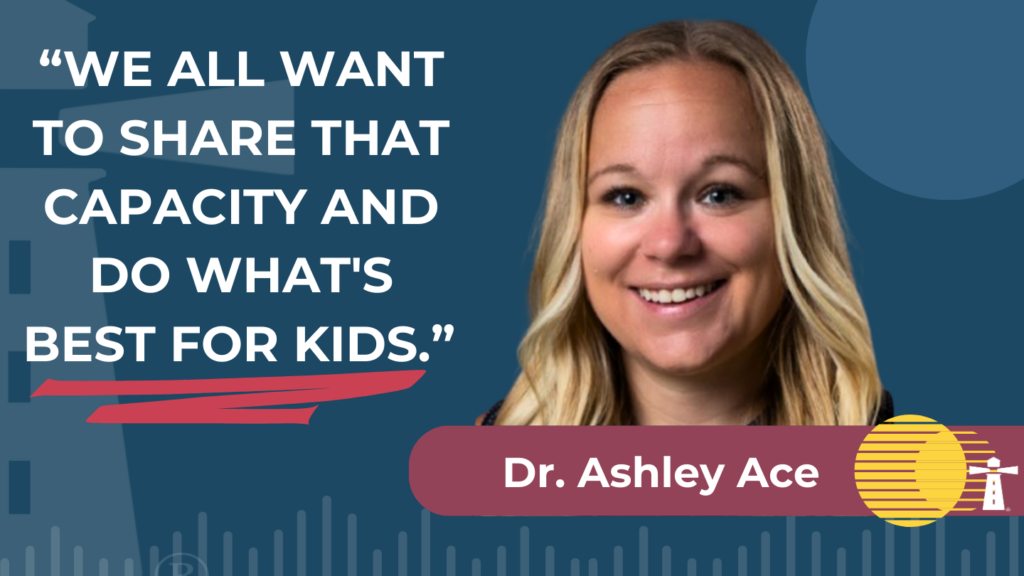
Dr. Ashley Ace is an Alternative Education Coordinator with the Montello School District, bringing years of hands-on experience navigating the complexities of serving diverse learners while building collaborative cultures. Her insights come from the trenches of real school implementation, where she’s learned what actually works when educators put kids first.
What You’ll Learn
Discover why collaboration isn’t just a nice-to-have—it’s the missing ingredient in solving your most pressing challenges. From schedule mismatches to rural connectivity barriers to curriculum-standards gaps, Ashley reveals how educator teamwork creates creative solutions that systems and constraints alone never could. You’ll walk away with practical strategies for fostering vulnerability and openness among your teams, and concrete examples of what truly student-centered collaboration looks like in action.
Key Takeaways
– **90% of educators want to collaborate**—the barrier isn’t desire, it’s opportunity and systems design
– **Cross-functional teamwork generates breakthrough ideas** for your most stubborn instructional challenges
– **Vulnerability and openness** with peers unlock the best solutions for students
– **System constraints actually fuel creativity** when educators work together
– **Shared capacity and collective problem-solving** create sustainable, scalable change across entire districts
Memorable Quotes
“When we work together, we do what’s best for kids, and we’re going to across the board can make big changes.”
“The best times that I have in my room are when the math teacher comes in and he’s got a table full of people…they’re all sharing their ideas and we’re all just talking together about everything.”
“Be really open and vulnerable with your educator peers and be able to come together because again, the best ideas are when we’re all meeting and talking together.”
—
Ready to unlock the collaborative potential in your school? Hit play now and discover how to shift your culture toward the student-centered teamwork your educators are already hungry for.
Subscribe to never miss an episode featuring real educators solving real problems.
FULL PODCAST Transcript
Lighthouse Therapy (00:00.823)
Hi and welcome to the brighter together podcast. My name is Janet Courtney and my special guest today is Dr. Ashley Ace. Ashley is the alternative education coordinator at Montello School District in Montello, Wisconsin. Ashley, thank you so much for being on brighter together.
Dr. Ashley Ace (00:17.464)
Thank you for having me.
Lighthouse Therapy (00:19.479)
So Ashley, tell us a little bit about your role and about Montello.
Dr. Ashley Ace (00:26.774)
Yeah, Montello is a rural district in central, south central Wisconsin. My role as the alternative education coordinator is I support our students who don’t necessarily fit into that mold of the traditional classroom. We are lucky enough to have a virtual school. So the Montello Virtual Charter School within our building, which has been really incredible. So I support all of our students who are fully virtual, who are doing a hybrid version. And then I also support students within
our building who might be considered at risk or are struggling with the traditional classroom. And then on the opposite end, our students who are thriving in the traditional classroom and may need something extended or beyond that. So I’m kind of working to create plans and support the teachers with, again, any student who maybe is struggling with that traditional classroom.
Lighthouse Therapy (01:17.987)
Yeah, the thing that I’m seeing more and more in education is individualized, not just for, you know, for, for years and years and years, IEP’s individualized education plan. You know, it’s like always been about the student, but I’m seeing that come over into mainstream and into, you know, general education, which is so cool because, you know, not everybody’s going to be a rocket scientist. Not every, not every, some kids want to be welders. Some kids want to.
Fix hair, some kids wanna be a stay at home person, you know? And so it’s nice to see that coming, that emerging in education, which is exciting. how much, so how did you get into this role? Like what brought you to where you are today?
Dr. Ashley Ace (01:51.79)
Absolutely.
Dr. Ashley Ace (01:56.686)
Yes, absolutely.
Dr. Ashley Ace (02:05.55)
Well, I started as an elementary teacher, so teaching kindergarten and first grade. And similar to that, right, I was seeing our students who didn’t qualify for IEPs or who the traditional classroom wasn’t working for, and our systems weren’t in place to be able to support those students. And so it kind of happened over time. I started by going back to school and getting a special education license. And that wasn’t necessarily to be a special education teacher, but I wanted to support the kids in the classroom.
And so I was still the regular ed teacher, but I had more training and more resources to support the students that were coming into my classroom with some specialized needs. And so I was able to support them, whether or not they had an IEP or if they did have an IEP, I was able to support them in that least restrictive environment and including them into the classroom. So that’s kind of where it began. And then it kind of evolved from there. And now I’m supporting more of the high school end with some of those.
resources so within our virtual school I am starting to bring in some trade prep programs where I’m able to send kids out of high school with a certificate, right, an industry recognized certificate in HVAC, plumbing, all of those great things. Our virtual school does have a few cosmetology classes so kids can take those as electives. So again, sending them out already kind of having some things under their belt to help them to be more successful. That’s kind of where it started for me, yeah.
Lighthouse Therapy (03:13.295)
Nice, yeah.
Lighthouse Therapy (03:29.313)
Nice, nice. So how many students does Monticello have versus how many are in your alternative program then?
Dr. Ashley Ace (03:37.486)
Well, it’s kind of all over the place right now. We just got into second semester, so I’ve seen it grow, you know, little by little. I have about, I want to say less than 20 in our fully virtual program that are off-site, right? But then I have upwards of 40 to 50 that are just kind of coming in as a hybrid version where they come to me and they say, here’s what I want to do. Do you have anything that can help support that? And so they’re again in the building taking courses here, but then also coming into my space and being able to take a class here and there.
Lighthouse Therapy (03:43.001)
Okay.
Dr. Ashley Ace (04:07.394)
kind of support their needs. So it’s a little bit of both. As for our students who are just kind of in the building thinking about either at risk or advanced learners, again, probably about 20 students that we’re kind of creating plans for on either end of that traditional classroom setting.
Lighthouse Therapy (04:28.259)
Right, so this is not just for severely disabled kids and it’s not just for kids that are at risk of dropping out or something like that. You’ve got the full gamut of things that you guys are doing, yeah.
Dr. Ashley Ace (04:38.433)
Nope. Yep. Yeah, absolutely. And this is the first year that we’ve had this role. So we’re learning along the way kind of what the kids’ needs are and how we can best support them. It’s a work in progress, but it’s been really successful so far.
Lighthouse Therapy (04:52.257)
I was joking in one of our meetings, like we’re building a ship while we’re riding a bike. I was like, they don’t, you know, people say building a ship while you’re sailing it, but it’s no, it’s a little bit, maybe a little bit more complicated than even that. So yeah, so.
Dr. Ashley Ace (04:56.782)
Absolutely.
Dr. Ashley Ace (05:04.608)
It’s no, it’s absolutely, absolutely. The constraints of the system sometimes have to make us be really creative in how we’re going to meet the needs, but we’re here to do that. So yes, all the time. That didn’t work, let’s throw this. absolutely.
Lighthouse Therapy (05:16.781)
Right. And you shift. Sometimes you just have to shh. It’s like, OK, we’re shifting. We’re shifting now. Yeah, exactly. Because you only have them for this much, you know, like this much time. And for those of you that are listening, I’ve got about an inch between my fingers. know, it’s like it’s just there’s not that much time that you get them for. You know, for them, it seems like an eternity. But for us, it’s a blink of an eye. You know? Yeah. So.
Dr. Ashley Ace (05:27.395)
Mm-hmm.
Dr. Ashley Ace (05:32.482)
Yeah.
Dr. Ashley Ace (05:38.84)
Mm-hmm. It is, absolutely.
Lighthouse Therapy (05:42.989)
So what would you say, since this is a new program, are some of the challenges that you guys have faced?
Dr. Ashley Ace (05:46.094)
Mm-hmm.
Dr. Ashley Ace (05:50.314)
I think trying to meld it so often times students will come into my space and their schedules don’t fit, right? I really want to take this class but I can’t fit it in so we’re trying to be creative in those ways. I think sometimes within our fully virtual program being able to connect with the families if they are, you know, the struggles of just being in a rural space where like…
maybe families are living farther away or they only have one car and the parent took that to work. And so some of those constraints I think can sometimes get in the way. Also just kind of matching our curriculums. So we are really wanting to be in a standards-based. That’s been what’s really been helpful in meeting the kids’ needs is making sure that they’re meeting these different standards and showing proficiency. But some of our online curriculum doesn’t match that.
So being able to still continue to support our students in what we know as best practice when the curriculum doesn’t necessarily match that. So we’ve been getting creative and working with the students and kind of digging in deep to some of those curriculums that are more of just percentages and A’s, B’s, and C’s versus standard based. So those have been challenges, but we’re here to kind of work them out and the students are really great at working with me and you know.
Lighthouse Therapy (06:49.358)
Yeah.
Dr. Ashley Ace (07:07.682)
Give me a few days and let me dig into this and come back. So it’s been really good though.
Lighthouse Therapy (07:10.979)
Yeah, yeah, and the standards sometimes even that can be, you know, it’s like, how do you, how do you, when you’re talking about individualizing education and individualizing plans, the standards don’t always line up, do they? Yeah, yeah, yeah.
Dr. Ashley Ace (07:25.184)
Absolutely. So being able to get creative in how we can have students show their proficiency in a way that works for them and also it has to match the system that isn’t always set to best practice. is. Absolutely.
Lighthouse Therapy (07:32.398)
Yes.
Lighthouse Therapy (07:39.587)
Yeah, it’s a broken system. Let’s be honest. It’s a broken system and it’s frustrating. This is where I told you I was like, sometimes I get on my soapbox. This is one of them. It’s like, you you’re trying to put a round peg in a square hole all the time. All that. And then that’s what we’re measured as schools were measured on that. And it’s it’s it’s like, how do you it’s frustrating to me to because you know, you and I both know that everybody that’s working with these kids cares and is working really hard.
Dr. Ashley Ace (07:47.66)
Yeah.
Dr. Ashley Ace (08:05.518)
Absolutely.
Lighthouse Therapy (08:06.753)
And yet you’re held to a standard that doesn’t meet the needs of the kids that you’re working with and makes you look like you’re not doing your job. it’s like, that’s me. I, I, kudos to you. would pull my hair out. honestly would.
Dr. Ashley Ace (08:18.254)
Thank you, thank you. To me that’s the exciting part of education is getting to be creative when the system doesn’t always work itself out or budgets. Right now everybody is just saying we need more support, we need more special education teachers, we need more occupational therapists, we need more people, but we don’t have, there’s just not money in the budget and so how can we share our capacities and share what we know to support kids in the best way that we can. So, that’s been huge.
Lighthouse Therapy (08:23.31)
Yes.
Lighthouse Therapy (08:44.303)
Yeah, yeah, yeah. And that’s a challenge. It’s a challenge every, and it changes every year too. That’s the other piece of it, right? So what do you see for this program? do you see it like exploding, just steady growth? What’s your thoughts about that as it goes, now that you’re a semester in?
Dr. Ashley Ace (08:49.39)
It is.
Absolutely.
Dr. Ashley Ace (09:02.382)
I think it’s gonna be really fantastic. The teacher, Mrs. Crawford, who worked in this position before me, she retired over the summer, and so she laid a really great foundation, which has been fantastic. And then I’m just trying to continue to grow it. And so the little things that I’ve been finding, different things like world languages, right? How can we support those? We know that in these rural spaces, we don’t always…
Lighthouse Therapy (09:25.071)
you
Dr. Ashley Ace (09:28.674)
have a teacher, right? So if we lose a teacher, we get zero applicants sometimes for another Spanish teacher or different things. And so how can I support that online? And so I was able to dig in and find some different pieces. Like there’s a couple of sign language classes within this online curriculum that is really neat and something we probably could never offer on our own. We wouldn’t have enough need for it. But if we have this subset of students who want to take it, and then I’m able to offer it online, it’s been really neat.
Lighthouse Therapy (09:48.719)
All right.
Dr. Ashley Ace (09:57.294)
Also the trade prep program that I was telling you a little bit about has been really successful. We were gonna just do a pilot this spring and kind of see how it goes, but the students have, I’ve already had four or five say, I start it right now? And so I’ve been able to get them into that and support them. Yeah, I’ve had a student who says, know, I, this history, I need a history course, a history elective, it can’t fit into my schedule. Do you have anything? and by the way,
Lighthouse Therapy (10:13.374)
Nice.
Dr. Ashley Ace (10:25.9)
Right, by the way, I’m really interested in religious studies, right? when I leave here, I want to go to a religious-based college, and so I’m gonna dig in deep and try and find, you know, a biblical studies class, if possible, for different students. So it’s been really neat to, again, be able to individualize and give them kind of what they need in those ways that maybe wouldn’t be offered in our traditional classroom settings. So I think it has continued to grow this year.
Lighthouse Therapy (10:39.908)
need.
Lighthouse Therapy (10:53.941)
Neat, neat. So is it like, like the stuff that you’re talking about? Is that kind of similar to like a career center where they can like look and learn and try different things? Or is that kind of is it like that?
Dr. Ashley Ace (11:04.504)
Yeah. Sure, absolutely. we actually, because we have this virtual charter school within our kind of bigger school, we’re able to have a bundle of classes. And then even beyond that, as long as our budget makes it work, we’re able to reach out to our curriculum people and say, hey, I have a student who’s really interested in this. What can we do for them? And they can take the class. And as long as it lines up with our history credits or can be electives or different things,
Lighthouse Therapy (11:11.075)
Mm-hmm.
Lighthouse Therapy (11:30.263)
All right. Right.
Dr. Ashley Ace (11:31.894)
we can match them up and then it can count for some of those courses. So that’s been really neat.
Lighthouse Therapy (11:35.469)
Yeah, yeah, that’s it’s interesting. My son is in the Air National Guard and he’s in two months. He’ll be off to basic training and then he comes back and he has to do technical school and then he has six months on base that they’re going to have him because they’re getting these new F-15 jet planes in Selfridge where he’s he’s in Michigan and he gets a year’s worth of college once he gets past his basic training. I was like.
Dr. Ashley Ace (11:54.382)
interesting.
Lighthouse Therapy (12:02.703)
Well, how do you, what are they, I was asking that the other day, what are they, what does that equate to? You know, like how, and he’s like, I don’t know the formula, mom. I just know that I’m not gonna have to take some of those classes and I’ll be a year in. And I’m like, well, he’s 23. He’s like, he wants to be an engineer and he wants to fly. You know, good things. Those are all good things. But again, it’s like the same kind of thing, but at a, and he’s not young. He’s 20, like I said, he’s 23 and he’s just now seeking college out. And he worked for me, he’s worked for me for the last.
Dr. Ashley Ace (12:21.196)
Yeah, absolutely.
Dr. Ashley Ace (12:26.445)
Yeah, yeah.
Mm-hmm.
Lighthouse Therapy (12:31.305)
He was a 2020 graduate, poor baby. Yeah, so yeah. So the last six years he’s, but you know, I did the same thing. I don’t know what I wanted. I went for a year, quit for a year, went back part time for a year, quit for another year and then got serious. But that’s four years before I was even ready to figure out where I wanted to, what I wanted to do when I grew up. And even that’s morphed, you know? I’m an SLP, but I don’t practice quote every day.
Dr. Ashley Ace (12:39.416)
Wait. What?
Dr. Ashley Ace (12:45.998)
Good
Dr. Ashley Ace (12:49.548)
So.
Peace.
Absolutely, I, you know, when my initial college experience was for an elementary educator and now I’m sitting in more, you know, middle high school type stuff. I still support the elementary, but, you know, as this alternative education coordinator, I never thought I would be interested in working with these high schoolers, but I’ve found that I love them. They’re great, so.
Lighthouse Therapy (13:10.861)
Yeah. And when you have that passion, kids know when you’re being honest or when you’re faking it. They lock onto that authenticity really fast. And when they feel like you’re on their side, it matters. It really matters. They may bluster and, but still, Yeah, so that’s exciting.
Dr. Ashley Ace (13:15.8)
Yes, yeah, when you’re authentic.
Dr. Ashley Ace (13:27.126)
It does, absolutely. Sure, sure. Yeah, we also, what’s really neat too is within our, again, having this virtual charter school, we’re able to support kids based on their needs as well. So if a student is struggling with a math class.
within that program they have classes that called Accelerate to Geometry. So it’s not necessarily this full on, five unit full semester course, but it’s a good basis to get them ready for geometry or algebra. So those have been really neat as well. And then if a student is unable to pass a class or if it’s been a struggle for them and they do fail, we’re also able to support them in some credit recovery courses too so they can.
Lighthouse Therapy (14:15.309)
nice.
Dr. Ashley Ace (14:15.84)
earn that credit back, whether or not that’s with me during the school year or during our summer program, kids are able to do some really neat credit recovery so that they don’t fall too far behind, and can again show proficiency in what they missed throughout the school year. They can show that within our online classes, and then we can meld the two to say, they’ve mastered and showed proficiency in all of the standards, whether or not that was in the classroom a little bit, virtual little bit, but we can see that it’s there and we can get them going. So, it is.
Lighthouse Therapy (14:41.239)
Nice. That’s amazing. one of the things that you these kids that have dropped out, come back there when they do come back, they’re so far behind. So far behind. Yeah. So getting them, you know, getting them the credits they need and getting them as quickly as they can. Cause you know that life is still hard. What made them drop out before is probably still hanging out there. Yeah. Yeah.
Dr. Ashley Ace (14:51.96)
Exactly. Yep.
Dr. Ashley Ace (15:01.506)
Yes. It’s still a struggle. So yes, it’s been really neat to be able to support kiddos, again, on both ends, whether or not they’re taking some advanced courses. Again, we might not have enough students to fill a full calculus class here in rural Wisconsin, but we can offer it online, and then our math teachers support in the building. So that’s been really neat. That’s also something that we’ve started this year is our
Lighthouse Therapy (15:22.031)
Mm.
Lighthouse Therapy (15:26.479)
Nice.
Dr. Ashley Ace (15:29.87)
core subjects have a virtual support hour. So students are able to come into MySpace and get support for math, English, science, and social studies. And then our fully virtual kiddos can also log on. And our teachers are able to support through a video conferencing situation as well. So that’s been really helpful for kids. Before a test, they come in and study or do review packets with the teachers and things like that. So the virtual support hour has been successful.
Lighthouse Therapy (15:32.946)
nice.
Lighthouse Therapy (15:59.641)
So how did you, how did this, it sounds like the person before you kind of helped set it up, but what were the steps that were taken if you know them to get this live? I mean, to get this, to get buy-in, I guess, because you can’t do this alone. You’ve got a district behind you, you’ve got administrators behind you, but you also have to have the teachers and the people that you’re pulling in to do these things. They have to be on board as well. So I’m curious about how that came about.
Dr. Ashley Ace (16:05.262)
Mm-hmm.
Dr. Ashley Ace (16:21.622)
Mm-hmm.
Dr. Ashley Ace (16:27.63)
Absolutely. Yeah. And again, Ms. Crawford did more of that legwork. Absolutely. She was somebody who got this off the ground and got it all running. she, and it was, it was very successful under her. And so the, think just having her, the teacher buy-in was there and she, even though she did a lot of the fully virtual.
She was also still an employee here in the building. So we’re going to all of the PD with the teachers. The teachers are all sharing what we’re doing, right? We’re making, so I’m still having these relationships with the teachers. And our teachers are also ones who grade our online materials. it is still, right? So the students, again, I am an elementary educator by trade. And so I don’t have an English.
Lighthouse Therapy (16:50.477)
Mm-hmm. gotcha
Mm-hmm.
Lighthouse Therapy (17:03.727)
Okay.
Dr. Ashley Ace (17:11.39)
know, major in order to be a licensed teacher. And so our English teachers who are licensed educators in that area are grading and giving feedback. And our science teachers are giving grading and giving feedback for our science classes. And so that’s been really great and kept us all really connected when we’re all collaborating and working with the students on how to support them. So I think that’s part of it too, is being in the building. I think if I was working from home or maybe didn’t have the relationship with the educators, I wouldn’t maybe
Lighthouse Therapy (17:23.363)
Ciao.
Lighthouse Therapy (17:32.034)
Awesome, awesome.
Dr. Ashley Ace (17:41.41)
wouldn’t have as much buy-in, they’ve all been really supportive. So that’s great.
Lighthouse Therapy (17:43.127)
Yeah, yeah, yeah, yeah, for sure. And when you have people that love the kids, know, it’s definitely, yeah. And to see a child be successful who hasn’t been successful in the past is beautiful. It’s a beautiful thing. Yeah, yeah, and seeing.
Dr. Ashley Ace (17:55.982)
It’s absolutely, yep. I have a few elementary students who come up into my space too. And they just, to be able to be like that big kid in our space, they light up too. And you can just see this maturity come out of them because they’re in the big space. And so they’ll come up and maybe do science and social studies in my space. And so it’s just been really great all.
Lighthouse Therapy (18:06.029)
Mm-hmm.
Lighthouse Therapy (18:16.857)
So those are your accelerated kids, the kids that are, yeah.
Dr. Ashley Ace (18:19.214)
Sometimes accelerated, sometimes our students, we have a couple of students who are in our special education program at the elementary level and being in the classroom. Again, inclusion is our number one. We are getting them in as much as possible, but sometimes it’s not the best environment for them or maybe during that certain time. so if they’re taking, they might just take, again, like a hybrid version where they’re in person most of the day, but maybe they’re just taking one science class online or one social studies piece online. And so they will.
Lighthouse Therapy (18:36.772)
Gotcha.
Dr. Ashley Ace (18:48.952)
come up to our space to take that. And so that way they’re not in the special education room. still like, you’re virtual student for this class. You’re to go into the virtual classroom. yeah, they like that a
Lighthouse Therapy (19:00.495)
So when the year begins, because this is logistically, holy moly, this is logistically a lot, a lot. I I know schedules as a therapist and know what that takes, just trying to get 50, 60, 70 kids together and have a time to see them and whatever, and then have them go to that place and get to that place. And my goodness.
Dr. Ashley Ace (19:04.018)
Mm-hmm. Yep, it’s a lot. It is.
Dr. Ashley Ace (19:11.47)
Mm-hmm.
Mm-hmm. Mm-hmm.
Dr. Ashley Ace (19:24.173)
Really?
Lighthouse Therapy (19:24.897)
So how do you, is it something that you guys start like in, I’m thinking about for like the next school year, when does that process start to think about, okay, these are the kids that I, probably not yet, I don’t know, but I should let you answer the question and not try to answer it for you. But how do you do that?
Dr. Ashley Ace (19:31.171)
Mm-hmm.
Dr. Ashley Ace (19:41.39)
Yeah, I a part of my contract is that I do work for six weeks out of the summer. So again, oftentimes teacher contracts have the summer off, but I’m working closely with all of the educators in the building because then I work six weeks out of the summer to help with again credit recovery or any classes that students were not able to fit in during the during the school year. So those those questions are already happening and then I’m just working collaboratively with.
our families at home who are fully virtual. I’m working with our special education or elementary teachers at that level to see what their kiddos need. And it can change because IEPs are not necessarily in September or at semester change. They’re all over, And so oftentimes I will be working with
Lighthouse Therapy (20:25.591)
No, they’re not. Yeah, you can’t do, yeah.
Dr. Ashley Ace (20:31.566)
a family or a special education teacher who will come to me in October and say, hey, the IEP we just met and we think this is gonna be the best environment for them, can you get them signed up for the science class or the social studies class or this piece online? And so we will just work together at that time, right, to get it set up. do, when, so I mentioned how I have the, I have kids in my room all day long, right, it’s just like a classroom.
Lighthouse Therapy (20:49.039)
Gotcha.
Dr. Ashley Ace (20:55.49)
with those fully, those virtual support hours where staff are helping our students, they come into my room so then I get kind of a second prep hour. There’s some prep hours throughout the day, which has been really helpful, whether or not I’m video conferencing with fully virtual families who don’t come into the building to check in on them or how are they doing, or just kind of sending out emails, meeting with our representatives for our fully virtual programs to ensure that we have all of the classrooms set up and that.
Lighthouse Therapy (21:03.072)
gotcha. Okay.
Dr. Ashley Ace (21:24.024)
passwords are working and technology is working and all of that good stuff. that has been really helpful logistically wise, right? Because oftentimes I get someone who, again, in October is saying, can you get them in quick? And it’s like, yep, let me, what do they need? You know, they’re in fourth grade, perfect. I will get that set up, get everything taken care of, and then send off their passwords and everything and then get all their workbooks ordered and things. So logistically, it’s been helpful to have those prep hours throughout the day. Yep.
Lighthouse Therapy (21:26.253)
Mmm.
Lighthouse Therapy (21:35.513)
Yeah.
Lighthouse Therapy (21:49.903)
that time, yeah. Amazing, amazing. You’ve gotta be organized, that’s for sure. Super organized. Yeah.
Dr. Ashley Ace (21:53.654)
It is, yes. It’s absolutely, and it’s collaborative. So a big props to our high school principal who has really helped me to meld kind of the two pieces of the in-person and then the online and how can we support all of it has been really helpful. So, yeah.
Lighthouse Therapy (22:11.791)
So one other question and this one is you can’t say money because you know we only every school needs more money but if you could in your world fix miraculously one thing and never have to deal with it again what would that one thing be?
Dr. Ashley Ace (22:20.771)
Absolutely.
Dr. Ashley Ace (22:30.894)
This one might go along the lines with money just because I don’t know that I can fix this either, but it would be technology. know, it’s like yesterday I got some middle schoolers logged into their online Spanish class and they know more about technology than I do. They’re fantastic. Some keyboards aren’t working and then some passwords aren’t working and you’re like, so it would maybe be that piece, but also.
Lighthouse Therapy (22:38.095)
Mm.
Lighthouse Therapy (22:48.989)
yeah.
Dr. Ashley Ace (23:01.324)
I think just collaboration, think. And 90 % of educators are, we all want to share that capacity and do what’s best for kids. sometimes teachers want to be a lone ranger in their classroom sometimes, and I understand that. But when we work together, we do what’s best for kids, and we’re going to across the board can make big changes.
Lighthouse Therapy (23:16.878)
Mm-hmm.
Dr. Ashley Ace (23:24.686)
If there was one thing, a change or suggestion would just be to be really open and vulnerable with your, you know, with our educator peers and be able to come together because again, the best ideas are when we’re all meeting and talking together. And then we’re just gonna bring in, bring in a lot of really great work. Like the best times that I have in my room are when, again, like the math teacher comes in and he’s got a table full of people because there’s a geometry test that week. And you know what mean? They’re all sharing their ideas and we’re all just talking together about
Lighthouse Therapy (23:36.705)
Yeah. Yeah.
Lighthouse Therapy (23:49.015)
Dr. Ashley Ace (23:53.688)
about everything and the student is just, yeah, it’s fantastic. It’s really good.
Lighthouse Therapy (23:57.335)
Yeah, sounds like it, sounds like it. So I’m sure you’ve piqued the interest of somebody out in our audience. Where would they go, Ashley, to learn a little bit more about this program and maybe pick your brain a little bit?
Dr. Ashley Ace (24:04.12)
for you.
Dr. Ashley Ace (24:09.302)
Yeah, absolutely. So our website is montelloschools.org. And so that is going to be the best place. And within there, you’ll see kind of all of our different schools, because we also have a really cool environmental charter school. It’s called Highmark, so that’s been really, really fantastic. So if you go to our website and you can kind of go out, you can see our schools, and then there’s a virtual school section that will have all of my information in there. So absolutely, that would be a place to reach out to me.
Lighthouse Therapy (24:24.898)
neat.
Lighthouse Therapy (24:35.116)
Okay.
Dr. Ashley Ace (24:38.604)
But if you’re also interested, environmental charter school is again within our building and they’re fantastic too, so check them out.
Lighthouse Therapy (24:44.887)
Awesome. And for those of that are listening and don’t know, Montello is M-O-N-T-E-L-L-O, two L’s, just so we’re clear. I never want somebody to be listening and go, I don’t know how to spell it, can’t find it. It’s not a tough one, but Charlevoix is a little bit harder to spell than that.
Dr. Ashley Ace (24:51.544)
Yep, absolutely. Yep.
Dr. Ashley Ace (24:58.456)
Sir. Sir.
Yeah, absolutely.
Lighthouse Therapy (25:05.109)
You get that French in there and it’s like, my gosh, it doesn’t sound anything like how you spell it. I never could spell very good either. Anyways, I’m so good. One of the best things for me was spell check when I, when I became a therapist and was doing reports and going, look at that. Spell checks and Grammarly. Excuse me. That’s so great. So,
Dr. Ashley Ace (25:11.182)
Yes.
Dr. Ashley Ace (25:18.286)
Absolutely. That’s helpful. absolutely.
Lighthouse Therapy (25:26.797)
Well, actually, it has been a real pleasure to have you on this show. You guys are doing amazing work and you know, the kids win because of what you guys are doing. So thank you for being willing to come in and talk about it.
Dr. Ashley Ace (25:33.71)
Thank you, thank you.
Dr. Ashley Ace (25:38.422)
appreciate that. Absolutely. Thank you so much for having me.
Lighthouse Therapy (25:42.602)
Absolutely.
And there you go.