

Episode Description
Cameron Lazar, Coordinator of Special Education at Cuyahoga Falls City School District, reveals how one critical question changed everything: Why are certain student groups disproportionately identified with disabilities and disciplined at higher rates? Through a six-year equity initiative, Cuyahoga Falls shifted from deficit-based thinking to asset-based practices, proving that inclusive schools aren’t just a nice idea—they’re a strategic imperative that strengthens entire communities.
Noteable Quotes
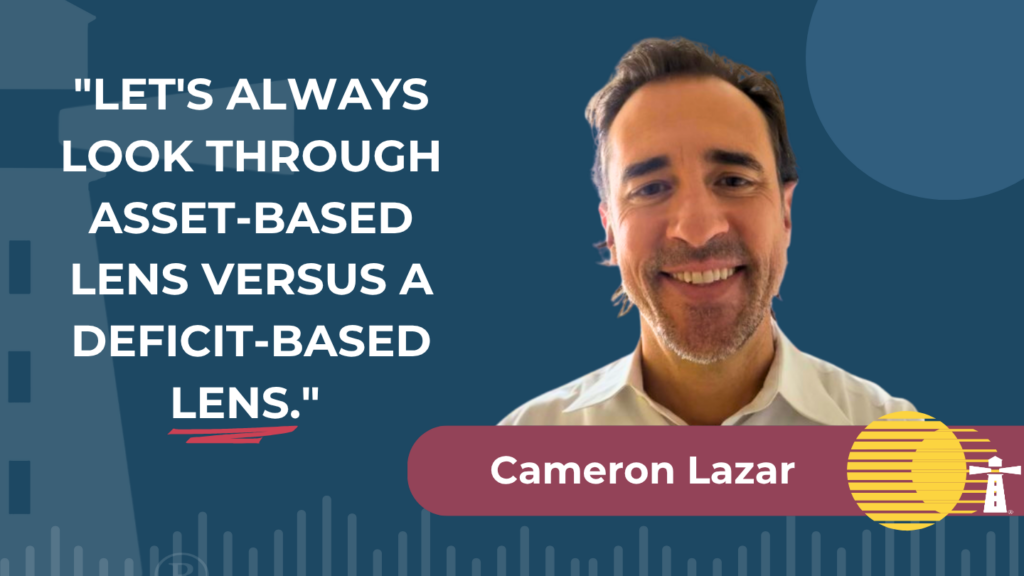
- “Let’s always look through asset-based lens versus a deficit-based lens.” [00:14:19]
- “Everyone that my child encounters makes them a better person.” [00:12:08]
- “We can provide that in the building that you would normally attend.” [00:15:29]
- “It is a confusing place, and it can be very intimidating.” [00:20:07]
- “That’s data we’re not always accustomed to reviewing as school districts.” [00:08:11]
Full Podcast Transcript
Lighthouse Therapy (00:00.694)
Hello everyone and welcome to the brighter together podcast. My name is Janet Courtney and my special guest today is Cameron Lazar. Cameron is the coordinator of special education at Cuyahoga Falls City School District and that’s in Cuyahoga Falls, Ohio. Cameron, welcome to the show.
Cameron Lazar (00:19.992)
Thank you so much, Janet. It’s a pleasure to be here. Thank you.
Lighthouse Therapy (00:23.18)
I’m glad you’re giving us your time. I appreciate it. tell us a little bit about how and it sounds like you’ve been a coordinator for a while, but what was your journey to becoming a coordinator of special education? And then tell us a little bit about Cuyahoga Falls.
Cameron Lazar (00:38.382)
Sure. Yeah. So my journey, I guess, started in Florida where I got my first teaching position in the middle school, just teaching general education science to middle school children. And I transitioned from there after about a decade to administration. So a couple of degrees later and worked as an assistant principal in an elementary school.
Lighthouse Therapy (00:46.134)
Okay.
Cameron Lazar (01:07.394)
The journey kind of took me through like, you know, the foundation of teaching and instructional strategies and pedagogy to administration. So assistant principal left the public school district and went to charter school. So worked with at-risk youth and gang prevention in an at-risk credit recovery charter school partnering with the Manatee County School District.
as well as Manatee County YMCA and the Sheriff’s Office. So I think a super powerful time in my life in terms of like transitioning and beliefs and values and challenging my practice and my beliefs and expectations. Wonderful experience. Spent a little time outside of education with a think tank out of Sarasota, Florida, working predominantly with the military and
curriculum evaluation, as well as program management. So that was an amazing experience that really, I think, helped me, an opportunity that helped me grow my skills significantly. Family, because we’re from Ohio, brought us back to Ohio shortly after that, where I found myself running a credit recovery program here in Cuyahoga Falls as the executive director, working
Lighthouse Therapy (02:06.09)
Mmm.
Lighthouse Therapy (02:25.698)
gotcha, okay.
Cameron Lazar (02:35.307)
a little bit differently, removed the gang prevention component and still worked with at risk and trauma informed care here in Cuyahoga Falls. And then an opportunity arose within the public school district and I jumped on it as a coordinator of special education. And it’s been a wonderful journey since then, almost a decade here in Cuyahoga Falls city schools. Yeah, so it’s been a wonderful, wonderful journey. Learned quite a bit through that.
Lighthouse Therapy (02:49.846)
Awesome.
Lighthouse Therapy (02:56.576)
Wahoo!
Cameron Lazar (03:04.173)
process. And I think that that really ignites my beliefs and who I am today. I guess that second part of your question, a little bit about Cuyahoga Falls. So we are a first ring suburb of Akron. So we’re just outside of what they call one of the big eight here in Ohio, which is Akron Public Schools. It’s a very large urban school district.
Lighthouse Therapy (03:10.439)
Awesome.
Lighthouse Therapy (03:33.27)
Right.
Cameron Lazar (03:33.631)
and we’re a direct first ring suburb of Akron. So supporting approximately 4,500 students across, we have six elementary buildings, we have a preschool building, and now we have a beautiful new campus, six through 12 campus, which was at one time two middle schools and a high school, separate facilities, now one.
Lighthouse Therapy (04:01.567)
nice.
Cameron Lazar (04:01.774)
And that just opened in January of 2026. So that’s an exciting part of our story here in Cuyahoga Falls.
Lighthouse Therapy (04:04.502)
Love it. Yeah, that is exciting. So did you spend Christmas moving? Like did they have you moving stuff at Christmas time?
Cameron Lazar (04:12.014)
Yeah, I think that conversation is probably a whole nother podcast. Yeah, those that have experienced, you know, consolidating buildings and moving buildings and the logistics around, you know, supporting teachers and staff and physically moving things was, you know, years in the making, quite honestly. So luckily, I wasn’t too hands on lifting boxes.
Lighthouse Therapy (04:17.236)
Ha ha ha ha!
Lighthouse Therapy (04:23.487)
Yeah.
Lighthouse Therapy (04:34.144)
Yeah, for sure. I’m sure. Yeah.
Cameron Lazar (04:40.076)
but certainly supporting staff and the preparation for that and what they can expect into a new space.
Lighthouse Therapy (04:46.518)
Wow. So as the coordinator, are you like the one that’s in charge of the entire special education department? And then, you you manage your instructional specialist, et cetera, et from there. I mean, I know it’s a team effort. I get that. But is that is that kind of your role? Are you kind of at that level?
Cameron Lazar (05:06.924)
Yeah, you know, again, my journey here within the district has changed a lot. Like I was the sole individual responsible for what at the time of my hire was coordinator of exceptional children. So that encompassed special education, it encompassed, you know, linguistically diverse individuals as well as gifted programming and health and wellness. You know, a decade later, yeah, it was, it was, it was quite a bit to take on.
Lighthouse Therapy (05:18.539)
Okay.
Lighthouse Therapy (05:27.328)
Mm-hmm.
You’re Yeah.
Cameron Lazar (05:36.471)
And in our department, you we had some other instructional specialists that I collaborated with. You know, fast forward almost a decade, and I am one of two coordinators under a director. So now we’ve kind of, we’ve sectioned off the special education department specifically because of the vast importance that it is. We have a director of special education and then we have two coordinators. So I have the privilege of being the
Lighthouse Therapy (05:40.246)
Mm-hmm.
Lighthouse Therapy (05:48.459)
Okay.
Okay.
Cameron Lazar (06:04.814)
preschool through fifth grade coordinator of special education. Yeah.
Lighthouse Therapy (06:06.518)
Gotcha, okay. I figured it was probably by grade. That’s typically what you’ll see, is so many that do the littles and then sometimes, depending on the size of the school, right? You can do the middles and then you can do the high or split at six or fifth or sixth grade, something like that. So that makes sense, Yeah, awesome, awesome. So you’ve seen a lot of changes. So what are some of the biggest changes that you’ve seen in the last 10 years?
Cameron Lazar (06:23.79)
Mm-hmm.
Lighthouse Therapy (06:36.17)
Like as far as like special education, mean.
Cameron Lazar (06:38.702)
Yeah, of course.
I would say that some of the most significant initiatives that we’ve really been a part of collaboratively with the district are equity and inclusion of children with disabilities. So we worked really hard, really supported by our Department of Education at the state level around looking at disproportionality. So we’d receive information about
know, different groups of children and diverse groups of children that are more disproportionately identified with a disability or disciplined with higher frequency. And I think this was really an ongoing work that we’re doing collaboratively as a district for about, I would say, six years approximately up until now that really took a look at our data.
and started asking some critical questions. Why? Why is this student group seem to be more disproportionately identified with a speech and language disability? Why is this group that has a speech and language disability disciplined with a higher frequency than this group? So I think that’s also, think the power of that work and that change as a district is the opportunity to sit with
Lighthouse Therapy (07:53.356)
Mm-hmm.
Lighthouse Therapy (08:01.164)
Mm-hmm.
Cameron Lazar (08:11.702)
a lot of great people and have conversations with people that are open to that dialogue and that space, to ask those questions, to be critical about what our data is telling us, because it’s data that, as school districts, we’re not always accustomed to reviewing. We can look at our reading and literacy data. We’re really good looking at our math data, but not necessarily looking at data that impacts us in a different way through more of a wellness lens.
Lighthouse Therapy (08:29.653)
Mm-hmm.
Lighthouse Therapy (08:37.93)
Right.
Cameron Lazar (08:41.154)
You know, that’s been a beautiful change for us as a district to really dig into that work, to commit to that work. And through that umbrella, really taking a look specifically at, you know, why do a predominant proportion of our learners identified with a disability spend a certain percentage of their time away from their peers? You know, and to start having those conversations and
Lighthouse Therapy (09:06.452)
Mm-hmm.
Cameron Lazar (09:10.094)
through the lens of
know, the federal law, really start looking at least restrictive environment in terms of how can we really be true to that in terms of the least restrictive environment is always the general education setting is always where we start with children. Yes, ma’am.
Lighthouse Therapy (09:19.424)
Mm-hmm.
Lighthouse Therapy (09:27.692)
Right, Inclusion, right? Yeah, absolutely. Yeah. And how is that? Are you guys getting there? Is it moving that direction? you, cause I know some schools are a hundred percent inclusion. Like that’s just what they do. A hundred percent inclusion. Others are, nope, we include them in the, you know, it’s such a, it’s a spectrum really. I mean, just across the board, no inclusion, a hundred percent inclusion.
Cameron Lazar (09:41.998)
Mm-hmm. Yes.
Cameron Lazar (09:49.923)
Yeah.
Yes, ma’am. Yes.
Lighthouse Therapy (09:56.429)
And it just depends on who you talk to and where. I don’t think there’s anybody that does know inclusion. I don’t think that’s true at all. But because we love our kids and we want them to be included in. And if you’re a special educator, you know, you want them to be in that group. You want them to be able to be with their peers and just have those. One of the things as an SLP that I always love to do was bring in a quote normal child, especially if I was doing social.
pragmatic groups, know, stuff like that. Who am I as a middle-aged mother of three who, you know, is a white woman going to be the perfect model for these kids who don’t even, you know, they don’t even, there’s, it’s just, it’s just interesting that. So my, my thought was always let’s bring somebody, one of their peers in, you know, or a sibling or somebody obviously with lots of.
Lots of approval, lots, you you never do that just because, it’s, but it’s really, it’s so important. And, it was, I mean, I sat back and went, okay, let’s talk about, they would, and it was, it was lovely to see, lovely to see, give those kids the practice, give them an opportunity to talk to a peer and, and feel loved and included is, it’s just, it’s amazing. So.
Cameron Lazar (10:53.72)
Sure, sure.
Cameron Lazar (11:13.496)
You know, and you saying those things just now, Janet, in terms of like, you know, this quote unquote normal. you know, we really want our children to be able to participate in the general education setting. You know, it reminds me of something that I’m constantly reminded of from others and share this story. It was a TED talk and maybe I can look it up and share it with you. But a gentleman did research on
families of children with disabilities, severe disabilities with significant needs. you know, looked at a giant sample size. And in the end, one of his takeaways, you know, he asked parents, would you want to take away that disability from your child? Right? That’s a heavy, heavy question. And he said, almost 100 % of the time, parents would say,
Lighthouse Therapy (11:43.137)
Mm-hmm.
Lighthouse Therapy (11:59.309)
Ooh, that’s a big question. Yeah, that’s a hard question.
Cameron Lazar (12:08.826)
For my child, 100%. For my child, I would take away their disability in a second. I would even have to second guess that. For everyone else, no. Because everyone that my child encounters makes them a better person. Which is just, that just gives chills. Something to resonate with that I think really
Lighthouse Therapy (12:28.746)
Yeah. Yeah. Yeah.
Cameron Lazar (12:35.726)
takes you out of the moment and how difficult Cameron is in the classroom or how much he can’t do to having to support Cameron and come together as a team to have that conversation really makes everyone a better person. Unique lens.
Lighthouse Therapy (12:53.708)
Mm hmm. Yeah. Including the Gen Ed kids and everybody that’s around them. And yeah, yeah. And, you know, I’ve said this many times on the show, you know, it’s when we’re as special educators, we don’t see kids as a disability. They have something that is causing them to struggle with learning. But that doesn’t define who they are as a human being.
And that’s the beauty of what we do. And the world doesn’t always see that. And so I think that’s part of our job as special education people is to help the general population, whether it’s in the school or outside of the school, to realize that there is a person with needs and values and loves and likes and dislikes and all of those things. And they just happen to have been dealt this particular hand.
Cameron Lazar (13:50.063)
Yeah. And again, I think as a district to help us remember that point, we use the language, let’s always look through asset-based lens versus a deficit-based lens. that’s really hard to do because we’re so trained to identify your weaknesses. Yeah. What’s wrong and how can we fix that versus what are the assets around your abilities? So I think that’s all.
Lighthouse Therapy (13:54.796)
Mm-hmm.
Lighthouse Therapy (14:02.924)
Hmm.
Lighthouse Therapy (14:19.264)
Yeah, for sure, for sure. So what other things make Cuyahoga Falls City School District shine in special education?
Cameron Lazar (14:31.566)
Great question. You know, we have a, I would say we have a model of allocating resources from a district’s perspective to make sure that it’s equitable. And you referred to it a little bit earlier, this full continuum of services. So we’re on the spectrum of everyone’s included and no one’s included, the other end of the spectrum.
Lighthouse Therapy (14:52.459)
Mm-hmm.
Cameron Lazar (15:01.922)
You know, we really pride ourselves on ensuring that there’s a full continuum of services in the building that you would residentially attend, right? So that’s been a challenge for us, but I think is a significant strength for us to ensure that if you need a specialized classroom where the predominant proportion of your instruction comes from.
Lighthouse Therapy (15:12.043)
Okay.
Cameron Lazar (15:29.004)
an intervention specialist or a special education teacher, we can provide that in the building that you would normally attend of your residency.
Lighthouse Therapy (15:37.613)
And that’s huge. I think that I really want to want people to understand what you’re saying because that’s huge because a lot of times in smaller districts or in other districts, you know, it’s like, well, we have our self-contained classroom in this building and we have our whatever at the county building. You know, we have to, we can’t serve them. So we, we ship them and, not rightfully so some do, mean, you know, but the fact that you guys are keeping the kids with
Cameron Lazar (16:03.64)
Of course.
Lighthouse Therapy (16:07.914)
their peers is incredible. So I love that so much for you and for your kids, yeah.
Cameron Lazar (16:13.197)
Yeah, so it’s a thank you. mean, it’s again, similar to inclusion. It’s a it’s a constant effort that we all have to be mindful of to make sure that we’re able to offer that. But so far, you know, we’ve been very successful.
Lighthouse Therapy (16:27.05)
Yeah, I love the fact too that you have this brand new beautiful building and you know all of this this new this new campus so that probably has made it a little hopefully a little bit easier to be able to maintain that so.
Cameron Lazar (16:42.201)
Yeah, certainly. And the beautiful thing about it is that the architecture firm that we worked with and all of our executive leadership was very mindful of designing the building to meet the needs of some of our most vulnerable students. So there are some beautiful spaces.
Lighthouse Therapy (17:02.788)
Awesome. That’s fantastic. Well, congratulations on that. That’s exciting. And among itself, you know, just the fact that you have is I’ve told this story once before on the show, but when I was in middle school, I was where we went to where I went to middle school because it was one of those things where it’s a bunch of elementary schools that fed into two middle schools that then fed into one high school. Right. And I was at this this middle school and it was a two mile.
Cameron Lazar (17:08.025)
Thank you.
Lighthouse Therapy (17:30.997)
I mean two miles I think and in Grand Island, Nebraska walnut junior high school and they They built a brand new walnut junior high school six. It was six seven six seven and No, seven eight and nine. It’s been forty forty five years ago seven eight nine and It was it had been a college at one point. It was an old building. It was you know
Cameron Lazar (17:55.85)
Interesting.
Lighthouse Therapy (17:56.173)
two and a half miles away, whatever I said, two miles, something like that. My dad would take us in the morning, we always had to walk home, rain or shine, summer, winter, spring, you know, that kind of thing. And yeah, uphill both ways, absolutely. The brand new middle school was built literally across the alley on the next street across the street from my house. And they opened it the year that I went to high school.
Cameron Lazar (18:21.391)
Wow.
Cameron Lazar (18:25.569)
ouch.
Lighthouse Therapy (18:28.419)
So yeah, never got to go. I’ve never stepped a foot in that building, believe it or not. Yeah. So, but yeah, yeah. was big, campus and okay, I’m a little salty about it. But it was, you know, it’s just one of those things where it’s like, man, oh man, why couldn’t they do this like three years ago? So, but yeah. But it was, mean, and now, you know, that building’s probably 40 years old now, so.
Cameron Lazar (18:30.383)
Great story.
Mmm.
Cameron Lazar (18:37.017)
Great story.
I sense that a little bit,
Lighthouse Therapy (18:56.938)
But crazy, crazy, crazy life. Life happens, doesn’t it? It just is. That’s the way it goes sometimes. OK, so Cameron, where do people go if they want to learn a little bit more about Cuyahoga Falls and if they have a question?
Cameron Lazar (18:58.369)
Certainly. Yes ma’am.
Cameron Lazar (19:12.483)
Yeah, that’s a great question. you can certainly, we have a beautiful website recently redesigned in the past couple years, Cuyahoga Falls City School District. Very easy to find and access. You can see departments that are identified very easily and kind of like the toolbar at the top and special education is nestled right underneath there. You’ll find out some information about our department. You’ll find out.
ways to contact us, of course, if you have any questions about anything that we’re engaged in, or, you know, for for families of children, we really try to be a support and a collaborative partner and an ally for our families. And hopefully, I’m speaking to families not only of Cuyahoga Falls City School District residents, but also to any family on this podcast.
Lighthouse Therapy (19:57.27)
Mm-hmm.
Cameron Lazar (20:07.768)
we would be more than happy, and I can speak for our entire department, more than happy to talk to you about ways to navigate the special education landscape. It is a confusing place, and it can be very intimidating. We completely understand that. We recognize that when you sit down at a table as a parent advocating for your child with potentially a group of other individuals from the school district that are telling you,
Lighthouse Therapy (20:17.579)
Yes.
Lighthouse Therapy (20:34.933)
Mm-hmm.
Cameron Lazar (20:36.344)
through a deficits-based lens, here’s the problems with your child and here’s how we’re trying to remedy those. So I say all that to say we would certainly love to be a resource for any family out there that has questions, that is confused, that needs an ally or an advocate, and we’re certainly happy to bridge that gap, which is the role that we predominantly service with our own families and our buildings because we’re
Lighthouse Therapy (20:39.787)
Right.
Lighthouse Therapy (21:03.82)
Mm-hmm.
Cameron Lazar (21:05.41)
You know, we’re not living in the building from speaking from a department perspective. You know, we’re in district office. So we often try to be the bridge that can help explain, that can slow things down, that can have conversations, that can help advocate for children and their families and their needs. you know, and we and we know our buildings, we know the individuals that work there and we can help, you know, ease that anxiety, answer those questions.
Lighthouse Therapy (21:25.483)
Yeah.
Cameron Lazar (21:35.382)
not only again for our residents, but also for others.
Lighthouse Therapy (21:38.209)
That’s a beautiful thing. Thank you so much for that offer because it is confusing and it is, and you know, when as an educator, when you’re, you’ve been doing it for a long time, being able to like step back and break it down for parents, that’s such an amazing skill. So thank you for that. Thank you for what you do for those parents. It’s so incredibly important and keep it up. So Cameron, thank you so much for being on the show.
It has been an absolute pleasure to speak with you and to learn a little bit more about Cuyahoga Falls.
Cameron Lazar (22:12.024)
Thank you, Janet. I’m humbled by the opportunity and look forward to speaking with you in the future.
Lighthouse Therapy (22:18.049)
Thanks. All right.