


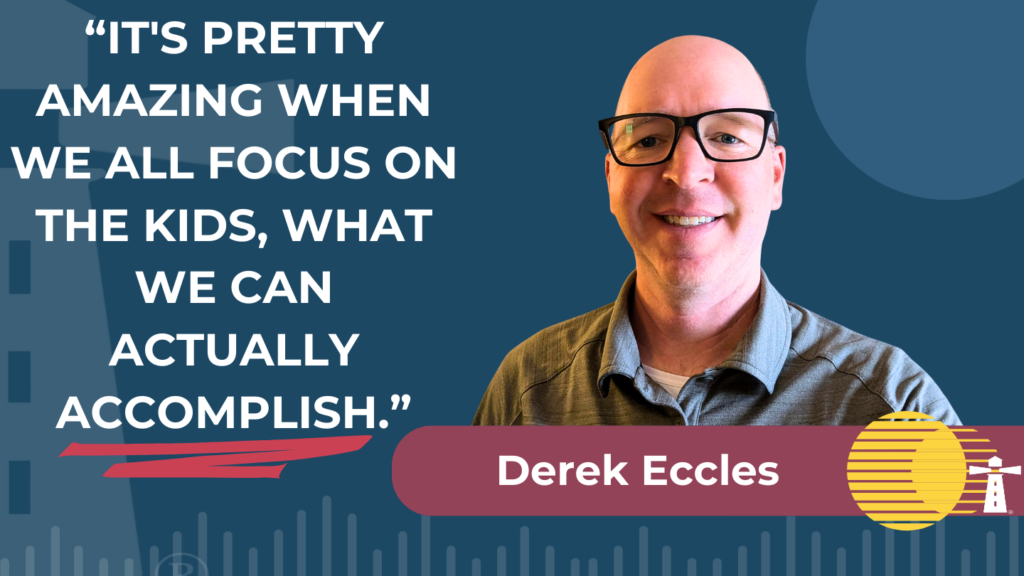
The simple shift that transforms special education meetings from confrontational to collaborative.
When Derek Eccles transitioned from the classroom to Special Education Director at Filer School District, he quickly realized that one of the most powerful tools in his leadership toolkit had nothing to do with policy or procedure—it was about where he chose to sit.
In this episode, Derek shares how small acts of intentionality can dramatically reshape the dynamics between schools and families, reduce conflict, and create genuine partnerships focused on what matters most: the students themselves.
About Our Guest
Derek Eccles is the Special Education Director for Filer School District in Filer, Idaho, where he leads efforts to support students with special needs and their families. Drawing from years of classroom experience, Derek brings both empathy and practical wisdom to his administrative role.
What You’ll Learn
This conversation explores how school leaders can build trust with families during their most vulnerable moments—from reframing how we communicate assessment data to recognizing when team dynamics are hindering progress. You’ll discover:
– Why the physical arrangement of IEP meetings matters more than you think — and how sitting beside parents, rather than across from them, signals partnership instead of judgment
– How to translate clinical language into plain English — making assessment data accessible and less intimidating to families
– The difference between compliance-focused and collaboration-focused leadership — and why parents ultimately just want to be heard and know you care about their child
– When and how to address difficult personalities on your team — without losing sight of your shared mission
– The power of unified focus on students — what becomes possible when administrators, teachers, and families align around one goal
Key Takeaways
✓ Physical positioning and body language set the tone for productive family partnerships
✓ Complex assessment data loses its power to intimidate when explained in accessible language
✓ Parents’ deepest need is to feel heard and to know you genuinely care about their child’s success
✓ Not every team member will embrace collaborative perspectives—and that’s a personnel conversation worth having
✓ When everyone focuses on the student, previously intractable problems often find solutions
—
Notable Quotes
“It’s pretty amazing when we all focus on the kids, what we can actually accomplish.”
“I mean, it’s got to be nerve-racking, right, coming into a meeting, sitting down, and there’s all these other people you don’t know at this table? Sometimes I like to go sit by them.”
“I try to put all the psychological jargon away and just explain what these numbers mean—in ways that everybody can understand.”
“Parents just kind of want to be heard and if they know that you care about their kid and you’re trying, for the most part, you guys are going to be able to work something out.”
—
Ready to transform how your school partners with families? Listen now to hear Derek’s practical wisdom on building trust, managing conflict, and creating genuine collaboration in special education. Subscribe so you never miss an episode that challenges conventional thinking and empowers better leadership.
FULL PODCAST Transcript
Lighthouse Therapy (00:01.144)
Hello everyone and welcome to the brighter together podcast. My name is Janet Courtney and my special guest today is Derek Echols. Derek is the special education director at Filer School District, which is in Filer, Idaho. Derek, thanks for being on the show.
Derek Eccles (00:18.466)
Yeah, thanks for having me. This will be exciting.
Lighthouse Therapy (00:20.97)
Yeah, I’m excited to have you here. So where exactly is Filer, Idaho?
Derek Eccles (00:27.404)
Hmm, it’s a super small town. Well, I say super small, but it is small a little over 2,000 people And we are in southern. Yeah, we are in southern, Idaho Some people know where Twin Falls, Idaho is it’s as the big Snake River Gorge there people come base jumping off the bridge all the time. So We are about six miles or so either
Lighthouse Therapy (00:32.238)
Mm-hmm.
yes, mom.
Lighthouse Therapy (00:41.709)
Okay.
Lighthouse Therapy (00:51.01)
Not me anytime soon.
Derek Eccles (00:54.936)
We’re about six miles west of Twin Falls.
Lighthouse Therapy (00:57.934)
Awesome. So tell us a little bit. You told me before we went started recording that you’ve only been a special education director for two years. How did you get there?
Derek Eccles (01:10.936)
You know, I was a school psychologist for 18 years and I you know when you work in education, you’re always thinking well, what else could I do? You know, it’s not like you’re getting promoted, you know? Working way up the ladder. So I got my Administrator’s degree a few years back thinking man just in case you know an opportunity presents itself. Although I had no desire to go into administration Long story short
Lighthouse Therapy (01:35.592)
Hahaha!
Derek Eccles (01:40.822)
Yeah, so I was in Twin Falls, Idaho as a school psychologist and then Filer, the position opened and I knew some people over there and they were kind of like, hey, you should apply. So I figured, hey, I’ll apply. It’ll be good experience to go through the interview process. And next thing I know, they’re calling on offering me a job and I was pretty surprised and had to make a choice and decided to give it a try. So.
Lighthouse Therapy (01:54.094)
Ha
Lighthouse Therapy (02:02.946)
Wow. So how has it been?
Derek Eccles (02:06.124)
Different. But not…
Lighthouse Therapy (02:07.254)
Yeah. I’m sure from being a school psychologist to being a director, I’m sure. Yeah.
Derek Eccles (02:11.254)
Yeah, I mean a lot of pros and cons. mean the honestly the hardest thing was leaving a district I’d been for so long and I’d built so many friendships and and that was tough. You know my kids are still in that other district too so kind of giving some of that up was was tough and being the boss is hard right not everybody likes what you have to say all the time not everybody wants to be your friend and if they do it’s not always for the right reasons. So learning to manage people has been
Lighthouse Therapy (02:22.444)
Yeah, for sure.
Lighthouse Therapy (02:29.592)
Mm-hmm.
Lighthouse Therapy (02:35.438)
Mm-hmm.
Derek Eccles (02:40.918)
a really good experience honestly. You as much as it’s been a challenge, I’ve seen a lot of skills in myself that I’ve been able to develop and just become kind of a better human being all around and more understanding. And so it’s been good and challenging and a learning experience all mixed into one.
Lighthouse Therapy (02:50.466)
Yeah.
Lighthouse Therapy (02:57.902)
Yeah, yeah, so as a school psychologist, you treating, like doing any counseling or was it mostly assessments? What did your job look like before? I mean, because there’s a lot of different ways you can be a school counselor, right? Or a school psychologist, I’m sorry, I apologize, school psychologist.
Derek Eccles (03:09.706)
I’m a
Derek Eccles (03:13.336)
Sure, yeah. Yeah, that’s okay. You know, people say that all the time. It’s fine. I know. I had to pay to go to school for that title,
Lighthouse Therapy (03:19.102)
I know, but there is a difference and I know the difference.
Right, absolutely.
Derek Eccles (03:26.552)
In the districts that I’ve been in, I’ve been in a few over the years and it really is more of just a testing district. I mean there’s so many kids that are struggling academically, you know, trying to help them get the services and supports that they need. I almost feel like sometimes you’re just doing triage too. You’re like, one school to the next, just trying to solve a solution, find a solution, test a kid, figure out what they need and move on to the next.
However, the school, I was housed at a high school, was my office was, and you get to know the student body there. And so I would have kids that would just kind of pop in and be like, hey, can I ask you some questions about things? And so I did get to do a little bit of that, not real therapy therapy, but just kind of talking and listening and offering advice. And I really enjoyed that part, honestly, working with the kids in different ways. And I guess I should throw out there. I also teach for the…
Lighthouse Therapy (04:03.533)
Nice.
Derek Eccles (04:20.439)
the community college in Twin Falls. It’s a college in Idaho, so I’ve been teaching dual credit psychology and then I also teach like a night class on campus. Just psych 101 and coached a lot of baseball at the high schools. You know, did a lot of baseball coaching and yeah, just trying to stay involved.
Lighthouse Therapy (04:34.51)
You’re busy.
Lighthouse Therapy (04:38.606)
Wow, wow, wow. So let’s talk about, so you take this job and what’s the first year look like for you?
Derek Eccles (04:50.104)
Trying to figure out what I’m supposed to be doing. I sat down with the previous director before she left and she sat down and she was very nice and she gave me all the stuff and pulled her computer out and went through all the stuff and I was like more overwhelmed than before I met with her, you know? And I think the whole year it was just, I was worried I was missing something. I kept telling my wife, I’m like, there’s probably something I’ve been needing to do all year and I…
Lighthouse Therapy (04:52.743)
Mm-hmm, yeah.
Lighthouse Therapy (05:12.654)
Mm.
Derek Eccles (05:17.154)
just but I don’t know and there’s no one here to really tell me and so that was tough but what we have here in Idaho in this area is they have they do a directors listserv so a lot of the directors and
Lighthouse Therapy (05:18.851)
Right.
Derek Eccles (05:30.168)
region. Everyone’s kind of popped questions out on this email and it sends to all the other directors. so that has been great. I may not always be asking questions, but I’m saving every one of those emails and all the responses that people are giving. They also had some…
Lighthouse Therapy (05:35.85)
nice.
Derek Eccles (05:49.24)
little cohort for new directors, which I did last year and I’m doing this year as well. And it’s just kind of going through all that basic stuff, learning to like support each other, offering advice, how we can be help, how the state can help you, you know. So that’s really been helpful. If I haven’t had some different communities like that, would, I’d probably be going back to being a school psychologist again.
Lighthouse Therapy (06:10.584)
Right, yeah, having the support of your peers and people that are doing the same job you are is super helpful, I’m sure. I wish I had known more entrepreneurs when I started this than I did. Maybe I would have done it, maybe I wouldn’t have, I don’t know. Sometimes ignorance can be bliss, you know.
Derek Eccles (06:29.718)
there.
Yes, yes, can’t, can’t, I can’t say I’m the new guy anymore. You know, I’ve been here two years now. I have to know it now.
Lighthouse Therapy (06:36.334)
No, you can’t. You’ve got, yeah, you’ve got some skin in the game. You’ve been there a while. So, biggest wins, what would you say are some of your biggest wins?
Derek Eccles (06:43.084)
Yeah.
Derek Eccles (06:48.408)
We haven’t got sued yet. Honestly, that was one of my biggest concerns. Honestly, coming in, I was more concerned about parents. I’m like, man, parents. You’re going to run into those parents that are just unhappy. How can I do that? The least of my concerns was staff.
Lighthouse Therapy (06:50.094)
Derek. my goodness.
Lighthouse Therapy (07:01.678)
Mmm.
Derek Eccles (07:11.586)
Well, now that I’ve been in it for a while, that’s flip-flopped. I I spend more time probably dealing with personnel issues with staff members, putting out little fires, trying to make sure everybody’s getting along and working as a team. And that kind of surprised me. And it’s not that it’s bad. It’s just there’s been a lot more stuff I’ve had to kind of get in order, you know, and try to get everyone to understand that we’re a team and we’re all working together.
Lighthouse Therapy (07:14.217)
okay.
Derek Eccles (07:39.232)
Everybody has their own opinions and ideas, but the goal is to help the child.
Lighthouse Therapy (07:43.49)
Right.
Derek Eccles (07:44.28)
with the parents, what I actually started to do is, when I got here, there of course was people telling me, watch out for this parent and this parent, you know, they’re kind of like throwing those names out there. And so what I did is I just made sure that I started to reach out to them. You know, I was like, let’s go ahead and build a relationship now. So I’m showing up at those meetings. I’m making phone calls to them, you know, checking on them, see how things are going. And there was a little contention in some situations, but honestly, for the most part, there hasn’t been too many parent problems.
Lighthouse Therapy (07:58.808)
Mmm.
Derek Eccles (08:14.234)
I kind of found that parents just kind of want to be heard and if they know that you care about their kid and you’re trying, for the most part, you guys are going to be able to work something out.
Lighthouse Therapy (08:17.548)
Yeah.
Mm-hmm.
Lighthouse Therapy (08:24.504)
Yeah.
Derek Eccles (08:25.048)
Ironically enough, last time we were going to chat a few weeks ago, I was driving back from a training and I started thinking about this parent thing and how to help parents. so what I want to do, probably going into next year, is I want to, when I have new parents, so I don’t know if I’d do this like twice a year, every couple of months, but when I have parents that are like brand new to this whole world of special education, I want to have kind of like a, I don’t know if you it a town hall meeting or just kind of a little meeting altogether in the evening and just talk
them about the world of special education. What the F-P meaning, because at that point they were probably already in that meeting, right? They probably have questions still and just kind of walking them through the process. Yeah, letting them know what things are, what they mean, and really just letting them know that they’re a big member of that team. I think too often the parents kind of just defer to the school. Yeah, you guys know what’s best. So yeah, yeah, go ahead. Like, no, like we want, you’re your, you know, child’s parent and expert and we want to know what works.
Lighthouse Therapy (08:58.318)
Mm-hmm.
Lighthouse Therapy (09:04.279)
overwhelming.
Lighthouse Therapy (09:12.014)
Mm-hmm.
Lighthouse Therapy (09:18.382)
Mm-hmm.
Lighthouse Therapy (09:23.71)
Advocate, yeah, yeah, primary, yeah.
Derek Eccles (09:24.918)
Yeah, so I’m hoping that might build a little more community, know, more relationship between the community and the school. You know, always trying to think of little things like that that I can do to have good relationships.
Lighthouse Therapy (09:33.186)
Yeah.
Lighthouse Therapy (09:38.456)
Yeah, for sure. I was talking to, and I’m scrolling down looking at my list, but there was a guest that I had on my show. I think it was, I’m trying to remember who it was now. That’s terrible. Because we were just talking about building strong, the same kind of thing, building strong relationships and making sure that,
the IEPs, it was Kristin Davis. So when you, and she’s from Noonan, So when that podcast comes out, it’ll be, should be just shortly before yours, because she was three before you, but she was talking about how in the IEP meeting, she has flipped it on its head and said, let’s talk about all of the great, just all of the good things about your child. And you know, they go in and they don’t have the document completely done and they.
They set, you know, they have ideas of what the goals are going to be, but then they talk about them as a team. And it was really interesting because it was like, I was like, how do you make sure that you get everything in a line? And she’s like, once you get used to doing it that way, you know, it’s, and it, and it becomes, cause it’s always supposed to be a team decision, right? That’s always the way it is. But, but it was just really interesting. Her perspective on IEPs. And I mean, it was specifically what you were talking about parents, you know, getting
parents involved making sure parents know and understand what’s happening. And she said, it’s made like you said, you did the same thing. You’re proactive with difficult parents. You’re proactive with your parents and that’s what they need. That’s what they need to hear. And then you don’t have the problems because you’ve kind of headed off with the past, right?
Derek Eccles (11:23.842)
Yeah, that’s the idea. Yeah, it’s just trying to help them out and educate them. I mean, it’s got to be nerve-racking, right, coming into a meeting, sitting down, and there’s all these other people you don’t know at this table, right?
Lighthouse Therapy (11:26.038)
Right? Yeah.
Lighthouse Therapy (11:36.472)
that are experts. Yeah. Yeah.
Derek Eccles (11:37.77)
Yeah, and how often do we sit on one side of the table and the parents sit on the other, you know? So sometimes I like to try to go sit by them. I did that as a school psychologist too, you I try to put all the psychological jargon away and just, this is what these numbers mean. Hey, let’s talk about it and let’s explain it ways that everybody can understand. And just, yeah, let’s just focus on the kids. It’s pretty amazing when we all focus on the kids, what we can actually accomplish.
Lighthouse Therapy (11:43.628)
Yeah, which is.
Lighthouse Therapy (11:57.262)
Mm-hmm.
Lighthouse Therapy (12:04.172)
Yeah, yeah. And the kids, not the disability, right? The kids. Yeah, who’s that child? Who is that child and how can we help that child to access education better? Because that’s the whole point of IDA, right? Access to education. So yeah, and we all access learning differently. which you know, as a school psychologist, that we don’t all learn the same ways, Yeah. So okay, that’s a good question. So my brain just went, ask that question.
Derek Eccles (12:08.662)
Yeah, correct. Correct.
Derek Eccles (12:26.188)
Yes, for sure.
Lighthouse Therapy (12:34.562)
How much of being a school psychologist in those 18 years have you pulled into your job as a special education director?
Derek Eccles (12:48.074)
Not as much as I would have thought and simply because the school psychologist that we have here is great. So she does such a great job that I don’t really have to intervene and say, hey, we should consider this. But it is nice. She actually enjoys that I’m a school psychologist because she can bounce ideas off me a lot. She’s like, finally somebody that understands some stuff similar, similarly. So we talk about stuff and bounce ideas off each other every
Lighthouse Therapy (12:53.698)
Ha, that’s good.
Lighthouse Therapy (13:01.026)
Mm-hmm.
Lighthouse Therapy (13:11.233)
Mm-hmm.
Derek Eccles (13:17.998)
now and then. I think just my background in psychology, you know, just teaching those psych one-on-one classes, you just understanding human behavior when you’re in a kind of an administrative position, I mean, that definitely helps, right? And then I guess just being a psychologist and understanding the different nuances a little bit of how we function in our brain and learn. It’s the same way when you’re working with staff, right? Hey, I present this this way, but I these four staff, they need me to present it this way.
Lighthouse Therapy (13:30.008)
Mm-hmm.
Lighthouse Therapy (13:39.682)
Yeah, people.
Lighthouse Therapy (13:45.024)
Mm-hmm. Mm-hmm.
Derek Eccles (13:45.784)
so that they can understand what we’re trying to accomplish here. So probably more than I realize, honestly, now I’m going to re-answer that question now that I think about it.
Lighthouse Therapy (13:48.439)
Mm-hmm.
Lighthouse Therapy (13:52.098)
Yeah, right. Now that you stop and think about it, right, it some of it becomes some of what we do become so inherent with how we work, right, that we just don’t even even I know. And it’s funny when I’m when I’m around kids. And I tell people always and it’s come up a lot lately, but I’m an SLP.
I’m always going to be a speech language pathologist. My job now is owner and founder and CEO of Lighthouse Therapy, but I don’t even, it’s never the first thing that comes out of my mouth. Like, what do you do for like, well, I’m an SLP, but I have my own business. I mean, it’s always a, but I, know, yeah, because it’s, it’s just such a part in 31 years doing that. And, you know, that was one of the hardest things for me to give up was seeing kids, you know, being able to work with kids.
Derek Eccles (14:28.76)
Thank
Sure.
Derek Eccles (14:43.67)
Yeah, I do miss that. I mean, I can get into the schools, obviously, right? But not having an office in the school just where kids are wandering in front of my office door all day like that, I miss that. I miss the bells ringing and all the just the nuances of being in a school building. He definitely, I mean, I have five or six other people right here in my office with me, but it’s not the same, right? We’re all supposed to be professional now.
Lighthouse Therapy (14:55.64)
Mm-hmm.
Lighthouse Therapy (15:07.362)
Yeah, it’s different, But, yeah, but you know too, the way that I’ve thought about it and the way that that helps me is, you know, I could serve 55 kids or so as an SLP full-time. We have 3,300 kids that we’re serving and everything I do, you know, is about serving our therapists so they can serve their kids. it’s food for thought for you because, you know, all you’re doing is.
all the things that you’re doing is allowing those people that work, including your school psychologist, to serve those kids. And without a solid leader like yourself, maybe not, maybe not so good, right? And yeah.
Derek Eccles (15:47.082)
Yeah, sure. Well, I’ll let you know how this gig goes if you need a psychologist. Let me know. It starts getting more challenging.
Lighthouse Therapy (15:53.382)
Yeah, right? There you go. There you go. We’re always hiring.
Derek Eccles (15:59.672)
Yeah, you it’s funny you ask about, you use your psychology skills right in your job? I was just thinking, my wife always jokes around because she’s like, you’re a psychologist and you’re supposed to be good at listening and doing all those things, but you come home and you’re just not like, listen, I’m sorry, my powers are useless against my family members, you know, like my kryptonite.
Lighthouse Therapy (16:18.092)
Right? Yeah, exactly. Exactly. Yeah, exactly. For sure. My husband used to tease me when I first started doing teletherapy and was working from home. believe it or not, I was in Michigan and in the basement, which was I don’t like the cold. I think that’s part of the reason why I live in South Texas right now, because I spent so many years on a concrete floor. I still have the same little footstool to raise my feet up off of the cold floor.
And I have a heater under my desk. I don’t need a heater under my desk so much here, but it’s just like I got a, it’s like a, like a baby, a wooby or something. Yeah. It’s my comfort. Yeah. To know that if I get cold, I can push that button and I got warmth again, cause it was horrible. I was cold all the time. And you know, and it was just so moving down here was just get me out of that cold. So I, I associate some of it with just being cold. I don’t want to be cold anymore. So yeah, it’s funny how, but
Derek Eccles (16:49.834)
and circumference.
Lighthouse Therapy (17:11.362)
But you you love what you do and you keep doing those things that are put in front of you. I’m a Christian, so I say, God put me in front of it and I’ll do it. Keep doing it. Just keep telling me what to do, what you want me to do and I’ll keep stepping into it. okay, so one other question for you. What is the one thing in your sphere right now, your job, if you could just miraculously make that problem or that issue go away?
That one thing, what would that one thing be?
Can’t be money by the way, not money, because we never have enough money. Nobody ever has enough money.
Derek Eccles (17:46.881)
Yeah, no.
Derek Eccles (17:51.096)
wow, that’s a, you should have prepped me for that one.
Lighthouse Therapy (17:55.278)
Yeah, but see if you’re prepped for it, then you don’t then I don’t get this spontaneous answer and there’s a hard issue there, right? That’s the reason I asked the question is what is that thing that what’s the first thing that comes to mind when you think about that?
Derek Eccles (17:58.655)
I’m just…
Yeah.
Derek Eccles (18:07.53)
Okay, I would think, I would probably say there’s certain people, be careful here, there’s certain people at times you work with and it’s, I run into them and it’s challenging for them, well it appears to be challenging for them to see other people’s perspectives.
Lighthouse Therapy (18:16.419)
Yeah.
Lighthouse Therapy (18:26.693)
mm-hmm.
Derek Eccles (18:27.16)
So that’s just on my mind lately because there’s been some things I’ve been kind of working on with some people and they just Like they’re good at they’re good at their job. They know their stuff
Lighthouse Therapy (18:34.958)
Mm-hmm.
Mm-hmm.
Derek Eccles (18:37.804)
but they just have a really hard time understanding when other people offer ideas or when other people see it a different way, they just cannot seem to get on board with that. And it creates conflict and frustration. It does, it creates conflict in a team setting, because in the world of special ed, mean, so much of it is teaming, right? Working together for a common interest. yeah, that has definitely created some speed bumps along
Lighthouse Therapy (18:47.486)
Mm-hmm. Yeah, my way or the highway, right?
Lighthouse Therapy (18:59.01)
Mm-hmm, yeah.
Lighthouse Therapy (19:06.69)
Yeah, yeah, and if you could make that go away, that’s a good one. That’s a really good one if you could make it. So, my gosh, the problems in the United States that would be solved if people could see other people’s perspective. Wow, yeah.
Derek Eccles (19:17.4)
Okay.
Derek Eccles (19:21.424)
We talk about we talk about perception in my psychology class too and we we always have great discussions with these kids and it’s just it’s not about You guys see it my way because my way is the best way It’s just being able to understand other people come from different backgrounds different life experiences, right different beliefs And that’s what makes us all our own unique individual, right? so we all have something to bring and something to offer and We don’t have to agree with others But we should be willing to listen and to learn and see if there’s something that we can gleam from them
Lighthouse Therapy (19:31.554)
Mm-hmm.
Derek Eccles (19:51.594)
Right? And it would just be so much easier if everybody was willing to do that. And I say that, but I’m probably not always willing to do that either, so I gotta practice what I preach here.
Lighthouse Therapy (19:51.842)
Yeah.
Lighthouse Therapy (19:56.45)
Yeah, sure. We’re human. Yeah, we’re human. You know, I mean, it’s definitely true. I mean, I’m there’s so many things in my life that exactly the same thing, you know, it’s like you’ve really got to pay attention to where your people are coming from and make sure that you don’t just bowl over them, you know, and that that trying to direct them but direct them in a way that that allows them to be themselves but still
you know, move the mission or the issue forward so that we can get to a resolution is really important. You know, conflict resolution is a big one. I you just have to know. And especially as a leader, you understand that you’ve got to you’ve got to be able to see both sides of the coin. And I always tell people in conflict resolution when when we have an issue, you know, because we’re a contract company and we represent the therapist mostly. We serve the schools so that they can serve the kids.
And a lot of times when something goes wrong, usually it’s a parent that’s unhappy with a therapist. That’s the biggest thing. You you get that that happens. And I will get, and it’s never the therapist or the parent that tells me there’s a problem. It’s the school or the coordinator or somebody reaches out to us and say, it’s had this therapist is this pet. This parent is upset because the therapist did blah, blah, blah. And I always say the truth is somewhere in the middle. You know, it’s never just.
what the therapist did and it’s never just what that parent’s perception of what that therapist did is. Now sometimes the relationship is broken and you cannot repair it. we will just rather than try to push into something that’s never gonna get better, we’ll replace that therapist for that student in that family. But we always ask the therapist, well, what happened? What do you see that happened in this situation?
And they’ll be like, I didn’t even know there was a problem, you know, because people don’t people don’t even always voice their opinion, you know, or voice their frustration. They wait until they’re after and then they get mad. And that doesn’t help anybody. So, you know, and sometimes it is there, you know, it is them. And then I’m coaching and we’re coaching and explaining, hey, you know, there’s a more sensitive way you can do this. But it’s never just, you know, it’s never just this person is right and this person is wrong. So, you know.
Lighthouse Therapy (22:21.442)
That’s that that’s the empathy, having some empathy, right? Yeah.
Derek Eccles (22:24.77)
Sure, yeah, and we don’t ever want to tackle the problem head on, it seems like. You know, we want to try to go around it somehow, or, yeah, I got an issue with this person, but rather than talk to them, I’m gonna go like, talk about them over here to these people, and, yeah, we just create more issues. For ourselves. Awesome.
Lighthouse Therapy (22:31.278)
you
Lighthouse Therapy (22:37.346)
Yeah, yeah, and gossip is, I can’t stand it. I can’t, I don’t. That’s one of the things I always tell my management team. You got an issue with somebody, you need to go talk to them. You need to, I don’t want any gossiping here. And if I say, if I’m working with somebody and I say, well, well, so and so will probably do this or whatever it is. But I will say to them as well, if I’m saying something about that person,
I’ve either already talked to them or when I’m done with you, I’m going to go talk to them. We had a, we had a, a meeting today. As a matter of fact, I kept saying, our director of HR, when we hire a therapist, you know, they have to go through an onboarding process and she has such a sixth sense for this therapist is not going to work out just based on how they interact with her. And you know, sometimes it’s like, we really want to make sure that we help the school. So we.
push back a little bit on that and say, well, let’s give them a chance. Let’s whatever 99 % of the time we, we, we, we go, would have been better to wait, you know? And so today in the meeting today and our, our, meeting, we have an open positions meeting. So we make sure that all the, all the team members know what’s going on and what we got in the pipeline and what’s, you know, the, from recruiting to sales to, to HR to clinical, know, those are all the key people.
that make sure that we’re a well-oiled machine and that meeting is critical. And Amanda Tinkle is our director of HR and I said in that meeting, Amanda, I have been meaning to get ahold of you, but I’m gonna say it in front of everybody because you need to push us, push back a little bit on us when we say we wanna keep this person.
when you know they’re not going to work out because you know they’re not going to work and it and it always ends up coming back at us and we have to deal with this person because we didn’t listen to you. So and she’s like, I can definitely do that. But that’s, know, and that’s it. That’s what she I mean, it’s just in front every and she wasn’t upset that I did that. And I preface it with, know, you had tried to veto this other person and we let it go because we really wanted to fill that position. And she said, and now she’s leaving.
Derek Eccles (24:37.231)
Great.
Lighthouse Therapy (24:53.462)
And I’m like, and see, and see. Yeah. So, you know, it’s one of those things where it’s like, you just really have to not gossip. I hate goss. I would rather that people just tell me what they’re thinking to my face and let’s, let’s work it out rather than, yeah, deal with it. Right? Yeah. Deal with it. Don’t shove it under the carpet. That just gives you a place to trip. So who makes it worse? Makes it way worse. Well, Derek, I, I’m sorry. I felt like I was preaching at you. I don’t mean to be.
Derek Eccles (25:06.486)
Let’s just do it. Let’s just deal with it now. Yeah.
Derek Eccles (25:14.584)
That’s true, it makes it worse.
Derek Eccles (25:22.21)
Great.
Lighthouse Therapy (25:23.182)
It’s been a great conversation. know, if you could give one last question, I said I was done, but I want to get I want to ask one more question if you could now that you’re two years in now that you’re two years in one piece of advice to somebody new coming in as that’s never been a director of special education, especially somebody that’s not, you know, come up the traditional way, maybe even like you did, what would you recommend or what would you suggest to them?
Derek Eccles (25:32.395)
And that is your map.
Derek Eccles (25:50.968)
Don’t do it, no I’m just kidding.
Derek Eccles (25:55.12)
A couple of things, Get some allies quick, right? You know I mean by that? It’s just some other directors that you trust and you know, to help, because you need some unofficial mentors, right, that you can ask questions to. And I would, the step that I missed definitely was being in administration beforehand, right? Like even a vice principal in some way, or form. mean, at times I would help out with that stuff a little bit, because I knew I had that degree.
Lighthouse Therapy (25:57.176)
Mm-hmm.
Mmm.
Derek Eccles (26:24.676)
So if principles were gone, might, you know.
be the guy a little bit, but even then I wasn’t dealing with a ton. So having more experience just with that would have been huge, then you’re at then, because now it’s, gotta know, SPED law, special education law, and you have to know how to manage people, and you’re also doing evaluations and dealing with this, where if you’re an admin, okay, you would get to do a lot of that already, and then you could add more of the SPED stuff in when you became, you know, the director.
Lighthouse Therapy (26:28.726)
Mm-hmm. Mm-hmm.
Lighthouse Therapy (26:55.736)
Yeah. Awesome.
Derek Eccles (26:57.048)
And this is probably off, this isn’t too off topic, but I’m gonna add something if that’s okay. You can cut it out when you’re editing if you want. Something too that I would recommend is I don’t think, especially in roles like this in administration, I think we forget the importance of self care, taking care of ourselves. I mean, I have five kids, of varying ages so I got a lot going on already.
Lighthouse Therapy (27:02.092)
No, absolutely. You’re fine. Totally fine.
No, no, no.
Derek Eccles (27:27.744)
come to work we take on especially in an administrative role right we take on a lot of stress a lot of stuff and are we taking it home with us you know I think it’s really easy to do that if you’re not careful so finding some self-care like I decided years ago maybe because I was just lazy but I wasn’t gonna take work home you know I mean I’m like they’re not paying me to do it at home you know it’ll always be there the emails will always be there right all
Lighthouse Therapy (27:44.59)
No, I think that’s wise. Right.
Derek Eccles (27:50.712)
that stuff is always there when I come back. But then also just learning things to keep yourself mentally stable and physically healthy. I I started running about nine or 10 years ago and I’m kind of one those weird people that’s in like trail running. It’s like running the mountains and run like 100 mile races. It’s like weird stuff. To me, that is relaxing. like running, getting away, just getting to myself.
Lighthouse Therapy (28:07.566)
beautiful. Yeah, beautiful, though.
Derek Eccles (28:16.512)
just reflecting and just like looking around at nature, know, and just appreciating where I’m at and what I have here and not letting the just the everyday stresses that are compounded in this role, you know, as you’re dealing with other people that you can’t always control what they’re doing and you have to respond to those consequences sometimes. But you just really make sure you’re taking care of yourself mentally and physically and spiritually in any other way that you want to that’s appropriate.
Lighthouse Therapy (28:20.216)
Mm-hmm.
Lighthouse Therapy (28:45.762)
Mm-hmm, yeah, very good advice. It’s so true. You have to, I started crocheting about, well, it was a year ago at Christmas time and I was never considered myself artistic. It wasn’t like, I’m left-handed, so left-handed people are supposed to be artistic. We’re using the right side of our brain. I don’t know, there’s a crossover in there somewhere. I just was never, stick people. You want me to draw, I’ll give you a stick person. You want me to bang on a piano, it’s banging on a piano.
But this, for some reason, this is something where you give me some yarn and you give me a pattern and you, and I find somebody that wants it and there’s love and prayer and all of those things that go into it. And I end up with this beautiful whatever, you know, that is that I’m making. And that to me, and I also have the gift of philanthropy. I love to give away too much to my director.
Finance, he goes, my gosh, Janet, you’re, you’re, got to stop giving everything away. I mean, even this, mean, even this, we do this, this is an expense, you know, we use it, it’s got, it’s got both sides of it. It’s good. You know, I’m getting my name out there and, and, you know, we are marketing, but we’re also giving it back. So there’s a cost that comes with it as well, but it’s right up my alley because I want to take care of humans. You know, that’s what I do. I take care of humans. So, so, and when I see an injustice and
and it frustrates me and I know there’s something I can do brighter together is a result of that. It’s really about let’s let’s talk about the things that are happening in education because we’re all struggling and we’re all getting beat up by the media and let’s let’s show them. Let’s show the world that good things are happening in education and hopefully somebody will get something out of this that helps them, you know, and and that’s just paying it forward, you know, just constantly paying it forward. So
So those are the things that that I love that just, you know, keep me solid and and it’s fun, you know, and my husband, my husband teases me is like, I think I need to put some yarn on myself to get you to pay attention to me because my kids are grown, you know, I don’t have kids in the house anymore. You know, I got dogs, little dogs, but they don’t they they settle down and I’m not I’ve never been a TV watcher. I don’t like TV and just so I watch a movie once in a while, but even that.
Derek Eccles (30:51.544)
Thanks.
Lighthouse Therapy (31:09.026)
I don’t even like what’s coming out of Hollywood right now. So and I’m not a not a Marvel person. I’m not I don’t like horror movies. So, you know, this is it. Turn it off. I swear, if it wasn’t for my husband, I don’t think I’d have a TV in my house. and you can get the news from your phone. So I don’t even need that, you know. So anyway, great advice, great advice. my gosh, we were going to stop five minutes ago. We kept going. So
Derek Eccles (31:11.608)
It’s true.
Derek Eccles (31:28.898)
So yeah, that’s true too.
Derek Eccles (31:38.088)
Yes. Sure.
Lighthouse Therapy (31:38.146)
Thank you so much for being here. It’s been a great conversation, Derek. And thank you for sticking with it and fighting the fight for those kids. It’s because they matter. And I know that you’re doing all the right things to help them to get to where they need to be. So thank you.
Derek Eccles (31:54.424)
Sure, and no problem. Thanks for having me on, I appreciate it. Let me know if you ever want to do it again, I’m sure we can find more to chat about.
Lighthouse Therapy (32:00.523)
I bet we could. Thank you.





First Quarter Report Card Comments: 300+ Ready-to-Use Examples for Teachers